
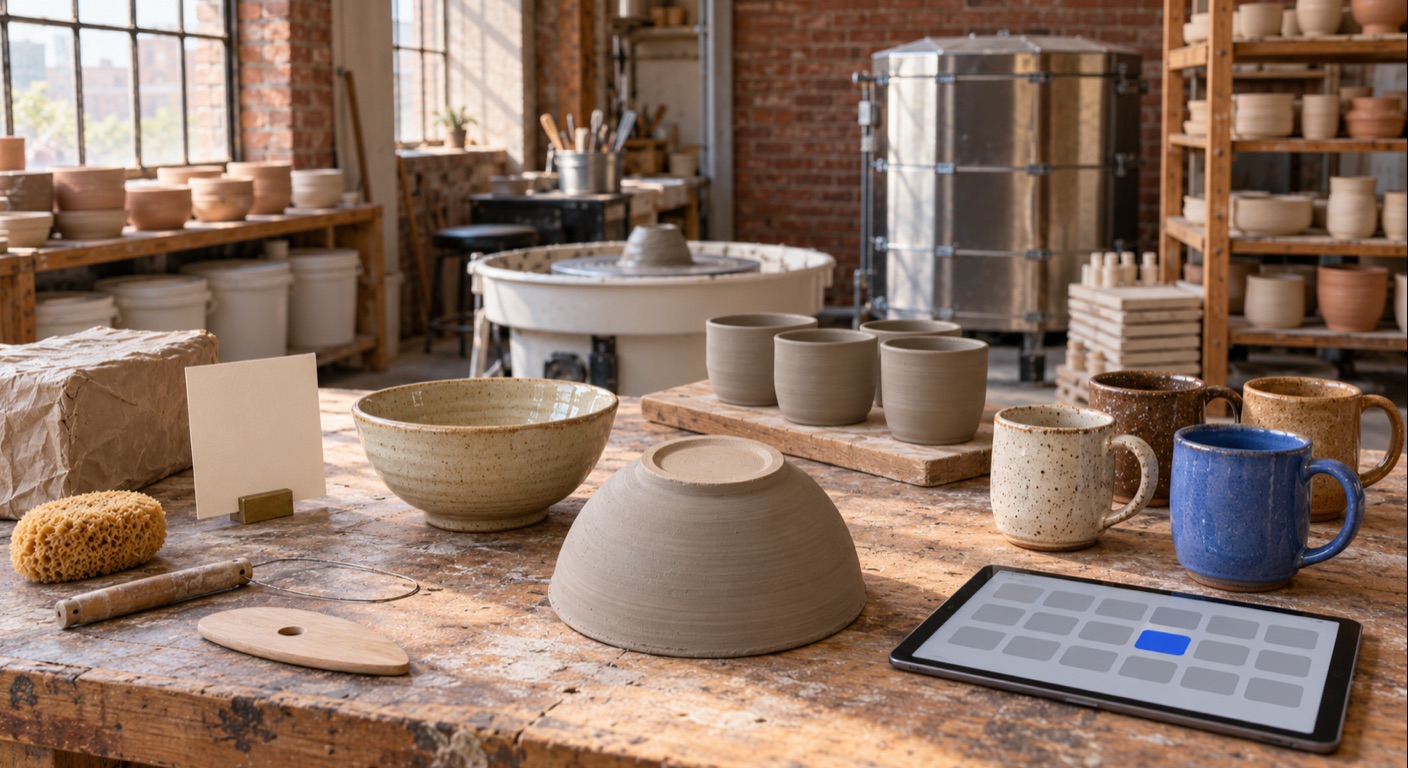
A potter in an old mill building along the Jones Falls is getting a holiday drop ready for the studio’s web shop: forty mugs, a dozen serving bowls and six large raku bowls, the most expensive pieces in the batch, with crackled white surfaces and smoky black lines where the glaze split in the reduction can. Raku is porous and nobody tests it for food, so the six listings say what potters’ listings usually say: decorative only, not food safe. Two days after the drop, a customer in New Jersey writes to ask whether one of the raku bowls would be all right for a salad, just this once, for a dinner party. The honest answer is no. The legal answer is stranger. Under a federal rule written in 1994, a decorative bowl that looks as if it could hold food counts as a food bowl unless a warning in letters at least an eighth of an inch high was fired onto its base and a sticker with the same warning sits where a shopper can see it. The line in the listing does not count, and the bases of the six bowls are blank.
In Towson, on a Saturday afternoon, a paint-your-own-pottery studio is running its third birthday party of the day. Twelve seven-year-olds are painting bisque plates and mugs at two long tables, and the studio will glaze and fire the pieces on Monday and text the parents when they are ready, in about a week. One parent asks the question every parent asks: can my son eat his cereal from this plate? The studio’s paints are sold as suitable for dinnerware when they are applied and fired the way the maker says, and the studio’s kiln log is the only record of whether this plate was. On the shelf by the register, the studio sells finished “kids’ breakfast sets” painted by its staff, which turn out to be a different product in the eyes of a different federal agency.
And in Station North, on a Tuesday night, a community studio with sixty members, twelve wheels and two electric kilns has run out of shelf space. The bisque shelf is full, a member needs a board of mugs glaze-fired before a holiday market on Saturday, a ceramics teacher from a county school has dropped off a box of student work to be fired by the cubic inch, and the studio manager is working out which of three loads can go into which kiln this week. The membership software knows who has paid this month. It does not know whose pieces are on which shelf, which glazes went into which firing, or what the last firing cost in electricity, and when a member asks whether a mug from that kiln can be called lead-free, the honest answer is a question about everyone else’s glazes.
None of these three studios has a software problem in the usual sense. Each has a booking system, a point of sale and a web shop that work. What none of those tools knows is the thing each studio got stuck on: in the United States, what a piece of pottery legally is depends on its shape, on what was fired onto its base, on how it was glazed and fired, on what it is called and on whom it is sold to, and nearly all of that is decided weeks before the piece is listed, in a room full of clay dust, by someone who is not thinking about software at all.
We start with Baltimore’s clay trade in numbers and what its software costs, then work through the federal rules on decorative and food ware, the lead and cadmium limits and the children’s-product rules, the kiln and its queue, Maryland’s sales tax on classes, painted pottery and firing, and the Baltimore rules that reach a studio’s building. Then we look at what Baltimore’s studios show customers and machines online, at the online store as the place where all of it meets a buyer who cannot pick the piece up, at how the same questions look in Lithuania, and at what we would build and what it would cost.
Baltimore’s clay trade in numbers
Federal statistics have no line for “pottery studio,” and the reason is instructive. The North American Industry Classification System splits one studio across four industries according to what it is doing at the moment. A wheel-throwing class is “ceramics instruction” under fine arts schools (611610). A paint-your-own studio is a retailer, listed in the 2022 index under hobby stores (459120) as “Pottery (unfinished pottery to be painted by customer on premises) stores.” A potter who sells mugs from the studio is a manufacturer: the index for pottery and ceramics manufacturing (327110) includes “Pottery made and sold on site.” And while a ceramic sculptor counts as an independent artist (711510), that industry’s definition sends craftspeople back to manufacturing. A studio’s industry, for the Census Bureau and for the business-code box on a tax return, is whichever of those lines brings in the most money, which is one more reason its books should keep them apart.
Read through those codes, Baltimore’s clay trade is mostly teaching and mostly small. County Business Patterns counted 31 fine arts schools in Baltimore City in 2023, with 274 employees, and 32 in Baltimore County, with 170; those numbers include dance, music and theater schools, which take most of the money. In the 2022 Economic Census, visual arts, crafts and photography instruction was 5.8% of what fine arts schools took in nationally, $397.8 million across 2,573 establishments, and 7.1% in Maryland, $10.8 million across 56. In Baltimore City, the 10 tax-exempt fine arts schools carried 88.8% of the category’s payroll, a reminder that many community studios here are nonprofits that need donations, grants and member records as much as a till. Employer pottery manufacturing barely registers: 3 establishments in Baltimore County, 9 in the metro area and 15 in Maryland, while the Census does not publish Baltimore City’s cell at all because it holds fewer than three.
The potters themselves are almost all sole proprietors. Nonemployer Statistics for 2024, published at the end of September, count 6 clay-product businesses without employees in Baltimore City with $35,000 in receipts between them, about $5,800 each, and 20 in the metro area with $236,000. Nationally there are 3,507, and 54.9% of them take in less than $10,000 a year. The broader independent-artist code holds 2,644 nonemployer businesses in the City, with average receipts of about $20,100. Those numbers set the budget for software. A $50 monthly subscription is $600 a year, about 3% of an average Baltimore artist’s receipts and more than 10% of an average City clay business’s. Any tool a working potter adopts has to earn its place against a margin that thin, and the honest answer for many of them is a free tier and a spreadsheet.
What makes Baltimore unusual is the calendar. The American Craft Council’s American Craft Made Baltimore ran for the 49th time in February 2026, with 458 artists and nearly 10,500 visitors, and 2027 will be its 50th year. And NCECA, the national council for ceramic art education, which says it has more than 4,000 members, brings its 61st annual conference, titled “Charm,” to the Baltimore Convention Center on March 10 to 13, 2027. For four days next spring, the largest gathering of potters, ceramics teachers and clay suppliers in the country will be within a short drive of every Baltimore studio in this article, looking for open studios, workshops and pieces to take home. A studio whose kiln queue, class calendar and web shop are not ready by February will find out in March.
The finished ware competes with imports. The United States brought in $1.3 billion of ceramic tableware in 2025, 69.1% of it from China, according to UN trade data, and the American tariff schedule already draws the line this article is about: some of its statistical codes for ceramic tableware separate pieces “suitable for food or drink contact” from all others. Since July 24, 2026, a stoneware mug from China has paid a 10% duty plus a new 12.5% Section 301 tariff, and the producer price index for pottery and fine earthenware was 8.1% higher in September than a year earlier. Etsy, where many potters sell, reported 5.6 million active sellers at the end of 2025, and its share of what passes through the marketplace, its take rate, rose from 22.3% in 2024 to 24.2% in 2025 and 26.2% in the third quarter of 2026, per its latest quarterly report.
What studio software costs, and what each meter counts
Unlike most of the trades we have written about, pottery has software built for it, and all of it is cheap. Kiln Fire, the best-known of the American products, lets a member photograph a piece, type in its length, width and height and be billed for firing weekly, every two weeks or monthly; members can see what the kiln is doing and get a message when their pieces are ready. Its price builder, read from the page’s own code, runs from $29 to $629 a month, set by how many of its eight modules a studio picks (firing fees, pickups, memberships, classes, paint-your-own table reservations, private events, studio purchases and a point of sale) and by a size tier counted in wheels, kilns, staff, members and visitors. Kilnfox charges $29, $70 or $130 a month and meters piece “submissions,” members and classes; it registers pieces with QR codes and emails their status at each stage. WheelOwl, a European product priced in euros, meters members, course sessions and firing orders from outside customers. None of the three takes a percentage of sales; card payments run through the studio’s own Stripe account, and Kiln Fire warns that Stripe adds 0.7% to recurring membership charges.
The generic booking tools that many studios use instead meter something else again. Punchpass charges $59, $99 or $149 a month, Acuity $16 to $69, Bookeo $14.95 to $119.95 by bookings a month, Pike13 $139 to $286 and WellnessLiving $69 to $349, while Mindbody starts at $79 a month and takes 20% of a new client’s first purchase through its consumer app, capped at $30. Several of the tools studios mention most often, Momence, Glofox, Peek and FareHarbor among them, publish no prices at all. And some tools put their fee on the customer. Eventbrite charges buyers 3.7% plus $1.79 per paid ticket and 2.9% for processing by default, so a $35 pottery date night ticket carries about $3.09 in service fees and $1.10 in processing on top of the price. Checkfront adds a 3% online booking fee that the studio can absorb or pass on. ClassBento, a class marketplace, charges the customer nothing extra but takes 20% of orders that come through its marketplace and 3.9% plus 30 cents on bookings made through its widget on the studio’s own site, and it files the sales tax.
The finished ware goes through a different set of meters. Square’s 2026 plans are free, $49 or $149 a month per location, with in-person card rates of 2.6%, 2.5% or 2.4% plus 15 cents and online rates from 3.3% plus 30 cents on the free plan; on rates alone, the $49 plan pays for itself only when a tenth of a percent of in-person sales plus four tenths of a percent of online sales reaches $49 a month. Shopify’s Basic plan is $39 a month, or $29 paid yearly, with online card rates from 2.9% plus 30 cents, and once a shop has more than 50 orders a month synced from marketplaces, Shopify adds a 1% fee capped at $99. Etsy’s fee policy, last updated on October 5, 2026, charges 20 cents to list or renew an item, 6.5% of the item price plus shipping, and 3% plus 25 cents to process the payment on the whole order. Its Offsite Ads take 15% of an ad-attributed order, or 12% once a shop has sold $10,000 in the past 365 days, at which point the ads become mandatory for the life of the shop, with the fee capped at $100 an order. Amazon Handmade takes 15% with a 30-cent minimum, and Faire’s last public price post set 15% plus a $10 new-customer fee on a shop’s first order from a retailer and 0% on orders the maker brings in through its own Faire link.
Put those meters on three modeled studios and the pattern is plain: subscriptions are the small line, payments are the large one, and the marketplace is the largest of all for a potter who sells online.
| Studio | What it takes in (our assumptions) | Stack | Monthly cost |
|---|---|---|---|
| Community studio, 12 wheels | $19,000: 60 memberships at $175 on cards on file, $6,000 of classes in 25 enrollments, $1,500 at the counter, $1,000 online | Kiln Fire (medium tier, 4 modules, $169) with Stripe, plus Square’s free plan for the counter and web shop | $839.50, of which $169 is software |
| Community studio, 12 wheels | The same | Square Plus ($49) for everything, with no firing or shelf features | $640.50 |
| Paint-your-own studio | $26,400: 400 walk-ins at $45 and 12 party balances in person; $4,200 online in seat and party deposits and 30 take-home kits | Square’s free plan | $835.20, all of it card fees |
| Production potter | $8,550: 150 web orders at $45 plus $12 shipping | Etsy, no Offsite Ads | $879.75 (10.3%) |
| Production potter | The same, a fifth of orders through Offsite Ads at 12% | Etsy | $1,084.95 (12.7%) |
| Production potter | The same | Own Shopify Basic store with Shopify Payments | $331.95 (3.9%) |
The last three rows hold the most useful number in this section. On fees alone, the potter’s own store is cheaper than Etsy from about ten orders a month. But fees are not the real comparison, traffic is: Etsy brings buyers, and a potter’s own website has to find them. At this volume selling through the potter’s own store saves $547.80 a month, or $3.65 an order, before Offsite Ads, and the store stays ahead only if it keeps at least 141 of the 150 orders. Put differently, a potter can afford to lose about one Etsy sale in seventeen in the move, or spend about $3.65 an order on finding customers, and still come out even. That is why many working potters keep both, and why the one thing their software has to do well is keep one record per piece in step across them, which we come back to in the online store section.
A decorative bowl is dinnerware until its base says otherwise
Start with the rule that decides what a pot is, because every other part of a studio’s system inherits its answer. Its core is two sentences long, it has not changed since 1994, and almost nobody outside the import trade has read it. Section 109.16 of FDA’s food regulations says that ornamental or decorative ceramicware that “appears to be suitable for food use will be considered to be for food use” unless one of two things is true. Either the piece carries both a conspicuous stick-on label “on a surface clearly visible to consumers” and a permanent statement “molded or fired onto the exterior surface of the base,” each in letters at least 3.2 millimeters (an eighth of an inch) high, or “a hole is bored through the potential food-contact surface.”
The wording on both the sticker and the base has to be one of three messages, and the regulation gives them verbatim: “Not for Food Use. May Poison Food,” “Not for Food Use. Glaze contains lead. Food Use May Result in Lead Poisoning,” or “Not for Food Use—Food Consumed from this Vessel May be Harmful.” If the base is too small for 3.2-millimeter letters, the permanent statement may shrink to the largest size that fits, but never below 1.6 millimeters. A potter may add “Decorative” or “For Decorative Purposes Only,” but only after the required statement, and may add a symbol, a circle at least an inch across. What the potter may not do is write “decorative only” on its own and stop there.
Read it as a programmer would. The default value of the field is “food use.” The default is decided by how the piece looks, not by what the potter intended, what the price tag says or what the listing calls it. The rulemaking gives only one yardstick for that look: pieces that could be mistaken for food ware “would have a size and configuration similar to food-use ware,” and its examples are pitcher-shaped vases for fresh flowers and commemorative plates. It sets no exception for craft potters or small makers. And the only two ways to change the default are physical: words that went through the kiln with the pot, or a hole that makes it useless as a bowl. An ordinary vase is not the problem; nobody eats from a vase. The problem is the bowl with a crackled raku surface, the platter glazed in a color the potter has never tested, the mug thrown as a pencil cup, the plate painted at a party to hang on a wall. Each of them looks like something you could eat from, so in the eyes of the regulation each of them is something you eat from.
Why the rule wants a sticker and a stamp
The two-label design is not an accident, and its history explains why it fits a web shop so badly. When FDA proposed the rule in 1989, it asked only for the permanent statement on the base. In the final rule published on January 12, 1994, the agency recorded that commenters worried a statement on the underside of a piece, in letters only 3.2 millimeters high, “may not be seen by many people,” and some asked for it on the side. FDA agreed that the side would be more conspicuous but concluded that a permanent statement there “would likely render the piece useless for ornamental or decorative purposes.” Its compromise was the sticker: a temporary label where a shopper would see it before buying, and a permanent one where the next owner would find it after the sticker was gone. The same rulemaking shows how carefully FDA read the words. Some commenters worried that “poison” would scare buyers off and proposed gentler phrasings; FDA accepted alternatives but rejected “Warning. Glaze Contains Soluble Lead. Not for Food Use,” because it does not tell the user that food held in the piece may become toxic.
Sixteen years later FDA had to repeat itself. Its 2010 guidance on traditional pottery and the term “lead free” reports pieces arriving with a stick-on label, or with the warning printed on the packaging “but not on the item itself,” and explains the danger: users “assume that the pottery is safe to be used for food-handling purposes after the packaging is discarded and/or the stick-on label is removed.” Then it addresses everyone in the trade, not only importers: “Firms making and selling ornamental or decorative ceramicware in the U.S. must ensure that their products comply with 21 CFR 109.16 as appropriate.”
Now put that next to a 2026 Etsy listing. The line “decorative only, not food safe” in a product description is the warning on the packaging. It is read, if it is read at all, by the person who buys the bowl, and it is gone the moment the bowl becomes a gift, a wedding present or a find at an estate sale. As we read the rule, a decorative bowl sold with that line and a blank base is, in FDA’s eyes, a food bowl, and a food bowl has to meet FDA’s limits on the lead and cadmium that leach out of its glaze. If its glaze would pass those limits anyway, the potter is fine and the line in the listing was simply unnecessary. If it would not, the listing line protects nobody, and the potter has sold an adulterated dish.
The sticker the online buyer never sees
There is a second, quieter mismatch. The rule’s stick-on label must sit “on a surface clearly visible to consumers,” which in 1994 meant the shelf of a gift shop, where a buyer picked the piece up and turned it over. Nothing in section 109.16 mentions a catalog, a website or a photograph, and we found no FDA statement about how the sticker should work when the consumer is looking at a screen in another state. So the rule is satisfied by a sticker that the online buyer cannot see until the box is open, after paying. The law does not ask for more, but a studio that wants its buyer to know what they are buying before they pay has an easy fix: photograph the base with its fired statement, show the sticker in the photos, and repeat the exact message in the listing. In the European Union this is no longer optional; as we explain in the note for readers in Lithuania, the EU’s product safety regulation requires warnings to appear in the online offer itself.
For the software, the consequence is that “decorative” is a production decision, not a listing decision. The statement has to be “molded or fired onto the exterior surface of the base,” or painted on permanently when the piece is not fired after decoration, so it has to be stamped or written on before the last firing. A studio that decides a bowl is decorative on the day it photographs the bowl has decided late: what remains is another firing to put the statement on the base, a test that shows the bowl meets the food limits, or a drill. That is why, in the systems we describe later, the intended use is a field on the piece from the moment it is glazed, the kiln log records it, and the web shop refuses to publish a bowl, plate, cup, mug or pitcher whose field is still empty.
What dinnerware has to meet, and why a ruler decides the limit
Once a piece counts as food ware, FDA’s question is how much lead and cadmium its glaze gives up to food. The limits are not in a regulation. They sit in two compliance policy guides that tell FDA staff when to recommend legal action or detain an import: CPG Sec. 545.450 for lead and CPG Sec. 545.400 for cadmium. Both are dated November 2005, and both charge a failing piece as adulterated under section 402(a)(2)(C) of the Federal Food, Drug, and Cosmetic Act, on the theory that the lead or cadmium leaching from the glaze is an unsafe food additive. They apply to domestic ware as much as to imports; the titles say so.
The test is the same in both: six units of the same article, filled with a leaching solution and measured by one of the methods the guides name (ASTM C738, AOAC 973.32 and 973.82, or two FDA laboratory bulletins). The limits, in micrograms of metal per milliliter of solution, depend on what kind of article it is, and the kind depends on its measurements.
| Category (as the guides define it) | Lead | Cadmium |
|---|---|---|
| Flatware: internal depth of 25 mm or less, measured from the lowest point to the plane of the rim | 3.0, average of 6 units | 0.5, average of 6 units |
| Small hollowware: deeper than 25 mm, capacity under 1.1 liters (other than cups and mugs) | 2.0, any one of 6 units | 0.5, any one of 6 units |
| Cups and mugs: small hollowware for drinks above room temperature, usually about 240 mL with a handle | 0.5, any one of 6 units | 0.5, any one of 6 units (as small hollowware) |
| Large hollowware: capacity of 1.1 liters or more (other than pitchers) | 1.0, any one of 6 units | 0.25, any one of 6 units |
| Pitchers: large hollowware for juices or other acidic drinks at or below room temperature, with a handle and lip spout | 0.5, any one of 6 units | 0.25, any one of 6 units (as large hollowware) |
Three things in that table matter for a studio’s records. The first is that the line between a plate and a bowl is 25 millimeters of depth, so a shallow pasta plate and a slightly deeper one from the same glaze batch can fall into different categories, with different limits. The second is that the arithmetic changes with the category: flatware passes or fails on the average of six results, every other category on the worst single result. The same six numbers can pass as plates and fail as bowls. The third is that a mug’s lead limit, 0.5, is one sixth of a dinner plate’s. The guide’s definition of a cup is written around use, not shape: a small vessel “commonly used for consumption of beverages, for example, coffee or tea at above room temperature,” normally, “but not exclusively,” with a handle. As we read it, a handleless tea bowl is a cup. Creamers, coffeepots and teapots are expressly not pitchers, so a 1.2-liter teapot is large hollowware with a lead limit of 1.0 while a 1.2-liter pitcher is held to 0.5.
The lead guide carries one more line that potters should know about. Plates “manufactured solely for ornamental display purposes,” which it lists as commemorative plates, souvenir plates, hand-painted plates and other highly decorated plates, are exempt from the dinnerware limits, “provided the article is in compliance with 21 CFR 109.16(b).” The exemption is the label, in other words. A hand-painted plate with a fired statement on its base and a matching sticker is out of the limits; the same plate with a blank base is dinnerware.
“Lead-free” is a claim about a test, not about a recipe
Most glazes a Baltimore studio buys today are sold as lead-free, and many potters repeat the phrase in their listings. FDA’s 2010 guidance draws the line where a careful reader would: ceramicware “that contains extractable lead when tested according to the method prescribed in the CPG should not be labeled as ‘Lead Free,’” and if it is, FDA “may consider the use of the term ‘Lead Free’ in the labeling to be false and misleading,” which makes the piece misbranded. So the claim is about what comes out of the finished pot in a laboratory, not about what went into the bucket. The same guidance explains how lead gets into pottery whose glaze never contained it: shared buildings, shared tools and, above all, kilns. The practices it describes for producers switching to lead-free glazes include making and packing the lead-free ware in a separate building, keeping lead out of the production area, and modifying kilns that had fired lead glazes, for example by replacing the insulation, and then testing the ware to prove the cleanup worked.
That reads differently in a community studio, where sixty members share two kilns and some of them bring glazes from home. A studio that lets outside glazes into its kilns cannot know what has been fired in them, and a member who writes “lead-free” in an Etsy listing for a mug fired there is making a claim about the whole studio’s history. This is one reason many studios allow only their own glazes in shared kilns. For the software, it means the kiln log is part of the evidence for every claim a piece makes: which kiln, which firing, which glazes went in with it.
The glaze jar stopped saying “food safe”
For years the easiest answer to “is this mug food safe?” was the word on the glaze jar, and that answer is going away. On September 11, 2026, Mayco, one of the largest American makers of studio glazes, began replacing “Food Safe” and “Dinnerware Safe” with “Suitable for Dinnerware” and dropping “Non-Toxic” and “Lead-Free” from its labels. It says its formulas have not changed, that layered glazes are not automatically suitable, that firing temperature and clay body can change the result, and that “Finishedware producers bear responsibility for food-contact testing of ware sold into commerce.” Coyote, a New Mexico glaze maker, tells potters making ware for food use that they must test their own work. Older jars, brochures and resellers’ pages will carry the old words for a while, and so will AI answers trained on them, but the makers’ message is now plain: a glaze’s rating is a starting condition, and the finished piece is the potter’s to vouch for.
No federal rule requires a test before a mug is sold. The compliance guides are enforcement criteria rather than a licensing step, and a potter does not register with FDA. Enforcement is rare, but selling locally is no shield when it comes: food law presumes the link to interstate commerce that gives FDA jurisdiction, so a potter who sells only at Baltimore markets cannot count on being outside it, and the handful of FDA recalls of ceramic ware since 2020 include decorated plate sets recalled in 2024 because they might leach more lead than the 3.0 flatware level allows, and clay cups a spirits company gave away free at tastings in 2023. Testing costs less than its reputation. Published figures are rough and undated, but Digitalfire, a ceramics reference, describes a certified lab charging $30 to $60 for each metal tested on a glaze, and FDA’s own examination uses six units of an article, so one form in one glaze tested for lead and cadmium is a few hundred dollars, not a few thousand. California adds a rule for anyone shipping there: its tableware law requires the maker’s name to be fired into every piece of glazed tableware sold in the state unless it was made without lead or cadmium, either as an ingredient or as a contaminant, and the bright reds and oranges colored with cadmium inclusion stains are, on our reading, the obvious case. California’s Proposition 65 warnings, by contrast, do not apply to businesses with fewer than ten employees.
The kids’ mug is a different product
FDA’s rule turns on how a piece looks. The Consumer Product Safety Commission’s rules turn on whom it is for, and a pottery studio crosses that line more often than it thinks. A “children’s product,” in the Consumer Product Safety Act’s definition, is a consumer product “designed or intended primarily for children 12 years of age or younger,” and the Commission’s regulation spells out how to decide: by what the maker says about the product, including on its label and in its advertising, by whether its packaging, display and promotion present it as suitable for children, and by whether consumers would commonly recognize it as meant for them. A plain stoneware mug is not a children’s product. The same mug sold as a “kids’ cocoa mug,” painted with a cartoon fox and shelved next to the birthday-party sign-up sheet, very probably is.
That matters because children’s products carry a lead rule of their own, and it measures something different from FDA’s. FDA asks how much lead leaches out of a glaze into acid in 24 hours. Section 1278a of the federal code asks how much lead the product contains: no more than 100 parts per million in any accessible part. CPSC’s guidance on lead in paint says that ceramic glazing does not meet the definition of paint in its paint rule, and its staff have explained that a vitrified glaze becomes “part of the substrate of the product” for testing purposes. So a kids’ mug is tested as one fused piece of clay and glass, for total lead, against 100 parts per million, and passing FDA’s leaching test does not answer that question. CPSC’s own FAQ adds that a soluble-lead test for Europe does not satisfy its total-lead requirement either.
The paperwork is what catches small studios. A children’s product generally needs testing by a CPSC-accepted third-party laboratory, a Children’s Product Certificate based on those tests, and permanent tracking marks on the product and its packaging that identify the maker and when and where it was made, along with a batch or run. The burden is lighter for the smallest makers, and the Commission’s pages disagree about how small is small enough: its small batch FAQ gives a revenue ceiling of $1,436,864, while the registry where a maker actually signs up gives $1,480,296, in both cases with no more than 7,500 units of the product made in the previous year. A registered small batch manufacturer is spared third-party testing for some requirements but not for others, has to register again every year, and still has to meet the limits themselves. CPSC also notes that X-ray fluorescence is approved for testing ceramic and other siliceous materials for lead content, a method that can make screening cheaper.
Two details make the children’s rules stricter for a pottery studio than they first look. Small batch relief covers the total-lead limit, which CPSC lists among the requirements a registered small maker may test without a third-party lab, but not the separate limit for lead in paint and similar coatings, which always needs one. Fired glaze is not paint; an acrylic or other unfired coating is, so the painted bisque in a paint-your-own take-home kit sold for children falls under the 90 parts per million paint limit and third-party testing even for the smallest studio. And FDA’s 1994 rule closed one door explicitly: children’s ceramic tea sets “may not obtain status as a nonfood item by virtue of its bearing any statement that it is not for food use,” because children play at eating from them. Maryland has a children’s-product lead law of its own, sections 6-1301 to 6-1310 of the Environment Article, whose list of products names “Decorative objects” and “Lunch boxes and eating utensils” for children under 13. It asks for a certificate from “a testing entity qualified or certified under federal law,” sent to the retailers who sell the product, and a report within 24 hours of learning of a violation. On our reading that may ask more of a small maker than the federal small batch relief does; we found no guidance from the Maryland Department of the Environment on how the two fit together.
Where does a paint-your-own studio sit? On our reading, the mug a child paints at a birthday party is usually not a children’s product: the bisque blank is the same one an adult would paint, and what the studio sells is a session, not a product designed for children. The finished “kids’ breakfast set” on the shelf by the register is another matter, and so is a web-shop category called “for little ones.” The safest arrangement for most studios is the plain one: sell children the experience, sell finished pieces without marketing them to children, and if a line of children’s dishware is worth doing, treat it as its own product line with its own tests and certificates. For the software, “children’s product” is a flag on a product line, set by how it is described and displayed, and the web shop should refuse to file anything with that flag under a children’s category until its certificate is attached.
The kiln is the studio’s real calendar
Every piece a studio sells, fires or hands back passes through a kiln at least twice, and the kiln keeps its own time. A cone 6 glaze firing in a mid-size electric kiln climbs for about eight and a half hours on a medium-speed program (Skutt’s own example uses 8.47), then needs most of a day to cool before anyone can open the lid, and the bisque firing before it takes about as long. So a studio with two kilns and a full class schedule is really running a queue: greenware drying on shelves until there is enough for a bisque load, bisqueware waiting to be glazed, glazed pieces waiting for a load that matches their size and their temperature, and finished pieces waiting for their owners. The dates a customer sees, the class that ends on a Thursday, the party whose plates will be “ready in about a week,” the market a member is firing for, all sit downstream of that queue, and most booking software cannot see it at all.
Studios charge for firing in at least six different units, which is the first sign that the queue is hard to model. Some measure each piece and charge by the cubic inch, rounding length, width and height to the nearest half inch and setting a minimum height for plates; some charge by the half cubic foot, the shelf, the half kiln or the whole kiln; one charges by the pound of clay, weighed at drop-off; one charges a flat price for up to ten pieces. Among the studios around the country that publish a per-cubic-inch rate, the middle value is about 4 cents for a bisque firing, 4 cents for a single glaze firing and 8 cents for both. In Baltimore, Baltimore Clayworks’ handbook charges its students 8 cents per cubic inch for glaze firing, or a “bulk rate at 6 cents after 1200 cubic inches,” a phrase a billing system has to read one way or the other: on 1,500 cubic inches it is $114 if only the inches past 1,200 get the bulk rate and $90 if the whole order does. We found no Baltimore studio that publishes a rate for firing outside work; Arteasy, a multi-craft studio on Light Street, prices it case by case, and paint-your-own studios usually fold the firing into the price of the piece. Renting a whole kiln is far cheaper per cubic inch of chamber, five to eight times cheaper in the price lists we read, because nobody’s pieces fill a kiln the way their measurements suggest.
What a firing costs, and why the power bill is the small part
Skutt publishes the formula most potters use to estimate a firing’s electricity: the kiln’s kilowatt rating, times the length of the firing in hours, times the price of a kilowatt-hour, times an adjustment factor of about 0.5, because the elements are switched on for only about half of the firing. Applied to the BGE rates that took effect on October 1, 2026, the answer is small.
| Kiln (240 volts) | kWh | Home, Schedule R (20.0¢) | Small business, Schedule G (21.6¢) | Time-of-use GS, off-peak (19.9¢) | Time-of-use GS, on-peak (24.5¢) |
|---|---|---|---|---|---|
| Skutt KM-1027 or L&L e23T-3, single phase (11.52 kW) | 48.79 | $9.77 | $10.56 | $9.72 | $11.96 |
| Skutt KM-1227PK (14.3 kW) | 60.56 | $12.13 | $13.10 | $12.06 | $14.85 |
| Skutt KM-1231PK, single phase (17.3 kW) | 73.27 | $14.67 | $15.85 | $14.59 | $17.96 |
| L&L e28T-3, three phase (16.62 kW) | 70.39 | $14.10 | $15.23 | $14.02 | $17.26 |
Ten or fifteen dollars of electricity is not what a firing fee pays for. Skutt says its KM-1027 holds 38 bowls six inches across and three inches tall; at 6 cents a cubic inch, toward the top of the glaze-firing rates we found, those bowls would bill $246.24 against about $10.56 of power. The difference pays for the person who loads, wads, unloads and sands, for elements and relays that wear out every hundred firings or so, for shelves that crack and glaze that runs, for the space and for the risk of a piece that explodes and takes its neighbors with it. One studio’s published estimate puts the kiln itself at about $6.25 a firing, a $2,500 kiln written off over 400 firings, and replacement parts at about $3.75 a firing. A firing-fee price list that looks generous next to the electric bill is usually only covering its costs.
Two details in BGE’s tariffs are worth building into a studio’s scheduling, and the first is counterintuitive. The first is that a business pays more for each kilowatt-hour than a household. The supply price on the small commercial schedule is lower, but the surcharge that funds the EmPOWER Maryland efficiency programs is 3.566 cents a kilowatt-hour for small businesses against 1.310 cents for homes, and electricity sold to a business carries Maryland’s 6% sales tax unless an exemption applies; BGE’s tax rider names residential use, manufacturing, government and certain nonprofit organizations as exempt. The second is the clock. On BGE’s time-of-use schedule for small businesses, weekdays from 7 to 11 in the morning and 5 to 9 in the evening are on-peak outside the summer, and nights, weekends and holidays are off-peak, so outside the summer a glaze firing started at 9 on a weekday evening runs its whole climb at the cheaper rate. On the smallest kiln in the table the saving is up to $2.24 a firing, or several hundred dollars a year for a studio on that schedule that fires two such kilns three times a week, and it costs nothing but a delayed start.
Size matters too. A metered half-hour demand of 25 kilowatts or more moves a small business from BGE’s Type I to its Type II standard offer service, which is priced for shorter periods, and two of Skutt’s larger single-phase kilns firing at once draw 34.6. Demand charges themselves only start on BGE’s large general service schedule, at a monthly demand of 60 kilowatts. A studio does not need to fear either line, but its software should know where the lines are before the manager starts both kilns on the same Friday night.
The building decides how hot a kiln can go
A kiln’s maximum temperature is not a property of the kiln alone. It depends on the voltage it is fed. L&L rates its e28T-3 to cone 10 on three-phase power but only to cone 8 on 240-volt single phase and to cone 5 on 208-volt single phase; Skutt’s KM-1027 reaches cone 10 on 240 volts and cone 6, 2,250 degrees Fahrenheit, on 208-volt single phase. Commercial buildings are often wired for 208 volts rather than the 240 of a house, so a kiln that fired cone 10 in a garage can fall short in a storefront. By Orton’s chart, cone 6 is about 2,232 degrees and cone 10 about 2,345 when the kiln climbs its last 180 degrees at 108 degrees an hour, and a member who books a cone 10 glaze firing on a kiln that tops out at cone 5 gets underfired, possibly unsafe ware. That is a rule a booking system can enforce: each kiln record holds its voltage, its phase and the highest cone it is rated for at that voltage, and the system refuses a firing it cannot reach.
The kiln’s own controller is less help than it should be. Skutt’s KilnLink Premium costs $100 a year per kiln, or $325 for five years, for alerts, automatic logging and maintenance notes; Bartlett’s KilnAid adds alarms and advanced monitoring for $1.99 a month; the TAP controller’s app can email every stored firing log, with a premium plan at $49.99 a year; Orton’s AutoFire software is a $250 Windows program that reads up to four kilns over USB. None of the four documents an interface another program could use to pull its firing data. So the record that matters for everything earlier in this article, which pieces were in which firing, with which glazes, to which cone, has to be joined by the studio’s own system: the controller knows the temperature curve, and only the studio knows what was on the shelves.
Shelves, pickups and the thirty-day rule
The queue ends at a shelf, and how long a piece may sit there is a rule some studios publish and others only enforce when the shelves fill up. The Clay Studio in Philadelphia holds finished work for 30 days before donating it to its pottery sale or recycling it, and charges the card on file when the work is ready; a studio in New York holds classwork for 90 days. None of the six Baltimore studios we read that fire customers’ work publishes such a rule, though five publish how long the wait is. Amazing Glaze in Mount Washington says a painted piece is ready five days after painting, Arteasy fires bisque and low-fire work every two to three weeks and its midrange glazes about once a month, and pieces from classes, workshops and private events at two City studios come back five to eight weeks later. Clayworks gives each of its 24-hour Springboard members two and a half shelves and asks for 30 days’ written notice before leaving. Each of those numbers is a clock, and a studio enforcing them by memory will either throw away a piece someone was coming back for or run out of shelves. In software they are a status on each piece, from greenware to bisque queue, glaze queue, ready and picked up, with a date on every change and a reminder before the last one.
Maryland taxes the mug, not the lesson
A pottery studio’s receipts cross more lines in Maryland’s sales tax than almost any small business we have written about, and each line is drawn by how the sale is described and delivered rather than by the clay. Maryland taxes sales of goods and a short list of named services at 6%. An in-person class is neither, so it is not taxable, and section 11-219 of the Tax-General Article keeps it that way even though the student goes home with a fired bowl, as long as the goods are “an inconsequential element for which no separate charge is made.” The studio pays the tax instead, when it buys the clay, glaze and other materials a class uses up, which is what COMAR 03.06.01.01 requires of anyone providing a nontaxable service. The Comptroller’s guide to admissions and amusement tax says “Charges for lessons or instructional fees are not subject to the tax,” and none of the five kinds of charge that tax reaches names a class, a painting session or a studio membership, so, on our reading, Baltimore’s local amusement tax stays out of the picture too.
The trouble starts at the edges, and they are edges a booking system creates. On our reading, a class invoice that lists “clay and materials” as its own line has made a separate charge, and that line becomes a taxable sale. A prerecorded online course is a taxable digital product. A live online class is harder: the statute exempts live, interactive instruction only when it is “instruction in a skill or profession in a buyer’s current or prospective business, occupation, or trade,” so a hobby wheel class taught over video looks taxable to us, even though the Comptroller’s own tax tip sums the rule up more loosely as “live instruction is not taxable.” A one-night “make a mug” event priced per piece, with little teaching, starts to look less like a class and more like the next case.
Paint-your-own pottery is a sale of a finished piece
A paint-your-own studio sells a bisque blank, a seat, paint and glaze, and a firing, and many itemize those on the receipt. Maryland’s definition of taxable price pulls them back together. It includes, in COMAR 03.06.01.08, “Any charges for any services to bring the subject of a sale to its finished state ready for delivery and in the condition specified by the buyer, including charges for assembly, fabrication, alteration,” and customizing. As we read it, the bisque price, the studio fee and the firing are one taxable price for one finished plate, at 6%, however the receipt splits them, so an $18 blank and a $10 studio fee carry $1.68 of tax, and a separately stated $4 firing fee adds 24 cents more. We found no Maryland ruling written about paint-your-own studios. Other states show how differently the same afternoon can be taxed: Georgia ruled in 2014 that paint parties are amusements, while Maryland’s amusement tax has no clause for taking part in an activity, which leaves the painted plate under the ordinary sales tax.
Firing someone else’s pot is a taxable service, on our reading
Firing outside work is the line where the states disagree most openly. Virginia’s Tax Commissioner ruled in 1987 that a ceramic shop firing greenware it had not sold was providing a nontaxable service. California’s tax board said in 1950 that “the firing of ceramics appears to be a step in the production or creation of the finished product,” so the charge “is subject to the tax.” Maryland’s rules point the California way. Section 11-101(m) of the Tax-General Article taxes the “production of tangible personal property … by special order,” and COMAR 03.06.01.30 says the rule “applies with equal force to those situations where the materials are furnished by the customer and the fabrication consists wholly of labor,” and that “all charges for bringing the item to its finished state are subject to the tax.” A bag of greenware that goes into a kiln and comes out as finished ware is, on our reading, exactly that, so a firing fee for outside work should carry 6%. Renting the kiln by the hour to a potter who runs it is a different transaction with the same result: a charge billed on a time basis is presumed to be a lease, and leases are taxable. A flat monthly membership for studio access is, on our reading, closer to the untaxed privilege of using a facility, while clay sold to members is taxable like any other sale.
The kiln exemption, and the meter
The purchase side has its own reward for keeping good records. Maryland exempts equipment “used directly and predominantly in a production activity,” meaning producing goods for sale, and COMAR 03.06.01.32-2 sets the test at “more than 50 percent of the time.” There is no size or revenue threshold, so a production potter’s kiln qualifies as readily as a factory’s, while a kiln that mostly fires students’ and members’ work probably does not. The same regulation exempts safety glasses, safety gloves and breathing apparatus and expressly taxes shelving. Electricity follows the same logic, one meter at a time: COMAR 03.06.01.10 exempts power consumed “directly and predominantly” in production, judged by connected load and time of operation over a year, and the buyer files form SUT206 with the utility to claim it. If more than half of a meter’s use is firing ware for sale, the whole commercial bill escapes the tax; if it is not, none of it does, and the certificate has to be revoked when the share drops. That is a calculation only a kiln log can make, one more reason to record what each load was for: production, paint-your-own, outside work, classes, members or tests.
Craft fairs and markets
Selling at a fair is simpler than many potters fear. A maker is exempt from Maryland’s trader’s license, and a person who “hand crafts items for sale at special events, including fairs, carnivals, art and craft shows” is excluded from the transient vendor license, but every seller still needs to collect sales tax, and an occasional seller can ask the Comptroller for a temporary license valid for 30 days. Promoters of shows have a duty of their own under section 17-1811 of the Business Regulation Article: they must collect a copy of each exhibitor’s trader’s license or an exhibitor’s affidavit before the show and send the affidavits to the Comptroller within seven days after it ends. The biggest show of the year, the American Craft Council’s Baltimore show, returns to the Convention Center on February 19 to 21, 2027. For the software, a market is an event with a location, a license number that may be temporary, and sales that may have to be reported separately, and a finished mug shipped by carrier to another state is not taxed in Maryland at all.
The Baltimore rules that reach a studio’s building
Baltimore’s zoning code names pottery outright, and it does not file it where most people would. Section 1-302 of the Zoning Code defines an “arts studio” as a place where an art or activity “is taught, practiced, or studied, such as dance, martial arts, photography, music, painting, gymnastics, or yoga,” and then excludes from that definition any establishment that teaches the crafts of the next one: “Arts studio: Industrial” means “a studio for artisan-related crafts, such as small-scale metalworking, glassblowing, furniture making, pottery, leathercraft, and similar activities.” A wheel-throwing studio is therefore not an arts studio in Baltimore. It is an industrial arts studio, a use the commercial use table permits in every commercial district from C-1 to C-5 and the industrial tables permit in OIC, IMU-1, IMU-2 and I-1, but not in any residential district, OR, BSC, I-2 or MI, and among the transit-oriented districts only in TOD-2 and TOD-4. The split produces one oddity worth knowing when looking at buildings: in the OIC and I-1 districts a pottery studio is permitted and a yoga studio is not.
A paint-your-own studio is harder to place. Painting is on the list for an ordinary arts studio, selling bisque is retail, and firing is the pottery process, so which use a given studio is will be the zoning administrator’s call, and an owner should ask before signing a lease. A home studio in the City has a different limit altogether: the home occupation rules allow no more than one employee from outside the family and no more than three customer visits a day and ten a week, so a single four-person class on a Saturday breaks the daily cap. A booking system for a home studio can count that for the owner.
The kiln manual is part of the building code
Baltimore adopts the 2021 International Mechanical Code without changing its section on small ceramic kilns, and that section is short: “Kilns shall be listed and labeled,” “Electric kilns shall comply with UL 499,” and kilns “shall be installed in accordance with the manufacturer’s instructions.” The fuel gas code says the same of gas kilns. That turns a kiln maker’s installation pages into requirements. Skutt’s pages ask for at least 18 inches between a kiln with a controller and any wall, no shelves above it and a 120-volt outlet within eight feet for the vent, and they size the wiring by the National Electrical Code: a 48-amp kiln on a 60-amp breaker with 6-gauge wire, a 60-amp kiln on an 80-amp breaker with 4-gauge wire and no plug at all. In the City the electrical permit can be issued only to an electrician licensed to do business here, the application has to carry that electrician’s name, and an electrical certificate is required “before electric service may be energized.” A studio’s kiln record should hold the permit number, the electrician, the certificate date and the manual edition the kiln was installed to, because those are the documents an inspector, an insurer or a landlord will ask for.
The fire code is less tidy. Baltimore adopted the 2021 International Fire Code, which requires an operational permit for “industrial ovens regulated by Chapter 30,” and the current Chapter 30 sets no upper temperature at all, so a kiln is not excluded just because it runs hotter than an oven. Whether the City treats a pottery kiln as one is decided by a Fire Prevention Permit Schedule that is not published online, so the answer has to come from the Fire Marshal’s office. Propane is clearer. The code requires an operational permit for the storage and use of LP-gas, and its only exemption covers small containers serving homes, so a studio that fires raku in a propane kiln in the back lot needs one. One more trap for anyone quoting section numbers: Baltimore’s amendments to the 2021 fire code still follow the 2018 edition’s numbering, so its line declaring section 105.6.15 “not adopted,” meant for fire hydrants, points in the 2021 text at the permit for LP-gas installations.
Air, drains and glaze buckets
The air rules are friendlier than potters fear. Maryland exempts from air permits “Kilns used for firing ceramic ware, heated exclusively by natural gas, liquefied petroleum gas, electricity, or any combination of these,” in COMAR 26.11.02.10, along with the vents that serve them. A wood- or oil-fired kiln is not on that line and needs a look at the regulation’s conditional catch-all exemption, or a permit. The federal air standard for clay ceramics plants is aimed at tile, sanitaryware and dinnerware factories, and its definition says outright that “artisan potters, art studios, school and university ceramic arts programs, and any facility that uses less than 45 Mg/yr (50 tpy) of wet clay” are not in the regulated category. Fifty tons of wet clay is about 2,000 fifty-pound boxes a year, more than a small studio goes through, and the studio exclusion applies whatever the tonnage.
Glaze waste is where Maryland is stricter than Washington. A glaze sludge is hazardous waste only if it fails the federal leaching test, at 5.0 milligrams per liter for lead, 1.0 for cadmium, 5.0 for chromium and 100.0 for barium. But a business that generates such waste falls under Maryland’s full generator rules once it generates 100 kilograms or more in a calendar month or accumulates more than 100 kilograms at any time, where the federal rules for very small generators allow ten times that much to accumulate. A bucket of settled glaze from a busy wash sink can be tested once and logged, and a studio that keeps a weight on hand in its records will know long before it comes near the line. The drains have a rule too: the City’s sewer code bars discharging solids “in quantities capable of causing obstruction,” naming sand and mud among them, and the plumbing code calls for interceptors where sand and heavy solids go down a drain. No section names a clay trap, but a trap that is never cleaned is how a studio ends up on the wrong side of that rule, and its cleaning is a recurring task the software can schedule and log.
Clay dust, and who counts as an employee
Dry clay and glaze dust carry crystalline silica, and OSHA’s silica standard for general industry applies wherever employees are exposed: a permissible limit of 50 micrograms per cubic meter averaged over eight hours, an action level of 25, no dry sweeping or compressed air where wet methods or a HEPA vacuum would work, and medical exams for anyone at or above the action level for 30 or more days a year. The standard does not apply at all where the employer has objective data showing that exposure will stay below the action level under any foreseeable conditions, which makes those data the most valuable document a studio with staff can keep. Maryland adopted the rule effective July 16, 2018, and its version reaches something federal OSHA does not: public employers, which means the ceramics teacher in a county school or a recreation center. The standard covers employees, not members or students, and Maryland defines an employee as someone employed “for a wage or other compensation,” so, on our reading, a studio assistant who works shifts in exchange for a free membership is an employee for this purpose even if nobody thinks of the arrangement as a job. The people records in a studio’s system need to know the difference.
The wine-and-clay night
The last rule is the one most likely to surprise a studio owner. Bring-your-own-bottle pottery nights are a staple of date-night marketing, and in Baltimore City they collide with section 12-2501 of the Alcoholic Beverages and Cannabis Article. It applies to any establishment not licensed by the City’s liquor board that is “open to the public,” and it says such an establishment may not “serve or keep alcoholic beverages” or “allow alcoholic beverages to be consumed” at a location it controls. The only exception is for unlicensed restaurants, and only when the customer brings the drink, drinks it with a meal, pays no admission and sits in a room the Fire Department has capped at 50 seats. A violation is a misdemeanor punishable by up to two years in prison and a $10,000 fine, and the police may close the business on the spot if they find an emergency. In Baltimore County, the matching section bites only after legal closing hours, so, as far as the state’s alcohol law goes, the same Friday night class is, on our reading, lawful in Towson until 2 a.m. and unlawful in Hampden at any hour. Whether a private party booked by one group is “open to the public” is a question we could find no ruling on. For the software, events are created from templates by jurisdiction: the City template keeps the word “BYOB” out of the listing and never bundles a drink into the ticket price, and the County template adds an age check at the door.
What 14 Baltimore pottery studios show customers, and machines
We tried to list every pottery and ceramics studio with a location in Baltimore City or Baltimore County: community and class studios, paint-your-own studios and potters’ shops that sell to the public. We found 14, ten in the City and four in the County, and could confirm that eight are operating in 2026. The frame is small and fragile. Six of the fourteen have no working website: four domains are dead or parked, and two studios have none. One County paint-your-own studio has become a mobile service, and OpenStreetMap has marked another as closed since 2025. Studios in Howard, Harford, Carroll and Anne Arundel counties, where several of the region’s paint-your-own studios sit, we listed separately and left out of the chart. On October 29 and 30, 2026, we read each working website the way a customer and a crawler would.
The booking side is healthy and wildly varied. Five studios book classes or sessions online, and no two use the same system: Baltimore Clayworks runs on Art Center Canvas, a platform for arts centers; Mudhouse Pottery Studio on Wix Bookings; Arteasy on Acuity for open studio and Squarespace for classes; a potter’s shop sells its workshops as a Shopify product; and Manor Mill, an arts center in Monkton, on a site built for it. The rules behind those pages are the ones this article has been describing. Mudhouse’s membership, at an introductory $250 a month with cone 6 firing included, is full and has a waiting list; Arteasy offers memberships from $25 to $100 a month, one of them on a sliding scale, and publishes a refund ladder in which studio credit is always worth more than cash and both shrink as a class gets closer; Manor Mill’s six-week wheel class includes 25 pounds of clay and a bisque firing but charges extra for glazing. Five of the six studios that fire customers’ work tell customers how long it takes, from five days at a paint-your-own studio to five to eight weeks for pieces from classes, workshops and private events, and none of the six publishes what happens to work nobody collects.
The food-safety picture is where the census meets the earlier sections. Four of the eight websites say somewhere that their ware is food safe, and the clearest statement comes from Beaumont Pottery, a family pottery in Phoenix, in Baltimore County, that has been making ware since 1971: “Each piece is safe for food and for use in the microwave and oven.” Elsewhere the claim is usually about the glazes, as in “food safe once fired,” which is the glaze maker’s condition rather than a result for the finished piece. None of the eight sites says “not for food use,” “decorative only” or “lead-free.” In the 28 ware listings we sampled from the two studio web shops, none said whether the piece was safe for food, nine made dishwasher or microwave claims, and sixteen showed a photograph of the base. Half of the eight websites also mention bringing your own drinks to some sessions, which, as the section on Baltimore’s rules explains, is a question the software should answer by jurisdiction.
Machines see even less. None of the eight sites blocks an AI crawler, which is the right choice for a small business that wants to be recommended, and four serve an llms.txt file, all four generated automatically by their site builders; two of them, written by Wix, include a section addressed to AI agents that the studios may never have seen. LocalBusiness markup appears on four sites, Course or Event markup on two of the seven that sell classes, and Product markup on one of the two ware shops. Search is the weakest link. Across seven local searches, from “pottery classes Baltimore” to “kiln firing service Baltimore,” only 10 of 139 results were a studio’s own website, and all ten belonged to Baltimore Clayworks. Event pages from Visit Baltimore, newspapers and calendars, class directories and deal sites took most of the rest; the Baltimore pottery pages of two class marketplaces returned “not found,” a deal site’s Baltimore page offered two deals from studios outside the City and County, and a search for ceramics classes in Towson found no local studio at all. When the answer to “where can I take a pottery class in Baltimore” is assembled from directories, the studio whose own pages say what it offers, when, for whom and at what price is the one an AI assistant can quote.
The online store, where nobody can turn the bowl over
Everything in this article so far assumes a buyer who can pick a piece up. The 1994 rule puts its sticker where a shopper in a gift shop will see it and its permanent warning where the next owner will find it. The lead limits depend on a depth and a capacity that anyone holding a bowl can judge in a second. A parent at a paint-your-own studio can ask the person behind the counter whether the plate is safe for cereal. In a web shop all of that has to happen in photographs and words, before the buyer pays, for a piece they will not touch until it arrives in a box. A studio’s online store is therefore not just a till with pictures. It is the only place where the facts in the piece record reach the customer, and the place where a missing fact does the most damage.
What a listing for a pot has to say
For a piece meant for food, the listing should say so plainly and state the care claims the studio can stand behind, and no others. “Dishwasher safe” and “microwave safe” are claims about the finished piece, and the glaze makers’ own pages tie their food-use language to conditions a studio controls: the clay body, the application, the cone, the firing. The glaze makers now put that responsibility on the potter in so many words, and the FTC’s long-standing policy expects “a reasonable basis for advertising claims before they are disseminated.” “Lead-free,” as we saw, is a claim about a laboratory result for that form and glaze. For a piece that is decorative, the listing should show a photograph of the base with its fired statement, show the sticker, and repeat the exact required message in the text, not a paraphrase such as “decorative only.” None of that is required by the 1994 rule, which predates online shopping, but it is the only way an online buyer learns what a shopper in a gallery would learn by turning the piece over. Of the 28 listings we sampled from Baltimore studios’ web shops, sixteen showed a photograph of the base, but none said whether the piece was meant for food.
One-of-a-kind ware adds a problem that no mass-market catalog has: each listing can sell exactly once. A potter who lists the same bowl in a web shop, on Etsy and at a Saturday market has to mark it sold everywhere the moment it sells anywhere, and has to decide what happens to its page afterward. Deleting the page throws away whatever search traffic it had earned; leaving it up as a sold piece, with a link to similar work and a way to ask about commissions, keeps it. The piece record makes that possible, because the listing on every channel is a view of one record, not a separate copy someone has to remember to update.
Google, Etsy and the AI shopping assistants
The channels where pottery is bought online have no place for the fact that matters most. Etsy’s listing form for mugs and bowls offers yes-or-no attributes for “Dishwasher safe” and “Microwave safe,” and for bowls a depth and a capacity, which happen to be the two measurements FDA’s categories turn on, but nothing for food safety, lead or “not for food use,” and every attribute is optional. OpenAI’s product feed specification for ChatGPT had warning fields in its October 2025 version; the October 2026 version no longer lists them. Google has one structured slot, a consumer_notice of type safety_warning that its agentic checkout guide makes mandatory for items with regulatory warnings, but it is shown at checkout inside Google’s own buy flow, not in ordinary shopping results. So the only place a decorative bowl’s warning reliably reaches a buyer, a search engine and an AI assistant at the same time is the studio’s own product page, in plain text, next to a photograph of the base.
The rest of the feed is about identity and stock. A handmade piece has no barcode, and Google’s help pages disagree with each other about what to send instead: one says handmade and one-of-a-kind goods should simply declare that no identifier exists, another tells a maker who is the only seller to use the store’s name as the brand and make up a part number, and OpenAI’s specification says not to invent one. The safest pattern is a stable studio SKU that is never reused, the studio’s name as the brand, no GTIN or part number, and an explicit “no identifier.” Stock is stricter: Google disapproves a product whose availability differs between the feed, the page, its structured data and checkout, so a mug sold at a Saturday market has to flip to sold out everywhere at once, and a piece away at a gallery show should be paused rather than deleted. The facts behind a food-use claim have their own places in Google’s feed: confirmed details in product_detail, questions and answers, and up to five PDF documents per product, such as a lab report, all of which Google says can feed the answers in its AI Mode. Google’s certification field cannot carry a lead test; it currently reads only European energy labels and vehicle emissions classes.
Classes have been pushed further out. Google retired the Course Info rich result in 2025 and stopped showing FAQ rich results on May 7, 2026; its agentic checkout excludes “lessons, online classes” outright. What remains is Event markup for sessions that are open to the public, bookable and held at a physical place, each on its own page, and the course list result for sites that mark up at least three courses. Booking from Google’s own surfaces depends on the studio’s software: Reserve with Google’s partner list includes Mindbody, Square Appointments, WellnessLiving and Bookeo, but not Acuity, Momence, Punchpass or Eventbrite, whose studios get a plain link instead. The AI assistants are moving in the same direction as the rest of the web, back to the merchant’s own site: OpenAI says it is moving away from standalone Instant Checkout in ChatGPT, with Etsy and Shopify catalogs included automatically and purchases completed on the seller’s own checkout; Shopify turns on its “agentic storefronts” by default for eligible stores; and Google began rolling out its Universal Cart in the United States on October 15, 2026, with the merchant as seller of record. Every one of those systems reads the same product page and the same feed, which is why the piece record has to be right before any of them sees it.
What the answers online get wrong
A potter or a customer who asks a search engine about decorative pottery is likely to be told something the rule does not say. A horticulture page at the University of Washington that ranks for the question quotes an older source saying FDA’s rules cover “only tableware that is imported or that is brought into the state for sale,” and that decorative pieces must either be permanently labeled or be made unable to hold liquid. FDA’s own 2010 guidance addresses “Firms making and selling ornamental or decorative ceramicware in the U.S.,” and the rule requires the sticker and the permanent statement together, or a hole. A search engine’s AI summary we saw said a warning or a symbol would do, though the symbol is an optional extra. Results for “is my handmade mug food safe” were almost all product listings calling themselves lead-free, and for “is pottery food safe” the first result was a British supplier explaining British law. Etsy, for its part, says the studio that fired your mug is “limited assistance,” not a production partner, which settles one question potters ask and leaves the bigger one, whether the mug may be called food safe, to the potter.
Shipping a bowl
The carriers treat pottery as a special risk, and their rules belong in the software. FedEx’s 2026 service guide limits any shipment containing “Glassware, including, but not limited to, signs, mirrors, ceramics, porcelains, china, crystal, glass” to a maximum declared value of $1,000, whether or not the piece is art, so a $1,400 platter cannot be fully covered by FedEx itself. The Postal Service includes $100 of insurance with Priority Mail and Ground Advantage and sells more up to $5,000, but its claims rules refuse payment where the “Fragile nature of article prevented its safe carriage in the mail, regardless of packaging,” require the buyer to keep the box and packing for inspection, and close damage claims 60 days after mailing. UPS gives no special handling to boxes marked fragile and expects packaging that passes the ISTA 3A drop tests. Third-party insurance through a label service such as Pirate Ship costs about $1 per $100 of value but replaces the carrier’s own coverage rather than adding to it, so it has to cover the whole value. For the shop, each of those is a rule: route ceramics worth more than $1,000 away from FedEx or insure them elsewhere, record the declared value, the insurer and photographs of the packed box for every order, and remind the buyer to keep the packaging until the piece is unwrapped and whole.
A note for readers in Lithuania
Part of our team works from Lithuania, so we checked how the same bowl looks there. The first surprise is how much the two systems agree. The European Union’s ceramics directive of 1984, as amended in 2005, sorts ware by the same 25-millimeter line FDA uses: articles that cannot be filled or are no deeper than 25 millimeters are tested per square decimeter of surface, with limits of 0.8 milligrams of lead and 0.07 of cadmium, while everything else that can be filled is tested per liter, with 4.0 milligrams of lead and 0.3 of cadmium, and cooking ware, along with packaging and storage vessels over three liters, gets tighter limits of 1.5 and 0.1. The test is the same idea too: 4% acetic acid, 24 hours, room temperature. Claims that the EU lowered these limits in 2025 or 2026 are wrong as of this writing; the EU’s publications database lists, as the only act ever to amend the directive, the 2005 one. Individual countries are moving on their own, though. The Netherlands has applied national limits since May 29, 2026 that, according to SGS’s summary, cut the lead limit for flatware from 800 micrograms per square decimeter to 6, so a Lithuanian potter’s plate that meets the EU limits may not meet the Dutch ones.
Two things differ, and both matter for software. The EU has no equivalent of the American exit through a sticker and a stamp. Its framework regulation for food-contact materials, Regulation 1935/2004, reaches articles that “can reasonably be expected to be brought into contact with food,” and nothing in it lets a label take a bowl back out. And the EU asks for a document the United States does not: ceramic food ware must be accompanied, at every stage “up to and including the retail stage,” by a written declaration of compliance from the manufacturer or an EU seller, backed by the lab results, and renewed “when substantial changes in the production bring about changes in the migration of lead and cadmium.” In Lithuania that duty sits in hygiene norm HN 16:2011, and the State Food and Veterinary Service, VMVT, repeats it in its guidance. In software terms, the declaration is a versioned record for each combination of clay, glaze and firing, and a change of glaze supplier is a new version.
The online offer is where the EU has already done what the American rule never did. Since December 13, 2024, Article 19 of the General Product Safety Regulation has required a distance seller’s offer to show “clearly and visibly” the manufacturer’s name with a postal and an electronic address, a picture and an identifier of the product, and “any warning or safety information to be affixed to the product or to the packaging,” in the consumer’s language. Under Lithuania’s Product Safety Law as amended for the regulation, failing a duty under it carries a fine of €1,000 to €5,000, starting from the midpoint. Enforcement so far has been light and elsewhere: VMVT sampled 50 food-contact items in all of 2024 and found every one compliant, and the consumer protection authority’s 52 product-safety decisions from January to September 2026 concerned mostly children’s clothes and toys, none of them ceramics or online offers.
The studios themselves look much like Baltimore’s at a smaller price. In Vilnius and Kaunas, a class of an hour and a half to two hours costs €20 to €35, monthly courses about €80, and one Vilnius studio sells an €80 monthly membership with a key, a shelf and a wheel, with firing charged extra by the space a piece takes in the kiln, the European version of the cubic inch. The studios we read usually need two visits per piece, one to make it and one to glaze it, and about two weeks before it is ready. Tax is where the two countries part ways: in-person hobby classes are untaxed in Maryland, while in Lithuania the EU’s education exemption covers recognized schools and private tuition in school or university subjects, so a VAT-registered studio’s hobby class carries the standard 21%, and Keramikos akademija, which teaches in Kaunas and Vilnius and sells mugs in its own web shop, states that its private event prices include VAT.
Lithuania also has a label the United States has no counterpart for. Traditional crafts can be certified as national heritage products, tautinio paveldo produktai, and since January 1, 2026 the Agriculture Agency, Žemės ūkio agentūra, has decided certifications in place of the ministry. The national catalog lists 47 potters and pottery firms under pottery, holding 51 certificates for 222 products, and certified products carry the heritage mark. For a potter’s web shop that is one more field with a source: a badge shown only while the certificate behind it is valid.
What custom actually costs, and when it pays
We price every project at a fixed fee, agreed before we start, and publish the starting points on our pricing page. For a Baltimore pottery business, whether it is a community studio with members and two kilns, a paint-your-own studio that lives on birthday parties, or a production potter who sells online and at markets, the packages map onto this article like this.
| Package | Fixed price | What it would be for a pottery studio |
|---|---|---|
| Prototype Sprint | $3,500 | A one-week working prototype built on your own exports: every listing in your web shop and Etsy shop checked for its intended use, its claims and a photograph of its base, with a list of the pieces that need a stamp, a sticker, a test or a rewrite; or a piece tracker with printed labels that shows what is on which shelf and how long it has been there |
| Online Store | from $6,000 | Your own shop for one-of-a-kind ware: a record behind every piece, food-use and decorative pieces published with the statements and photographs each needs, care claims tied to tests, quantity-one items that sell out everywhere at once and leave a sold page behind, packing and insurance rules for fragile goods, a sync with Etsy, a Merchant Center feed, structured data and an llms.txt file |
| Custom App or Internal Tool | from $12,000 | The kiln desk: intake with measurements and photographs, firing fees in your unit with your minimums, kiln records with voltage and cone limits, load planning from the shelves, off-peak starts, controller logs where they can be had, pickup clocks with notices and charges, and the firing record behind every piece |
| Operations System | from $12,000 | The whole studio on one record: classes, camps, parties and memberships with rules for your jurisdiction, shelves and the kiln queue, the piece record from glazing to sale, the web shop and marketplaces, receipts with the right tax lines, and the registers for permits, waste and silica that nobody wants to keep in a binder |
Most of our projects land between $6,000 and $30,000, and none requires you to give up a booking tool, a point of sale or an Etsy shop that already works; the demos page shows finished work. In Maryland, the state’s 3% tax on software and IT services applies to a custom build, so the Online Store package starts at $6,180 with tax and a Custom App at $12,360.
Be clear about what custom does not save. Pottery software is some of the cheapest we have priced in this series: a community studio on Kiln Fire’s medium tier with four modules pays $169 a month, and a Custom App at $12,360 would take more than six years of that subscription to pay back on price alone. If what a studio needs is firing fees, shelves and memberships, it should buy them. The production potter’s case looks better and is not what it seems. Our modeled potter saves $547.80 a month by selling through their own store rather than Etsy, but Shopify’s Basic plan captures that saving for $39 a month; what a custom store adds is the piece record behind each listing, not the fee difference. Build when the work runs across tools that do not talk to each other, when one-of-a-kind pieces are oversold between a web shop and a marketplace, or when the listings make claims that nobody can trace back to a firing or a test.
The other returns are about risk, and they are lopsided. A food-use piece that leaches more lead than FDA’s limits allow is, in FDA’s terms, adulterated, whatever its listing said. A children’s dish sold without its tests and certificate is a federal violation, and the CPSC can seek a recall. A BYOB pottery night at an unlicensed studio in the City is, on our reading, a misdemeanor with a fine of up to $10,000. And a member’s mug thrown away a week early, or a kiln that cannot reach the cone a member booked, costs a studio its reputation in a small community. Measured against those, the layer is cheap. Measured against a potter who sells forty mugs a month at markets and has never had a complaint, it is not, and we would say so.
What we would build for a Baltimore pottery studio
We would not build a booking system, a point of sale, a payment processor or a marketplace, and if a studio already runs Kiln Fire or Kilnfox and likes it, we would not replace that either. Those tools are good at the jobs they were made for, and they are cheap. What none of them knows is the thing this article keeps coming back to: what each piece legally is, what was fired with it, what its listing may honestly say, and whose shelf it is on. That is the layer we would build, connected to the tools the studio already pays for.
The first part is a record for every piece of ware, created when it is glazed and kept until it is sold, picked up or recycled. It holds the facts the rules turn on, in fields rather than in someone’s memory: the maker, the clay body and its cone range, each glaze with the maker’s own food-use statement and the batch it came from, and the intended use, food or decorative, chosen at glazing time because that is the last moment it can be acted on. It works out the piece’s category for the lead and cadmium limits from its measurements: depth under or over 25 millimeters, capacity under or over 1.1 liters, a handle, a spout, a drink served hot. It links the piece to the firing it went through and, if the studio has had that glaze and form tested, to the lab report and its numbers. And it holds the photographs, including the one most listings leave out: the base, with its stamp or its fired statement.
The second part is the kiln desk. Every kiln has a record with its kilowatts, voltage, phase and the highest cone it is rated for in this building, so the system refuses a cone 10 load on a kiln that tops out at cone 5. Loads are planned from the shelves, by temperature and size, and the desk proposes an off-peak start when the studio is on a time-of-use rate and warns when two kilns would run together past BGE’s 25-kilowatt line. Outside work is measured at intake and priced in whatever unit the studio uses, by the cubic inch, the shelf or the half kiln, with the minimums and rounding rules written into the price instead of into a sign on the wall. Where the controller can export its logs, as TAP’s can by email, the desk imports them; where it cannot, a two-field form after each firing records the peak cone and the time, which is more than most studios keep today. Each piece then moves through its statuses, and the clocks start themselves: a pickup notice when it is ready, a reminder before the 30th day, a charge to the card on file if that is the studio’s rule.
The third part is the listing gate, which is where the first two pay off. Before a bowl, plate, cup, mug or pitcher goes to the studio’s web shop, Etsy or a Google feed, the gate checks its record. A piece marked for food carries its care claims only if a test or the glaze maker’s conditions back them; “lead-free” appears only on a form and glaze combination that has been tested, never as a default. A piece marked decorative is published only with a photograph of its base showing the fired statement, and with the same warning in the listing text and in its structured data. Anything filed under a children’s category needs its certificate attached first. And because a one-of-a-kind mug can be sold only once, the gate keeps the shop, the marketplace and the feed in step, marks the piece sold everywhere within minutes and leaves a sold page behind that still answers questions.
The fourth part is the calendar the customer sees: classes, camps, make-ups, parties, memberships and open studio hours, built from templates that know the jurisdiction. A City studio’s date-night template has no BYOB line, a County template asks for ID at the door, and a home studio’s calendar will not book a fourth visitor on a Saturday. The receipts carry the sales tax lines that Maryland actually draws between instruction, materials and finished goods. Behind all four sit the reports an owner reads on a Monday: pieces older than their pickup deadline and shelves near capacity, firing fees against what each kiln cost to run, food-use pieces still waiting on a test, the weight of glaze waste on hand, and the permits, certificates and silica records that expire this quarter.
Build, buy, or leave it alone
Most Baltimore pottery businesses should not build anything, and we would tell yours so on the first call if it is one of them. The honest way to decide is to look at where the studio’s time, money and risk actually go, not at how dated the booking page looks or how polished another studio’s web shop is.
- Leave it alone if you are a working potter selling at markets, from your own small shop and on Etsy, or a studio with one kiln and a few dozen students. A free point-of-sale plan, a marketplace and a spreadsheet are hard to beat at that size. Do four things this month and stop there: decide each piece’s intended use when you glaze it, not when you photograph it; stamp or write the required statement on the base of anything decorative before its last firing and keep stickers by the packing table; take “lead-free” out of any listing you cannot back with a test of that form and glaze; and start a firing log with the date, the kiln, the cone and the glazes in each load.
- Buy if your problem is firing fees, shelves and memberships. Kiln Fire and Kilnfox were made for exactly that, start at $29 a month and take no share of your sales, and a generic class tool such as Punchpass or Acuity handles the calendar for less than a member’s monthly dues. Test them on your own worst week before you sign: a member’s glaze load, a box of outside work to be measured, a birthday party, a make-up class and a pickup reminder for a piece that has sat for 28 days. Whatever you choose, check how it charges your customers, because some booking tools add their fees at checkout.
- Build the layer if you sell finished ware online through more than one channel, sell or plan to sell anything for children, fire outside work in several kilns, or run a nonprofit studio whose members, donors, classes and kiln queue live in four systems that disagree. That is where a piece’s legal status, its claims and its place in the queue have to travel with it, and where a missed rule costs more than the software.
- Wait for the right month if you are reading this in November. Nobody should change systems between the holiday markets and the new year, when every shelf is full. January and February are the window: a studio that wants its classes, kiln queue and web shop ready for the thousands of potters NCECA brings to Baltimore in March should decide by then. Keep a list of what went wrong in the meantime, and bring it to the call.
Whichever way you go, keep the data portable. The piece records, firing logs, test reports, member and student lists and sales history are the most valuable things a studio owns after its kilns and its community, and any tool, ours included, should let you take all of them with you in a format another tool can read.
Questions Baltimore potters and studio owners ask us
Do I have to label decorative pottery “not for food use”?
If it looks as if it could hold food and you want it treated as decorative, yes. Under 21 CFR 109.16, ornamental or decorative ceramicware that “appears to be suitable for food use” is treated as food ware unless it carries both a conspicuous stick-on label where consumers can see it and a permanent statement molded or fired onto the outside of its base, each in letters at least 3.2 millimeters high, or unless a hole is bored through the surface food would touch. The statement must be one of three messages the rule spells out, such as “Not for Food Use. May Poison Food.” A vase or a sculpture that nobody would eat from does not need it; a bowl, plate, cup or platter sold as decorative does.
Is “decorative only, not food safe” in an Etsy listing enough?
Not under the federal rule. The listing text is neither the sticker nor the permanent statement on the base, and FDA’s 2010 guidance on traditional pottery warns that warnings on packaging rather than on the piece are lost once the packaging is thrown away. A decorative piece with a blank base and a warning only in its listing is, in FDA’s eyes, food ware, and must meet the lead and cadmium limits for food ware. The fix has to happen before the last firing, when the statement can be stamped or written onto the base, or afterward by testing the piece or drilling a hole through it.
Is handmade pottery food safe?
It can be, and much of it is, but it depends on the glaze, the clay, the firing and the shape of the piece, not on the word “handmade.” FDA judges food ware by how much lead and cadmium leach from it into a mild acid in a standard test, with limits that depend on the piece’s category, and a glaze sold as food safe usually comes with conditions about the clay body, the application and the cone it must be fired to. Raku, pit-fired and other porous surfaces are generally sold as decorative. If you are buying, ask the potter whether that glaze on that form has been tested; if you are selling, keep the records that let you answer.
What are FDA’s lead limits for ceramic mugs, bowls and plates?
FDA’s compliance policy guide for lead sets action levels in micrograms of lead per milliliter of leaching solution: 3.0 for flatware such as plates, averaged over six units; 2.0 for small hollowware such as bowls under 1.1 liters; 0.5 for cups and mugs; 1.0 for large hollowware of 1.1 liters or more; and 0.5 for pitchers. The line between flatware and hollowware is an internal depth of 25 millimeters. The cadmium guide sets 0.5 for flatware and small hollowware and 0.25 for large hollowware. Ware that exceeds them is treated as adulterated.
Can I call my pottery lead-free?
Only if the finished piece has been tested and shows no extractable lead. FDA’s 2010 guidance says ceramicware “that contains extractable lead when tested according to the method prescribed in the CPG should not be labeled as ‘Lead Free,’” and that FDA may treat such labeling as false and misleading. A glaze sold as lead-free is a start, not proof, because lead can also come from shared kilns, tools and other glazes fired in the same load.
Is a mug made for kids a children’s product?
If it is designed or intended primarily for children 12 or younger, yes, and the Consumer Product Safety Commission decides that from how it is labeled, packaged, displayed and advertised as well as from what it is. A children’s product must contain no more than 100 parts per million of lead in any accessible part, and CPSC treats a fired glaze as part of the ceramic substrate for that test. It generally needs third-party testing by a CPSC-accepted laboratory, a Children’s Product Certificate and permanent tracking marks. Registered small batch manufacturers are spared some of the third-party testing but not the limits themselves. Unfired paint on bisque, as in a paint-your-own take-home kit, counts as paint, with a 90 parts per million limit that always needs third-party testing, and Maryland’s own children’s-product lead law names decorative objects and eating utensils.
Do pottery classes in Maryland charge sales tax?
Not when they are taught in person. Maryland’s sales tax reaches goods and a list of named services, and an in-person class is neither; section 11-219 of the Tax-General Article keeps it untaxed even when the student takes a fired piece home, as long as no separate charge is made for the materials. The studio pays the 6% instead when it buys the clay and glaze a class uses up. On our reading, a separately charged materials fee is taxable, a prerecorded online course is a taxable digital product, and a live online hobby class probably is too, because the exemption for live online instruction covers skills for the buyer’s business or trade. Classes are not subject to the admissions and amusement tax: the Comptroller says “Charges for lessons or instructional fees are not subject to the tax.”
Is paint-your-own pottery taxable in Maryland?
Yes, at 6%, and on our reading the whole price is taxable, including the studio fee and the firing. Maryland’s taxable price includes “Any charges for any services to bring the subject of a sale to its finished state,” so a bisque blank, a studio fee and a firing are one sale of a finished piece however the receipt lists them. We found no Maryland ruling written specifically about paint-your-own studios. It is ordinary sales tax rather than Baltimore’s admissions and amusement tax, because the amusement tax has no clause for taking part in an activity such as painting.
How much does it cost to fire a kiln in Baltimore?
Less than most people expect, in electricity. Using Skutt’s estimating formula, a cone 6 glaze firing in a mid-size 11.5-kilowatt kiln uses about 49 kilowatt-hours, roughly $9.77 on BGE’s residential rate and $10.56 on its small business rate from October 1, 2026, before sales tax and smaller surcharges; a larger 17.3-kilowatt kiln uses about 73 kilowatt-hours, or $14.67 to $15.85. On BGE’s time-of-use schedule for small businesses, a firing started at 9 on a weekday evening outside the summer months runs its whole climb at the off-peak rate. Most of a firing fee pays for labor, space and risk; one studio’s estimate puts wear on the kiln and its parts at about $10 a firing, roughly what the power costs.
How much do pottery studios charge to fire outside work?
Studios use at least six different units: per cubic inch, per half cubic foot, per shelf, per half or whole kiln, per pound of clay, or a flat price per set of pieces. Among the studios around the country that publish a per-cubic-inch rate, the middle value is about 4 cents for a bisque firing, 4 cents for a single glaze firing and 8 cents for both, often with a minimum charge and a rule for rounding measurements. In Baltimore, Baltimore Clayworks charges its own students 8 cents a cubic inch for glaze firing, or 6 cents in bulk past 1,200 cubic inches, and we found no studio here that publishes a rate for firing outside work; most include firing in their class, membership or painting prices instead.
Can a pottery studio in Baltimore host BYOB classes?
In Baltimore City, on our reading, no. Section 12-2501 of Maryland’s Alcoholic Beverages and Cannabis Article bars an establishment that is open to the public and not licensed by the City’s liquor board from keeping alcohol or allowing it to be consumed on its premises, with an exception only for small unlicensed restaurants serving a meal; a violation is a misdemeanor carrying up to two years in prison and a $10,000 fine. In Baltimore County, the matching state law reaches unlicensed establishments only after legal closing hours, so a BYOB class that ends before 2 a.m. is not barred by it, though the state’s rules on underage drinking still apply and county rules may add conditions.
Where can a pottery studio open in Baltimore City?
Baltimore’s Zoning Code classes a pottery studio as an “Arts studio: Industrial,” a studio for crafts “such as small-scale metalworking, glassblowing, furniture making, pottery, leathercraft,” which is a different use from an ordinary arts studio for dance, yoga or painting. It is permitted in every commercial district from C-1 to C-5, in the OIC, IMU-1, IMU-2 and I-1 industrial districts and in TOD-2 and TOD-4, but not in residential districts. A home studio is limited to three customer visits a day and ten a week. A paint-your-own studio may fit more than one use, so confirm with the zoning office before signing a lease.
How much does pottery studio software cost?
Pottery-specific tools are inexpensive: Kiln Fire’s published price builder runs from $29 to $629 a month depending on modules and studio size, and Kilnfox charges $29, $70 or $130 a month, neither taking a share of sales. Generic class-booking tools such as Punchpass ($59 to $149) and Acuity ($16 to $69) are similar, while some tools, such as Eventbrite, add fees to the customer’s ticket. For a production potter, the larger cost is the marketplace: in our model, 150 orders a month cost $879.75 in Etsy fees before Offsite Ads, against $331.95 on Shopify’s Basic plan with its payments.
Is it worth building custom software for a pottery studio?
Usually not for the parts existing tools already do, such as memberships, class booking and firing fees. Custom pays when a studio’s work runs across tools that do not talk to each other: when one-of-a-kind pieces sell on several channels and get oversold, when listings make food-safety or lead claims that nobody can trace to a firing or a test, when a studio fires outside work in several kilns, or when it sells products for children. Our fixed prices start at $3,500 for a one-week prototype, $6,000 for an online store and $12,000 for a custom app or operations system, plus Maryland’s 3% tax on software services.