
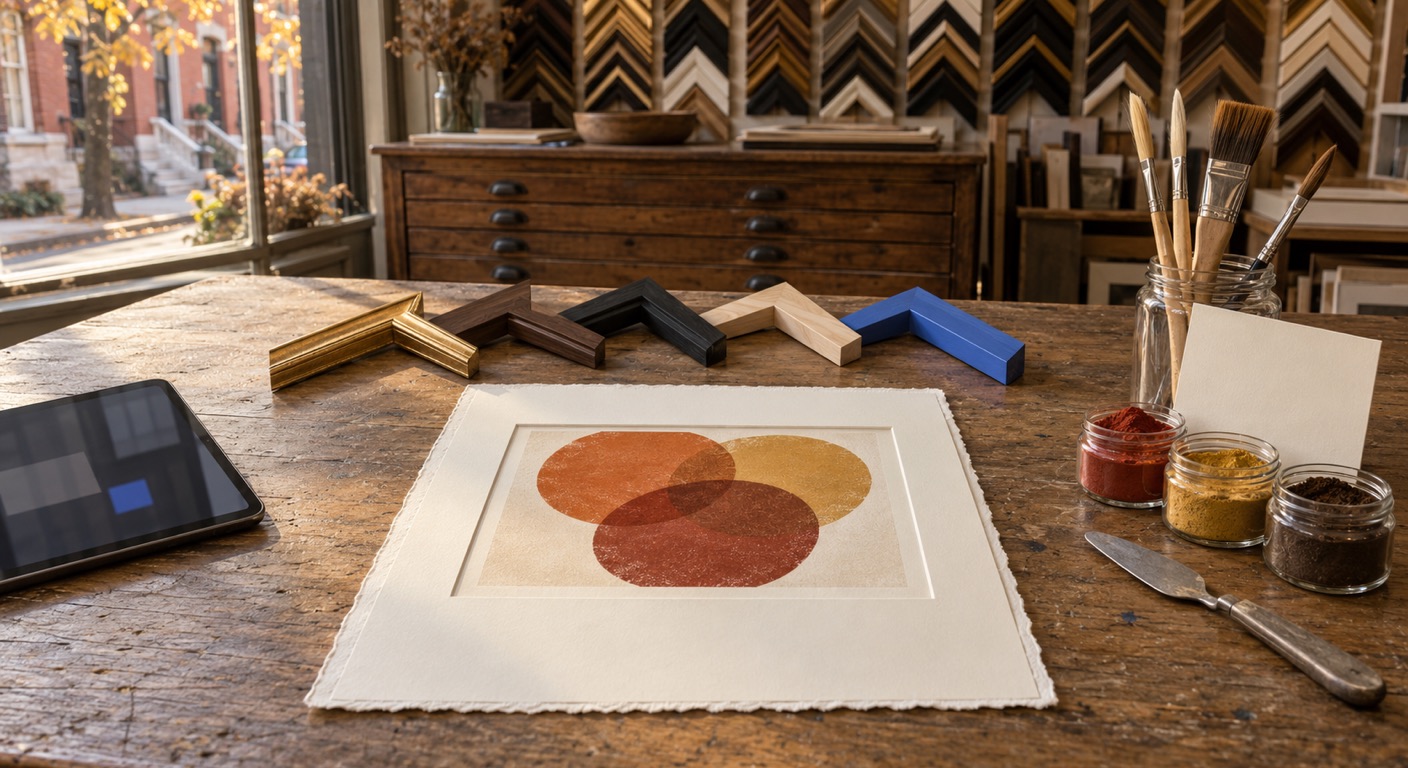
On a Saturday morning in October, a frame shop and art supply store near Station North does four ordinary things before lunch. It sells a hand-pulled screenprint by a local printmaker, signed and numbered 12 of 40, unframed, for $30. It sells a framed giclée of a harbor painting, a “signed limited edition of 250,” for $185, and ships another copy of it to a buyer in Ohio from the artist’s studio around the corner. A fourth-grade teacher buys three tubes of cadmium red for a classroom. And in the back room, the shop crates a $2,500 painting for a collector in California, to go out by FedEx on Monday. All of it is routine, and each sale rests on a fact the shop’s software almost certainly does not hold.
The screenprint is the sharpest of the four. Under a Maryland law from 1974, a print sold for more than $25 unframed must come with a written disclosure of the year it was printed, the size of its edition, the number of proofs, whether the plate was canceled and where it was printed; framed, the same print would be exempt up to $40. The giclée turns on a word: a reproduction is exempt unless the seller calls it limited, signed or numbered, which this one does. The cadmium red carries a label saying it is inappropriate for use by children, and federal law lets the Consumer Product Safety Commission go to court to stop schools buying such materials for children up to sixth grade. The painting will be covered by FedEx for no more than $1,000, whatever the shop declares. And the copy shipped to Ohio may count toward the artist’s Maryland income tax break, depending on where it was made and where it shipped from.
This article goes through those questions for Baltimore’s frame shops, art supply stores, print studios and galleries: the 1974 print law, the federal rules that send every tube of paint to a toxicologist, Maryland’s tax rules for framing and its arts-district tax break, what the carriers cover, what the software costs, what 37 Baltimore businesses and 55,965 listings on 79 web stores show, what changes for a web store and the AI agents that read it, and what we would build. We are a software studio, not lawyers; where a rule is our reading of the text rather than an agency’s statement, we say so.
The trade in Baltimore: one-person studios, a handful of galleries, and a framer from Bethesda
The government does not count frame shops or art supply stores on their own. In the industry classification the Census Bureau uses, custom picture-frame shops are filed under “all other home furnishings stores,” next to bath shops and housewares; art supply stores share a catch-all code with about two dozen unrelated trades; and Michaels, which frames pictures at the back of its craft stores, is counted as a craft and hobby store. Only art dealers have a code of their own. In County Business Patterns for 2023, Baltimore City had five art dealers with paid employees, 20 employees between them; Baltimore County had 11; Maryland had 51, nine fewer than in 2019; the United States had 4,729. Maryland’s art dealers paid $31,077 per employee. The national average, $73,797, is a New York number: New York State has 15% of the country’s art-dealer establishments and 52% of their payroll.
Most of the trade’s businesses have no employees at all. The Census’s nonemployer statistics for 2024 count 43 one-person art dealers in Baltimore City, against those five with staff, and 2,644 independent artists, writers and performers, with average receipts of $20,117. Across the city and Baltimore County there are 5,397 of them. Nationally there are 1.1 million, and 54.6% took in less than $10,000 in 2024. The category also counts writers and performers, but it is where the Census puts the painter who sells giclées at markets, the printmaker with an edition on a web store and the illustrator with a print shop on Etsy: the people the Maryland print law was written for, whether or not they have heard of it.
| Area | Art dealers with employees | Their employees | One-person art dealers | One-person artists, writers and performers | Their average receipts |
|---|---|---|---|---|---|
| Baltimore City | 5 | 20 | 43 | 2,644 | $20,117 |
| Baltimore County | 11 | 37 | 36 | 2,753 | $20,952 |
| Anne Arundel County | 9 | 23 | 39 | 2,075 | $20,768 |
| Maryland | 51 | 169 | 350 | 21,592 | $21,167 |
| United States | 4,729 | 17,120 | 19,126 | 1,115,783 | $32,015 |
The national framing names are close by. Framebridge, which began in 2014 as an online framer, is headquartered in Bethesda, according to the 2025 annual report of its owner, Graham Holdings, with 44 retail locations at the end of the year, three manufacturing facilities in Kentucky, Nevada and Virginia, and about 852 employees. Its store locator lists a Baltimore shop in Roland Park, on Falls Road, and the same parent owns Saatchi Art and Society6: one Maryland-based company now owns a framer, an online gallery and a print-on-demand marketplace. Michaels, with more than 1,300 stores, owns its own framing manufacturer, Artistree, and spent 2026 adding same-day printing and new framing services. Behind the independent shops sit suppliers with famous parents: Larson-Juhl, the moulding and mat company, belongs to Berkshire Hathaway, and Tru Vue, the picture-framing glass maker, belongs to Apogee Enterprises, which in September completed the purchase of Groglass, a Latvian maker of anti-reflective glass, for about €62.5 million.
Baltimore’s own art economy has deep roots. MICA, chartered by the state in 1826, is celebrating its bicentennial this year with about 1,700 students on Mount Royal Avenue. When Globe Poster Printing, whose letterpress show posters were a Baltimore signature for more than 80 years, closed in 2011, MICA took in its archive of posters, wood type and printing blocks. Station North became the first area in Baltimore designated a state Arts & Entertainment District, in 2002. The Baltimore Museum of Art holds about 65,000 prints, drawings and photographs. Artscape, the city’s free arts festival, now runs on Memorial Day weekend. The wider market is less cheerful at the bottom. The Art Basel and UBS report for 2025 put global art sales at $59.6 billion, up 4%, but online sales fell to $9.2 billion, their lowest since 2019, and auction sales below $50,000, the price range where most prints and local galleries live, declined.
What the software costs, and what the meter counts
A frame shop, an art supply store and a gallery buy different software, and the market for each is small enough that a few vendors decide what it looks like. The prices below are from each vendor’s own page on 3 October 2026, unless we say otherwise.
Framing software has just lost one of its best-known names. FrameReady, a point-of-sale system independent framers have run for years, has been discontinued: frameready.com now redirects to a LifeSaver page announcing that FrameReady is moving to LifeSaver’s cloud product, with a warning about shops running it on Windows 10, older versions of macOS and aging FileMaker installations. LifeSaver’s own pricing page shows one number, $79 for its Startup plan with two simultaneous users, and a configurator instead of prices for the plans with five and ten users; a site-wide banner offers to waive a $750 setup fee. Its blog still lists $69, $99 and $149 a month. At the other end, SpecialtySoft sells a perpetual license for $1,495 and charges $510 a year for weekly supplier price updates; FerenSoft charges $1,495 a year per computer and $695 or $895 a year for the moulding price files.
| Product | Published price | What the meter counts |
|---|---|---|
| LifeSaver (framing) | Startup $79; Core and Plus by configurator; $750 setup, currently waived | Simultaneous users (2, 5 or 10); several locations only on Plus |
| FramingPOS | $35 a month; $10 a month per user over five; visualizer $20 a month | The shop, then users; card fees are Square’s |
| Virtual Framer | $125 a month or $1,375 a year | The shop |
| SimulArt | $32.95 to $399.95 a month | Users, storage and visualizer image requests |
| SpecialtySoft | $1,495 once, plus $510 a year for supplier updates | A license, then a year of price files |
| ezFramer | $349, $650 or $999 once, for Windows; support and supplier updates $250 or $350 a year after the first | A license, then a year of price files |
| FerenSoft Trio! | $1,495 a year per computer; price files $695 or $895 a year | Computers, then supplier files |
| Wizard mat cutter service plans | $85, $140 or $275 a month | Each computerized mat cutter; the design software license is in the plan |
| Artlogic (galleries) | $205 or $409 a month billed yearly; top tier by request | Artworks managed (25,000 or unlimited), website artworks, emails |
| ArtCloud | $0, $99, $132 or $193 per user a month; website $77 to $303 a month | Users, artworks and contacts |
| ARTERNAL | $95, $195 or $325 per user a month; website $200 a month | Users, artworks and artists, on a 12-month term |
| Masterpiece Manager | $39, $89, $169 or $299 a month; setup $0 to $3,000; shopping cart $750 once | Users, artists and items |
| Square | $0, $49 or $149 a month per location; 2.6%, 2.5% or 2.4% + 15¢ in person; 3.3% or 2.9% + 30¢ online | Locations, plus a share of every card sale |
| Big Cartel | Free, $15 or $30 a month | The plan; card fees go to the processor |
Two things stand out. In framing software the supplier’s price list is a product in its own right, because a framer quotes from thousands of mouldings whose prices change; vendors either bundle the price files or charge for them by the year. And the gallery systems count artworks and users, not sales.
For anyone selling art online, though, the subscription is not the number that matters. The number that matters is the percentage, because art is expensive. Here is what selling one $2,500 painting to a Maryland buyer costs through each channel, using each one’s published fees; where a fee is charged on the sales tax or shipping as well, we included the 6% Maryland tax.
| Channel | Published fee | Cost of the sale |
|---|---|---|
| Singulart | 50% commission, plus a membership of €49 to €199 a month | $1,250, before the membership |
| Saatchi Art | 40% commission | $1,000 |
| Amazon Handmade | 15% referral fee | $375 |
| eBay | 13.6% of the total including tax, plus 40¢ | $360.80 |
| Etsy | 20¢ listing, 6.5% of the price, 3% + 25¢ processing on the total | $242.45, more if an Offsite Ad gets the credit |
| Own site, card at 2.9% + 30¢ | Card processing on the total | $77.15 |
| Own invoice by bank transfer (Square Plus, PayPal) | 1%, capped at $10 | $10 |
Saatchi Art’s, Etsy’s and INPRNT’s fee pages refused our automated requests, so for those we used the vendors’ own pages as they appear in search results; INPRNT says artists earn 50% on fine art prints. Artsy publishes no price for galleries at all. On a single painting, the gap between Saatchi Art’s commission and a bank transfer to the gallery’s own invoice, $990, is more than a year of LifeSaver’s Startup plan. That is the economic case for a gallery or an artist owning the store. The marketplaces sell an audience, and for a new artist that may be worth 40%; for a gallery whose collectors already know it, the second sale through a marketplace is the expensive one.
The part no national platform models: in Maryland, a print comes with paperwork
Maryland has a law about prints that almost nobody who sells them has heard of. It was passed as Chapter 300 of the Acts of 1974, Senate Bill 59, “concerning Sale of Fine Prints,” and moved a year later into the Commercial Law Article, where it sits today as sections 14-501 to 14-505. The 1975 revisor’s note on its central section refers to “the California counterpart to this section,” and that is where the idea came from: California’s fine print law dates from 1970. California has since widened its law to photographs and sculpture casts, made a stated edition size an express warranty and added a sign in the shop, attorney’s fees and civil penalties. Maryland has kept its 1974 rules essentially unchanged.
The law defines a fine print as “a printed image on paper or any other suitable substance which has been taken off a plate by printing, stamping, casting, or any other process commonly used in the graphic arts,” and says it includes “an engraving, etching, woodcut, lithograph, or serigraph.” A plate is “a plate, stone, block, or other material used to create a fine print.” Then it does two things. Section 14-503(b) says a person may not knowingly sell a fine print, at retail or wholesale, “unless a written invoice, receipt for the purchase price, or certificate furnished to the purchaser clearly and conspicuously discloses” a list of facts. And section 14-503(a) says a person may not knowingly publish or distribute “any catalog, prospectus, or circular which offers for sale a fine print” unless it carries the same list.
Seven facts, and a rule for the ones you don’t know
The list in section 14-504 reads like a database schema written fifty years before anyone would build one. The seller has to disclose the year the print was printed and the artist’s name; whether it is part of a limited edition, and if so the maximum number of signed or numbered prints, the maximum number of unsigned or unnumbered ones, the number of artist’s, publisher’s, printer’s or other proofs outside the regular edition, and the total size of the edition; whether the plate has been destroyed, effaced, altered, defaced or canceled; if there were earlier plates of the same image, how many, and which one this print came from; if there were earlier or later editions from the same plate, which edition this is and how big the others were; whether the edition is posthumous or a restrike, and if so whether the plate was reworked; and the name of the workshop where it was printed.
The sentence that matters most for software comes next. Under section 14-504(b), if the seller does not know one of those facts, “he shall disclaim that knowledge specifically with regard to each of these items of information so that the purchaser is able to judge the degree of uniqueness or scarcity of each print.” Silence is not an option the law offers. Every field has three possible states: a value, an explicit “we do not know,” or a violation. A product page or a receipt that simply leaves the proofs out has not disclaimed anything.
| Section 14-504 asks for | Where a print seller usually keeps it | Listings that state it |
|---|---|---|
| The artist’s name | The product title or vendor field | Nearly all, often only in the vendor field |
| The year it was printed | Often nowhere; sometimes in the description | At most 20.6% |
| Signed or numbered copies in the edition | A line such as “edition of 50” | 65.1% |
| Artist’s, printer’s and other proofs | Rarely recorded at all | 15.4% mention them; 5.3% give a number |
| Whether the plate was canceled or destroyed | The printmaker’s memory | None |
| The workshop where it was printed | A chop mark in the margin | 5.4% |
| All of the above, or a specific disclaimer for each | No standard field anywhere | None |
The frame moves the line
Two kinds of print are outside the law. Section 14-502 exempts a print printed before July 2, 1974, and a print “offered for sale or sold at retail or wholesale for: (i) $25 or less, if unframed; or (ii) $40 or less, if framed.” Those numbers have not changed since 1974; the 1975 recodification carried them over with “only changes in style.” Adjusted by the consumer price index, $25 in July 1974 is about $170 today and $40 is about $271. Had the thresholds been indexed, most posters, risographs and small screenprints would sit below them. They were not, so in 2026 the law reaches a $26 print. California’s law starts at $100 and New York’s above $100, in both cases not counting the frame. Maryland is the narrowest of the three in what it covers, prints taken off a plate and nothing else, and by far the widest in the prices it reaches.
It also means the framer’s work changes the legal status of the print. A signed screenprint sold unframed for $30 needs the paperwork; the same print framed and sold for $40 does not. That is a price test on each line of a sale, built from facts the register already holds, and exactly the kind of rule a person forgets at the counter on a busy Saturday. A point-of-sale system can apply it every time and print the disclosure on the receipt and the web page when it applies. We have not seen a framing or retail system that does.
“Reproduction” is a way out, until the word “limited” appears
The law’s other exception is a word. Under section 14-503(c), if a fine print is described as a “reproduction,” none of the disclosures are required, “unless the print allegedly was published in a limited edition, an edition of numbered or signed prints, or any combination of them.” An open-edition poster honestly called a reproduction is exempt. A reproduction sold as a “signed limited edition of 250” is back inside the law, with every item on the list, because those are precisely the claims the law was written to police: scarcity and the artist’s hand.
Much of today’s market for prints of paintings looks exactly like that. The common product is a giclée, an inkjet print made from a photograph or scan of an original, signed and numbered by the artist and sold at art fairs and on web stores; in our census, giclées were about a quarter of the limited-edition print listings above Maryland’s threshold. Whether a giclée is a “fine print” under a 1974 definition is a fair question. The statute speaks of an image “taken off a plate,” and an inkjet printer has no plate. On the other hand, the reproduction clause assumes that reproductions can be fine prints, and offset lithographic reproductions are printed from plates; and the art consignment law in the same Commercial Law Article names “offset print” and “photograph” outright, which the print law never does. Our reading is that a seller who calls an inkjet print limited, signed or numbered should treat it as covered. The cost of disclosing is one more block of text that the seller’s records should already contain; the cost of guessing wrong is set out in the next section.
Three times the price, for three years
The remedy in section 14-505 is a refund. A seller who violates the law is liable to the buyer, when the buyer hands back the print, “for its purchase price, with interest from the date of payment.” A willful violation costs “three times the sum of the purchase price and interest.” The buyer has one year from discovering the violation, and no more than three years from the sale, to sue. For a $185 limited-edition giclée sold without its paperwork, the exposure for a willful violation is $555 plus interest, per print, for three years after every sale.
It is also a quiet law. We searched CourtListener’s collection of published Maryland and federal decisions and found none that interprets it; it appears in the case law only as an example, in a footnote of the Court of Appeals’ 2000 opinion in Admiral Mortgage v. Cooper, of a statute that trebles damages automatically. A law nobody has litigated is not a law that does not apply. It is a law whose first test case has not happened yet, and the seller in that case will want to show the paperwork.
The edition number also decides what the framer may do
The same two facts, a signature and a number, matter in federal copyright law. The Visual Artists Rights Act of 1990 protects a “work of visual art,” which 17 U.S.C. 101 defines as a painting, drawing, print or sculpture “existing in a single copy, in a limited edition of 200 copies or fewer that are signed and consecutively numbered by the author,” posters excluded. For such a work, section 106A gives the artist, not the owner, the right to prevent “any intentional distortion, mutilation, or other modification” that would harm the artist’s honor or reputation, and only the artist can waive it, in a signed writing.
Framers have their own clause. Under section 106A(c)(2), a modification that is “the result of conservation, or of the public presentation, including lighting and placement, of the work” is not a violation “unless the modification is caused by gross negligence.” We found no reported case against a frame shop. The point is that one field on the intake ticket, signed and numbered in an edition of 200 or fewer, marks the prints for which trimming a margin or permanently dry-mounting is not just poor conservation practice but a modification of a federally protected work. The shop already makes that distinction by eye; a work order can make it on paper.
Framing a print does not make a new work, at least in two circuits
Does framing someone else’s art create a “derivative work” that needs the copyright owner’s permission? The leading cases disagree about the edges and agree about the frame. In Mirage Editions v. Albuquerque A.R.T. Co. (1988), the Ninth Circuit held that a company that cut pages out of an art book, glued them to ceramic tiles and sold the tiles had prepared derivative works and infringed. In Lee v. A.R.T. Co. (1997), the Seventh Circuit refused to follow it for notecards and lithographs mounted the same way, and said so as a deliberate split. Judge Easterbrook’s opinion is the one to keep at the counter: “No one believes that a museum violates § 106(2) every time it changes the frame of a painting that is still under copyright,” and “If mounting works a ‘transformation,’ then changing a painting’s frame or a photograph’s mat equally produces a derivative work.” We found no ruling on the question from the Fourth Circuit, which covers Maryland. Framing a print the customer owns is safe on either reading; turning pages from a book into framed “prints” for sale is the line Mirage drew.
Art supplies: every tube on the shelf has been to a toxicologist
The paint aisle has its own federal statute. The Labeling of Hazardous Art Materials Act of 1988 turned a voluntary industry standard, ASTM D-4236, into a federal regulation, now printed in full at 16 CFR 1500.14(b)(8). An art material is “any substance marketed or represented by the producer or repackager as suitable for use in any phase of the creation of any work of visual or graphic art of any medium.” Every one of them must have its formulation reviewed by a toxicologist, at least once every five years and again whenever the formula changes; the CPSC’s answers to frequent questions add that “a change in the supplier of a component is considered to be a change in product formulation and requires reevaluation.” And every one of them must carry a statement of conformance, such as “Conforms to ASTM D-4236,” whether or not it is hazardous. The regulation is explicit: the Commission reads the law “to require a conformance statement regardless of the presence of any chronic hazard warnings.”
If the toxicologist finds a chronic hazard, the label must say WARNING, list the hazards and the hazardous ingredients, give safe-handling instructions, name the producer or repackager with a United States address and telephone number, and carry “a statement that such art materials are inappropriate for use by children.” That is the block of small print on a tube of cadmium red or lead white.
The regulation names the art supply store
Most of this is the manufacturer’s job, but the store is in the text. The CPSC will not enforce the rule against everyday products such as plain wood pencils and single-colored pens, markers and chalk unless they are marketed as art materials, and among the factors it lists is “where it is sold (e.g., products sold in an art supply store are likely to be art materials).” The aisle a product sits in is evidence of what it is. The same policy excludes tools, among them “brushes, chisels, easels, picture frames, drafting tables and chairs, canvas stretchers,” so the frames on the wall are not art materials. A primed canvas is, because the CPSC says the primer can be ingested, absorbed or inhaled in handling.
Three duties reach the store directly, and each is a record-keeping problem. The Federal Hazardous Substances Act makes it a prohibited act, under 15 U.S.C. 1263(c), to receive a misbranded hazardous substance in interstate commerce and deliver it to a customer, and under 1263(b) to alter, obscure or remove part of a label while the product is held for sale; a price sticker over a warning, or a store label pasted over the producer’s, is the everyday version. The defense for a retailer against the Act’s criminal penalties, in section 1264(b)(1), is good faith, and it is lost if the retailer “refuses to furnish on request” the name and address of the supplier and copies of the documents for the delivery. Second, a store that buys pigment, clay, glaze or solvent in bulk and decants it into its own labeled jars fits the regulation’s definition of a repackager, a person “who obtains materials from producers and without making changes in such materials puts them in containers intended for sale as art materials.” By our reading, the store-brand jar then needs its own toxicologist review, its own conformance statement and, if it is hazardous, its own warning label, and the store must send its labeling criteria and a list of its hazardous products to the CPSC. A store that imports its own private-label line is a producer. Third, a store that bundles class kits or gift sets should make sure the outer package carries the signal word and “Read cautions on individual containers carefully” when it hides the individual labels.
The school buys it, and the law aims at the purchase
The law’s last subsection is unusual. Under 15 U.S.C. 1277(f), the CPSC “may bring an action ... to enjoin the purchase of any art material required to be labeled under this chapter which is for use by children in pre-kindergarten, kindergarten, or grades 1 through 6.” Nothing in federal law stops the store from selling a tube of cadmium red to a fourth-grade teacher. The federal remedy is aimed at the purchase, and we found no record of the CPSC ever using it. California goes further: since the 1987–88 school year its Education Code section 32064 has barred schools from ordering or purchasing art materials containing toxic substances for kindergarten through sixth grade, against a list now kept by the state’s environmental health office. Any web store that sells to schools and teachers in California needs to know, product by product, which items are on the wrong side of that list.
The industry’s own answer is a pair of seals. The Art & Creative Materials Institute certifies products with an AP seal, meaning a toxicologist found nothing in harmful quantities, and a CL seal, meaning the product carries a cautionary label; ACMI’s own advice is to “never give children in sixth grade or younger a product with the CL Seal.” The seals are voluntary. ACMI is a membership program with dues from $1,000 to $50,000 a year, and the regulation says only that producers “may wish to have compliance certified.” “Non-toxic” is not defined in law at all: the CPSC has not stopped manufacturers using it on products that need no cautionary label, and warns that using it on products that do “could be considered deceptive.”
Two recalls from this year show where the risk sits. In February the CPSC announced a recall of about 9,400 children’s fingerpainting kits that contained methanol, ethylene glycol and a banned phthalate; they had been sold only online, on the seller’s own site and on Amazon, from June 2023 to February 2025, and the recall came a year after the last sale. In January, Primark recalled about 600 coloring sets sold in its stores, including in Maryland, because the crayons held high levels of strontium and aluminum. Art materials made for children are also children’s products, with third-party testing, a Children’s Product Certificate, tracking labels and a 100-parts-per-million lead limit on top.
The standard moved this year. The law did not.
ASTM published a revised D4236 on 8 January 2026, and the 1994 text is now marked historical. The federal rule did not change with it: the statute froze the version “in effect on November 18, 1988,” and a revision becomes law only if the CPSC adopts it after notice and comment. As of October 2026 the federal regulations still print the old requirements, so “Conforms to ASTM D-4236” on a label is, legally, a statement about the CFR, not about the standard in ASTM’s store.
One state puts the warning on the web page
California does reach the page. Its Proposition 65 regulations say that for internet purchases the warning must appear on the product display page, behind a clearly marked “WARNING” link on that page, or otherwise prominently before the purchase is completed, and that it is not prominent “if the purchaser must search for it in the general content of the website” (27 CCR 25602(b)). Cadmium, lead and several other pigment metals are on the Proposition 65 list, so a Baltimore store that ships a tube of cadmium red to Los Angeles is selling into that rule. Until 2028, a transition clause gives retailers 60 days to put a supplier’s updated short-form warning online after they receive it, which is a clock that only works if the product record knows when the warning changed.
Maryland: the framing is taxed, and the studio’s address can be a tax break
Framing is fabrication, and restoration is repair
Maryland taxes the “fabrication, printing, or production of tangible personal property ... by special order” under Tax-General section 11-101(m), and the Comptroller’s regulation on fabrication, COMAR 03.06.01.30, applies the tax to “the full selling price,” even when labor is listed separately and even when the customer supplies the materials, if the work produces a new item; its example is “a tailor making a suit from materials furnished by his customers.” A new item includes “the assembly of a piece of property for the first time.” We found no Comptroller publication that mentions picture framing at all; the state’s list of taxable goods and services is silent on frames, mats and mounting. Our reading is that framing a customer’s own print assembles a new item to order, so the whole charge (moulding, mat, glass and labor) carries the 6% tax, as we concluded for long-arm quilting. Restoration is the other side of the line. Under COMAR 03.06.01.03, labor that restores property “to its original condition or usefulness” is not taxed; separately stated materials are, and on a lump-sum repair the shop pays tax on its own materials instead. By the same reading, re-gluing a broken frame is repair and putting old art in a new frame is fabrication. A framing ticket therefore needs a type, because the type decides the tax.
An online sale counts for the arts district only if it ships from the district
Maryland gives artists an income tax break that depends on geography, which is exactly what a web store blurs. The state has 29 Arts & Entertainment Districts, four of them in Baltimore City: Station North (in 2002, the city’s first), Highlandtown, Bromo Tower and the Pennsylvania Avenue Black Arts District. Under Tax-General section 10-207(v), a “qualifying residing artist,” who must live in Maryland but not necessarily in the district, subtracts from Maryland income “income derived within an arts and entertainment district ... from the publication, production, or sale of an artistic work that the artist created, wrote, composed, or executed in the arts and entertainment district.” There is no cap. The statute lets the Comptroller decide how receipts are allocated, and the Comptroller’s Form 502AE does it in a few lines. Work created and sold within any district qualifies. Work created outside a district, or sold outside one, does not. “Income received by an artist from internet, mail order and catalog sales of artistic work shipped from within a district qualifies for the subtraction, if the artist created the artistic work within any district.” Royalties and income from reproduction rights do not.
For a printmaker with a studio in Station North or Highlandtown, that turns two ordinary facts into tax evidence: where each print was made, and where each order shipped from. A print made in the district studio and shipped from it to a buyer in Ohio qualifies; the same print shipped from a fulfillment service in Delaware does not. The state arts council’s own answers add that a sale through a gallery inside a district counts, which makes a district gallery’s consignment records part of its artists’ tax files. A system that records the place of making on the edition and the ship-from address on the order produces that evidence as a side effect; a spreadsheet reconstructed in April usually does not. The arts council’s latest impact study credits the districts with more than 1,900 jobs and nearly $284 million of economic output in fiscal 2025.
Two Baltimore rules for galleries that buy, and artists who sell to the City
A gallery or frame shop that buys used art from the public is, in Baltimore City, a regulated dealer. The City Code’s definition of an antique dealer names “paintings” and “sculpture,” the definition of a second-hand dealer covers any used “moveable personal property,” and the only things carved out are motor vehicles, records, tapes, compact discs and books; we went through that license and its purchase records in our posts on consignment shops and bookstores. A gallery that only sells new work consigned by living artists is probably outside it, though Maryland’s separate fine-art consignment law, which makes the gallery the artist’s bailee, still applies. On the other side of the ledger, the City is a buyer: under Article 5, section 21-16, at least 1% of the eligible funds for every publicly bid City construction project costing more than $100,000 must go to artwork or other public art uses, chosen through a nine-member Public Art Commission that must include a professional visual artist.
Shipping art: one carrier stops counting at $1,000
A gallery that sells a $2,500 painting online has one more decision the web store rarely helps with: how to ship it so that a broken corner or a lost box is somebody else’s loss. The carriers’ own terms answer more of it than most sellers realize.
FedEx is the strictest. Its 2026 Service Guide limits its liability to $100 a package unless the shipper declares and pays for more, up to $50,000, and then lists categories of goods for which the maximum declared value is $1,000, whatever the shipper writes on the label. Artwork is the first item on the list, defined broadly enough to include paintings, drawings, limited-edition prints, sculpture and collector’s items, and the same list includes glassware, mirrors and “framed glass.” A framed print under glass is in two of the excluded categories at once. Declaring more than the cap is void even if FedEx accepts the package. At FedEx’s 2026 declared-value charge of $4.95 for a value up to $300 and $1.65 for each further $100, a gallery pays $16.50 to declare the $1,000 maximum on a $2,500 painting and is uncovered for the other $1,500.
UPS’s terms of service, effective 17 April 2026, have no rule for art. The general maximum is $50,000 a package, and the published declared-value charge in UPS’s 2025 rate guide was $1.60 per $100, $40 for a $2,500 painting. But a package created in a UPS shipping system and handed to a driver is capped at $1,000 unless the driver signs a high-value shipment summary, and UPS pays at most the lesser of the declared value, the replacement cost and “the purchase price paid by the Consignee,” with exclusions for packaging that does not meet its standards. The Postal Service sells additional insurance up to $5,000 on Priority Mail and Priority Mail Express, and up to $50,000 on Registered Mail, under section 503 of its mailing standards, which also require the clerk to ask whether a package holds anything fragile.
None of this is exotic, but it has to be decided item by item, and a store that knows the value, the medium and whether the frame is glazed can decide it automatically: ship framed work over $1,000 by a carrier and service that will cover it, or with acrylic glazing instead of glass, or by a fine-art shipper; ask for the signature UPS requires; keep the invoice that caps a UPS claim. The same goes for the art supply side. Under Publication 52, aerosol paint products classed as flammable gases, a description that fits many spray fixatives and varnishes, go by surface transportation only, and only as a limited quantity. Flammable liquids are sorted by flash point: at 20°F or below they cannot be mailed at all, up to 140°F they go by ground only, from 140°F to 200°F by air or ground, and above that they are not regulated as hazardous. Which of those a jar of solvent falls into is on its safety data sheet, which is one more field the product record should hold.
What 37 Baltimore frame shops, art stores and galleries show a customer, or a machine
On 3 October we listed 37 businesses in the trade, not counting the big framing chains: 26 in Baltimore City, 10 in Baltimore County and one online-only print seller, of which 17 are frame shops, 5 art supply stores and 15 galleries and print studios. We took the names from OpenStreetMap and web searches, placed each in the city or the county from its map coordinates, and read each website the way a customer’s browser and an AI crawler would. The chains, Framebridge’s Roland Park store, six Michaels and a Hobby Lobby, we counted separately.
Twenty-five of the 37 have a website that works. One art supply site turns away anything that is not a full browser, three listed websites are broken or gone, and for eight businesses we found no website we could tie to them. Nine of the 25 working sites have a cart that takes an order. Two sell prints online, and in three print listings we sampled from one of them, none gave an edition size or a year. Of the 13 frame shops with a website, three offer any kind of online framing design tool, and one of those embeds a supplier’s visualizer that still shows its unfilled template placeholders; two publish any framing price, one of which is a $129.99 diploma special; four take appointments online. The rest ask the customer to call or come in, which is reasonable for custom framing and a lost sale for a customer comparing a local framer with Framebridge’s price grid at eleven at night.
The machine view is mixed. None of the 24 sites whose robots file we could read blocks the AI crawlers from OpenAI, Anthropic or Perplexity across the site. Five independents and Framebridge serve an llms.txt file, the new plain-text summary for AI systems, and none was written by a person: three come from one website builder’s template, one says an SEO plugin generated it, and the Shopify stores serve Shopify’s standard “Agent Instructions.” Six independents describe themselves to search engines with LocalBusiness structured data, all of it platform defaults. OpenStreetMap, the open map many apps draw on, knows 26 of the 37; ten have a website on their map entry, and three of those ten point to a dead or broken site.
Three details say more than the counts. Plaza Artist Materials closed its city store on Cathedral Street in March 2024, according to Baltimore Fishbowl, and kept its Towson store. The parent of Artist & Craftsman Supply, whose Baltimore store is on North Avenue in Station North, filed for Chapter 11 in December 2025 in Maine; its store finder still lists the Baltimore shop. And micastore.com, the address a student or an AI assistant might reasonably guess for MICA’s campus art store, is a domain for sale; the real store is at shop.mica.edu. A trade whose customers search for “art supplies Baltimore” and “framing Baltimore MD” is being described to machines mostly by defaults, by its suppliers’ templates and by whoever owns the domain.
What 55,965 listings on 79 web stores say about prints and paint
On 3 October we read the public catalogs of 58 American web stores on Shopify that sell fine-art prints: print publishers and printmaking studios, screenprint and gig-poster artists, risograph and letterpress shops, print galleries and dealers, and artists selling giclée editions, including the only two Maryland print sellers we found on the platform. Between them they list 37,067 products, 21,456 of them prints. We kept the 11,000 print listings that Maryland’s law would reach if the buyer were in Maryland: priced above $25 unframed or $40 framed, not evidently printed before 1974, and described as limited, signed or numbered, which also takes away the reproduction exemption. Their median price is $100, and a quarter of them are giclées.
Sellers state the edition size, and not much else. Of the 11,000, 65.1% say how many prints are in the edition. At most one in five says when the print was printed: 20.6% give a year next to the edition details on the broadest reading we could defend, 9.2% on a strict one, although more than half mention a year somewhere, usually when the image was made. Proofs are mentioned in 15.4% and counted in 5.3%; the workshop or printer is named in 5.4%. None says whether the plate was canceled or destroyed (two listings matched our search, and both turned out to be about canceled orders), and none mentions a restrike or a posthumous edition. Not one listing states everything Maryland asks for or disclaims what it does not know, and 63.0% say nothing at all about the year printed, the proofs, the workshop or the plate. Prints made from a plate, stone, block or screen, which the 1974 law plainly covers, look much the same: of their 7,304 listings, 64.9% give the edition size and 7.9% the workshop. Giclées and photographs give the edition size more often, 72.6%, and almost never name a printer. The two Maryland sellers we found are not ahead of anyone: of their 150 covered listings, 25 state an edition size and 3 a year. A certificate of authenticity is promised in 16.3% of the listings; it is one of the three documents Maryland accepts for the buyer’s disclosure, but a web page that offers the print is still a catalog in its own right.
Two cautions. A store’s product data is not the whole page: some themes show edition details stored elsewhere, and a printmaker may write the year and the edition in pencil on the print itself, which no census can see. We fetched 114 product pages from 57 of the stores to measure the gap: of 90 sampled listings whose product data gave no edition size, 7 showed one somewhere on the page, so the true shares are somewhat higher, though not by enough to change the picture. Hand-checked samples showed the year to be the least reliable field, hence the range. And these are national stores, most of which may never sell to a Maryland buyer. The point is not that 11,000 listings break a Maryland law. It is that the information the law treats as essential to a print’s value is, for most of the market, not recorded anywhere a register, a web page or an AI assistant could find it.
The second census is of art supplies: on the same day we read the catalogs of 21 American art supply web stores on Shopify, from retailers such as Cheap Joe’s, SoHo Art Materials, Rileystreet and Texas Art Supply to paint, pastel and clay makers selling direct, 18,898 listings in all. Of these, 618 name as an ingredient a metal whose compounds appear on the usual art-hazard lists, by name or by Colour Index code: cadmium, cobalt, chromium, manganese, nickel, lead, mercury, arsenic or barium. We left out anything sold as a hue, an imitation or a substitute. Only 194 of the 618, or 31.4%, carry any warning, cautionary wording, conformance statement, Proposition 65 notice or statement about children in the listing’s own data, and more than half of those come from a single encaustic paint maker that puts a Proposition 65 warning on every cadmium listing. Without it, the share is 16.8%. Ten of the 618 mention ASTM D-4236, 25 say anything about children, 8 point to a safety data sheet, and none mentions the CL seal.
That is not a count of violations. Not every cobalt or manganese paint needs a warning, since a toxicologist decides, and the federal rule is about the label, not the page; some stores also add warnings through their theme or an app, which product data does not show, so these numbers are floors. The point is that the page tells the buyer less than the tube does, and the page is what a teacher, a parent and an AI shopping assistant read. Across all 5,502 paint listings, 94 call themselves non-toxic. Of 1,809 solvent, medium and aerosol listings, 35 mention any shipping restriction, all at three stores; one notes that gallon cans of a popular odorless mineral spirit cannot be shipped to several states, Maryland among them.
The e-commerce half: what a print, frame and art supply web store is actually selling
Put the rules next to the census and a pattern appears. The facts the law cares about belong to one object, not to a product: this print, from this edition, printed in this year at this workshop; this frame, cut to this size from this moulding; this jar of pigment, from this delivery, under this label. Web store software is built around products with prices and variants, and the four places below are where the difference costs a shop money.
Sell the edition, not the image
An edition is a small table. It has an artist, an image, a year, a workshop, a maximum number of signed and numbered prints, a number of unsigned ones, a number of proofs of each kind, a total, a plate status and, sometimes, an earlier edition from the same plate. Each print in it is a numbered copy with its own condition and its own price, and some copies may already be in other dealers’ hands. A web store that records the edition once and generates everything from it gets the Maryland disclosure for free: the product page shows it, the receipt prints it, the certificate of authenticity is the same text on better paper, and any field nobody knows prints as “unknown” instead of disappearing. A web store that lists a product called “Harbor at Dusk, signed limited edition” has to remember all of that in a description box, and in our census it usually did not.
It also lets the shop sell what collectors ask for. A buyer who wants number 7 of 40, or a proof rather than a numbered print, is asking about copies, not about a product. And when an edition sells out, the record shows the scarcity the law exists to protect: the edition was 40, there were 4 artist’s proofs, and they are gone.
A frame is a configuration, not a variant
Custom framing is priced from a formula. A frame shop prices moulding by the foot, with a waste allowance for the miters; mat board and glazing by area or by united inches, the width plus the height; and labor by size and difficulty. Change the size by an inch and every line moves. That does not fit a store whose products are a list of variants, even a generous one, and it is part of why only three of the 13 frame shops with websites in our local census offer any online design tool. The online framers that do sell it, Framebridge with its own software and Michaels through a separate custom-framing site, built configurators that compute the price from the inputs. A local shop can have the same thing, because its price list is already a formula: the supplier’s price per foot, the shop’s multiplier, glass and mat by size, and fitting. What a chain cannot match is the rest of the ticket: conservation glazing, a print hinged instead of dry-mounted, and knowing which prints are signed and numbered before the work order is written.
Art supplies need flags, not just categories
A category tree answers where a product sits in the store. The rules in this article ask other questions: does this item carry a chronic hazard label, is it a children’s product, is it on California’s list for schools, does it need a Proposition 65 warning when it ships to California, can it go by air, and which supplier delivery did this jar come from. Those are flags on the product record that the store uses at checkout: a teacher’s cart warns on a CL-labeled item, a California address triggers the warning before purchase, a can of fixative is held to ground shipping, and a recall is matched to the lots that were sold. It is a few fields per product and a few rules at checkout, but it has to be built, because no general web store asks for it.
What Google, ChatGPT and AI shopping agents can read
Machines are already reading these stores, and the vocabulary they are given is thin. Schema.org, the structured-data vocabulary used by Google and other search engines, has a VisualArtwork type with an artEdition property, “the number of copies when multiple copies of a piece of artwork are produced,” plus artMedium and artform; in our sample of 114 product pages from 57 of the print stores in our census, 82 carried Product structured data and not one used VisualArtwork, artEdition or artMedium. Shopify’s standard product taxonomy, version 2026-08, gives the Prints category an attribute called “Print edition type” whose values are Artist proof, Limited edition, Numbered edition, Open edition, Signed limited edition, Special edition and Other, and an “Artwork authenticity” attribute with three values: Original, Reproduction and Other. There is no attribute for the size of the edition, the year or the workshop, and the “Printing method” attribute offers Engraving, Lithography, Offset printing and Other; etching, woodcut and serigraph, three of the five processes Maryland’s law names, are not on it, and neither is inkjet. A store on Shopify can say in machine-readable form that a print is a signed limited edition. It cannot say of how many.
The shopping feeds are no better. Google Merchant Center has no attributes specific to art; an edition size can go into its optional product detail pairs, up to 100 per product, which Google says help customers discover products “across AI-driven surfaces, like AI Mode in Google Search.” ChatGPT’s product feed specification requires nine fields, one of them a brand, and has no field for the artist, the edition, the medium or the year; the nearest is “material.” For a print, the artist ends up in the brand field or nowhere. The result is that an AI assistant asked for a signed etching from an edition under fifty finds stores that typed those words into a description, not stores that recorded them. A shop whose product pages carry the edition record as structured data, in the VisualArtwork vocabulary and in plain text on the page, is the one an assistant can quote.
A note for readers in Lithuania
Part of our team works from Lithuania, and the same three businesses look different under EU law. The biggest difference is where the warning lives. Since 13 December 2024, the EU’s General Product Safety Regulation, Regulation (EU) 2023/988, has required every online offer to show, “clearly and visibly,” the manufacturer’s name with a postal and an electronic address, a responsible person in the EU if the manufacturer is outside it, a picture and identifier of the product, and, under Article 19(d), “any warning or safety information to be affixed to the product or to the packaging,” in the language of the country where it is sold. In the United States, the chronic-hazard warning on a tube of cadmium paint is a label rule, and nothing in the federal art-material regulation reaches the web page; the common exception is California’s Proposition 65. In Lithuania, the web page owes the warning itself, in Lithuanian.
On 3 October we opened 12 product pages for cadmium- and cobalt-named paints and pigments on four Lithuanian art supply web shops. None showed the manufacturer’s postal and electronic address, none named an EU responsible person for the five products made outside the EU, and none showed a warning, a hazard statement or a hazard pictogram; nine showed a product code and three named the manufacturer. Several of the “cadmium” colors were hues, which contain no cadmium and need no warning, but the ones that did contain it, a French oil stick and a dry pigment marked as Italian, showed no warning either.
Custom framing has its own consumer rule. Online and distance sales in the EU normally carry a fourteen-day right of withdrawal, but Article 16(c) of the Consumer Rights Directive excludes “goods made to the consumer’s specifications or clearly personalised.” Lithuania’s Civil Code, Article 6.22810(2)(3), adds that the exception applies whether or not production has started, „neatsižvelgiant į tai, ar prekės pradėtos gaminti, ar ne.“ A frame ordered online to the customer’s size and moulding cannot be returned on a whim; a ready-made frame from the same web store can, and the store has to say which is which before the order.
The gallery side differs most. Lithuania gives artists a royalty on resales of their work, under Article 17 of the Law on Copyright and Related Rights, whenever a gallery, salon, auction house or other dealer takes part and the price is at least €300 net of taxes, far below the €3,000 the EU directive allows as a ceiling. The rate is 5% of the first €3,000, falling in bands to 0.25%, capped at €12,500 a work, and signed, numbered prints made with the artist’s authorization count as originals. The dealer is jointly liable with the seller and must keep the sale information available for three years. The United States has no equivalent: California’s resale royalty law was held preempted by federal copyright law for every sale since 1978 in Close v. Sotheby’s. VAT works differently too: Lithuania has no reduced rate for works of art, so an original painting sold by a VAT-registered gallery carries 21%, an exhibition ticket 12%, and second-hand art can go under the margin scheme of Articles 106 to 110 of the VAT Law, with no tax shown on the invoice. A gallery that frames, resells and exhibits has three tax treatments on one counter.
Lithuanian framers price the way Baltimore framers do, by moulding and by area; a marketplace price guide puts picture framing at €30 to €120 a square meter, €78 on average, and one workshop, Remink, sells through a full online configurator with photo upload and sliders for the mat. Its own blog is candid about the limits of that: „ekrane matomas vaizdas yra orientacinis“ (the image on the screen is only indicative), so complex work still needs a consultation. A Lithuanian interiors magazine profiled an artist last year who sells giclée reproductions on heavy paper, hand-signed after a quality check and framed behind glass. If such prints are also numbered, Article 17(2) of the copyright law treats them as originals for the resale royalty, which is the Lithuanian version of Maryland’s question about what a signed giclée is.
What custom actually costs, and when it pays
We price every project at a fixed fee, agreed before we start, and publish the starting points on our pricing page. For a frame shop, art supply store, print studio or gallery, they map onto this article like this.
| Package | Fixed price | What it would be for a frame shop, art store or gallery |
|---|---|---|
| Prototype Sprint | $3,500 | A one-week working prototype on your own data: last year’s framing tickets and your moulding price file turned into a quote calculator, or your print inventory turned into edition records, that you can try at the counter before you commit to anything |
| Online Store | from $6,000 | A web store built around editions and frames: every edition a record with its numbered copies and proofs, the Maryland disclosure generated on the page, the receipt and the certificate, a framing configurator priced from your supplier files, art supplies with hazard, school and shipping flags, and structured data an AI shopping agent can read |
| Custom App or Internal Tool | from $12,000 | A framing work-order app: intake with photos and condition notes, a signed-and-numbered flag that switches the job to reversible methods, quotes from current moulding prices, job tracking and pickup messages; or an edition manager for a print studio or publisher |
| Operations System | from $12,000 | One system behind the register, the web store and the marketplaces: edition and copy inventory, consigned work and artist payouts, supplier and delivery records for every art material, Maryland’s tax rules for framing, and shipping rules that know what a carrier will and will not cover |
Most of our projects land between $6,000 and $30,000, and none requires you to drop the register, the card processor or the framing software that already works; the demos page shows finished work. In Maryland, the state’s 3% tax on software and IT services applies to a custom build, as we explained in a separate post, so the Online Store package costs $6,180 with tax.
Here is when it pays for itself, using the fee table above. A gallery that sells a $2,500 painting through Saatchi Art gives up $1,000; on its own site, with a card at 2.9% plus 30 cents, the same sale costs $77.15, and by bank transfer $10. Moving one collector’s repeat purchase to the gallery’s own store saves $922.85 by card, so the store pays for itself after seven such sales. A printmaker selling $60 prints is in a different position: Etsy charges about $6.26 on a $60 print shipped to Maryland and the printmaker’s own site about $2.14, a saving of $4.12 a print, so the same store needs about 1,500 prints sold on the printmaker’s own site before the fees alone repay it. An artist who sells a few dozen prints a year should not build anything. A printmaker or gallery that already sells several hundred works a year online to buyers who come back is paying for a store whether or not it owns one.
What we would build for a Baltimore frame shop, art supply store or print gallery
If a Baltimore frame shop, art supply store, print studio or gallery asked us to fix the problems in this article without replacing anything that already works, this is what we would build, roughly in this order.
- An edition record. One row per edition: artist, image, year printed, workshop, process, signed and unsigned edition sizes, proofs by kind, total, plate status, earlier editions, place of making. One row per copy under it: number, condition, location, price, sold or not. Every field can say “unknown,” and says so out loud.
- A disclosure that writes itself. When a print is priced above $25 unframed or $40 framed, the product page, the receipt and the certificate all print the Maryland disclosure from the edition record, including each item the seller does not know. When it is described as a reproduction and not as limited, signed or numbered, they do not.
- A framing quote that is a calculation. The shop’s moulding, mat and glazing prices from its supplier files, its own multipliers and labor table, a configurator on the web store and the same calculator at the counter, and a work order that carries the customer’s photos, condition notes and a flag for signed and numbered work that switches the job to reversible mounting.
- Art supplies with flags. Chronic-hazard label, children’s product, California schools list, Proposition 65, shipping class from the safety data sheet, and the supplier delivery each lot came from, so a teacher’s cart can warn, a California order can show the warning first, a can of fixative can stay on the ground, and a recall can be matched to what was sold.
- Shipping rules that know what art is. Value, medium and glazing on every order line, so that framed work over $1,000 never goes by a service that will not cover it, and the high-value paperwork UPS requires is printed with the label.
- One feed for every machine. Product pages with VisualArtwork structured data, the edition size in Google’s product details, the artist and medium in plain text, and the same facts on the receipt, so that a search engine, an AI assistant and a buyer all read the same record.
For a shop that already runs LifeSaver, Square or Shopify, most of this sits beside the register. The register keeps taking cards and the framing software keeps writing tickets; the edition record, the disclosure, the configurator and the feed are the parts we would build and hand back to you to own.
Build, buy, or leave it alone
Most Baltimore frame shops, art supply stores and galleries should buy their software, and several of the products in this article do their job well. If you run one frame shop, a framing system such as LifeSaver or FramingPOS will price mouldings, write tickets and take cards faster and more cheaply than anything we could build for you; if FrameReady is still on your counter, the question is not whether to move but where. If you run an art supply store, a general point-of-sale system and a decent web store are enough. Keep them, and do a few things by hand this month. Write the Maryland disclosure for every print you sell above $25 unframed or $40 framed, on the product page and on the receipt, and write “unknown” where you do not know. Stop calling a reproduction “limited” unless you will also say how many. Put a sticker policy in writing so that price labels never cover a warning. Keep the supplier invoices for every hazardous art material where you can find them. And ask your shipping software what it will declare on a $2,500 painting before a customer finds out.
If you sell editions in volume, ship framed work across the country, sell to schools, or run a gallery that consigns, frames and exhibits, the question is different. Your problem is not the register but the record: which copy of which edition, made where, shipped from where, under which label, worth how much in transit. Do not migrate everything. Add the edition record, the disclosure, the configurator and the shipping rules around the systems you have, and replace the web store only when its workarounds (description boxes, quote forms, pasted certificates) cost you more than owning the store would.
Leave alone what is cheap and works: the card processor you have negotiated with, the mat cutter’s own software, the supplier price files, your accounting package and the marketplaces that bring you new buyers. Build the few things nobody sells in this trade: the edition that knows its own paperwork, the frame that is priced from a formula on the web, the art material that carries its label into the cart, and the feed that tells Google and every AI agent what your print actually is. If you are not sure which of those is costing you money, a one-week prototype on last year’s framing tickets and print sales is the cheapest way to find out.
Questions frame shop, art supply and gallery owners ask us
What is the best picture framing software for a frame shop?
There is no single best one; choose on how it handles your supplier price files, your number of users and your card payments. LifeSaver shows $79 for its two-user Startup plan and quotes larger plans through a configurator; FramingPOS costs $35 a month for up to five users; SpecialtySoft sells a $1,495 license plus $510 a year for supplier updates; FerenSoft charges $1,495 a year per computer plus $695 to $895 for price files. FrameReady has been discontinued and is moving its users to LifeSaver’s cloud product. None of them, as far as we can see, prints Maryland’s fine print disclosure.
What must a seller disclose when selling a limited edition print in Maryland?
Under Commercial Law sections 14-503 and 14-504, a print that sells for more than $25 unframed or $40 framed, printed after July 2, 1974, needs a written invoice, receipt or certificate disclosing the year it was printed and the artist; whether it is a limited edition, and if so the number of signed or numbered prints, unsigned prints, proofs and the total; whether the plate was destroyed or canceled; any earlier plates or editions; whether it is a posthumous edition or restrike; and the workshop where it was printed. A catalog offering it must carry the same facts, anything the seller does not know must be disclaimed item by item, and a willful violation can cost three times the price plus interest.
Do giclée prints count as fine prints under Maryland law?
It is an open question. Maryland’s 1974 definition covers images “taken off a plate,” an inkjet printer has no plate, and no Maryland court has ruled. A print honestly called a reproduction is exempt anyway, but the exemption ends when the seller claims it is limited, signed or numbered. Our reading is that a seller of signed, numbered giclées should give the disclosure: it costs little, and the downside is triple damages.
What is an artist proof, and does it count toward the edition?
An artist’s proof is a print pulled outside the numbered edition, traditionally for the artist, and usually marked AP. Maryland requires the seller to disclose the maximum number of artist’s, publisher’s, printer’s or other proofs outside the regular edition and the total size of the edition, so a buyer of number 12 of 40 learns that there are also, say, six proofs. In our census of web listings for limited, signed or numbered prints, 15.4% mention proofs at all and 5.3% say how many.
What does “conforms to ASTM D-4236” mean on art supplies?
It means the producer says a toxicologist reviewed the formulation under the federal art-materials rule, 16 CFR 1500.14(b)(8), and that the label covers any chronic hazard found. Every art material must carry the statement, hazardous or not, so on its own it does not mean non-toxic. The binding text is the 1988 version printed in the federal regulations; ASTM’s January 2026 revision has no legal effect unless the CPSC adopts it.
What is the AP seal on art supplies?
It is a voluntary certification by the Art & Creative Materials Institute that a toxicologist found nothing in the product in amounts harmful to humans, including children, when used as intended. Its CL seal marks products with cautionary labels, which ACMI says should never go to children in sixth grade or younger. Federal law requires the toxicologist review and the label, not the seal.
Can schools buy cadmium paints and other art materials with warning labels?
Federal law does not stop a store from selling them, but it lets the CPSC sue to stop the purchase of any art material that needs a chronic hazard label for use by children from pre-kindergarten through sixth grade, and those labels must say the material is inappropriate for children. California bars its schools from buying such materials for kindergarten through sixth grade outright. A store selling to teachers should flag these items at checkout.
How do you ship a framed painting with FedEx or UPS?
Check the declared value first. FedEx’s 2026 terms cap the declared value of artwork, including paintings and limited-edition prints, and of framed glass, at $1,000 a package. UPS has no art-specific cap, but a package handed to a driver from a UPS shipping system is capped at $1,000 unless the driver signs a high-value shipment summary, and UPS pays no more than the buyer paid. The Postal Service insures up to $5,000 on Priority Mail and up to $50,000 on Registered Mail. For valuable framed work, use acrylic glazing or a fine-art shipper.
Is custom framing taxable in Maryland?
By our reading, yes, on the full price. Maryland taxes fabrication by special order, and COMAR 03.06.01.30 applies the tax to the whole charge, even when the customer supplies the materials, if the work produces a new item; framing a customer’s print assembles one. We found no Comptroller publication that names framing, so ask for a ruling if framing is most of your business. Restoring a frame or a damaged piece to its original condition is repair labor and is not taxed, though separately stated materials are.
Do online sales count for Maryland’s arts and entertainment district tax break?
Yes, if the work was created in a district and shipped from one. The Comptroller’s Form 502AE says internet, mail order and catalog sales of artistic work shipped from within a district qualify if the artist created the work within any district; royalties and reproduction rights never do. The subtraction is for Maryland residents with a business in one of the state’s 29 districts, such as Station North or Highlandtown, and has no cap.
How much does custom framing cost?
It depends on size, moulding, mat and glass. As a published benchmark, Framebridge charges $85 to $365 to frame a customer’s own piece, $150 up to 12 by 18 inches and $200 up to 18 by 24, plus a $10 mail-in fee; Level Frames starts at about $59 for a small frame. Michaels advertises percentage-off promotions on custom framing; its pages refused our automated requests, so we cannot quote a current price. Most independent Baltimore frame shops do not publish price lists; of the 13 we found with websites, two publish any framing price.
Where can I get custom framing or buy art supplies in Baltimore?
For framing, independent shops with their own websites include JLP Custom Picture Framing on North Charles Street, The Frame Room in Fells Point, Framin’ Place, The Chessler Company, Canton Gallery, Fleckenstein Gallery and Full Circle Fine Art Services in the city, and More Than Fine Framing, Artisan Frameworks and Charlotte’s Corner in Baltimore County; Framebridge has a store in Roland Park, and Michaels frames in six stores around the city. For art supplies there are Blick, the MICA Store, Artist & Craftsman Supply on North Avenue and SCRAP B-More, a creative reuse center, in the city, and Plaza Art in Towson, whose city store closed in 2024.