
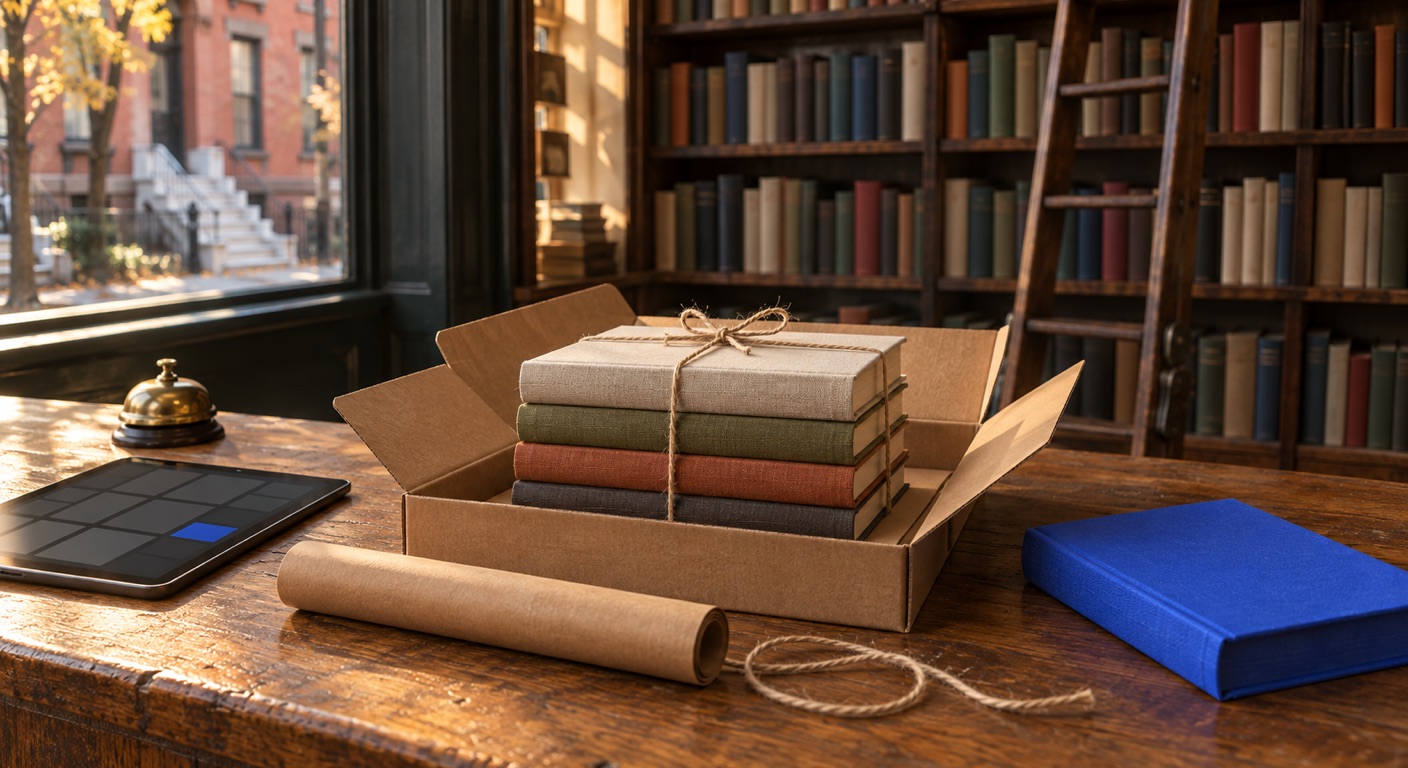
Late on a Saturday in October, a bookseller in Baltimore packs a web order at the counter. It is a good order: a signed copy of a new hardcover by an author who read at the shop on Thursday, a crossword book for the customer’s father, a 1962 paperback of a novel the customer remembers from college, and one of the shop’s canvas tote bags. On the shelf, all four are ordinary stock. In the box, every one of them is a small problem that the store’s software almost certainly does not know about.
The tote bag means the parcel cannot travel by Media Mail, the Postal Service’s cheap rate for books, and the crossword book could not have gone that way on its own either, because the Postal Service has ruled that crossword books are not reading matter. Every Media Mail parcel may be opened for inspection, and the difference in postage can be collected. The signed copy, by Google’s own definition, is a used book: Merchant Center counts anything autographed as used, so a feed that lists it as new is wrong. And the 1962 paperback has no ISBN at all, because it was printed years before the number existed; the standard was adopted internationally in 1970. To a shopping feed, it is a book that cannot be identified.
None of this is obscure. It is in the Domestic Mail Manual, in Google’s help pages, and in the history of a thirteen-digit number every bookseller scans a hundred times a day. Almost none of it, though, is modeled by the software small bookstores run. When we read the public catalogs of 83 independent bookstore web stores in the United States, 30.5% of the 41,818 books listed on them showed no ISBN anywhere in the store’s public catalog, and neither did 41.8% of the used copies. When we tried the product pages of Baltimore’s own independents, none of the ten we could read put the ISBN in the structured data search engines read.
It is a good moment to care. In late October, Barnes & Noble opens a store of about 10,000 square feet at 801 Aliceanna Street in Harbor East, its first stand-alone store in Baltimore City in six years. Greedy Reads, a finalist for Publishers Weekly’s Bookstore of the Year this spring, keeps its Fells Point shop on the same street. On the sidewalk, the independents compete on curation, events and people, and they compete well. On the page a search engine or an AI assistant reads, the contest is different. Barnes & Noble’s product pages describe every edition of a book as structured data, with its format, price and stock. Six of the ten independent pages we could read had no structured data at all.
We build custom software for small businesses in Baltimore, so my interest here is practical. I am not a lawyer, and none of this is legal or tax advice: check the rules that apply to your shop with the Postal Service, the Consumer Product Safety Commission, the Comptroller of Maryland and your accountant. The question I want to answer is narrower. Which facts about a book, and about each copy of it, does a store’s software need to know before it sells the book, ships it, lists it online or buys it over the counter, and what does it cost to make sure it does?
What Baltimore’s book trade looks like, counted two ways
The federal statistics see this trade in two halves, and neither half is the whole of it. The Census Bureau’s County Business Patterns, which counts only establishments with paid employees, found 17 bookstores in Baltimore City and 10 in Baltimore County in its 2023 file (the latest published; it still files bookstores under the NAICS 2017 code 451211). The City’s 17 employed 211 people on a combined annual payroll of $3.79 million. That is $17,962 per employee, about 85% of the Maryland figure of $21,240 and 78% of the national $23,118: a trade of part-time and modestly paid booksellers, which matters when you read software prices quoted per user or per register.
The City’s stores are also larger than the state average, 12.4 employees each against 8.8, but that number is flattered by the kind of store the code includes. College and university bookstores are bookstores to the Census, and Baltimore has a lot of campuses. Eight of the City’s 17 establishments have fewer than five employees and 13 have fewer than ten, which is a better picture of the independent end of the market.
The other half is the Nonemployer Statistics, which count businesses with no payroll at all: one person, a shelf, a website, a table at a market. Its 2024 file, which uses the newer NAICS 2022 code for book retailers and no longer separates stores from online-only sellers, counts 26 nonemployer book sellers in Baltimore City and 33 in Baltimore County. The City’s 26 took in $474,000 between them, about $18,000 each; the County’s averaged about $48,000. Nationally, two-thirds of these businesses take in less than $25,000 a year and only about one in nine reaches $100,000. Line the two files up for 2023, the one year both cover, and 19 of the City’s 36 book businesses and 31 of the County’s 41 had nobody on payroll. For most of the trade, software is not an IT budget. It is the owner’s evenings.
The national picture is steadier than the headlines of the last decade suggested. Circana BookScan counted 762.4 million print books sold in the United States in 2025, up 0.3% on the year before: a flat market, not a shrinking one. Inside that flat market the independent stores have been growing. The American Booksellers Association reported in May that its membership grew 19% in 2025, that 605 new storefronts, pop-ups and mobile shops opened that year, and that sales through IndieCommerce, the web-store platform it runs for members, rose 21.5%. Bookshop.org, the online store that shares its margin with independent shops, said in August that it has now passed $50 million paid out to bookstores.
The supply side has narrowed at the same time. Baker & Taylor, for decades the other big national wholesaler, stopped selling to bookstores in 2019 and shut down entirely in October 2025. For most independent stores, the wholesale account that matters now is Ingram’s. And the chain is back in town. Barnes & Noble, which ended 2025 with 702 stores after three years of opening more, replaces the Power Plant store it closed in August 2020 with the Harbor East store later this month, and has announced another for Lutherville Station in the County.
That is the setting for this article: a city with two dozen or so real bookstores, a handful of new ones in the suburbs (two romance-only shops have opened in Cockeysville and Overlea since last fall), dozens of one-person sellers, and a national chain about to open down the street from one of the best independents in the country. Online, where a growing share of first contact happens, all of them compete on data, and the rules of the book trade, and of the Postal Service, make that a surprisingly technical contest.
What bookstore software costs, and what the meter counts
Before the part of this article no vendor sells, it is only fair to describe the part several of them sell very well. We checked every price below on the vendor’s own pages on 30 September 2026, using its help center, or an archived copy of its own page, where the live site would not load for us or showed another country’s prices.
The book trade has its own software, and most of it does not publish a price. Anthology, IBID, WordStock and Booklog all ask you to contact sales. Two systems do publish, and they could hardly be more different. Bookmanager, the Canadian system that runs the web stores of Greedy Reads and Charm City Books among many others, sells a license: $6,000 once for up to four stations, with a year of maintenance and data conversion included. After that, maintenance is $625 a year (plus $85 for each additional workstation), and BMData, the service that brings in metadata for about 29 million titles and live stock at more than 50 US suppliers, is $1,330 a year if the store shares its weekly sales, or $1,780 if it does not. The web store is $500 a year plus 1% of web orders up to $200,000, and 0.5% above that. Bookmanager’s own two-station package comes to $8,230 in the first year. Basil, from Georgia, is a hosted subscription: $250 to set up and from $245 a month depending on the size of the store, or $70 per machine per month on its lighter plan for used bookstores.
It is worth saying plainly that these are good products. What a new-book shop needs most, day to day, is to know what exists, who has it, what it costs and when it will arrive, and to order, receive and return against that. The book trade’s systems do that far better than any general platform, and Bookmanager’s own conversion list, which names Basil, Anthology, Booklog, Square, Shopify, IBID, WordStock, Lightspeed and QuickBooks among the systems stores move from, is a fair map of what American independents actually run.
| Product | Published price | What the meter counts |
|---|---|---|
| Bookmanager (book-trade system) | $6,000 once (1–4 stations); then $625/yr maintenance + $1,330–$1,780/yr data; web store $500/yr + 1% of web orders | Stations, years, and web sales |
| Basil (book-trade system) | $250 setup + from $245/mo; Lite for used shops $70 per machine/mo; +1% of sales on marketplaces it manages | Store size, machines, marketplace sales |
| Anthology, IBID, WordStock, Booklog | Not published | — |
| BookTrakker (used-book listing) | $10–$25/mo | Edition and computers |
| Square | $0 / $49 / $149 per location/mo; in person 2.6% + 15¢ on the free plan; online 3.3% + 30¢ (free) or 2.9% + 30¢ | Locations and every card payment |
| Shopify | $39 / $105 / $399 per month ($29 / $79 / $299 billed yearly); POS Pro $89 per location; online 2.9% + 30¢ on Basic, 3.5% + 30¢ for “premium” cards | Plan, locations, card type |
| Lightspeed Retail | $89 / $149 / $289 per month, billed annually, with its own payments | Plan and registers |
The general platforms are cheaper to start and better at taking money, but none of them knows what a book is. On Square or Shopify an ISBN is a barcode like any other, the title, author and cover come from an app or from a clerk typing, and a used copy is a product with a quantity of one that nobody else in the world has. That is fine for a shop whose stock is mostly gifts and a few hundred frontlist titles, and painful for one with ten thousand.
The channels, and where the meter bites
A bookstore’s real software bill is not the subscription. It is the share of each sale that goes to whichever channel made it, and the channels meter very different things.
Bookshop.org is the simplest of them. A store with an ABA membership gets a page, earns 30% of the cover price on every sale it refers, holds no stock, packs nothing and answers no customer emails; Ingram ships the book, and Bookshop.org sets the price and handles service. It charged customers $3.99 for Media Mail shipping plus $1.25 per additional item when we checked. It also puts 10% of its sales through non-bookstore affiliates into a pool that is split among stores twice a year, and it pays the same 30% on e-books its stores refer. IndieCommerce, the ABA’s own web-store platform, listed $50 and $175 a month for its two tiers in September 2025; its pricing page now carries a notice titled “An Important Update on Your IndieCommerce Website and Future Pricing” and would not load for us, so check the current figure with ABA. ABA membership itself starts at $199 for the first year and renews from $331 by sales band. Audiobooks usually go through Libro.fm, whose program page at ABA says partner stores earn 15% of single-title sales and 10% of membership payments.
For used and rare books, the meter moves to the marketplaces. AbeBooks introduced a Basic plan in July 2025 with no subscription, 15% of the item and shipping on the first $500 and $1 per item sold; its Premium plan keeps the old subscription, from $25 to $500 a month by listing count, with an 8% commission capped at $40 and a 5.5% processing fee. Amazon charges 15% on books plus a $1.80 closing fee on every media item, and $39.99 a month for a professional account. eBay takes 15.3% of the total including shipping and tax, plus 30 or 40 cents an order. Biblio and Alibris sit in between.
| Channel | Taken by the channel | $18 paperback: store keeps | $32 hardcover: store keeps |
|---|---|---|---|
| In the shop, Square free plan | 2.6% + 15¢ | $7.66 | $13.74 |
| Own web store on Shopify Basic (store packs and ships) | 2.9% + 30¢ | $7.46, before packing and labor | $13.49, before packing and labor |
| Bookshop.org, store-referred sale (Ingram ships) | Everything but 30% of cover | $5.40, no handling | $9.60, no handling |
| Amazon, professional seller, store ships | 15% + $1.80 | $3.18 to $3.78 | $7.52 to $8.12 |
Read across the rows and the logic of the trade’s online half appears. The channel that pays least per book, Bookshop.org, also costs the store nothing but a link, which is why so many shops use it and why they are right to. The store’s own web store keeps about $2 more on an $18 paperback, and that $2 has to pay for a padded mailer, ten minutes of someone’s time and any mistake in the postage. Amazon’s $1.80 closing fee is a flat charge, so it is 10% of an $18 paperback and much more of a $6 used one. And the card fee on a small ticket is dominated by its fixed cents: 15 cents is almost 2% of an $8 used paperback before the percentage starts.
For used books there is one calculation worth doing before anything else. On a $12 book with $4 of shipping, AbeBooks’ Basic plan takes $3.40 and Premium takes $2.16 plus the subscription, so Premium pays for itself above roughly 20 orders a month at its $25 tier and 30 a month at its $37 tier. A shop that lists a few hundred books and sells a handful a week should be on Basic; one that ships every day should not.
The part no national platform models: what a book is, to the Postal Service, to Google and to the law
Every rule in this section answers the same question, asked by a different authority: what exactly is this item? A bookseller answers it by looking at the thing. A web store has to answer it from a record, and the record usually holds a title, an author, a price and a number. That is not enough for any of them.
To the Postal Service, a book is reading matter
Media Mail, known for decades as “book rate,” was created in 1938 to lower the cost of mailing books, and the Postal Service’s own rulings describe its purpose as encouraging the flow of educational materials through the mail. It is the reason a bookstore can ship a two-pound hardcover across the country for about five dollars.
The definition that decides what qualifies is short. Under section 173.4.1 of the Domestic Mail Manual, a book must be “of at least eight printed pages, consisting wholly of reading matter or scholarly bibliography, or reading matter with incidental blank spaces for notations,” and it must contain “no advertising matter other than incidental announcements of books.” Two phrases in that sentence do most of the work: reading matter and advertising.
The Postal Service has applied them in published rulings, and the results map uncomfortably well onto a modern bookstore’s shelves. Customer Support Ruling PS-064 says workbooks, fill-in self-help textbooks, books with pages blank on one side and loose-leaf bound books all qualify. The same ruling says that “crossword puzzles, pattern books, poster books, iron-on transfer books, and cut-out books which do not consist of reading matter as well as publications containing advertising are not acceptable” at Media Mail prices. Ruling PS-334 adds that games, “including board games and games in an electronic format,” are used primarily for entertainment and do not qualify either. On the other side, the manual itself lets sound and video recordings ride Media Mail, so the store’s vinyl, its audiobooks on CD and its DVDs travel at the book rate even though the crossword books do not.
Then there is the large middle of a bookstore’s gift table, where no ruling names the item and the definition has to be read. A coloring book is not reading matter. Nor, on its face, is a blank journal, a planner or a calendar. A single-issue comic usually carries advertising for things other than books. We found no Postal Service ruling on any of these, so the honest reading is that they are probably not eligible, and that a store should treat them as ineligible unless the Postal Service tells it otherwise.
| Item | Media Mail? | Basis |
|---|---|---|
| Novels, nonfiction, poetry, picture books (8+ printed pages, no ads) | Yes | DMM 173.4.1a |
| Workbooks, fill-in textbooks, loose-leaf bound books | Yes | Ruling PS-064 |
| Signed or inscribed copies | Yes | DMM 173.6.2: an inscription “not having the nature of personal correspondence” |
| Sheet music and songbooks | Yes | DMM 173.4.1c |
| Vinyl, CDs, audiobooks on disc, DVDs | Yes | DMM 173.4.1e |
| Crossword, puzzle, pattern, poster and cut-out books | No | Ruling PS-064 |
| Board games and video games | No | Ruling PS-334 |
| Magazines and other publications carrying ads | No | DMM 173.4.1a, ruling PS-064 |
| Coloring books, blank journals, planners, calendars, single-issue comics with ads | Probably not | Not reading matter, or carry ads; no ruling names them |
| Tote bags, mugs, candles, socks, any merchandise | No, and the parcel loses Media Mail | DMM 173.4.2 and 173.6 list what may go in with books |
Notice what this does to a store’s catalog. Many of the items in the “probably not” row have ISBNs, because publishers assign ISBNs to anything they distribute through the book trade. In our national census, 927 items with a valid ISBN were, by their titles and product types, games, puzzles, calendars, journals, stationery, bookmarks, tarot decks or coloring books. The ISBN says book. The Postal Service, quite reasonably, does not care what the ISBN says.
One tote bag in the box
The second half of the rule is about the parcel rather than the item. Section 173.6 of the manual lists what may travel with qualifying books, and it is generous in the right places. Any loose printed matter that could be mailed as Marketing Mail may go in the box, which covers a bookmark, a flyer for next month’s events or the store’s catalog. An invoice may go in if it relates only to the contents, and it may show the price, the tax and the order number. A personal note does not cost extra postage either: the manual’s own examples of permitted written additions include “Happy Birthday, Mother.” So does an author’s inscription.
What the list does not include is merchandise. A tote bag, a mug or a candle is not printed matter, not an invoice and not a greeting, and the Postal Service’s consumer page is blunt about the consequence: “If you try to include anything that’s not allowed, you (or your recipient) will have to pay higher postage rates.” The same page reminds senders that all Media Mail packages are subject to opening and inspection, and section 173.2.2 of the manual says that mailing at Media Mail prices is itself consent to that inspection.
The way the difference gets collected has changed with the software. A store that prints labels through Shopify, Pirate Ship, Stamps.com or any other PC Postage provider is subject to section 604.4.4 of the manual, under which a postage discrepancy is settled by an automatic payment adjustment through the provider, by returning the parcel, or by collecting postage due from the recipient. If the adjustment cannot be collected, the provider gives the mailer 14 calendar days to pay, and after that the provider can be told to suspend the store’s ability to print postage. For a store that ships every day, that is not an abstract risk.
Put the two halves together and Media Mail stops being a shipping option and becomes a rule about a basket. A store can offer it only when every item in the cart is eligible, and the cart has to know, item by item, which items those are. Of the 83 web stores we read, only 38 had a shipping policy at the standard address; 11 of those mentioned Media Mail, and three said that gifts or non-book items change the shipping method. One store in Minneapolis put it in a single honest sentence: “Media Mail rates are available for books only.”
The book rate got cheaper this summer
The arithmetic explains why the rule is worth getting right. When the Postal Service raised its mailing services prices by about 4.8% on 12 July 2026, it lowered Media Mail by about 1.8%: a one-pound parcel went from $4.47 to $4.39. A year earlier, in July 2025, it abolished the separate commercial presort prices for Media Mail, so a store now pays the same price online as at the counter. Ground Advantage, the alternative for anything that does not qualify, has had three price lists already this year, and a temporary peak-season increase starts on 4 October and runs to 17 January 2027. Media Mail is not part of that increase.
| Weight | Media Mail (any zone) | Ground Advantage, Zone 1 | Zone 4 | Zone 8 |
|---|---|---|---|---|
| 1 lb | $4.39 | $7.61 | $8.15 | $10.67 |
| 2 lb | $5.13 | $7.99 | $8.51 | $12.87 |
| 3 lb | $5.86 | $8.64 | $9.67 | $15.75 |
| 5 lb | $7.34 | $9.70 | $11.02 | $19.19 |
| 10 lb | $11.02 | $11.91 | $14.44 | $25.34 |
A three-pound box of books to the West Coast costs $5.86 by Media Mail and $15.75 by commercial Ground Advantage, or $22.40 at the retail counter. Media Mail is also slow and carries no delivery guarantee: the Postal Service quotes two to eight days. A good checkout offers both, explains the difference in a sentence, and never offers the cheaper one for a basket that does not qualify. It is also worth knowing what customers compare you with. When we checked, Bookshop.org charged its customers $3.99 for Media Mail plus $1.25 for each additional item, which is less than the Postal Service’s own price for a one-pound parcel.
The ISBN is the product key, and it has edges
Every system in this article identifies a book by its ISBN, and every one of them is right to. Since 1 January 2007 an ISBN has thirteen digits and begins with 978 or 979, which makes it the same number as the book’s EAN barcode and the same number Google calls a GTIN. Google’s Merchant Center wants “the ISBN-13 of a book” as its product identifier and calls the old ten-digit form deprecated. ChatGPT’s product feed accepts an ISBN-13 and tells merchants not to submit an ISBN-10 at all. Books with an ISBN beginning 979, a prefix the US agency began issuing in 2020, have no ten-digit form. In our census, 1,066 books still used a bare ISBN-10 as their SKU.
An ISBN identifies an edition in a format, not a book in the ordinary sense. Bowker, the US agency, says you need “one ISBN for each edition and format of your book,” so the hardcover, the paperback, the large-print edition and the e-book of the same novel are four products to every feed. A used copy is identified by the ISBN of the edition it is a copy of, which is right for the book and useless for the copy: the number says nothing about the coffee ring on page 40.
Two edges matter most to a Baltimore store. The first is age. The Standard Book Number began in Britain in 1967, and the ISBN became an international standard in 1970, so most books printed before then have no ISBN at all. Google’s own help page uses “books published before 1970” as its example of products without a GTIN and tells merchants to mark them with identifier_exists set to no. In our census, 41.8% of the used and rare copies on independent web stores had no ISBN anywhere in the data. The second edge is the local author. A self-published memoir on consignment at the counter may have no ISBN because a single one costs $125 from Bowker, ten cost $295, and a hundred cost $575. Both kinds of book need a real identifier of the store’s own, and a record that says honestly that there is no GTIN.
A smaller edge sits next to the barcode. The five-digit add-on printed beside most American book barcodes is a price: a 5 for US dollars followed by the price in dollars and cents, so 51899 means $18.99, while 90000 means no price is encoded. A scanner set to read add-ons sends all eighteen digits, and a register that does not expect them will either reject the book or store a number that is not an ISBN.
To Google, a signed copy is used
Google’s product data specification makes the condition field optional for new products and required for used ones, and it allows exactly three values: new, refurbished and used. Its definition of used includes any product that has been “customized, repackaged, autographed, or otherwise modified from its original state.” By that definition, every signed copy a store sells after an event is a used book, even if it came out of the carton that morning. A store that lists signed stock as new in a feed is, by Google’s own rules, mislabeling it. In our census, 41 of 83 stores listed at least one signed book, and at one children’s bookstore in New York, 40% of the books online were signed.
The same specification has a rule that collides with the used book trade. Google asks merchants not to submit several products for the same country and language with the same GTIN and the same values for their variant attributes. A used bookstore with three copies of the same edition, one fine, one good and one with a broken spine, has three copies with one ISBN and one Google condition, because Google’s vocabulary has no grades. In a feed they collapse into one offer per ISBN and condition; the grades, prices and photos of the individual copies belong on the store’s own page.
Children’s books and the 1985 line
Every used bookseller has heard that children’s books printed before 1985 are a problem, and the date has a real origin. In 2008 Congress set a limit on lead in children’s products, now 100 parts per million, and in February 2009 the Consumer Product Safety Commission announced that it would not penalize anyone for selling “an ordinary children’s book printed after 1985.” Older books were left in doubt, because some older printing inks contained lead.
A 2011 law changed the picture in two ways, and most of the folklore did not change with it. Congress exempted ordinary books from third-party testing, though not from the limit itself, and defined them narrowly: a conventionally printed and bound book that is “intended to be read or has educational value,” not one designed for children three or younger, not one with “inherent play value,” and not one with metal or plastic parts beyond its binding. In the same law, Congress took used children’s products outside the lead content limit altogether, unless the seller actually knows a product violates it, and except for children’s metal jewelry. That exclusion is written for the content limits; the separate limit on lead paint sits in a different subsection of the statute.
The Commission’s own guide for resellers, last revised in February 2025, still uses the old line. It says children’s books printed after 1985 that are printed conventionally and intended to be read are “OK to sell,” with a warning that some books with metal spiral bindings have been recalled for lead paint, and that vintage children’s books are OK to sell as collectibles “not considered primarily intended for children.” Read together, the practical advice for a used bookstore is narrower than the folklore and more specific than the statute: know when each children’s book was printed, decide on purpose whether an old one is shelved for children or sold to collectors, take extra care with board books, novelty books and anything with a painted metal spiral, and check recalls. Every one of those is a field on the item, and almost no bookstore system has them.
Used books are invisible to one federal marketplace law
A used bookstore that sells on AbeBooks, Amazon, Biblio or eBay meets another federal rule through the marketplace rather than directly. The INFORM Consumers Act, in force since 27 June 2023, requires online marketplaces to collect and verify the bank, tax and contact details of every “high-volume third party seller,” to have them recertified at least once a year, and to suspend a seller that fails to respond within ten days. For sellers with $20,000 or more in annual revenue on the marketplace, buyers must be shown the seller’s name and address.
The definition contains a detail that matters enormously to this trade. A seller becomes high-volume after 200 or more discrete sales and $5,000 or more in gross revenue in any continuous twelve months of the previous twenty-four, but the sales that count are sales of “new or unused consumer products.” A shop that sells only used books may never cross the line, however busy it is. One that adds new releases or remainders to its marketplace listings can cross it in a season. The penalty, $53,088 per violation and unchanged for 2026 because this year’s inflation adjustment was canceled, falls on the marketplace. For the store, the consequence is paperwork, an annual recertification and the risk of a suspended account at the worst possible moment, and the variable that drives it is a field almost no inventory system records per channel: new or used.
Maryland and Baltimore: no book exemption, an e-book law nobody can enforce, and a secondhand law that skips books
Maryland’s own layer is thinner than for most trades in this series, and each piece of it is a little strange. Books are taxed at the standard 6%; as we found when writing about toy and game stores, the state’s exemptions subtitle exempts no books of any kind. E-books and audiobooks are taxable too: the definition of a taxable digital product in Tax-General §11–101(c–4) names “a book, generally known as an ‘e–book’,” and a recording of “readings of books or other written materials.”
Maryland also has a statute about e-books that bookstores sometimes ask about, and it is a curiosity. Education Article §23–702, passed in 2021, says that a publisher who offers to license an e-book or audiobook to the public must also offer it to Maryland’s public libraries on reasonable terms. The Association of American Publishers sued, and in 2022 a federal judge in Maryland declared the law unenforceable because it conflicts with the federal Copyright Act. The section is still printed in the Education Article today, which is worth knowing before anyone builds a library-licensing feature around it.
Trade credit is the piece with real consequences for used bookstores. Maryland’s gift certificate law, Commercial Law §14–1319, forbids any expiration date or fee within four years, and it expressly includes store credit “issued as a store credit for returned goods,” a point we covered for apparel boutiques. Credit for a box of books a customer sells to the store is not, strictly, credit for returned goods. But the statute also covers a certificate “issued by a person for a cash value,” and its exclusion for promotional certificates applies only where “the recipient does not give money or value,” which a customer who hands over thirty paperbacks plainly does. Whether trade credit is a gift certificate is a question for your lawyer. The safe design is to treat it as one: date every credit when it is issued, never let it lapse quietly inside four years, and print any later terms the way the statute requires, in at least 10-point type.
Baltimore City adds one exemption that used bookstores rarely know they have. The City’s secondhand dealer law, Article 2, Subtitle 12 of the City Code, requires a $50 annual license for each place of business that buys used goods for resale, and it comes with the records and holding period we described for game stores’ buy counters. But its definitions of a second-hand dealer and of an antique dealer both end with the same exclusion: “excluding motor vehicles, records, tapes, compact discs, and books.” A shop that buys only books and records over the counter is outside the subtitle. The DVDs, video games, board games, framed prints and antique maps that a used bookstore often buys at the same counter are not named in that list. The exemption follows the item, not the store, so the buy screen has to know which category each item is in. Charities exempt under section 501(c)(3) or 501(c)(4) are outside the subtitle entirely. Outside the City, Baltimore County has its own code, and the County’s website would not load for us, so check it before you open a buy counter in Towson.
Imported books: no tariff, and still a customs entry
Used and rare dealers who buy stock abroad have had a confusing year. Printed books are “informational materials” under the federal emergency powers statute, and Customs listed chapter 49 of the tariff schedule, which covers printed books, among the goods outside the 2025 emergency tariffs. Those tariffs ended when the Supreme Court held on 20 February 2026 that the statute does not authorize tariffs at all. The ordinary duty on printed books is zero. But since 24 June 2026, a Customs rule has suspended the low-value exemption for everything arriving through the international postal network, and its text contains no exception for books. Whether a given parcel of books now needs a formal entry, and whether this summer’s new trade duties reach it, is a question for a customs broker, and a field on the purchase order: country of origin, value and how it traveled.
What 28 Baltimore bookshops show a customer, or a machine
To see how this plays out locally, we listed every bookstore we could find in Baltimore City and Baltimore County on 30 September and looked at each one’s website the way a customer and a crawler would. We worked from OpenStreetMap, Visit Baltimore, Baltimore Magazine, the Banner and directories of comics shops, because Yelp, the Bookshop.org store finder and the American Booksellers Association’s store locator would not answer automated requests. We left out the two Barnes & Noble stores already open in the County, the two it has announced, campus stores and free book exchanges, and kept 28 locations: 21 in the City and 7 in the County, belonging to 27 businesses. That is a floor, not a census. For scale, the ABA told the Banner last year that it has 16 member stores in Baltimore.
| What the website does | Businesses | Notes |
|---|---|---|
| Sells from its own web store | 13 | Shopify 6, Bookmanager 2, Wix 1, WooCommerce 1, custom or own platform 3 |
| Sells online only through Bookshop.org | 2 | Three more stores link to Bookshop.org alongside their own store |
| Website, or a social page, but no online store | 11 | Includes a store whose Shopify site is password-locked and one that links to an Amazon storefront |
| Could not be read by our tools | 1 | A Cloudflare challenge on every page, its robots.txt included |
Thirteen of 27 is a respectable number for a trade where most businesses are one or two people, and the web stores we could open were, for a human, good. A Greedy Reads item page, opened in an ordinary browser, shows the title, the author, the publisher, the subjects, the format, the publication date, the price and which of its two shops has the book, with buttons for the audiobook and the e-book. That is better than many national retailers manage.
The machine-readable layer is a different story. We could fetch ten book pages on four stores’ own sites. None of the ten put an ISBN or any other product identifier in structured data. The six pages on the two Bookmanager stores had no structured data at all. We opened one of them in a real browser to be sure: even after its JavaScript had run, there was no product markup, the page described itself to link previews as a website rather than a product, the item address was a hashed code rather than the ISBN, and the ISBN did not appear anywhere in the page’s code. Without JavaScript, which is how most automated readers fetch a page, each one offered about a hundred characters of visible text, with the title and author only in the tag meant for link previews. The two pages on a Wix store did describe a product with a price and availability, without an ISBN. The two on Viva Books’ own platform went further and stated each book’s condition, the only pages we tested that did, which is exactly right for a store that sells used books.
That matters more this year than it did two years ago. In December 2024, Vercel and MERJ published an analysis of real crawler traffic showing that none of the major AI crawlers rendered JavaScript, OpenAI’s search and training crawlers included. Google does render it. So the same Bookmanager page that a person and Googlebot can read in full is, to the crawler that feeds ChatGPT’s search answers, a title and a store name. By comparison, Barnes & Noble’s product pages, which now run on Shopify, carry a block of structured data describing every edition of a book, hardcover, paperback, e-book and audiobook, each with its price, its stock and its condition. Even Barnes & Noble does not label the ISBN as an ISBN in that markup; it appears as each edition’s SKU and in the address. But a machine can read all of it without running a line of code.
Nobody is shutting the machines out on purpose. Of the 25 robots.txt files we could read, none blocked GPTBot, OAI-SearchBot, Google-Extended, PerplexityBot or ClaudeBot; one store asked two of them to slow down. The door is open, and there is not much in the room. The one site we could not assess at all served a security challenge to every automated request. A challenge like that normally lets verified search engines through, so it may not cost the store anything with Google, but it is worth asking the web host what it does to AI assistants.
Maps are the other half of being findable, and they are easier to fix. Nineteen of the 28 locations are in OpenStreetMap, the open map that many apps and assistants draw on, and 13 of those have a website listed. Nine are missing, including Everyone’s Place, the long-running Black-owned bookstore and cultural center on North Avenue, and some entries are out of date: one comics shop is still mapped in Essex although its website now gives an address in Harford County. Adding or correcting a store takes about ten minutes and costs nothing.
The richest data we found was on a used bookstore’s Shopify site. Almost every one of The Book Escape’s online listings carries condition tags, binding and year, which is the information a used book buyer actually wants. But every listing names Shopify’s default “My Store” as its vendor, the SKU is an internal serial number, and the ISBN, when there is one, sits only in the description text. A person can find everything. A feed would find a book with no identifier and no brand, sold by a store called My Store.
What 65,060 listings on 83 independent web stores contain
Ten pages in one city is an anecdote, so we also read the public catalogs of independent bookstores across the country. Shopify publishes every store’s product list in a standard format, which makes it the one platform whose catalogs can be compared without guesswork. We found 83 independent US bookstores running a Shopify store, from general bookshops to used, children’s, comics, romance and specialty stores, six of them in Maryland and the District, and read the newest 1,000 products from each on 30 September: 65,060 products in all. Shopify is a minority platform in this trade: of the independent bookstore websites listed in OpenStreetMap, only about 7% run a public Shopify store, and at most about 12%. Read what follows as a picture of one slice of the market, and the slice that is easiest for a machine to read.
The first thing the catalogs show is that an independent bookstore’s web store is not only a bookstore. Of the 65,060 products, 64.3% were books, 23.7% were sidelines such as cards, totes, games, socks, candles and stationery, and 11.5% were comics, zines and magazines without an ISBN, concentrated in comics shops. In 34 of the 83 stores, at least a quarter of the products online were sidelines, and 39 stores sold event tickets as products. Every one of those mixed baskets is a Media Mail decision waiting to happen.
The second thing is how much of the book data is invisible. Only 53.8% of the 41,818 books carried their ISBN in the SKU field. Another 15.8% had it somewhere a person could see it, in the description, the web address or the tags, and 30.5% showed no ISBN anywhere in the store’s public catalog. Specialty stores were the extreme. At the median art, architecture or cookbook store, 58% of books had no readable ISBN; one well-known New York cookbook shop kept the author’s name in the SKU field and the publisher’s code in the vendor field, so none of its books showed an ISBN in its public catalog. Among the 6,104 used and rare copies, 41.8% had no ISBN, which is partly age and partly habit. There is a technical wrinkle too: Shopify’s public catalog does not include the barcode field at all, so a store that keeps its ISBNs only there is fine for Google, which receives the barcode through Shopify’s own sales channel, and invisible to anything else that reads the store’s public catalog.
Other fields were thinner still. More than half the books, 54.7%, did not say anywhere whether they were hardcovers or paperbacks. The vendor field, which most feeds read as the brand, held the publisher for 46.4% of books, the store’s own name for 19.0% and the author for 17.7%. Signed copies were 3.1% of books and appeared in 41 stores, pre-orders were 3.6% and appeared in 28, and nearly a quarter of all variants were marked unavailable, mostly sold-out copies and future comics left on the list. The median book cost $18.99, and 84% of book prices ended in .00 or .99, which is what you would expect from stores selling at the publisher’s list price. Only 5.5% were shown as discounted, almost all of them at a single comics shop.
Used stock was rarer than the stores’ reputations would suggest. Only 13 of the 83 stores had used or rare copies making up a tenth of their online books, and the median store labeled as used or used-and-new flagged just 2% of its online books as used. Used bookstores, in other words, mostly keep their used books off their own websites, and sell them in the shop or on AbeBooks and eBay. That is rational when every copy has to be photographed, graded and described by hand, and it is exactly the part of the trade that better software could open up.
Shipping was the least documented part of all. Forty-five of the 83 stores had no shipping policy at the standard address. Of the 38 that did, 11 mentioned Media Mail, 16 mentioned local pickup, and three said that non-book items change the shipping method. Most of these stores, in other words, do not tell a customer, in words a machine can read, that the candle in the cart changes the price of the box.
The e-commerce half: what a bookstore’s online store is actually selling
An independent bookstore cannot win online by having more books. Bookshop.org and every wholesaler-fed web store already show almost everything in print, and Barnes & Noble shows it with better data. What an independent has that nobody else has is its shelf: the copies actually in the shop today, the staff picks, the signed stock from last week’s event, the used and rare books that exist nowhere else, and a counter where a customer can pick a book up an hour after ordering it. Each of those is a different kind of product, and the software has to treat it that way.
Sell the shelf, not the database
The database still has a place. For a title the store does not stock, a link to its own Bookshop.org page earns 30% of the cover price for no work at all, and that is often the right answer. For the books it does stock, the store’s own site should say, in plain text, that the book is on the shelf and at which shop, the way a Greedy Reads item page does, and should offer pickup. In our census, 42% of the stores with a shipping policy mentioned local pickup; it is the cheapest delivery method there is, and one no online-only seller can match.
Google has a channel built for exactly this. A store that sends a local inventory feed can show its stock in free local listings, including the “See what’s in store” panel on its Business Profile, and Google says retailers showing local inventory saw 16% more organic shopping impressions in its own data. The feed is small but strict. Each item needs a store code that matches the Business Profile exactly, upper and lower case included, an availability value, and ideally a quantity: Google treats three or more as in stock, one or two as limited and zero as out. Unlike the online feed, which only strongly recommends an identifier, the local product data asks for a GTIN on every new product that has one, which for a book means the ISBN-13. Stores that offer pickup must say how soon an order is ready. One more date matters: Google sunset its old Content API for Shopping on 18 August 2026, and any home-made feed integration still using it has been returning errors since September.
Every used copy is its own product
A new book is one product with a quantity. A used book is a quantity of one, with its own condition, flaws, printing, photographs and price, and two copies of the same edition are two products that share an ISBN and nothing else. That is the main reason used stores keep their stock off their own websites: listing a copy properly takes minutes of a person’s time, and most systems make it slower than it needs to be.
The data model is not hard once it is written down. The edition carries the ISBN, if it has one, and the bibliographic facts. The copy carries the grade, a short description of its flaws, the photographs, the price paid and the price asked, where it is shelved and every channel it is listed on. Feeds get one offer per ISBN and condition, as Google’s duplicate rule requires, with the best copy’s price; the store’s own page shows every copy. When a copy sells in the shop, every marketplace listing for it comes down in the same minute, because a store that sells one book twice on a Saturday night pays for it in a canceled order, and the marketplaces count cancellations against the seller. The same record knows whether the copy is used or new, which is the field the federal marketplace rules care about.
Signed copies, pre-orders and tickets are products with rules
A signed copy is the most valuable thing many independents sell online, and it is a different product from the unsigned copy next to it: a different price, often a limit per customer, and, to Google, a different condition. Give it its own record, mark it used in any feed, and the problem disappears; it still travels by Media Mail.
Pre-orders have their own vocabulary. ChatGPT’s product feed has an availability value of pre_order, and Google’s accepts a pre-order status too, so a store does not have to choose between listing a book before publication and telling machines the truth about it. The register side matters as much: charge when the book ships, release pre-orders on the publisher’s on-sale date and not a day earlier, and keep signed pre-orders apart from the unsigned ones. Event tickets, which 39 of the 83 stores in our census sold as products, are often a ticket and a book in one line. They should be built as two products sold together, so the book can be counted, shipped or held for pickup like any other copy, and so the ticket can be refunded without unwinding the book.
Shipping is a property of the basket
The checkout rule follows directly from the Postal Service’s. Media Mail is offered only when every item in the cart is eligible, which needs a yes, no or ask flag on every product. When a cart mixes eligible and ineligible items, the customer gets a choice in one sentence: ship everything together by Ground Advantage, or split the order so the books go at the book rate. A store that does this can also explain why the price of a box of books jumps when a tote bag is added, which customers do ask. The flag protects the store from itself, too: a clerk printing labels on a busy afternoon will pick the cheapest service the software offers, and if that is Media Mail for a parcel with a candle in it, the difference may come back weeks later as an adjustment on the postage account.
What Google and ChatGPT will list
Machines learn about a bookstore’s catalog in two ways: from feeds the store sends, and from crawlers that read its pages. Both now matter for discovery, because customers increasingly ask an assistant before they open a browser.
For pages, Google’s documentation for merchant listings is unusually specific about books. It recommends a product identifier on every item and says the isbn property is valid only on the Book type, so a book page should be marked up as both a Product and a Book. It wants one condition, and the ISBN in its thirteen-digit form. None of the Baltimore pages we could read did this, and Barnes & Noble’s does it only in part.
For feeds, ChatGPT’s product feed asks for nine fields: an ID, a title, a description, a URL, an image, a price, availability, a seller name and a brand. Unlike Google, it has no exception for books, so a store needs a rule for what counts as the brand of a novel, and the publisher or imprint is the sensible one. The GTIN is optional, and an ISBN-13 is accepted while an ISBN-10 is not. A missing condition “may be treated as new,” which is precisely wrong for a used bookstore, and the feed has no field for quantity at all. Feed onboarding is open to approved partners and, for now, to the US. Checkout inside ChatGPT, the feature that got the attention last year, is being wound down: OpenAI told CNBC in March that Instant Checkout is moving to apps, and Shopify said purchases will complete in the merchant’s own store. For a small bookstore, the discovery half was always the half that mattered.
Crawlers are the simpler problem. OpenAI says that sites which block its search crawler, OAI-SearchBot, will not be shown in ChatGPT search answers except as navigational links, and none of the Baltimore stores block it. What they need is something worth reading when it arrives: the title, author, format, ISBN, price and stock in the HTML the server sends, not only in what JavaScript paints on the screen afterward. It is also possible to welcome assistants without feeding model training. Bookshop.org’s own robots.txt lets the AI search crawlers onto its product, shop and list pages and blocks the AI training crawlers from the whole site, a deliberate split any store can copy in a few lines.
The most complete book markup we saw in a week of reading catalogs was not in Baltimore at all. It belongs to a small tutoring company in Vilnius, and it is in the note for Lithuanian readers below.
A note for readers in Lithuania
We write mostly for Baltimore, but part of our team and many of our readers are in Lithuania, and on books the two countries have drawn some of the same lines in different places.
Start with the definition of a book. Since 1 January 2026, under the amendment adopted as Law No. XV-287, Lithuania charges 5% VAT on “printed and electronic books” and similar non-periodical publications, down from 9%, against a standard rate of 21%. The list in the law includes textbooks, workbooks (pratybų sąsiuviniai), dictionaries, children’s picture books, sheet music, maps, and drawing and coloring books (piešimo ir spalvinimo knygelės). It excludes calendars and notebooks, publications that are more than four-fifths advertising, and publications that are mostly music or video. Put that next to the Postal Service’s rulings and the two systems agree about calendars, notebooks and advertising, and disagree about coloring books: the Lithuanian tax code calls a coloring book a book, and the Postal Service almost certainly does not. Both of them agree, as it happens, that a workbook is a book. Audiobooks are not named in the Lithuanian law or in the tax authority’s guidance, so a shop selling them should ask the VMI rather than assume.
The listing rules are stricter. Since December 2024 the EU’s General Product Safety Regulation has required an online offer to identify the product and its manufacturer, which for a book is the publisher, with a postal and an electronic address; we went through Article 19 in detail in the toy store article. We read 40 printed-book pages on six Lithuanian web shops, Pegasas, Patogu pirkti, Vaga, Tyto alba, Alma littera and the Vilnius independent Mint Vinetu. The ISBN was shown on 34 of them and was in structured data on 24, a far better result than Baltimore’s. The publisher was named on 34. On none of the 40 pages did the product page itself give the publisher’s postal and electronic address. One publisher selling its own books, Tyto alba, puts both in its site footer, which arguably covers its own titles; the other shops show an email address or their own address at most. Nine pages showed a discount and none labeled a lowest price from the previous 30 days, which the EU rules do not strictly require as a label, so that is an observation rather than a finding of fault. Vaga showed something no Baltimore store does: the price in its physical shops (Knygyne) next to a lower online price.
The market is moving in the opposite direction from Baltimore’s. LRT reported in late 2024 that Lithuania lost 36% of its bookstores in a decade, mostly in the regions, and that about 20 municipalities have none; Pasvalys kept its municipal bookstore only after residents opposed its closure. A year earlier, owners of used-book shops told LRT that their biggest competitors were online sales and book-swap groups on social networks. Meanwhile knygos.lt, the largest online bookseller, reported €10.5 million in revenue for 2024 and has been opening physical stores, seven so far, where it charges its web prices. In Baltimore, the independents are adding web stores to their shelves; in Lithuania, the biggest web store is adding shelves. And in March 2025, publishers warned in 15min that the planned tax reform could raise book prices by at least 10 to 15 percent. Three months later, the law that passed moved books to 5% instead.
The independent end looks familiar. Mint Vinetu runs on Shopify and sells used books, a “blind date with a book” for seven euros and a book subscription, which is a good list of products for any small shop. Its listings, though, carry no ISBN and no product markup, the same gap a Baltimore independent on a basic theme would have.
The best-marked-up book pages we read anywhere this week belong to edtalk, a tutoring platform in Vilnius whose store sells 66 products: printed math workbooks by Lithuanian authors, PDF workbooks and bookable lessons, in one catalog with three ways of being delivered. Each printed workbook page in its workbooks section is marked up as both a Product and a Book, exactly as Google’s documentation asks, with the author, the price, the stock, the condition, a 14-day return policy and a €2.82 delivery rate with a one-to-two-day transit time, all in structured data. Those last two are fields Google recommends for merchant listings and that Barnes & Noble’s markup leaves out. It is a useful model for a Baltimore store for a simple reason: it shows that the gap in this article is not a question of size. A small team with a clear record for each product can describe its books to a machine better than a national chain does.
What custom actually costs, and when it pays
We price every project at a fixed fee, agreed before we start, and publish the starting points on our pricing page. For a new-book shop, a used and rare dealer, or a store that is both, they map onto the problems in this article like this.
| Package | Fixed price | What it would be for a bookstore |
|---|---|---|
| Prototype Sprint | $3,500 | A working audit of your own catalog in about a week: every item checked for a valid ISBN or a real substitute identifier, format and condition filled in, a Media Mail flag set per item, pre-1985 children’s books found, and a product feed Google and ChatGPT can read, with a list of the listings that would be rejected and why |
| Online Store | from $6,000 | A store on your own domain and your own card account that sells your shelf rather than a wholesaler’s database: live stock from the register, used copies as single items with their own photos and grade, pre-orders that charge on the on-sale date, signed copies and event tickets as real products, local pickup, Media Mail offered only when the whole basket qualifies, and the ISBN and the rest of the record in structured data on every page |
| Custom App or Internal Tool | from $12,000 | A buy counter for used books: an ISBN scan that proposes cash and credit offers, the city’s secondhand dealer categories built in, a record and a hold where the law asks for one, and a trade-credit ledger that dates every credit and never lets one expire quietly |
| Operations System | from $12,000 | The back office for a store with several channels: returnable stock by supplier and invoice date, consignment copies for local authors with their settlements, school and library accounts with exemption certificates on file, event sales reconciled, and marketplace listings kept in step with the shelf |
Most of our projects land between $6,000 and $30,000, and none of them requires you to drop the point-of-sale system, the wholesale account or the Bookshop.org page that already works; the demos page shows what finished work looks like. If you are in Maryland, remember that the state’s 3% tax on software and IT services applies to a custom build, which we explained in a separate post.
The honest case for building is not that bookstore software is expensive; the book trade’s own systems are priced for small shops, and the channels are fair about what they take. It is that money leaks out between the systems. Here is one worked example, with every assumption stated. Take a store that ships 150 web orders a month, averaging two pounds, mostly to Zone 4. If it plays safe and sends everything by commercial Ground Advantage, postage costs $8.51 a parcel, or $1,276.50 a month. If its checkout knew which baskets qualify for Media Mail, and seven in ten did, those 105 parcels would go at $5.13 and the other 45 at $8.51, for $921.60 a month. That is a saving of about $355 a month, or roughly $4,260 a year, and more between October and January, when Ground Advantage rises and Media Mail does not. The same flag protects the store that makes the opposite mistake and sends everything Media Mail: the 45 parcels that do not qualify carry about $152 a month of postage it may be asked to pay, and an unpaid adjustment can stop its label printing. Add the used copies that sell twice, the signed stock listed as new and the books no feed can see, and the number moves; the shape does not. None of it shows up on a software invoice, and all of it depends on one record that the register, the box, the feed and the buy counter share.
What we would build for a Baltimore bookstore
If a bookstore in Baltimore asked us to fix the problems in this article without replacing anything that already works, this is what we would build, roughly in this order.
- A record for every item, not just every title. The ISBN when there is one and a real identifier when there is not, the format, the edition and printing, the publication year, and for a used copy its condition, its flaws, its photos and what the store paid for it. Alongside those, the facts shipping and the law care about: whether the Postal Service would call it a book, whether it is a children’s book printed before 1985, and whether it came in over the buy counter from a member of the public.
- Shipping options generated from the basket. Media Mail offered only when every item in the box qualifies and nothing but printed matter, paperwork or a note goes in with it, a plain sentence at checkout when a mixed order has to go another way, and a packing slip that states the class the parcel is traveling in.
- A buy counter that knows the city’s rules. An ISBN scan that proposes a cash price and a credit price, a category check that separates books and records from the DVDs, games, prints and maps the secondhand dealer law still covers, a hold and a record where the law asks for them, and trade credit that is dated when it is issued and never quietly expires.
- A web store that sells the shelf. Live stock from the register, used copies as single items with their own photos and grade, pre-orders that charge on the on-sale date, signed and personalized copies as their own products, event tickets bundled with the book, and local pickup and delivery.
- Pages and feeds a machine can read. Structured data with the ISBN, author, format, price, stock, condition, return policy and shipping on every product page, and the same facts in the feeds Google and ChatGPT read, generated from the same record so they never disagree.
- A returns and accounts ledger. Returnable stock by supplier and invoice date, consignment copies for local authors with their settlements, school and library accounts with their exemption certificates, and marketplace sales reconciled against the shelf so a copy sold on one channel disappears from every other.
None of that is exotic engineering: an item record, a basket rule, a counter screen, a store, a feed and a ledger. It is also why, as far as we could find, nobody sells it as one product. The book trade’s own systems are superb at the title and the wholesaler; the general platforms are superb at the checkout; and the gap between them, where a single used copy, a Postal Service rule and a city ordinance meet, is too specific to one kind of shop to be anybody’s roadmap.
Build, buy, or leave it alone
Most Baltimore bookstores should buy their software, and several products in this article are very good at their job. If you run one new-book shop, the book trade’s own systems will order from Ingram, receive against the invoice, track your returns and run a web store from the same database, and a general point-of-sale system will take a card faster than anything we could build. Keep them. Before the holidays, do a few things by hand: check that every product page you control shows the ISBN, the format and the price as text; stop offering Media Mail on orders that include a tote, a mug, a candle or a journal; write down which of your non-book items the Postal Service would not call a book, and mark them; and if you sell used children’s books, pull the ones printed before 1985 out of the children’s section and decide, on purpose, how you will sell them.
If you run a used and rare shop, sell on two or three marketplaces as well as your own site, or buy books over the counter every day, the question is different. Your problem is not the register or the storefront but the single copy: a record for each one that the counter, the shelf, the website, the marketplaces and the feeds all share, so a book sold in the shop on Saturday afternoon is not sold again on AbeBooks on Saturday night. Do not migrate everything. Add the item record and the rules around the systems you have, and replace the storefront only if the storefront is what is costing you sales.
Leave alone what is cheap and works: the wholesale account and its ordering portal, the Bookshop.org page that earns you money on sales you would never have made, the audiobook partnership, and your accounting package. Build the few things nobody sells in this trade: the item record that knows what a used copy is, the shipping rule that knows what the Postal Service calls a book, the buy counter that knows what the city calls a second-hand dealer, and the feed that tells Google and ChatGPT what is actually on your shelf. If you are not sure which of those is costing you money, a one-week prototype on last month’s sales and shipping is the cheapest way to find out.
Questions bookstore owners ask us
What is the best POS system for a small bookstore?
It depends on what the store sells. A new-book shop that orders mostly from Ingram is usually best served by a book-trade system such as Bookmanager or Basil, because they know what is in print, who has it and what it costs, and they handle ordering, receiving and returns. A shop whose stock is half gifts and a few hundred frontlist titles can do well on Square or Shopify with an ISBN lookup app. A used and rare shop needs, above all, a record per copy with its condition, photos and price, kept in step with every marketplace it lists on. No single product does all three well.
How much does bookstore software cost in 2026?
At published prices checked on 30 September 2026, Bookmanager costs $6,000 once for up to four stations, then about $1,955 a year for maintenance and data, plus $500 a year and 1% of web orders for its web store. Basil costs $250 to set up and from $245 a month, or $70 per machine per month for used shops. Square’s plans are $0, $49 and $149 per location a month, and Shopify’s are $39, $105 and $399 a month. Anthology, IBID, WordStock and Booklog do not publish prices. Card fees, marketplace commissions and the cost of packing orders usually cost a store more than any of these subscriptions.
Can I ship books by Media Mail with other items in the box?
Only with printed matter and paperwork. Under the Domestic Mail Manual, loose printed matter such as bookmarks, flyers or a catalog, an invoice showing the price and tax, a personal note and an author’s inscription may all travel with books at Media Mail prices. Merchandise may not: a tote bag, a mug or a candle in the box means the parcel no longer qualifies, and the Postal Service, which may open any Media Mail parcel, can collect the higher postage from you or from your customer.
Can comic books, coloring books or crossword books ship by Media Mail?
Crossword, puzzle, pattern, poster and cut-out books cannot: Postal Service ruling PS-064 says they do not consist of reading matter. Board games and video games cannot either. Coloring books, blank journals and calendars are not reading matter, and single-issue comics usually carry advertising, so treat them as ineligible; we found no ruling that names them. Bound graphic novels without advertising should qualify as books, although no ruling names them, and workbooks, sheet music, vinyl, CDs and DVDs do qualify.
What are the Media Mail rates in 2026?
Since 12 July 2026, Media Mail costs $4.39 for one pound, $5.13 for two, $5.86 for three, $7.34 for five and $11.02 for ten, in any zone, and the price is the same at the counter and online. That was a cut of about 1.8% while other mailing services rose. Media Mail is not part of the Postal Service’s peak-season increase that runs from 4 October 2026 to 17 January 2027, and it carries no delivery guarantee; the Postal Service quotes two to eight days.
How does Bookshop.org pay independent bookstores?
A bookstore with an ABA membership earns 30% of the cover price on every sale made through its own Bookshop.org page or links, on print books and on e-books, and holds no stock and ships nothing; Ingram fulfills the order and Bookshop.org sets the price and handles customer service. Bookshop.org also puts 10% of the sales it makes through non-bookstore affiliates into a pool that it divides among bookstores twice a year. On an $18 paperback, the store’s 30% is $5.40.
Can you buy e-books from independent bookstores?
Yes. Many independents sell e-books through their Bookshop.org pages, where the store earns 30% of the list price, and through the ABA’s Kobo program, and audiobooks through Libro.fm, whose partner stores earn a share of each sale. In Maryland, e-books and audiobooks are taxable digital products at the standard 6% rate, the same as printed books.
Do I need an ISBN to sell a book on Google Shopping or in ChatGPT?
Not always, but you should use one whenever it exists. Google asks for the ISBN-13 as the product’s GTIN and treats ISBN-10 as deprecated; for books with no ISBN, such as most books printed before 1970, you set identifier_exists to no. ChatGPT’s product feed makes the GTIN optional, accepts an ISBN-13 and rejects an ISBN-10, but it requires a brand for every product, so you need a rule such as using the publisher. On your own pages, Google says the isbn property is valid only on the Book type, so mark book pages up as both a Product and a Book.
Can a used bookstore sell children’s books printed before 1985?
Federal law takes used children’s products outside the lead content limit unless the seller knows a product violates it, but the Consumer Product Safety Commission’s reseller guide, revised in February 2025, still treats 1985 as the line: conventionally printed children’s books from after 1985 are fine to sell, and older ones are fine to sell as collectibles not primarily intended for children. Board books, novelty books with parts and books with painted metal spiral bindings deserve extra care, and recalls are worth checking. This is not legal advice; for a large children’s section, ask a lawyer.
Does a used bookstore in Baltimore need a secondhand dealer license?
Not for books and records. Baltimore City’s secondhand dealer law, Article 2, Subtitle 12 of the City Code, excludes “motor vehicles, records, tapes, compact discs, and books” from its definitions of second-hand and antique dealers. But a shop that also buys DVDs, video games, board games, prints or maps from the public is buying goods the law does cover, which means a $50 annual license per location and the subtitle’s records and holding rules. Baltimore County has its own code, so check it separately.
Does store credit for traded-in books expire in Maryland?
Maryland’s gift certificate law, Commercial Law §14–1319, bans expiration dates and fees within four years and expressly covers store credit issued for returned goods. Credit for books a customer sells to the store is not named, but the law also covers certificates issued for a cash value and excludes promotional ones only where the recipient gives no money or value. The safe course is to treat trade credit as a gift certificate: date it, do not let it expire within four years, and print any later terms in at least 10-point type.
Is it worth building custom software for a bookstore?
For most new-book shops, no: buy a book-trade system or a general platform and keep it. Custom work pays when money leaks between systems, most often in used and rare stock sold on several channels, in shipping that cannot tell which baskets qualify for Media Mail, in signed stock and pre-orders, and in catalogs that search engines and AI assistants cannot read. Our fixed-price packages start at $3,500 for a one-week prototype and $6,000 for an online store, and most projects land between $6,000 and $30,000.