
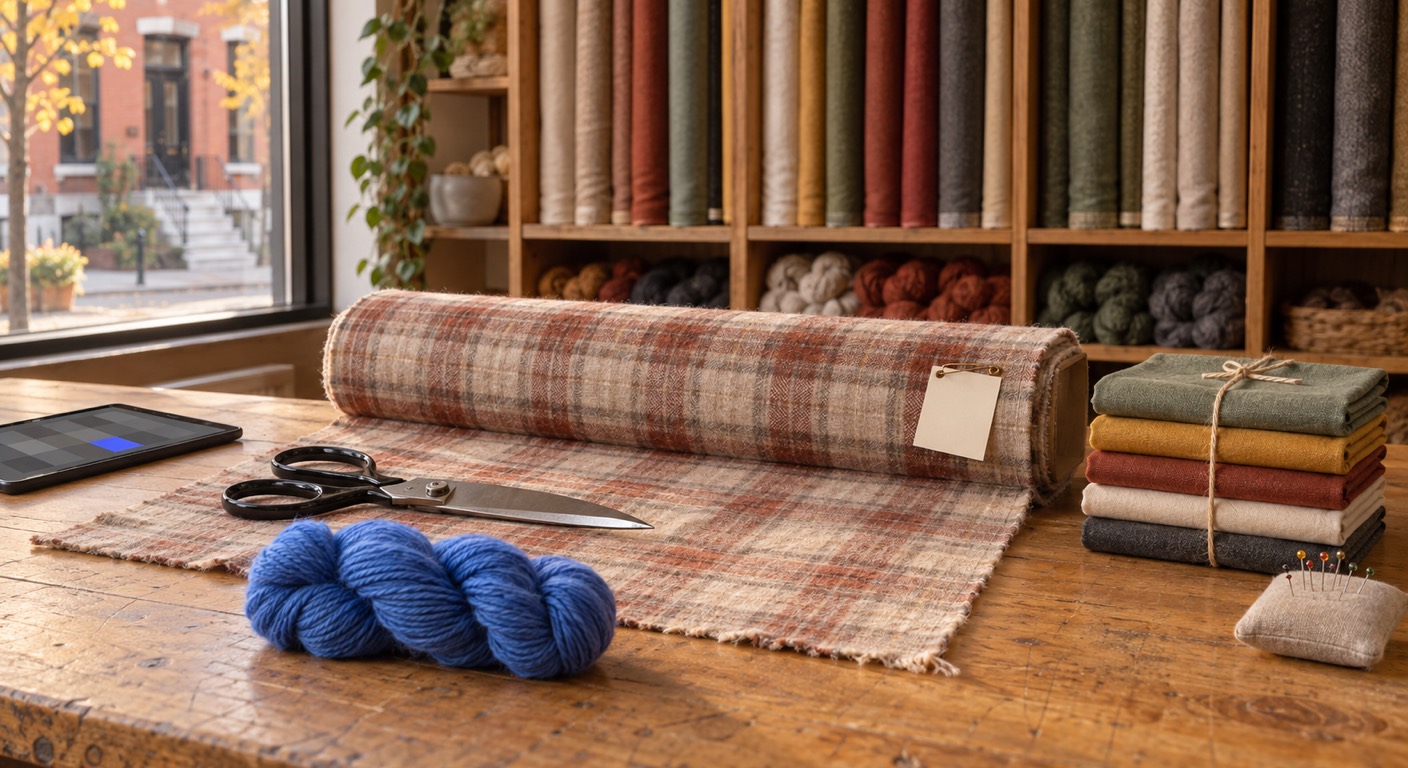
On a Saturday morning in October, a quilt and fabric shop in Baltimore County does four ordinary things before lunch. It ships two and a half yards of fox-print cotton flannel that a customer ordered at midnight from a web store collection the shop named “Cozy Kids’ PJ Flannel” three winters ago. It cuts a yard and three-eighths of a batik for a quilter finishing a binding, a length its web store cannot sell because the store sells only in half yards. It pulls six skeins of a hand-dyed worsted from the back for a knitter who will collect them on Tuesday and who wants them to match. And in the back room, the long-arm machine quilts a customer’s own quilt top, for which the shop charges by the square inch. All of it is routine, and each sale rests on a fact the shop’s software almost certainly does not hold.
The flannel is the sharpest of the four. In federal law, fabric becomes a children’s sleepwear item when it is “promoted” for children’s sleepwear, and untreated cotton flannel is precisely the kind of fabric that cannot meet the sleepwear standard. The collection name is the promotion. The batik is a measurement problem: the length is real, but the cart can only count whole units. The skeins are a dye-lot problem that no statute covers and every knitter enforces. The quilting is a Maryland tax question with a specific answer.
This article goes through those questions for the fabric stores, quilt shops, yarn shops and sewing-machine dealers of Baltimore: the federal rules that read a product page as if it were a label, the Maryland rules that decide what is taxable and what may be agreed about prices, what the software costs, what 25 Baltimore businesses and 66,303 listings on 70 fabric and yarn web stores actually show, what changes for a web store and the AI shopping agents that now read it, and what we would build. We are a software studio, not lawyers; where a rule is our reading of the text rather than an agency’s statement, we say so.
The trade in Baltimore: Joann left, and the shops that stayed
The Census Bureau counts fabric, quilt and yarn shops together as sewing, needlework and piece goods stores, and in Baltimore City the count is almost too small to publish. County Business Patterns does not publish a cell with fewer than three establishments, and there is no 2023 row for this industry in the city. There is, however, a row for the wider group it belongs to, sporting goods, hobby, sewing and musical instrument stores: 19 employer establishments, of which 10 are sporting goods stores and 5 sell musical instruments. That leaves four for the two unpublished industries, hobby shops and sewing stores, and since neither can have more than two without being published, each has exactly two. Baltimore City had two employer fabric and sewing stores in 2023. Baltimore County had eight, with 146 employees; Anne Arundel had seven and Howard four.
Most of the trade does not have employees at all. The Census’s nonemployer statistics for 2024 count 43 one-person sewing and needlework businesses in Baltimore City, with $441,000 of receipts between them, about $10,256 each, and 56 in Baltimore County averaging $48,375. Nationally there are 32,980 of them against 3,602 employer stores, and 56% take in less than $10,000 a year. These are the hand-dyers, pattern designers, long-arm quilters and weekend market sellers who make up most of the trade’s businesses and a small share of its money. The employer stores are not rich either: Maryland’s 48 paid $15,604 per employee in 2023 and the national average was $16,409, about $10,800 below the wider sporting goods and hobby group, which is what a mostly part-time staff looks like on a payroll report. Between 2019 and 2023, Maryland lost 9 of its 57 employer stores, a fall of 15.8%, while the national count fell 6.3%.
| Area | Employer stores | Employees | One-person businesses | Their average receipts |
|---|---|---|---|---|
| Baltimore City | 2 (derived) | not published | 43 | $10,256 |
| Baltimore County | 8 | 146 | 56 | $48,375 |
| Anne Arundel County | 7 | 78 | 45 | $19,844 |
| Howard County | 4 | 63 | 20 | $13,550 |
| Maryland | 48 | 669 | 510 | $24,198 |
| United States | 3,602 | 34,437 | 32,980 | $23,600 |
All of those numbers predate the largest event in the trade’s recent history. Joann filed for bankruptcy on 15 January 2025 with about 800 stores in 49 states and about 19,000 employees, and closed every store by the end of May. Its roughly 800 stores were equal to more than a fifth of the 3,602 employer stores the Census counted in this industry. In Maryland, Joann’s store directory listed 15 towns in September 2024 and 14 in February 2025, after the Owings Mills store closed; the chain then announced it would close every Maryland store but Annapolis, and in the end closed that one too. Parkville, on Joppa Road, was the last Joann in Baltimore County, and Baltimore City had none. Michaels bought the Joann name and private-label brands in June 2025, joann.com now redirects to michaels.com, and by September 2025 Michaels was describing itself as “North America’s largest specialty fabric and party retailer,” with fabric in more than 840 stores. The question people type into Google, autocomplete shows, is “where to buy fabric now that Joann is closed.” Part of the answer is the independent shops in this article, and the other part is whoever shows up first in the search results.
The customers say they would rather buy locally. In Handi Quilter’s 2025 survey of more than 30,000 quilters, which put the American quilting market at $4.5 billion, 64% said they prefer to buy quilting supplies at a local shop and 13% online; for fabric and thread the split was 51% and 22%. The 2026 edition put the average quilter’s age at 67 and found that shop hours of ten to five shut out working customers and that younger shoppers expect contactless payment and a fast checkout. Yarn is further along: the 2025 consumer survey run by Berroco and Local Crafts Group found that online spending “consistently exceeds in-person spending in most categories,” and the 2026 survey that “Ravelry dominates across all age groups.” The trade lost its own wholesale fair in the same period: Quilts, Inc. discontinued International Quilt Market in December 2025, after 46 years, saying that “business models and practices have changed.”
Baltimore has a longer history with this business than most cities. The Baltimore Album quilts of the 1840s are among the best-known American quilts, and the Metropolitan Museum of Art credits one woman, Mary Simon, with a kit business: she “is thought to have composed and basted quilt squares as kits, which she sold to Baltimore quilt makers between 1846 and 1854.” Precuts and kits, in other words, are a Baltimore product with 180 years of history. The region’s largest fiber event is not in the city but at the Howard County Fairgrounds, where the Maryland Sheep & Wool Festival held its 53rd edition in 2026, with a juried vendor list and a waiting list behind it.
What the software costs, and what the meter counts
A fabric or yarn shop has three kinds of software bill: a register, a web store and whatever marketplaces it sells through. The prices below are from each vendor’s own page on 1 October 2026. Two vendors build specifically for this trade, and they turn out to be one company: Like Sew, which sells point of sale and websites to quilt, fabric and sewing shops, and Rain POS, whose “Quilt and Fabric Store POS” page advertises “tracking fabric by the yard,” share a pricing page and a parent, Rain Retail Software. Like Sew’s 2023 press release claims more than 2,000 customers. The useful thing to compare is not the monthly price but what each bill is counting.
| Product | Published price | What the meter counts |
|---|---|---|
| Like Sew / Rain POS | Startup from $99 a month billed annually; Core and Plus by quote | The plan tier. Classes, kit assembly, precuts and vendor purchasing are listed in Core; serialized inventory, work orders and Shopify integration in Plus |
| Square | Free $0, Plus $49, Premium $149 a month per location; 2.6%, 2.5% or 2.4% + 15¢ in person; 3.3% or 2.9% + 30¢ online | Locations, plus a share of every card sale. Converting a bolt into yards (stock conversion) needs Plus or Premium |
| Lightspeed Retail | $89, $149 or $289 a month billed annually; $109, $179 or $339 billed monthly | Plan tier per location; card rate not published |
| Clover Retail | Standard: $1,899 plus $84.95 a month, or $180 a month for 36 months; 2.3% + 10¢ | Hardware bundle, plus a share of every card sale |
| KORONA POS | $59, $79 or $99 per terminal a month | Registers |
| Shopify apps for selling by the yard | $9.99 to $49 a month, plus $5 to $10 per extra location for POS apps | Locations and app tier, on top of the Shopify plan |
| WooCommerce Measurement Price Calculator | $149 a year | One site |
| Etsy | $0.20 a listing, 6.5% of the sale, 3% + 25¢ processing; 15% or 12% more when a sale is credited to an Offsite Ad | Every listing and every order |
| Amazon Handmade | 15% referral fee, minimum 30¢ | Every order |
| eBay | 13.6% + 30¢ or 40¢ per order | Every order |
Shopify’s plan prices were shown to us only in euros from our network, so we have left them out rather than convert them. For yarn shops, Ravelry deserves a separate line: it charges nothing to sell patterns in the shop (“There are no Ravelry fees to shops for this service”) and $5 or $10 a month for directory ads.
Two things follow. The first is that for a register, the subscription is the small number. A shop taking $300,000 a year in card payments at an average ticket of $38 pays Square about $8,684 a year in card fees on the Plus plan and $588 for the plan itself, so 94% of the bill is the percentage. On fees alone, Plus beats the Free plan only above $588,000 of in-person sales a year, where its 0.1-point discount covers the $49 a month. A fabric shop usually pays for Plus anyway, because stock conversion, the feature that turns a bolt into yards, is not on the Free plan. The feature, in other words, costs more than the discount saves.
The second is that marketplaces are a different order of cost. Here is what the shop keeps from a $40 fat-quarter bundle sold through each channel, to a buyer in Delaware, where there is no sales tax to complicate the arithmetic, with shipping built into the price.
| Channel | Fees | Share of sale | Shop keeps |
|---|---|---|---|
| In the shop, Square Free card rate | $1.19 | 3.0% | $38.81 |
| Own web store on Square Online, Plus plan | $1.46 | 3.7% | $38.54 |
| Own web store on Square Online, Free plan | $1.62 | 4.0% | $38.38 |
| Etsy, no Offsite Ad | $4.25 | 10.6% | $35.75 |
| eBay, no store subscription | $5.84 | 14.6% | $34.16 |
| Amazon Handmade | $6.00 | 15.0% | $34.00 |
| Etsy, sale credited to an Offsite Ad (15%) | $10.25 | 25.6% | $29.75 |
A marketplace is not a mistake: it brings customers the shop would never meet, and for a one-person dyer it may be the whole business. But every repeat customer who comes back through a marketplace instead of the shop’s own site costs between about $2.80 and $8.80 on a $40 order, and a shop with a working web store can usually afford to keep the marketplace for discovery and send the second order home.
The part no national platform models: the words on the page are part of the fabric
Every retail platform stores a product the same way: a name, a price, a quantity in stock and a free-text description that the law is assumed not to read. In a fabric shop the law reads it. The federal rules that govern cloth were written for bolts, labels and store aisles, and nearly every one of them now applies to a product page, a category name or a cart. Five of them do most of the work.
Flannel is not for pajamas until the page says it is
The federal flammability standards for children’s sleepwear, 16 CFR Parts 1615 (sizes 0 to 6X) and 1616 (sizes 7 to 14), are usually described as garment rules. Their definition of what they cover is wider than that, and it is one sentence long:
“Item means any product of children’s sleepwear, or any fabric or related material intended or promoted for use in children’s sleepwear.” — 16 CFR 1615.1(d); Part 1616 has the same language
A bolt of fabric can therefore be a regulated sleepwear item before anyone has cut it. The Consumer Product Safety Commission’s enforcement policy, which still sits in the regulation at 1615.64 and 1616.65, says whether a fabric is “intended or promoted” for children’s sleepwear depends on the facts, including “the nature of the fabric and its suitability for use in children’s sleepwear” and “the likelihood that the fabric will be used primarily for children’s sleepwear in a substantial number of cases.” The same policy says retailers who carry fabric that does not meet the standard “have an obligation not to promote or sell such fabric or garment for use as an item of children’s sleepwear,” and gives them three pieces of advice written for store aisles: keep sleepwear apart from look-alikes, use signs that tell them apart, and avoid advertising a non-complying fabric “in a manner that may cause the item to be viewed by the consumer as an item of children’s sleepwear.” For garments, the commission’s current FAQ lists “the manner in which the product is distributed, promoted, and merchandised” among its factors, along with fabric features such as “fiber content, weight, print motifs, softness.”
Now look at what a quilt shop sells most of in October. CPSC says children’s sleepwear garments made from certain untreated fibers “typically fail” the sleepwear test, “including 100% Cotton, 100% Silk, 100% Rayon, and 100% Modal,” and in 1996 it put it more bluntly: 100% cotton fabric “cannot pass the flammability tests in the standards unless treated with a flame retardant.” Soft cotton flannel with a cartoon print is, in other words, the textbook example of a fabric that must not be promoted for children’s pajamas. On a shop floor the defense is a sign and a sensible aisle. On a web store, the aisle is the category tree, the sign is the collection banner, and the advertising is every title, tag, search synonym and “perfect for cozy PJs” sentence the shop has ever typed. A collection called “Kids’ Pajama Flannel” is the online version of the aisle that cost Nordstrom $150,000 in 1999, when CPSC staff found cotton terry robes “displayed for sale in the children’s sleepwear section of the store.” Robes count, by the way, and so does anything a children’s brand calls loungewear: CPSC staff treat both as sleepwear.
The familiar line on the bolt end, “not intended for children’s sleepwear,” is not a federal labeling requirement as far as we can find in Parts 1608, 1610, 1615 or 1616. It reads as the mill’s way of doing what the policy describes, a manufacturer that has “indicated by label, invoice, or, otherwise” that a fabric is not suitable for sleepwear, and its practical effect is to put the retailer on notice. A shop that receives a bolt with that line and then tags the same fabric “pajamas” online has written down, in its own catalog, both halves of the problem. That is our reading of the text rather than anything CPSC has said about bolt labels, and we found no case in which the commission went after a fabric shop for yardage. The enforcement lands one step later, on the garment: we counted 30 CPSC recalls of children’s sleepwear for flammability between January 2025 and September 2026, about 370,000 units, every one a finished garment and 29 of the 30 sold online, Amazon named in six of them and SHEIN in three. That is the market any home sewer who opens an online shop walks into.
The nap, not the fiber, decides whether the fabric needs a test
For fabric meant for adult clothing, the governing rule is 16 CFR Part 1610, and it explicitly covers cloth that is not yet a garment: it applies to textile fabric “in a form or state ready for use in an article of wearing apparel.” Most quilt-shop cotton never needs to be tested under it, because 1610.1(d) exempts two groups from testing: “plain surface fabrics, regardless of fiber content, weighing 2.6 ounces per square yard or more,” and all fabrics “made entirely from” acrylic, modacrylic, nylon, olefin, polyester or wool, at any weight and with any surface.
The line that matters is the word “plain.” A raised-surface fabric, in the rule’s definition, has “an intentionally raised fiber or yarn surface, such as a pile, including flocked pile, nap, or tufting,” and CPSC’s own FAQ lists the common ones: “terry cloth, fleece, corduroy, and flannel.” Put the two clauses together and two cottons on the same shelf have different legal status. A four-ounce quilting cotton is exempt from testing because it is plain and heavier than 2.6 ounces per square yard, which is 88.2 grams per square meter. A brushed cotton flannel is not, because the weight exemption covers only plain fabrics and cotton is not on the fiber list. A 100% polyester minky is exempt at any weight. A featherweight cotton lawn or rayon voile under 88.2 grams per square meter loses the weight exemption whatever it is made of. Exempt here means exempt from testing, not from the standard; a Class 3 fabric, the rule says, is “dangerously flammable and shall not be used for clothing.”
None of the platforms a fabric shop is likely to use has a field for surface type, and few shops record weight at all. Yet those two values, with fiber content, are the inputs to the one question the rule asks. The regulation even prints its own list of trouble: the fabrics CPSC found failing in the 1990s were sheer rayon and silk, rayon chenille, cotton fleece and sherpa, and cotton terry, which reads like the apparel aisle of any modern fabric store.
The supplier’s guaranty is a record, and it expires
The Flammable Fabrics Act makes not only the sale but “the offering for sale” of a non-conforming fabric unlawful (15 U.S.C. 1192), so a published product page is already inside the Act. A retailer’s protection is a guaranty from the supplier: under 15 U.S.C. 1197, a seller cannot be prosecuted if it can show a guaranty “received in good faith,” signed and carrying the name and address of the firm it came from. Three details turn this from a filing-cabinet matter into a data problem. The guaranty is no defense against a cease-and-desist order, an injunction or a seizure (16 CFR 1610.37). A guaranty from a firm outside the United States “may not be relied upon as a bar to prosecution” (16 CFR 1608.4), which matters to a shop that buys directly from a Japanese or European mill. And CPSC’s guidance says fabric that is printed, dyed or finished after it was guarantied “will generally be considered a new or different textile fabric,” so a shop that overdyes, hand-dyes or digitally prints its own cloth has become the guarantor. Continuing guaranties filed with CPSC must be renewed every three years.
That is a vendor field, an expiry date and a flag on every SKU that came from abroad or went through the shop’s own dye pot. When CPSC estimated the paperwork burden of these rules in a notice published on 28 September 2026, it modeled the typical firm as keeping records for ten fabrics. A quilt shop has a thousand bolts.
A yard is a measurement, and a fat quarter is a package
The Textile Act has a convenient rule for cutting tables: fabric “severed from bolts, pieces, or rolls of fabric labeled in accordance with” the Act needs no label of its own when it is sold (15 U.S.C. 70b(f)). The relief disappears if the cut piece is represented as having a different fiber content from the labeled bolt, and since an online listing counts as an advertisement that must name every fiber in order of weight (16 CFR 303.40 and 303.42), the bolt record is the legal record. A cut sold online should inherit its fiber content from the bolt it came from, not from whatever someone typed into the description. Care instructions belong on the end of each bolt for the same reason (16 CFR 423.7).
The measuring is regulated too, through state weights-and-measures law. Maryland adopts NIST Handbook 44 automatically, “as amended” (Agriculture Article §11-203(c)), and the handbook’s code for linear measures applies to any measure of length, “flexible or inflexible, permanently installed or portable.” It says “a flexible tape shall be made of metal,” so the cloth tape measure on many cutting counters is not a legal commercial measure, and a wooden yardstick needs ends protected by brass or an equally hard metal. Maryland also requires that a customer be able to see the measuring done (§11-208(d)(7)). Automatic fabric-measuring machines have their own code, which indicates length in steps as small as an eighth of a yard, the natural resolution for a web store’s quantity selector too.
Precuts are a different legal object. A fat quarter, a charm pack or a jelly roll cut and bagged before the sale is a “package” under the packaging regulation Maryland adopts from NIST Handbook 130 (COMAR 15.03.02.01, 2022 edition), and a package of pieces is declared by count plus the size of each piece, in both metric and US units: a charm pack is something like “42 squares, 5 in × 5 in (12.7 cm × 12.7 cm),” and a bag of mixed remnants must say “irregular dimensions” and give the minimum size. A remnant priced at a total, “1.37 yd, $16.44,” must also show the price per yard (§11-305(c)). And textiles are the one category where the national package-checking handbook, NIST Handbook 133, which Maryland also adopts, caps generosity as well as shortfall: for pieces under 24 inches, the tolerance is 6% short and 12% over, which by our arithmetic puts a five-inch charm square anywhere between about 4.7 and 5.6 inches. Federal packaging law, curiously, does not reach any of this; the FTC’s rules treat textiles and “handicraft and sewing thread” as outside its definition of consumer commodities. The state rules fill the gap.
Yarn: the weight is the legal quantity, and alpaca is legally wool
Knitters shop by yardage, and every ball band prints it. The law asks for something else. Under the same Maryland-adopted packaging regulation, “the net quantity statement for yarns shall be expressed in terms of mass or weight,” while sewing and handicraft thread is declared in meters and yards. Maryland also requires that when a packaged commodity is advertised with a price, the basic quantity be “closely and conspicuously associated with the price statement” (§11-306(b)). On a product page, that means “100 g” next to the price, with the yardage beside it as the information the customer actually wants.
The fiber names are defined by statute as well, and not always as a knitter would expect. Under the Wool Products Labeling Act, “wool” is the fleece of sheep or lamb, or hair of the Angora or Cashmere goat, “and may include the so-called specialty fibers from the hair of the camel, alpaca, llama, and vicuna” (15 U.S.C. 68(b)). Alpaca can legally be called wool; yak, bison, qiviut and angora rabbit cannot, and must be named with the word “hair,” “fiber” or “blend” (16 CFR 303.6). A shop that chooses the specialty name must use it with a percentage and consistently, “at any time reference is made to the specialty fiber” (16 CFR 300.18), so a ball band that says wool and a product title that says baby alpaca do not agree. Cashmere is a measured fiber, not an adjective: since 2007, a product labeled cashmere is misbranded if its average fiber diameter exceeds 19 microns or more than 3% of its fibers by weight exceed 30 microns (15 U.S.C. 68b(a)(6)). And a yarn called “bamboo” is usually rayon made from bamboo, a problem we covered in our clothing boutique post.
The dye lot, meanwhile, is not in any statute. It is the one yarn attribute that only the customer enforces, usually by returning the sweater’s worth of skeins that do not match, and it belongs to the e-commerce half of this article.
Maryland: the long-arm quilting is taxable, and the tax-free week skips the fabric aisle
Maryland taxes goods at 6% and leaves services alone unless the law names them. One of the few services it does name is the one a quilt shop sells most: “fabrication, printing, or production of tangible personal property” by special order (Tax-General Article §11-101(m)). The Comptroller’s regulation on fabrication, COMAR 03.06.01.30, says the tax is charged on the full selling price “even though charges for labor are segregated from the cost of the materials,” and that the rule applies with equal force “where the materials are furnished by the customer and the fabrication consists wholly of labor.” Its own examples could have been written for a sewing shop: a tailor making a suit from the customer’s cloth, and “the making of drapes or slipcovers from materials furnished by the customer.”
A long-arm quilting service takes three pieces of the customer’s cloth, a pieced top, a layer of batting and a backing, and returns one object that did not exist before. By our reading of that regulation, the whole charge is taxable, including the labor priced by the square inch, even though the shop sold the customer nothing but its time. The opposite case is repair. Business Tax Tip #7 says lump-sum charges to repair personal property are exempt, and that restoring used property “to its original condition or usefulness is repair, which is not taxable.” Mending a grandmother’s quilt is a repair; quilting a new top is fabrication. Monogramming is on Business Tax Tip #12’s list of taxable finishing charges, and a sewing-machine service follows the repair rule: a lump-sum repair is not taxed, but a part listed separately on the ticket is. None of this is exotic. It just means a service ticket needs one field the register rarely has, saying whether the work finishes a new item or restores an old one, because that field decides the tax. We are not tax advisers, and a shop with a large long-arm business should ask the Comptroller for a ruling, but we would not build the ticket without the field.
The tax-free week is not for fabric, thread or yarn
Every August, Maryland’s tax-free week exempts clothing and footwear priced at $100 or less, for seven days starting on the second Sunday of the month. The regulation that runs it, COMAR 03.06.01.37, is unusually specific about who is left out. Section C(4) excludes “items used to make or repair clothing or footwear, including fabric, thread, yarn, buttons, snaps, hooks, and zippers.” Alterations stay taxable too, and accessories such as scarves never qualify. A yarn shop that also sells finished knitwear can therefore have three answers on one shelf in the same week: a hand-knit sweater at $95 is exempt, a hand-knit scarf at $40 is taxed as an accessory, and the yarn and pattern for the sweater are taxed as materials. Most registers handle the holiday by category, so the work is to make sure every fabric, yarn, notion and kit sits in a category that never gets the exemption, including the “make your own skirt” kit that looks like clothing on a product page.
The same class is untaxed in the back room and taxable on Zoom
Instruction is not on Maryland’s list of taxable services, so a class taught in the shop is not taxed; when supplies come with a class, the Comptroller’s guidance on in-person continuing-education classes, the closest it comes to a sewing class, is that the provider pays tax on the materials it hands out, and a kit sold separately is taxed like any other goods. Online is different. Since 14 March 2021 Maryland has taxed digital products at 6%, and Business Tax Tip #29 says that, in general, prerecorded or live classes delivered electronically are taxable. The only carve-out is for “instruction in a skill or profession in a buyer’s current or prospective business, occupation, or trade” that is live and interactive. A recorded quilting course is taxable under the plain words of the guidance, and so, by our reading, is a live hobby class on Zoom, because learning to knit socks is rarely anyone’s trade. A downloadable PDF pattern is a digital product too. When a pattern sells through Etsy, Etsy collects the tax as the marketplace facilitator; when it sells on the shop’s own site, the shop does. A shop’s class calendar is therefore not one product type but two, and the web store has to know which one it is selling.
The sewing machine sells under the brand’s rules, and Maryland has a statute about prices
Fabric and machines live under different commercial rules. Fabric companies mostly welcome online sellers: Robert Kaufman lists “full service internet retailers” among its authorized outlets, and Andover sells to retailers “both brick and mortar, and online.” Some yarn companies want a real shop first; Berroco generally requires a retail store “located in a commercial location and operated on a full time basis” for a wholesale account. Sewing-machine brands tie the warranty to the dealer. Janome says it does not sell “directly to the general public via mail order or the Internet” and extends its warranty only to buyers from an authorized dealer. SVP Worldwide, which owns PFAFF, Husqvarna Viking and SINGER, “reserves the right to reject warranty claims for products purchased from unauthorized dealers, including unauthorized internet sites.” Baby Lock sells its machines only through authorized retailers, and BERNINA’s warranty needs a dealer’s countersignature or registration within 30 days. For a dealer, the web store’s job is therefore not just to sell a $2,000 machine but to say, on the page, that the shop is the authorized dealer, who services the machine and how the warranty is registered.
Prices are where Maryland parts company with federal law. In 2007 the Supreme Court ruled in Leegin that agreements fixing a minimum resale price are judged case by case under federal antitrust law. Two years later Maryland answered by statute: under Commercial Law §11-204(b), a “contract, combination, or conspiracy that establishes a minimum price below which a retailer, wholesaler, or distributor may not sell a commodity or service is an unreasonable restraint of trade or commerce.” The statute speaks of the price a retailer may sell at. It says nothing about policies on the price a dealer may advertise, so it is wrong to say that minimum advertised pricing is illegal in Maryland, and we are not lawyers. What it does mean for software is modest and concrete: the advertised price and the selling price should be separate fields, so a dealer can follow a brand’s advertising policy on the product page and still decide what to charge at the counter.
Two local footnotes complete the picture. A dealer in Baltimore City that buys used machines from the public, including trade-ins, is a second-hand dealer under City Code Article 2, Subtitle 12: a $50 annual license, a daily report that includes each machine’s serial number, and a ten-day hold before resale, rules we went through in more detail in our phone repair post. And the region’s biggest fiber event, the Maryland Sheep & Wool Festival at the Howard County Fairgrounds, brings out-of-state dyers who need a 30-day temporary sales and use tax license from the Comptroller and a trader’s license or exhibitor’s affidavit for the show; for a local shop with a booth, it is simply a second location for one weekend, which the register should treat as one.
What 25 Baltimore shops show a customer, or a machine
To see what a customer, a search engine or an AI assistant finds when it looks for fabric or yarn in Baltimore, we built a list of every independent fabric, quilt, yarn, needlework and sewing-machine business we could find in Baltimore City and Baltimore County. The sources were OpenStreetMap, a national quilt-shop directory, the Baltimore Heritage Quilt Guild’s list of local shops, an old CBS Baltimore guide and The Banner’s 2025 article on local alternatives to Joann. That gave 25 businesses, 12 in the city and 13 in the county: fabric and quilt shops, apparel and decorator fabric stores, yarn shops and a Baltimore hand-dyer, needlework shops, sewing-machine dealers, a craft studio and a creative-reuse center. The chains, Michaels and Hobby Lobby among them, are left out. On 2 October we opened every website, read its robots file and checked for a cart.
Fifteen of the 25 have a working website of their own, seven in the city and eight in the county, and 11 of those can take an order through a cart of their own; a twelfth, a craft studio, books its sessions through a scheduling service. The platforms are as varied as the shops: three run on Rain POS and its quilt-shop brand Like Sew, three on Shopify, two on Wix, and one each on Square Online, Squarespace, WordPress with an Ecwid store and Duda; two more are catalogs without a cart, and one is a hand-built catalog with a cart of its own. That one belongs to The Stitching Post in Catonsville, which has sold counted cross-stitch supplies since 1981 and still runs its own online store. The cleverest yardage workaround we saw was at A Fabric Place in Bare Hills, whose Shopify store gives every fabric two menus, whole yards from one to five and then a quarter, half or three-quarters on top, so each fabric is stored as 24 variants with a price for every length. It works, and it is exactly the kind of structure a shop builds when its platform cannot count a yard and a quarter.
The other ten are where a machine gets lost. Three of the web addresses listed for them in directories or in OpenStreetMap now open online-casino or gaming pages, two in Indonesian and one in Vietnamese. One domain is parked, two no longer resolve, two would not load properly for us, and for two we found no website at all. OpenStreetMap, which feeds many maps and assistants, knows 11 of the 25 businesses; five of those entries carry a website, and one of the five now leads to a slot-machine site. We are not naming the shops behind the broken addresses, several of which may simply have closed. The point is that a lapsed domain does not go quiet. Somebody else buys it, and every directory and map that still lists it sends the shop’s customers there.
The AI layer is decided by vendors more than by shops. The three Rain POS and Like Sew sites serve the same robots file, which tells OpenAI’s GPTBot, Anthropic’s ClaudeBot, Amazonbot and ByteDance’s Bytespider to stay out of the entire site; OpenAI’s search crawler, OAI-SearchBot, and PerplexityBot are not named, so they may crawl. None of the three shops wrote that file. In the other direction, seven of the 15 working sites publish an llms.txt, the file meant to tell AI systems what a site is about, and none of the seven was written by the shop either: the three Shopify stores serve an “Agent Instructions” file Shopify generates, Wix wrote two, a WordPress SEO plugin wrote one and the Duda platform one. Whether a Baltimore fabric or yarn shop can be read by an AI shopping assistant today depends mostly on which company built its website.
| Measure | Baltimore City | Baltimore County | Both |
|---|---|---|---|
| Businesses found | 12 | 13 | 25 |
| Working website of their own | 7 | 8 | 15 |
| Can take an order through its own cart | 5 | 6 | 11 |
| Listed web address now serves casino or gaming pages | 2 | 1 | 3 |
| Site blocks GPTBot and ClaudeBot (vendor’s robots file) | 1 | 2 | 3 |
| Publishes an llms.txt (all generated by the platform or a plugin) | 2 | 5 | 7 |
| In OpenStreetMap at all | 7 | 4 | 11 |
What 66,303 listings on 70 fabric and yarn web stores say
Baltimore alone is too small a sample to say what the trade does online, so we also read the public catalogs of 70 web stores across the country on 1 October. Fifty-nine are independent businesses, 23 quilt and fabric shops and 36 yarn shops and hand-dyers, and 11 are large online sellers, which we counted separately. All 70 run on Shopify, whose catalogs can be read in a standard format, and between them they list 66,303 products: 19,255 fabrics sold by length, 11,439 yarns, 2,358 precut bundles, 5,352 patterns, 1,311 classes, events and clubs, and 273 sewing machines. We classified every listing with text rules on its title, type, tags, options and description, so the numbers below are floors; a shop may say more in a photo or on another page. We do not name shops next to a weak result.
Start with the yard. Fifty-nine percent of fabric listings say somewhere what the unit is, a half yard or a yard or a quarter, but only 14% spell out what the quantity box means, in sentences like “a quantity of 1 refers to a 1/2 yard cut.” The rest leave the customer to infer it from the price. Fifty-one listings of 19,255 state a minimum cut. Width is given on 69% and fiber content on 77%, which is respectable, but the fabric’s weight appears as a number on only 12%, although weight is exactly the fact that decides whether a plain fabric needs a flammability test.
The napped fabrics are the sharpest result. We found 1,101 listings for flannel, fleece, minky, cuddle, velvet, corduroy, terry and the like, almost half of them flannel. Not one carries any statement about children’s sleepwear, neither the “not intended for children’s sleepwear” line that people ask Google about after reading it on a bolt, nor anything else. Most napped listings say nothing about children at all, which is the safe kind of silence. But 25 use pajama words, and 66 use pajama words or baby and nursery words, and nearly a third of the napped listings do not state the fiber, so a shopper cannot tell a polyester fleece, which needs no flammability test, from a cotton flannel, which does.
Yarn listings are better at the knitter’s facts than fabric listings are at the sewer’s. Eighty-one percent give the fiber content with percentages, 91% the weight class, from lace to super bulky, 77% the length and 63% the grams, and 57% give all four. Only 4% mention dye lots at all, at 21 of the 46 stores that sell yarn, and in the examples we read the mention was a disclaimer that lots may vary rather than a statement of which lot is on the shelf. Fiber names have the problems the law predicts: 83 yarns name bamboo as a fiber, and 55 of them never use the words rayon, viscose, lyocell or modal anywhere in the listing. Cashmere is named on 804 listings and alpaca on 792.
The rest of the catalog is where shops make their money and the platforms are thinnest. Sixty percent of precut bundles state both the number of pieces and their size, the two facts a package declaration needs. Forty-seven of the 70 stores sell classes or events online, 1,311 listings between them. Fifty of those are clubs and block-of-the-month programs, which are subscriptions in all but name: 24 mention a recurring charge or schedule, 13 give any cancellation or refund terms, and 12 describe recurring charges with no cancellation terms at all. The 273 machine listings sit at ten stores, every one of them shows a price, the median is $1,999, and 12% add “call for price,” “pick-up only” or similar wording, which is how the brands’ dealer rules look from the outside.
The e-commerce half: what a fabric and yarn web store is actually selling
A fabric shop’s web store looks like any other web store, and that is the problem. What it sells is not a quantity of identical items but a length of cloth from a particular bolt, a set of skeins from a particular dye bath, and a seat in a class or a place in a club. Each of those needs a different shape of record than the one the platforms give it.
Sell the cut, not the quantity
Shopify can display a price per yard: its unit-price feature supports yards, and its own help page uses feet and yards in the example. What it cannot do is sell one and a half of them. In Shopify’s storefront API a cart line’s quantity is an integer, and so is every inventory count in its admin API. A shop that wants to sell fabric by the yard has three workarounds, and our census found all three: make the unit smaller, so “quantity 3” means a yard and a half of half-yards; offer every length as its own variant with its own price; or sell a quantity of one and carry the length in a line-item note that the inventory never reads. Point-of-sale apps fill the gap at the counter for $25 to $29 a month, plus a fee for each extra location. ChatGPT’s checkout specification has the same limitation; its item quantity “should be a positive integer greater than 0.”
Square takes the opposite approach. Its item unit types carry decimal precision “up to the hundred-thousandth place,” its order API treats “2.25” plus a unit as a measurement, the unit list includes the imperial yard, and on its Plus and Premium retail plans a bolt received in one unit can be sold in another. Lightspeed’s older S-Series names fabric as the example for unit pricing and then rules out the way fabric is usually listed: “Items with variants cannot be unit priced.” WooCommerce sells a measurement extension for $149 a year whose own demo is “colored fabric by the yard,” and it takes lengths off the stock as lengths.
The point is not that one platform wins. It is that the cut is a different object from the quantity, and the shop has to decide where that object lives. A cut has a bolt, a length, a minimum, an increment and a rule for what happens to the last piece on the bolt. A shop that sells in half-yard units cannot sell the three-eighths of a yard a quilter needs for binding, will sell the same yard twice on a busy Saturday if the counter and the website count differently, and usually discovers the bolt is shorter than the website thinks only when it unrolls it. A fat quarter, meanwhile, is cut from a half-yard and then cut again, so a well-built store takes the yardage off the bolt when the precut is made, not when it is sold.
The dye lot belongs in the cart
A sweater takes five to ten skeins, and they have to come from the same dye bath, because two lots of the same color can differ visibly once knitted side by side. The law does not care, as we said above, but the customer does, and the maker cannot help: Malabrigo, one of the best-known hand-dyed yarn companies, says plainly that it does not “have a record of which yarn store receives a specific dye lot.” Only the shop knows which lots it holds. In our national census, 4% of 11,439 yarn listings mentioned dye lots at all, and the mentions we read were warnings that lots may vary, not a statement of which lot was in stock.
The fix is small and almost nobody has it: the lot is part of the stock record, the cart fills an order of six skeins from one lot or says plainly that it cannot, and a skein held at the counter for a Tuesday pickup is held from the same lot. For hand-dyed yarn, where every lot differs, the photo should be of the lot being sold.
Clubs, classes and block-of-the-month are subscriptions
Quilt shops sell a surprising amount of recurring revenue: block-of-the-month programs that ship a kit every month for a year, fabric clubs, and memberships. Since 1 June 2026, Maryland’s automatic-renewal law, Commercial Law §14-1329, has applied to exactly this kind of plan, alongside the federal Restore Online Shoppers’ Confidence Act; we went through what both require in our bakery and coffee roaster post. In short, the terms and the price after the first term must be shown next to the consent, consent must be recorded, and cancellation must be as easy online as sign-up. Of the 50 club and block-of-the-month listings in our census, 13 mention any cancellation or refund terms. Classes are simpler but have their own shape, with a seat count, a waitlist, a supply list and usually a kit, and they sell better when the supply list is a one-click cart.
What Google, ChatGPT and AI shopping agents can read
Google Merchant Center will show a price per yard if you give it one: unit_pricing_measure accepts inches, feet, yards, centimeters and meters, and it is optional in the United States, though required in the EU, the UK, Australia and New Zealand for products sold by length. Two details trip fabric shops up. Google says that for products with a minimum order quantity the feed price must be “the total price of the minimum purchasable quantity,” so a half-yard minimum means the feed should carry the half-yard price. And on the page itself, Google reads unit pricing from a UnitPriceSpecification with a referenceQuantity, using the UN/CEFACT code YRD for a yard, but if the page also carries a plain offers.price, “Google will use the price provided through the offers.price property and ignore the offers.priceSpecification property.” Most themes print the plain price, so the unit price quietly disappears. Schema.org even has a property for the cutting increment, billingIncrement, though Google does not say it reads it.
ChatGPT’s product feed has no unit-price field at all and no yards: its dimensions field accepts inches, centimeters, feet, meters and millimeters. To ChatGPT, a $14-a-yard cotton is a $14 item. The attributes that help across all of them are the plain ones: material (Google accepts up to three, separated by slashes), pattern, a color that matches the name on the page, and Google’s product_detail, a free-form specification list of up to 100 entries that Google says helps discovery on “AI-driven surfaces, like AI Mode in Google Search.” That is where width, weight, the bolt’s surface, yarn weight, grams and yards per skein belong, and few point-of-sale connectors fill it in. Shopify’s public catalog, which is often the first thing an agent reads, has no field for width or weight at all; in our census both existed only as words in titles and descriptions.
A note for readers in Lithuania
Part of our team works from Lithuania, and the same questions look different under EU law. The European rule on fiber names, Regulation (EU) No 1007/2011, covers yarn and fabric sold by the meter as “textile products,” and it is stricter than the American rule in one respect that matters online. Article 16(1) requires the fiber composition to be visible before purchase, “including in cases where the purchase is made by electronic means,” or in the Lithuanian text, „taip pat ir tais atvejais, kai perkama naudojant elektronines priemones.“ Only the fiber names in the regulation’s Annex I may be used, and neither bamboo nor sugar cane is one of them; what is sold as bamboo yarn is usually viscose, lyocell or modal. For cloth sold by the meter, Article 17(4) lets the composition sit on the roll in a shop. On a web store, the page is the roll.
The unit price is the other difference. Directive 98/6/EC requires a price per kilogram, liter or meter alongside the selling price, and in Lithuania the obligation sits in the Civil Code itself: Article 6.353(2) defines the standard unit price as the final price of „vieno kilogramo, vieno litro, vieno metro“ and so on. A fabric priced per half meter or per ten centimeters therefore also needs its price per meter, and since Google requires unit pricing in the EU for products sold by length, the same field feeds the Shopping listing.
On 1 October we read 42 product pages from seven Lithuanian web stores, three selling fabric by the meter and four selling knitting yarn. All 42 showed the fiber composition with percentages, which is better than any American sample we have taken. But 6 of the 18 fabric pages showed a bare euro price and never used the word meter; the unit existed only in a quantity box that started at 0.5 and stepped by 0.1. None of the 42 pages declared a unit in its structured data, so a search engine or an AI shopping agent reading them learns that a fabric costs €4.50 without learning whether that buys ten centimeters or a meter. None of the 24 yarn pages showed a price per 100 grams, four mentioned dye lots only as a disclaimer that colors may vary, and none said which lot was in stock. One page listed a yarn as 100% sugar cane, and a targeted search found two fabric listings described as 95% bamboo with no mention of viscose. One yarn shop does something we liked: a yarn calculator on every product page that turns a garment and size into a number of balls.
A Lithuanian beginners’ guide on jp.lt this May gave advice every fabric shop will recognize: „paimk 20–30 cm daugiau, nei sako šablonas“ (buy 20 to 30 centimeters more than the pattern says). A store that sells in ten-centimeter steps lets the customer follow it; one that sells in half meters makes the decision for them. Two more EU points for the comparison: the European standard for children’s nightwear flammability, EN 14878, is voluntary rather than a mandatory federal rule as in the United States; and a brand in a selective distribution system cannot stop an authorized dealer from using its own web shop without losing the protection of the vertical block exemption, Regulation (EU) 2022/720, Article 4(e). The EU’s new textile producer-responsibility directive, 2025/1892, requires schemes by 17 April 2028 for clothing and home textiles, but its list does not include yarn or fabric sold by the meter.
What custom actually costs, and when it pays
We price every project at a fixed fee, agreed before we start, and publish the starting points on our pricing page. For a quilt shop, a fabric store or a yarn shop, they map onto the problems in this article like this.
| Package | Fixed price | What it would be for a fabric, quilt or yarn shop |
|---|---|---|
| Prototype Sprint | $3,500 | A one-week working prototype on your own data: last season’s sales, your bolt list and a week of web orders, turned into a bolt-and-cut model you can try at the cutting table before you commit to anything |
| Online Store | from $6,000 | A web store built around the cut: a price per yard, lengths in eighths, the last piece on a bolt sold as a remnant with its real length, dye lots kept together in the cart, block-of-the-month sign-up with Maryland’s cancel button, and one product feed that Google and AI shopping agents can read |
| Custom App or Internal Tool | from $12,000 | A cutting-table and long-arm app: the bolt record and cut ticket, the long-arm quilting queue priced by the square inch and taxed as fabrication, and class rosters with waitlists and supply-list carts |
| Operations System | from $12,000 | One system behind the register, the web store and the marketplaces: bolt and lot inventory, supplier guaranties with their renewal dates, the wording checks, and Maryland’s tax rules for the tax-free week, fabrication and digital patterns |
Most of our projects land between $6,000 and $30,000, and none requires you to drop the register, the card processor or the web store that already works; the demos page shows finished work. In Maryland, the state’s 3% tax on software and IT services applies to a custom build, as we explained in a separate post.
Here is when the store pays for itself, using the $40 order from the pricing section. On its own web store, at a card rate of 2.9% plus 30 cents, which is what Square Online’s Plus plan charges, a $40 order costs the shop $1.46 in fees. On Etsy the same order costs $4.25 without an Offsite Ad and $10.25 with one. The Online Store package at $6,000, plus Maryland’s 3% tax on the build, is $6,180. Moving repeat customers from Etsy to the shop’s own site saves $2.79 an order, so the build pays for itself after about 2,200 orders, roughly $89,000 of sales; if those orders would have come through Offsite Ads, the saving is $8.79 and the build is paid off after about 700 orders, or $28,000. A shop that sells only a few hundred orders a year online should not build. A shop that already ships a few thousand, and whose customers find it on a marketplace first and come back, usually should.
What we would build for a Baltimore fabric, quilt or yarn shop
If a quilt shop, a fabric store or a yarn shop in Baltimore asked us to fix the problems in this article without replacing anything that already works, this is what we would build, roughly in this order.
- A bolt record and a lot record. Every bolt gets its own row: the fabric, the yards left on it, its width, its fiber content, its weight, whether its surface is plain or napped, and the supplier’s guaranty it arrived under. Every yarn delivery gets a lot row: the colorway, the dye lot, the skeins received and the skeins left. Everything else in the shop can stay a product with a price.
- A cut, not a quantity. At the cutting table and in the web store, a sale of fabric is a length taken from a specific bolt. The register and the cart record the length to the eighth of a yard, take it off that bolt, offer the last piece on the bolt as a remnant with its real length, and turn a half yard cut into fat quarters into two new products without losing track of the yardage.
- Wording rules that run before a page goes live. A short list of checks: napped fabric that mentions pajamas, sleepwear or babies must carry the shop’s own sleepwear statement or lose the words; yarn that says “bamboo” must name the fiber the law recognizes; anything that claims cashmere must have the supplier’s statement behind it; fiber content and origin come from the bolt or lot record, not from whoever typed the description.
- A cart that keeps lots together. When a knitter orders six skeins, the store ships six from one lot or says plainly that it cannot, and a hold at the counter reserves the same lot for the same customer.
- Clubs and classes as their own objects. Block-of-the-month programs with their renewal terms, the cancel button Maryland now requires and a shipping schedule; classes with seats, supply lists, waitlists and the kit sale attached, taxed correctly.
- One feed for everyone who reads the catalog. Product pages, Google, ChatGPT’s feed and any AI shopping agent all read the same record: the price per yard and the unit, the width, the fiber, the lot where it matters and real availability by length.
For a shop that already runs Square, Lightspeed or Shopify, most of this sits beside the register rather than replacing it. The register keeps taking cards; the bolt and lot records, the cart and the feed are the part we would own and hand back to you.
Build, buy, or leave it alone
Most Baltimore fabric, quilt and yarn shops should buy their software, and several of the products in this article do their job well. If you run one shop with a cutting table, a classroom and a small web store, a general point-of-sale system or a trade system like Like Sew will take cards faster and more cheaply than anything we could build for you. Keep it. Before the winter flannel season, do a few things by hand. Read your collection names, tags and search synonyms for pajama and baby words on napped fabric, and either remove them or add your own plain sleepwear statement. Put the fabric weight on the pages of everything thin or brushed. Write on every fabric page what one unit in the cart means. Put grams next to the price on every yarn page. Move fabric, yarn and notions into a category your register will never exempt in August. And ask the Comptroller about your long-arm work if it is a large part of your business.
If you sell a few thousand orders a year online, run block-of-the-month clubs, or sell the same bolts at the counter, on your site and on a marketplace, the question is different. Your problem is not the register but the record: which bolt, how many yards left on it, which dye lot, which supplier guaranty and which subscriber. Do not migrate everything. Add the bolt and lot records and the cart rules around the systems you have, and replace the web store only when its workarounds, the half-yard units, the line-item notes, the twenty-four variants per fabric, cost you more in mis-cuts, oversold bolts and returned skeins than owning the store would.
Leave alone what is cheap and works: the card processor you have negotiated with, the sewing-machine brands’ dealer portals, the long-arm machine’s own software, your accounting package and the marketplace accounts that find you new customers. Build the few things nobody sells in this trade: the cut that comes off a specific bolt, the lot that stays together in a cart, the wording check that reads a product page the way a regulator would, and the feed that tells Google and every AI agent what a yard of your fabric actually is. If you are not sure which of those is costing you money, a one-week prototype on last season’s cuts, web orders and yarn returns is the cheapest way to find out.
Questions fabric, quilt and yarn shop owners ask us
Why does fabric say “not intended for children’s sleepwear”?
Because fabric “intended or promoted for use in children’s sleepwear” is itself covered by the federal sleepwear flammability standards, 16 CFR Parts 1615 and 1616, and most untreated cotton, flannel included, cannot pass them. As far as we can find, the line on the bolt is not a federal labeling requirement; it is the mill telling the retailer the fabric is not suitable for sleepwear. A shop that then promotes the same fabric for children’s pajamas, in a title, a tag or a collection name, is doing what CPSC’s enforcement policy tells retailers not to do.
Can a fabric shop sell cotton flannel for kids’ pajamas?
It can sell flannel, but it should not promote it for children’s sleepwear unless the fabric meets the sleepwear standards, which CPSC says untreated 100% cotton typically fails. Keep pajama and sleepwear words out of napped-fabric titles, tags and collections, or add a plain statement that the fabric is not intended for children’s sleepwear. The standards’ exemptions for tight-fitting garments and for infant garments sized nine months and under are properties of a finished garment, not of a bolt of cloth, and CPSC staff treat children’s loungewear and robes as sleepwear too.
Does quilting cotton need flammability testing?
Usually not. Under 16 CFR 1610.1(d), plain-surface fabrics weighing 2.6 ounces per square yard (about 88.2 grams per square meter) or more are exempt from testing whatever their fiber, and fabrics made entirely of acrylic, modacrylic, nylon, olefin, polyester or wool are exempt at any weight. Standard quilting cotton is plain and heavier than that. Napped cotton such as flannel, and very light cottons and rayons, do not get the weight exemption. Exempt means exempt from testing, not from the standard itself.
What is the best POS system for a quilt shop or fabric store?
There is no single best one; it depends on how much you sell online and how you sell yardage. Like Sew, from the company behind Rain POS, is built for quilt and fabric shops and starts at $99 a month billed annually. Square’s retail plans cost $0, $49 or $149 a month per location and handle decimal yards, though converting a bolt into yards needs Plus or Premium. For most shops the card fees cost far more than the subscription, about 94% of the bill for a shop taking $300,000 a year on Square Plus, so choose on how the system handles a cut from a bolt, dye lots, classes and the web store, not on the monthly price.
How do you sell fabric by the yard online?
Decide where the length lives. Either sell in a small unit, usually a half or a quarter yard, and say on every page what one unit in the cart means, or use a platform or add-on that accepts lengths, such as Square’s decimal quantities or WooCommerce’s Measurement Price Calculator at $149 a year. Show the price per yard, the width, the fiber content and the weight, and state your minimum cut and whether several units are cut as one continuous piece. In our census of 19,255 fabric listings, only 14% explained what one unit in the cart meant.
Can Shopify sell half yards or fractional quantities?
Not as fractions. Shopify can display a price per yard through its unit-price feature, but cart quantities and inventory counts are whole numbers. Shops work around it by selling in half-yard or quarter-yard units, by offering each length as a variant, or by paying for an app; at the counter, point-of-sale apps for fractional sales cost about $25 to $29 a month. ChatGPT’s checkout specification also expects a whole-number quantity.
Is long-arm quilting taxable in Maryland?
By our reading, yes. Maryland taxes the fabrication of goods by special order, and COMAR 03.06.01.30 applies the tax to the full charge even when the customer supplies all the materials, naming drapes and slipcovers made from the customer’s cloth as examples. Quilting a customer’s top, batting and backing together creates a new item. Repairing an old quilt is a repair, which is not taxed when it is charged as a lump sum. If long-arm work is a large part of your business, ask the Comptroller for a ruling.
Is fabric tax-free during Maryland’s tax-free week?
No. The tax-free week in August exempts clothing and footwear priced at $100 or less, but COMAR 03.06.01.37 excludes items used to make or repair clothing, “including fabric, thread, yarn, buttons, snaps, hooks, and zippers,” along with alterations and accessories such as scarves.
Are online sewing classes and PDF patterns taxable in Maryland?
Generally yes. Maryland has taxed digital products at 6% since March 2021, and a downloadable pattern is one. The Comptroller’s guidance says classes delivered electronically, recorded or live, are in general taxable, unless they are live, interactive instruction in a skill for the buyer’s business, occupation or trade, which a hobby class rarely is. An in-person class is not taxed, though a kit sold with it is.
Why do yarn dye lots matter, and can an online store keep them together?
Skeins dyed in different batches can differ visibly once knitted side by side, so a sweater’s worth of yarn should come from one lot. The maker often cannot help: Malabrigo says it has no record of which store receives which lot. A web store can keep lots together if it tracks the lot as part of its stock and fills an order from one lot or tells the customer it cannot. In our census, only 4% of 11,439 yarn listings mentioned dye lots at all.
Can alpaca be called wool, and can yarn be called bamboo?
Alpaca, yes: the Wool Products Labeling Act says wool may include the specialty fibers from the hair of the camel, alpaca, llama and vicuna, and a shop may use the specialty name instead, with its percentage. Bamboo, usually not on its own: most bamboo yarn is rayon made from bamboo and should be named that way. In our census, 55 yarn listings named bamboo without the word rayon, viscose, lyocell or modal anywhere in the listing.
Where can I buy fabric and yarn in Baltimore now that Joann is closed?
Joann closed every store in 2025, including Parkville, the last one in Baltimore County, and Michaels now sells fabric under the Joann name. Independent shops with their own web stores include Domesticity in Hamilton, Happy Hour Fabric at Meadow Mill, Sew Chic at Open Works and A Fabric Place in Bare Hills for fabric; Lovelyarns in Hampden, Cloverhill in Catonsville and Black Sheep in Timonium for yarn; and The Stitching Post in Catonsville and Needlecraft Corner in Parkville for needlework. The Baltimore Heritage Quilt Guild keeps a longer list of quilt shops across the region.
Can a sewing machine dealer sell machines online?
Usually, but on the brand’s terms. Janome says it does not sell directly to the public by mail order or the Internet and extends its warranty only to buyers from an authorized dealer; SVP Worldwide, which owns PFAFF, Husqvarna Viking and SINGER, may reject warranty claims for machines bought from unauthorized internet sites; and BERNINA’s warranty needs a dealer’s countersignature or registration within 30 days. In Maryland, Commercial Law §11-204(b) treats agreements that set a minimum resale price as an unreasonable restraint of trade, though it says nothing about advertised-price policies.