
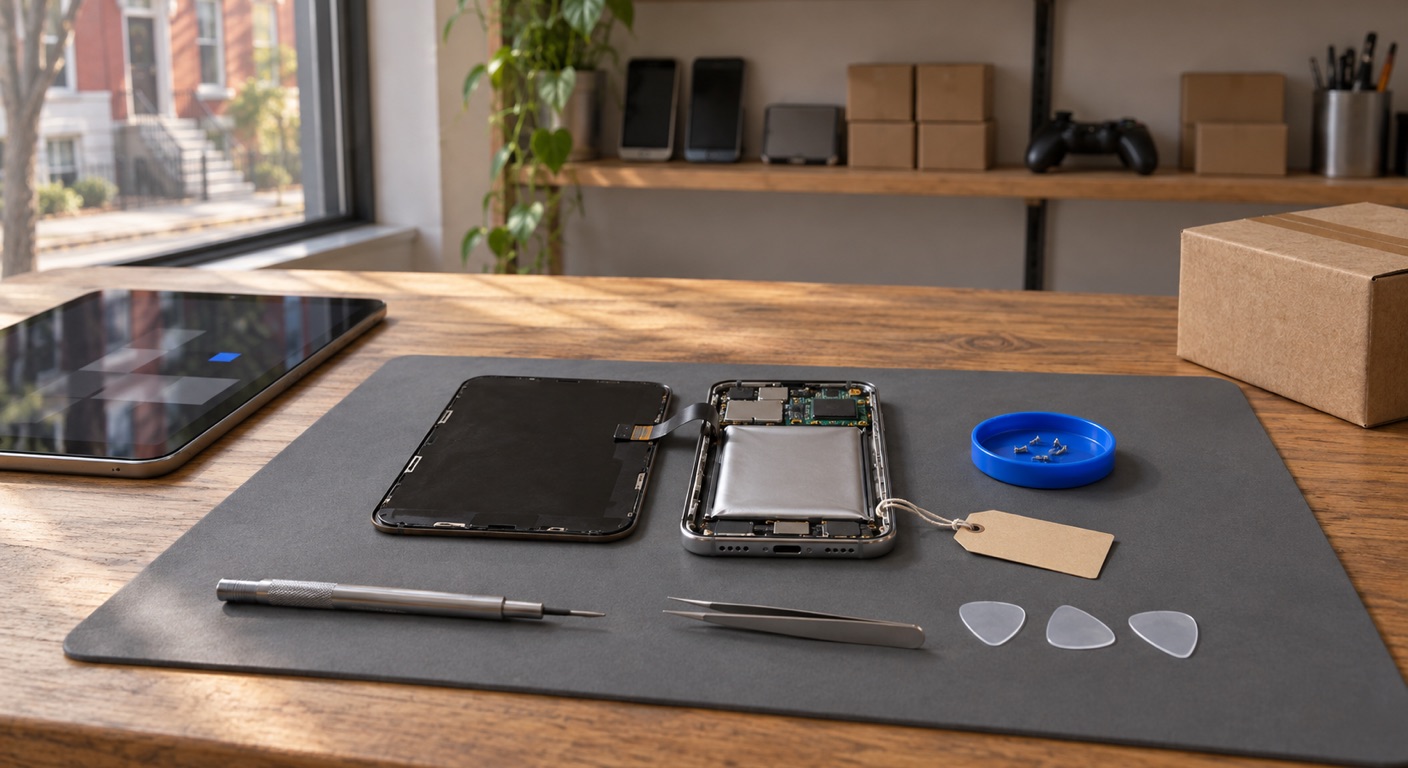
A student in Charles Village buys a refurbished iPhone 13 from a repair shop’s website for $299. The listing says “Grade A, unlocked, fully tested,” with a photo of the model and a line about a 30-day warranty. At home, the new owner opens Settings, then General, then About, and finds a section the listing never mentioned: Parts and Service History, with the display marked “Unknown Part.” Nothing on the page was false, exactly. The screen works. But the phone knew something about itself that the shop also knew, because a technician in the back room replaced that screen, and the one document the buyer saw before paying did not say it.
That gap is most of this article. A repair shop runs on three kinds of record that rarely meet. The repair ticket knows what was done to a phone: the fault, the part, the technician, the price. The phone itself now knows which of its parts were replaced and whether they were genuine, and it tells its owner. And the online store, if the shop has one, knows a model, a storage size, a color and a grade. Maryland law, the city of Baltimore, the Postal Service and the product feeds that Google and ChatGPT read all have something to say about the facts that fall between those records, and almost none of it is modeled by the software small shops use.
The trade is also harder to see than it looks. Phone and computer repair in Baltimore is a business of small counters, mall kiosks and one-person shops, spread between two jurisdictions, and as the next section shows, the federal statistics barely register it. Repairs are sold on trust and by word of mouth, while more and more of the questions customers ask, what does a screen cost, is this shop any good, will it void my warranty, are being answered by software that reads the shop’s website rather than by the shop.
We build custom software for small businesses in Baltimore, so my interest here is practical. I am not a lawyer, and none of this is legal advice: check the rules that apply to your business with the Consumer Protection Division, the city’s licensing office and your accountant. The question I want to answer is the one every repair shop with a website runs into eventually: which of the facts a technician records at the bench does the store need to know before it sells a phone, and what does it cost to make sure it does?
What Baltimore’s repair trade looks like, and why the federal statistics miss it
Start with a small puzzle. By the federal government’s own count, Baltimore City has no phone repair shops. The Census Bureau’s County Business Patterns for 2023, the latest year published, counts eleven businesses with employees in the city whose main line is repairing electronic and precision equipment. Eight of them repair computers and three repair other precision equipment, which leaves nothing at all for consumer electronics or for telephones. Anyone who has walked along Eastern Avenue, through Mondawmin or down York Road knows that is not true, and the census we ran for this article, described below, found seventeen repair storefronts in the city itself, thirteen of them independent.
The shops are real; the classification sends them somewhere else. In the 2017 edition of the North American Industry Classification System, which the 2023 figures still use, a business that fixes phones without selling new ones belongs in 811213, whose index entry is “telephone equipment repair and maintenance services without retailing new telephone equipment.” A computer repair shop is 811212. The moment the same counter sells cases, chargers and screen protectors as its main line, it becomes a “cellular telephone accessories store” in retail, NAICS 443142. If it mostly activates prepaid lines, it is a telecommunications agent. And the 2022 edition of the index, which the Census Bureau’s newer products use, lists “Smartphones (new and rebuilt) manufacturing,” so a refurbisher that rebuilds phones for resale can, on paper, be a factory. One storefront that fixes screens, sells cases, sets up prepaid plans and refurbishes trade-ins can land in any of four sectors depending on which line brings in the most money that year.
| Area | Computer repair (811212) | Consumer electronics repair (811211) | Phone and communication equipment repair (811213) | Electronics stores, incl. phone accessory stores (443142) |
|---|---|---|---|---|
| United States | 4,531 | 1,615 | 1,726 | 13,615 |
| Maryland | 76 | 31 | 36 | 224 |
| Baltimore metro area | 31 | 17 | 11 | 108 |
| Baltimore County | 6 | 11 | 5 | 39 |
| Baltimore City | 8 | 0 | 0 | 19 |
The two zeros for Baltimore City are our arithmetic rather than a published cell, and they are exact. The county file lists eleven establishments in the whole electronic and precision repair group (8112) and publishes two rows beneath it, eight in 811212 and three in 811219. Establishment counts are never blurred with statistical noise, so eleven minus eight minus three leaves exactly none for the other two. The city’s nineteen electronics stores are small, thirteen of them with fewer than five employees, and that is where a good share of its phone counters are probably counted. The table also shows the scale of the trade outside the city: Baltimore County has sixteen employer businesses in consumer electronics and phone repair where the city has none.
The rest of the trade has nobody on the payroll. The Census Bureau’s Nonemployer Statistics for 2023, which use the 2022 classification, count 41 one-person or family electronic and precision repair businesses in Baltimore City, with receipts of $1,559,000 between them, about $38,000 each, and 69 in Baltimore County with $1,209,000, about $17,500 each. Maryland has 549, 477 of them sole proprietorships. Put the two files together and in Baltimore City roughly four in five repair businesses of this kind have no employees at all. That is the owner with a heat plate, a microscope and a Square reader, and it is the reason so much of this trade’s software is priced per location and per technician rather than per repair.
The 2022 Economic Census shows why the averages are no help. It uses the merged 2022 code, 811210, which puts phone repair in one bucket with medical imaging equipment, radar, laboratory instruments and scale calibration. It counts fifteen such establishments in Baltimore City, with 180 employees and $28,686,000 in receipts, which is about $1.9 million each (Economic Census 2022, sector 81). That is the profile of a company that services hospital equipment, not a counter on Eastern Avenue. For a trade like this, the only way to know how many shops there are and what they do is to go and look, which is what the census later in this article does.
What phone repair shop software costs, and what the meter counts
The software in this trade comes in three families, and a shop usually pays for at least two. Repair shop systems, such as RepairDesk, RepairShopr, RepairQ, CellSmart and Orderry, are built around the ticket: intake, the technician’s notes, parts used, customer updates and the invoice. General retail systems, such as Square and Lightspeed, sell accessories well and repairs less well. And the channels that sell refurbished phones, eBay, Amazon and Back Market, bring buyers and take a share. We read each vendor’s own pricing page on 27 September 2026 and recorded what it publishes, in US dollars, and what it charges by.
| System | Published price | What the meter counts |
|---|---|---|
| RepairDesk | Essential $79 a store a month billed annually, or $99 billed quarterly; Growth $119 or $149; Advanced by quote; “Payment is upfront” | Stores, with 5 or 8 users |
| RepairShopr | Starter $69.99 a month; Repair Shop $139.99 ($129.99 on the annual plan); Big Chain $149.99 | Tickets and invoices (Starter: 75 a month, 1 user), then users and locations |
| RepairQ (ServiceCentral) | Starter $20 a month plus $5 a user, $5 per 50 tickets and $15 for inventory; Essential $90, Advanced $150, Professional $180 a location | Tickets, users, locations; onboarding $299 or $399 |
| CellSmart POS | Starter $89 a month on one page of its site and $139 on another; Growth $169; Premium $199; repair module $25, used-items module $10 | Screens or logins, text messages at 10¢ to 3¢ each, and a required card-processing agreement whose rate is not published |
| Orderry | $39, $69, $99 or $199 a month | Employees ($6 to $19 each above three), locations, work orders on the cheapest plan |
| Fixably | By quote | Repairs a year (plans for up to 6,000 and 12,000) |
| mHelpDesk | By quote; its pricing address returns a 404 | – |
| Square for Retail | $0, $49 or $149 a month a location | Plan tier, which also sets the card rate |
| Lightspeed Retail (US) | $89, $149 or $289 a month on annual billing ($109, $179, $339 monthly), sold with Lightspeed Payments at 2.6% + 10¢ | Locations; $59 for each extra register |
Sources are the vendors’ own pages: RepairDesk, RepairShopr, RepairQ, CellSmart’s pricing page and build-and-price page, Orderry, Fixably, Square for Retail and Lightspeed. Smaller products publish lower prices: RepairFlow’s web plan costs $39 a month, and a product called Repair Shop charges $45 to $85, metered by the number of computers. Of the ten repair-specific vendors we checked, eight publish at least one price and two sell only by quote, a better record than most trades we have written about. Several addresses had moved: RepairDesk’s pricing page now redirects to a new path, RepairQ’s old site returns a 404 and the product now sits under ServiceCentral, and Fixably’s pricing address redirects to a path named “archived/plans.”
The meters are the interesting part. RepairDesk charges by the store, RepairShopr and RepairQ by the ticket on their cheapest plans, Orderry by the employee, Fixably by repairs a year, and CellSmart by the screen, the text message and, less visibly, the card rate, because every plan requires its processing agreement. For a busy shop the ticket meters stop mattering quickly, since the middle plans are unlimited. What does not stop mattering is the card fee.
The card rate is the real subscription
Here is what the published rates take from typical repair tickets. We used Square because its US card rates are public and tied to its plans; PayPal’s standard online card rate is shown for comparison.
| Ticket | Square Free, in person (2.6% + 15¢) | Square Plus, in person (2.5% + 15¢) | Square Free, online (3.3% + 30¢) | Square Plus, online (2.9% + 30¢) | PayPal card, online (2.99% + 49¢) |
|---|---|---|---|---|---|
| $59 battery | $1.68 | $1.63 | $2.25 | $2.01 | $2.25 |
| $99 charge port | $2.72 | $2.63 | $3.57 | $3.17 | $3.45 |
| $149 screen | $4.02 | $3.88 | $5.22 | $4.62 | $4.95 |
| $249 screen, newer model | $6.62 | $6.38 | $8.52 | $7.52 | $7.94 |
| $449 refurbished phone | $11.82 | $11.38 | $15.12 | $13.32 | $13.92 |
The ticket labels are illustrations, not quotes; the prices Baltimore shops actually publish are in the census below. Now a worked month for a modeled shop: one location, three technicians, 250 repairs paid at the counter at an average of $149, and 30 online orders at an average of $99, about $40,220 of card sales. On Square’s free plan the card fees come to $1,112.10 a month; on Square Plus they come to $1,065.10, which saves $47 a month against a $49 subscription. Add the repair software and the monthly bill is $1,177.10 with RepairQ Starter plus add-ons for two more users, four more blocks of 50 tickets and inventory, $1,193.10 with RepairDesk Essential on Square Plus, and $1,252.09 with RepairShopr’s Repair Shop plan. Between 89% and 95% of every one of those bills is card processing. The difference between the cheapest and the most expensive repair system is $75 a month; the difference a single percentage point of card rate makes on this shop is about $400.
The same arithmetic decides where to sell a refurbished phone. On a $449 phone, eBay’s final value fee of 13.6% plus 40¢ per order comes to $61.46 (eBay); Amazon’s referral fee for consumer electronics, 8%, comes to $35.92 before its $39.99 monthly Professional plan, and it notes that “certain cell phone devices may require approval” (Amazon); on your own store with Square Plus the card fee is $13.32. Back Market, the best-known refurbished marketplace, publishes no commission on its US seller page, and we have not guessed one. The marketplaces earn their share by finding buyers you would not reach. They also attach conditions that look a great deal like the rules in the next section. eBay’s Refurbished program is open only to Top Rated sellers with at least 98% positive feedback and a 30-day free-returns policy, and it attaches a two-year warranty to its “Certified” grade and one year to “Excellent,” “Very Good” and “Good” (eBay Refurbished). Amazon Renewed gives most items a 90-day return period and its Premium tier 365 days (Amazon). Every serious channel for refurbished phones prices in a warranty, a return window and a definition of each grade. Your own store should too, for reasons that go beyond the marketplaces.
The part no national platform models: what Maryland and Baltimore say about a used phone
Repair software is built around the ticket: a device comes in, a technician works on it, a customer pays and takes it home. E-commerce software is built around the product: a model, a price, a few variants for storage and color. A repair shop that sells what it fixes needs a third thing that neither is designed for, which is the individual unit, because almost every rule that applies to a used phone in Maryland attaches to one particular phone rather than to a model. This section goes through those rules in the order a phone meets them: the words on the page, the purchase over the counter, the parts inside and the tax on the invoice.
Maryland’s consumer law already names your riskiest words
Most shops worry about Apple’s rules and forget that Maryland wrote its own list decades ago. The Consumer Protection Act defines unfair, abusive and deceptive trade practices in Commercial Law §13–301, and five of its clauses read as if someone had drafted them after an afternoon on a refurbished-phone website.
Unfair, abusive, or deceptive trade practices include any: … (2) Representation that: … (ii) A merchant has a sponsorship, approval, status, affiliation, or connection which he does not have; (iii) Deteriorated, altered, reconditioned, reclaimed, or secondhand consumer goods are original or new; or (iv) Consumer goods, consumer realty, or consumer services are of a particular standard, quality, grade, style, or model which they are not; (3) Failure to state a material fact if the failure deceives or tends to deceive; … (7) Knowingly false statement that a service, replacement, or repair is neededMd. Code, Commercial Law §13–301
Put a repair shop’s website next to that list. “Apple authorized” or “certified technicians” is a claim about affiliation, clause (2)(ii). “Like new,” “original screen” or “OEM battery” on a phone that has been opened and fitted with replacement parts is a claim about whether reconditioned goods are original, clause (2)(iii). “Grade A” is, word for word, a claim that goods are of a particular grade, clause (2)(iv). A listing that says nothing about a replacement screen when the phone itself will announce it the first time the buyer opens Settings is the kind of silence clause (3) covers. And clause (7) is the one every repair counter should read twice: a knowingly false statement that a repair or replacement is needed. We are not suggesting that Baltimore shops do any of this on purpose. The point is that each of those words is a field somebody typed, and the law treats it as a representation the business made.
The consequences are not trivial. The state can seek civil penalties of up to $10,000 for each violation and up to $25,000 for each repeat (§13–410), a violation is also a misdemeanor (§13–411), and a customer can sue for their loss and ask the court for attorney’s fees (§13–408). For a store that lists forty phones a month, the useful question is not whether it intends to mislead anyone. It is whether the words on each listing come from a record of what was actually done to that phone, or from a template.
A trade-in is a regulated purchase in Baltimore
Most repair shops buy phones as well as fix them: trade-ins against a repair or a new device, broken phones for parts, the occasional laptop or console. In Baltimore City that makes the shop a second-hand personal property dealer under Article 2, Subtitle 12 of the City Code, whose definition covers anyone in the business of buying used property for resale, trade or transfer, including “other moveable personal property,” with exclusions only for vehicles, records, tapes, compact discs and books. We walked through the basics in our post on toy and game stores, which buy used cards and consoles under the same subtitle: a license at $50 a year for each place of business, no purchases from minors, and a hold before resale. For phones, the details of the daily report are what matter.
Section 12–7 requires a report, every day, of each item bought, to the Police Commissioner and to the city’s consumer protection and licensing office. It has to describe the item by “the manufacturer, model number, and year of manufacture, if known, and any soundex number or unique identifying number found on the item” (for a phone, that is the IMEI and the serial number), say whether the item “appears to have been altered by any means,” including “obscuring a serial number or identifying feature,” and record the amount paid. It identifies the seller by name, date of birth and driver’s license number, or by two other forms of identification plus a physical description, and it carries two signatures. The report is filed electronically in the format the Police Commissioner requires before noon on the next business day (§12–8). The item then has to be held for at least ten days after the report (§12–9), eighteen for anything made of precious metal, and the police can extend that hold for up to a year. Every item in the shop has to be labeled so that it can be matched to its purchase record or, for a device in for repair, to its repair invoice (§12–11), and the records have to be kept for three years (Baltimore City Code, Art. 2, §§12–1 to 12–16). A violation is a misdemeanor with a fine of $500 to $1,000.
Read that as a data model and it says something specific. The phone a shop bought on Tuesday cannot appear on its website as for sale until the report has gone in and ten days have passed, it has to carry a label that links it to the Tuesday transaction, and if the police place a hold on it, it has to disappear from the store until the hold is lifted. None of the e-commerce platforms we know of has a field for a police hold. Most repair systems have a trade-in screen, and the question to ask of yours is whether that screen captures every field the city asks for and produces the report, or whether somebody retypes it.
Baltimore also settled a question other cities are still arguing about. The next subtitle of the same article, 12A, bans automated purchasing machines, which it defines as self-service devices that can take possession of property and pay for it “without the physical presence of a human agent”: “no person may purchase or offer to purchase any personal property by means of an automated purchasing machine,” and each transaction is a separate offense. That is the city’s answer to the phone-buying kiosk. ecoATM’s own locator lists 42 kiosks in Maryland, in supermarkets, Walmarts and malls, and has no location page for Baltimore; its pages for Towson, Glen Burnie, Dundalk, Catonsville and eleven other nearby communities send you back to the state list. Inside the city, a phone can be sold for cash to a person or by mail, but not to a machine, which is an advantage for a shop that makes the trade-in quick, and a problem for any website that promises an instant payout.
Maryland has a right-to-repair law, for wheelchairs
The question repair shops ask most often about Maryland law is whether they have a right to buy parts, tools and manuals from the manufacturers. For phones, tablets, computers and game consoles the answer is no. The only right-to-repair statute Maryland has enacted is Chapter 546 of 2025, House Bill 31, which took effect on 1 October 2025 and covers powered wheelchairs. It requires a manufacturer to make documentation, parts, embedded software, firmware and tools available to independent repair providers and owners on terms equivalent to those it gives its authorized providers, and its definition of a tool is worth quoting because it names the thing phone repairers fight about: a tool “includes software or other mechanisms that provide, program, or pair a new part, calibrate functionality, or perform any other function required to return the equipment or part to fully functional condition” (Chapter 546 of 2025, Commercial Law §14–5001). Maryland has written into law that pairing software is a repair tool. It has done so only for wheelchairs.
Bills for consumer electronics came first and went nowhere. A general right-to-repair bill was heard in 2020 without a vote; its successor, House Bill 84 of 2021, received an unfavorable report from the Economic Matters Committee by 21 votes to 2; and Senate Bill 631 of 2022, whose definition of consumer electronic equipment began with “laptops, cell phones, smart watches, and tablets,” received an unfavorable report in Finance and was withdrawn. No consumer electronics bill has been introduced in Annapolis since, according to the General Assembly’s own bill lists for 2023 to 2026. The 2021 hearing is worth reading for the arguments, which have not changed. CTIA, the wireless industry association, told the committee that “the marketplace already provides a wide range of consumer choice for repair.” TechNet wrote that any repair shop could apply to become an authorized repair provider without paying for it. Maryland PIRG put the savings from repair rights at $735 million a year, and the 17-year-old owner of a repair business in Washington, D.C., wrote that it had “had to discard at least a hundred Chromebook motherboards” because a firmware chip on each was paired to the board.
For software, this means parts access is a contract rather than a right. Whatever a Baltimore shop can buy from Apple, Samsung or Google it buys under the manufacturer’s program terms, which can change, and the only record of what it bought, from whom, and on what terms is the one it keeps. A shop that ever wants to show a customer, an insurer or a legislator what pairing costs it needs that record per part.
The phone keeps its own repair record
Here is the fact that changes the most for a shop that sells what it repairs. A current iPhone reports on its own parts. Under Settings, General, About, a section called Parts and Service History lists replaced parts with one of four labels, which Apple explains on a support page updated in July 2026. “Genuine” means the repair used genuine Apple parts and processes. “Unknown” appears in some situations, for example when a part was replaced with a nongenuine one or is not working as expected. “Unverified” means the logic board was replaced in an earlier repair. “Used” means the part was previously installed in another iPhone. Genuine parts are calibrated with data held on Apple’s servers, and without that calibration Face ID or Touch ID stop working for unlocking.
Apple has loosened the rules around this over the last two years. Since the autumn of 2024, genuine parts, new or used, calibrate on the device after they are installed, and Activation Lock now extends to parts, so a screen or battery taken from a phone that was reported lost will not calibrate in another (Apple, April 2024). In May 2025 Apple began selling genuine parts to shops with no direct relationship with it, through distributors such as MobileSentrix in the United States, and said its Self Service Repair store then covered 65 products (Apple, May 2025). Its parts support page, updated on 18 September, says used genuine parts can match new ones for performance and security, but that their quality may vary.
For a store, the consequence is simple and a little uncomfortable. Whatever your listing says about a refurbished iPhone, the phone will tell its new owner, in Apple’s words, what was replaced and whether it was genuine, new or used. A listing that says “Grade A, fully original” for a phone that shows an Unknown display is not a matter of opinion; it is contradicted by the product. The only safe design is for the listing to be generated from the same record the technician filled in at the bench: which parts were replaced, with what, and what Settings will show. Apple’s four labels are, in effect, a condition vocabulary the manufacturer has already published, and it is more precise than “A,” “B” and “C.”
What you may say about the manufacturer’s warranty
Customers ask the same question at every counter: will this void my warranty? Federal law gives a clear answer, and a shop’s ticket and website should give it the same way. The Magnuson-Moss Warranty Act bars a manufacturer from conditioning a warranty on the use of a branded part or service unless it provides that part or service free (15 U.S.C. §2302(c)), and the FTC’s rule gives the example that a warranty saying it is void “if service is performed by anyone other than an authorized ‘ABC’ dealer” is prohibited. The same sentence of the rule preserves the manufacturer’s defense: it may still deny a claim “where the warrantor can demonstrate that the defect or damage was so caused” (16 CFR 700.10(c)). The FTC’s 2021 report to Congress put it in the terms a repair shop needs: the law “forbids a smartphone manufacturer from voiding a warranty when a consumer has a new battery installed at a kiosk at the mall.” In July 2024 it sent warning letters to three computer-hardware makers, ASRock, Zotac and Gigabyte, over “warranty void if removed” stickers (FTC, July 2024).
So the accurate sentence is this: the manufacturer cannot cancel your warranty because we repaired your phone, but it can refuse to cover damage it can show our repair or our part caused. That is exactly why the record matters. If a customer comes back with a denial, the shop that can show which part went in, whose it was and what the phone reported afterward has something to argue with. Keep the sentence honest in the other direction too: unless you are an authorized service provider, do not imply that the manufacturer approves your work, for the reason in §13–301(2)(ii).
One more federal rule sits under all of this. Getting past a software lock to repair a device is lawful under an exemption to the Digital Millennium Copyright Act that covers any device “primarily designed for use by consumers” when circumvention is needed for “diagnosis, maintenance, or repair,” although for game consoles it covers only the optical drive (37 CFR 201.40(b)(15)). The exemptions last three years at a time, and the Copyright Office opened the next round on 9 June 2026 (91 FR 34795); comments on renewals are due on 28 September, the day after this article was published. iFixit’s renewal petition describes the problem in words a shop will recognize: after a new display or battery, a technician may need calibration software “so that the device recognizes the replacement part and accurately reports battery health.”
“Unlocked” is a fact about one phone on one day
The single most common word on a refurbished phone listing has no federal definition, and the rule behind it moved this year. The FCC proposed in 2024 to require every carrier to unlock phones 60 days after activation; that rulemaking is, in the Commission’s words from January, “presently pending.” Verizon, the one carrier that was already bound to a 60-day rule, asked to be released from it, and on 12 January 2026 the FCC granted the waiver until it settles an industry-wide approach. Verizon now follows the wireless industry’s voluntary code, under which postpaid phones are unlocked after the contract or device financing is paid off and prepaid phones “no later than one year after initial activation” (FCC DA 26-43). A trade-in that a shop would once have expected to unlock on its own after two months may now stay locked for a year.
“Unlocked” on a listing is therefore a factual claim about that handset, checked against that IMEI, on the day it was listed. It belongs in the unit record with the date it was checked, next to the result of a stolen-device lookup, and it is a different claim from “works on every carrier”: the FCC itself warns that an unlocked phone may not work fully on another carrier’s network.
Tax: labor, parts and the 3% line
Maryland taxes the parts and not the labor, and the invoice decides which is which. Under COMAR 03.06.01.03, the charge for labor to restore property “to its original condition or usefulness is not subject to tax.” If the invoice states the parts separately, the 6% applies to the parts; if the repair is billed as one lump sum, the customer pays no tax and the shop pays tax when it buys the parts (COMAR 03.06.01.03; the Comptroller’s Business Tax Tip #7 says the same). Refurbished devices, cases and chargers are ordinary taxable goods. And a trade-in does not reduce the tax: the Comptroller’s guidance is that a seller who accepts a trade-in must “charge tax on both the price paid and the value of the trade-in,” which matters online, where a trade-in entered as a discount code lowers the taxable price and one entered as store credit does not.
Then there is the 3% tax on data and IT services that Maryland introduced on 1 July 2025, which we covered in our post on the tech tax. It applies to services described under NAICS 518, 519 and 5415, and the regulation’s list for 5415 includes “computer software installation,” “computer hardware consulting” and “computer disaster recovery” (COMAR 03.06.01.48). Repair, NAICS 811, is not on the list. A computer repair shop’s menu therefore straddles three rates: a screen or board repair is untaxed labor plus 6% on the parts, a software installation or a consulting hour is 3%, and a bundle sold at one price where both rates could apply takes the higher one. The Comptroller’s technical bulletin on the tax does not mention device repair at all, and nothing we found settles where virus removal or an operating-system reinstall falls, so ask your accountant, or the Comptroller, before you set the rate on those lines.
The refurbished phone that cannot fly
The last rule arrives at the shipping step, and it is the one most online stores get wrong without knowing it. USPS Publication 52 defines a “used, damaged, or defective electronic device” as one with lithium batteries that “is not new in original packaging; is not manufacturer-certified new or refurbished; and/or has some form of damage or defect,” and it says such devices “are prohibited from air transportation” (Publication 52, section 349). A phone a shop refurbished itself is not manufacturer-certified, so it is a restricted device: the parcel must be marked “Restricted Electronic Device” and “Surface Transportation Only,” and it cannot go by Priority Mail or Priority Mail Express, which the Postal Service treats as air services. The Postal Service wrote the rule, in June 2022, with exactly this trade in mind: it covers “items sent for repair” and “used items sent pursuant to e-commerce or private sales transactions.”
A swollen or damaged battery is stricter still. The Postal Service prohibits damaged, defective or recalled batteries unless its product classification office approves, and federal hazardous materials rules allow them to travel only “by highway, rail or vessel,” each in its own non-metallic inner packaging inside a box built to the highest packing-group standard and marked “Damaged/defective lithium ion battery” (49 CFR 173.185(f)). For a mail-in repair service, that turns one intake question, “is the battery swollen?”, into a shipping decision the checkout has to make before it prints a label.
What 29 Baltimore repair shops show a customer, or a machine
To see the trade the federal files miss, we built our own list. On 27 September 2026 we pulled every repair-related shop that OpenStreetMap records in Baltimore City and Baltimore County, ran about 55 web searches by trade and neighborhood, from Fells Point and Highlandtown to Towson, Dundalk and Catonsville, checked the franchise locators, and then read each shop’s own website. We counted walk-in storefronts that repair phones, tablets, computers or game consoles, and kept franchises and big-box counters apart. The result is 29 independent repair storefronts, thirteen in the city and sixteen in the county, alongside 13 franchise locations (four uBreakiFix by Asurion stores, three Cellairis, two Cellaxs, two Batteries Plus, one CPR and one The Fix) and six big-box counters. It is a floor rather than a registry: repair counters inside phone and convenience stores are almost certainly undercounted.
The first finding is about being found at all. OpenStreetMap, the open map that many apps and some AI tools draw on, knew about only 11 of the 29 independents, and only four of those entries carry a website. We found the other 18 only through web searches. The map is also slow to forget. iPhoneAid, on Light Street in Federal Hill, closed on 1 February 2020 after almost ten years, and its owner blamed Apple for “programming components to the logicboard,” the pairing problem described above. Six and a half years later it is still on the map as an open phone shop.
The second is about prices. Only 6 of the 29 storefronts publish a price for a specific repair, so for 23 of them a customer, or an AI assistant asked what an iPhone screen costs on the east side, has nothing to quote. The prices that are published are modest: three shops list an iPhone 13 screen replacement, parts and labor included, at $89 with an aftermarket screen, at $104.99, and at $109 to $129. For comparison, iFixit sells an aftermarket screen kit for the newer iPhone 15, parts and tools only, for $89.99. One shop’s price list stops at the iPhone 8, a phone from 2017, and another’s machine-readable catalog, the most detailed in the census, lists an iPhone 14 Pro Max screen replacement at $14.99, almost certainly a typing error that any software reading the catalog would repeat as a fact.
The third is about software, and it surprised us. Not one of the 18 independent websites we could read embeds a booking or quote tool from RepairDesk, RepairShopr, RepairQ, CellSmart, Orderry, Fixably or mHelpDesk. The six that take bookings online use general-purpose WordPress booking plugins, or in one case an online store that sells each repair as a product; one computer shop uses a quote form from a smaller vendor, MyRepairApp. Shops may well run repair software at the counter, and many probably do, but from the outside it leaves no trace: the ticket system and the website are separate worlds. Eleven of the 18 sites run on WordPress and none on Shopify. Only four storefronts describe themselves as a local business in structured data a machine can read reliably, and a fifth tells search engines, in its markup, that it is a sports organization. Three mention buying or trading in devices; three state a repair warranty with a length, in each case 30 days; one explains how it wipes customer data; one publishes an llms.txt file for AI crawlers; and none blocks them.
The franchises are easier to find and, for a machine, sometimes harder to read. All four uBreakiFix location pages returned “403 Forbidden” to an ordinary non-browser request, and the Batteries Plus pages answered with a Cloudflare challenge. A person in a browser sees those pages normally; a crawler that does not run a full browser, which describes many of the fetchers behind AI answers, sees nothing. For a small shop that is an opening. The independent that publishes its prices, its warranty and its hours in plain text on a page any client can read is, for that kind of software, easier to recommend than a national brand that blocks it.
What 2,498 refurbished phone listings tell the buyer
Baltimore’s shops barely sell devices online, so to see what an independent store’s listing for a used phone usually says we had to look further afield. We found 18 independent US online stores that sell used and refurbished phones on Shopify, eight of them local repair or phone shops and ten online refurbishers, and read the public product feed of each on 27 September 2026, 2,498 phone listings in all. We then tested every listing for the facts a buyer of a used phone needs and the phone itself records, using simple keyword rules that we checked by hand on random samples.
The listings are thorough about the network and silent about the phone. Ninety-seven percent say something about the carrier, either a named network or “unlocked,” 75% give the phone a condition grade, and 47% use the word “unlocked.” But only 7.8% say what their grade means, only 12.9% say how long their warranty lasts, and only 2.4%, sixty listings in seven stores, give a battery health figure, although every recent iPhone shows its battery’s maximum capacity in Settings. And not one of the 2,498 says in words whether the screen, the battery or any other part is genuine, original or aftermarket, or mentions the Parts and Service History screen that the phone fills in for itself. The only parts information anywhere is a variant picker at one large refurbisher that lets the buyer choose between an original and a new battery, on 985 listings. None of the listings states that the IMEI is clean.
Some of what is missing from the listings turns up elsewhere on the same stores. When we read each store’s refund policy and any page about grading, warranty or quality, 14 of the 18 stores published a return window somewhere and 12 a warranty length, against one and seven in the listings themselves; 11 explained their grades somewhere and 9 gave a battery figure somewhere. One store states its warranty as six months on one page and a year on another. But whether the parts are genuine, what the phone’s parts history shows and whether Face ID works appear nowhere on any of the 18 stores we checked, in listings or on policy pages.
A typical listing carries two of the eleven buyer-facing facts we looked for, and none carries more than seven. The local repair shops in the sample do a little better than the online refurbishers on the facts a technician knows: four of the eight give a battery figure and four state a warranty length, against three of the ten refurbishers on each. The most complete store with more than a handful of listings, a mid-sized refurbisher in Illinois, states a minimum battery health of 90%, a 90-day warranty, a return window and that the phone has been wiped, which is not a high bar and still puts it first. The prices themselves are unremarkable: the median store asks $292 for a 128-gigabyte iPhone 13, $362 for an iPhone 14 and $467 for an iPhone 15.
These are small, busy businesses and we do not read the gap as bad faith. It is what a product template produces. A listing is written once for a model and a grade, and then each phone is poured into it, so the facts that differ from one phone to the next, which are exactly the ones on Apple’s parts screen, have nowhere to go. Two cautions about the figures: we read the product data in each store’s feed, so badges, tabs and photos outside it are not counted, and our matches are keyword tests, not judgments about whether any statement is true. But the pattern is clear enough to act on. The facts that decide whether a used phone is fairly described under Maryland law, and whether it counts as refurbished on Google, are the facts these listings leave out.
The e-commerce half: what a repair shop’s online store is actually selling
Put the rules, the channels and the phone’s own record together and the design of a repair shop’s online store follows from them. It sells three different things that happen to share a checkout: individual used devices, repairs, and trade-ins, which are purchases running the other way. Each of them needs its own record, and the store is the part the customer sees.
Every refurbished phone is its own product
Online store platforms describe a product as a model with variants: an iPhone 13, in 128 or 256 gigabytes, in five colors, perhaps with a variant called “Grade A.” That works for new phones, which are identical. It does not work for used ones, because two phones in the same variant can differ in every fact a buyer cares about. One has its original screen and a battery at 91%; the other has an aftermarket screen that Settings will call Unknown, a battery at 82%, and a trade-in record that is still inside its ten-day hold. Sold as one variant, the listing can only be accurate for one of them.
The fix is to treat each phone as a record first and a listing second. The record holds the IMEI and serial number, the battery’s maximum capacity on the day it was tested, every replaced part with its source (new genuine, used genuine or aftermarket) and what the phone reports for it, the lock status and the date it was checked, the grade with a written definition, the warranty, the purchase record and hold date if it was bought from the public, and the photographs of that phone. The listing is generated from the record, so the page, the receipt and the warranty card all say the same thing, and the phone cannot be listed before its hold has run out or while a police hold is on it. A shop that sells a few dozen phones a month can list each one individually; a shop that sells hundreds can group identical records into a variant, but the grouping should be done by the software, from the records, not by hand.
Condition is read by the law, by Google and by ChatGPT
The word that describes a used phone’s condition now has at least three readers, and they do not agree about what happens when it is missing. Maryland reads it as a representation, under the clause about reconditioned goods presented as new. Google reads it as a required field: in Merchant Center, condition is optional for new products but “required for each used and refurbished product,” and Google defines a refurbished product as one professionally restored to working order that “appears new, and comes with a warranty” (Google Merchant Center). A phone sold without a warranty is, on Google’s definition, used rather than refurbished, whatever the page says. And OpenAI’s specification for the product feeds that ChatGPT shopping reads makes the field optional, with a warning: “Omitted or empty may be treated as new; always specify used or refurbished condition” (OpenAI product feed spec). The same specification lists nine required fields, none of which is about condition, battery or parts, and it has no field for a warranty at all.
Put those side by side and the risk is plain. A store that leaves the condition field empty in a feed can have its used phone described as new by software acting on its behalf, which is the representation Maryland’s consumer law names. The fix is not complicated: one condition value per phone, taken from the record and written the same way into the page text, the structured data on the page (schema.org’s itemCondition, which offers NewCondition, RefurbishedCondition, UsedCondition and DamagedCondition, and where Google asks you not to specify more than one), the Google feed and any AI feed you submit. Everything the feeds have no field for, the battery, the parts, the grade definition and the warranty, belongs in plain sentences in the description, because that is the only place those readers will find it.
The repair is a product too
A repair is sold like a service and delivered like a product. Customers, and increasingly the AI assistants they ask, want a price for a specific model and a specific fault: an iPhone 13 screen, a Galaxy S22 charging port, a PlayStation 5 HDMI port. Of the 29 independent storefronts in our Baltimore census, only six publish such a price, so for most of them the answer to that question is somebody else’s price. A price list by model and repair, generated from the shop’s own parts costs and labor times, and published as ordinary text with structured data, is the cheapest search investment a repair shop can make. It is also the page that a question such as “how much is an iPhone 13 screen repair in Baltimore” can be answered from.
Mail-in repair adds the rules from the shipping section. The checkout has to ask whether the battery is swollen before it sells a shipping label, because a damaged battery cannot go through the mail and a swollen phone is not a mail-in job. For a phone going back to its owner after a repair, or to a buyer after a sale, the store has to offer ground services only unless the phone is new in its box or refurbished by its manufacturer, since a used device may not travel by air. A store that offers “Priority Mail, 1–3 days” on a refurbished phone is offering a service the Postal Service says that phone cannot use.
A trade-in at checkout is a purchase at the counter
Online trade-in offers are good marketing and awkward operations. The quote is made on the website, but the purchase happens when the phone is in the shop’s hands, and in Baltimore that is when the second-hand rules start: the seller’s identification, the IMEI, the daily report before noon the next business day, and the ten-day hold. The kiosk ban means the handover has to involve a person. The store’s job is to turn the quote into the intake record without retyping, to hold the credit until the phone has been checked against the quote, and to keep the phone out of the store until the hold ends. And because Maryland does not let a trade-in reduce the taxable price of what the customer buys with it, the trade-in credit should be applied at checkout as a payment, such as store credit, and not as a discount code that quietly lowers the tax.
The phone nobody collects
Every repair counter has a shelf of phones whose owners never came back. Maryland gives a repairer a lien for the cost of the work on property it has repaired, and if the charges are unpaid 90 days after the work is completed, the repairer may sell the property after at least 30 days’ notice by mail; when the owner’s address is unknown, the law accepts a notice posted in the shop and printed on the receipt, and anything the sale raises beyond its costs and the debt belongs to the owner (Commercial Law §§16–301 and 16–302). That is a clock and a letter, and it is exactly the kind of rule a ticket system can keep: the completion date, the notice date, the notice text on the receipt, and a list each morning of the phones that have passed both deadlines. Most shops keep it in a drawer. The same records raise the question customers ask most often, which is about their data. A trade-in log is full of names and driver’s license numbers, which Maryland’s data security law treats as personal information that a business of any size must protect and destroy securely, and so is an Apple ID and password written into a ticket note (Commercial Law §§14–3501 to 14–3504). A device passcode is not on the statute’s list, but it opens everything that is. It belongs in a restricted field that is deleted when the repair is done, not in a free-text note that lives forever.
A note for readers in Lithuania
We write mostly for Baltimore, but part of our team and many of our readers are in Lithuania, and on this subject the comparison runs the other way. Almost everything this article says Maryland leaves to manufacturers’ contracts and to a shop’s own records, the European Union has written into law, down to what a web shop must show next to the price.
Start with parts. Since 20 June 2025 the EU’s ecodesign regulation for smartphones and tablets, Regulation (EU) 2023/1670, has required manufacturers to supply professional repairers with batteries, cameras, charging ports, buttons, microphones and speakers for at least seven years after the last unit of a model is placed on the market, and to sell the display, the battery and a few other parts to consumers as well, with parts delivered within five working days during the first five years. Repair information has to be available to professional repairers who register, and the registration itself must be free; a manufacturer may ask only for proof of technical competence and liability insurance, and must answer within five working days. The regulation even addresses pairing. Where a replacement part is serialized, the manufacturer must give professional repairers “non-discriminatory access” to the software needed for the part and the phone to work fully, within three working days, and may require nothing more than the owner’s notification and authorization. That regulates pairing rather than banning it, and the Commission is due to review whether to prohibit it. A correcting regulation adopted in December 2025, Regulation (EU) 2025/2006, relaxed the rules on how easy the display must be to replace. And one requirement speaks directly to the listings in our census: the phone must record, in its settings, the battery’s date of manufacture, its first use, its number of full charge cycles and its “measured state of health.” In Europe, battery health is a figure the law requires the phone to know.
The product page is regulated too. The EU energy label for phones and tablets, introduced by Delegated Regulation (EU) 2023/1669 on the same date, carries a repairability class from A to E alongside the energy class, battery endurance in cycles, a class for surviving repeated drops and the dust and water rating. A shop selling online must show that label next to the price (“in proximity to the price,” or in the Lithuanian text „prie gaminio kainos“), or a colored arrow with the class that opens it, together with a link clearly marked „Gaminio informacijos lapas“ (“Product information sheet”). The common charger rules add a pictogram showing whether a charger is in the box, which in distance selling must also appear „greta kainos“, next to the price. When we checked 39 listings for phones launched since August 2025 at eleven Lithuanian online stores on 27 September, 29 showed the label or its colored arrow near the price, but only six showed the repairability class as a letter on the page, only 8 of the 28 links to the information sheet carried the required wording, and 12 showed the charger pictogram. The picture across the EU is similar: of 2,334 smartphone records in the EU’s product database, Right to Repair Europe found this month that only about 18% link to usable spare-part prices or repair instructions (Right to Repair Europe, September 2026). In Maryland the equivalent page is governed by whatever the seller chooses to type; in Lithuania, EU law decides part of it.
Then there is the repair shop itself. Lithuania transposed the EU’s right-to-repair directive through two laws adopted on 26 March 2026 and in force since 31 July, which we described for appliances in our post on appliance stores; phones and tablets are on the directive’s list as well. For repairers, the amended Consumer Rights Protection Law does three new things. It defines a repairer, taisytojas, to include independent repair providers alongside manufacturers and sellers. It introduces the European Repair Information Form, a standard quote that a repairer may offer and, once given, must honor for 30 days; the Ministry of Justice approved the Lithuanian form in May. And it states the principle that American right-to-repair campaigners have been asking legislatures for: „Vartotojas turi teisę pasirinkti bet kurį taisytoją“, “the consumer has the right to choose any repairer.” The consumer rights authority, VVTAT, can fine a business from €500 to €5,000 for breaches of the new section.
The detail we find most interesting is a directory. Under a VVTAT order of 30 June 2026, repairers, sellers of refurbished goods and community repair initiatives will be able to register, voluntarily, in the Lithuanian section of a European online repair platform, searchable by category, location and map, with the option of requesting a repair form online. It goes public once the European Commission’s common interface is ready, which the directive requires by 31 July 2027. In other words, the Lithuanian state is building the thing this article keeps recommending to Baltimore shops: a structured, public record of who repairs what, where, at what price, that a machine can read. A Lithuanian repair shop that registers when it opens will be findable in a way its neighbors are not; a Baltimore shop has to build that for itself.
The refurbished trade in Lithuania has the same blind spot as the American listings in our census. One retailer’s own line of refurbished iPhones states a 24-month guarantee and nothing about battery health or replaced parts, and a marketplace seller on another site promises a battery of at least 80% but says nothing about whether the parts are original. Repair prices, at least, are public: two Lithuanian repair chains list an iPhone 13 screen replacement at €149 with an original part and €89 with a cheaper equivalent (Egosmart, Telesfera), close to the Baltimore prices above, and one repair-shop manager told a Lithuanian electronics site that a phone is „verta taisyti tik tuo atveju, jeigu taisymas neviršija trečdalio telefono kainos“, worth repairing only if the repair costs less than a third of the phone’s price. Tax differs as well. A Lithuanian dealer in second-hand goods may charge VAT only on its margin on phones bought from consumers, under Articles 106 to 110 of the VAT Law, with no VAT shown on the invoice, and the tax authority’s guidance names phones as an example. In Maryland a refurbished phone carries the full 6% sales tax on its price.
What custom actually costs, and when it pays
We price every project at a fixed fee, agreed before we start, and publish the starting points on our pricing page. For a phone, computer and console repair shop they map onto the problems in this article like this.
| Package | Fixed price | What it would be for a repair shop |
|---|---|---|
| Prototype Sprint | $3,500 | A working unit ledger on your own stock in about a week: every phone you bought, repaired or refurbished as its own record, with its IMEI, battery capacity, replaced parts, grade and hold date, and the product page and the city’s daily report both generated from that one record |
| Online Store | from $6,000 | A store on your own domain and your own card account: refurbished devices listed unit by unit, with condition, battery, parts and warranty on the page and in the product feeds that Google and ChatGPT read; repair prices by model that a customer, or an AI assistant, can actually quote; mail-in repair checkout that screens out swollen batteries; and trade-in offers that become intake records |
| Custom App or Internal Tool | from $12,000 | A bench app: intake with photos and a pre-repair check, a passcode field that never lands in a ticket note, every part used recorded with its source (new genuine, used genuine or aftermarket), the customer’s approval before extra work, and text updates when the repair moves |
| Operations System | from $12,000 | The back office for a shop with several counters: parts stock and supplier orders, the secondhand report and hold queue, warranty returns, listings on Back Market, eBay or Amazon kept in step with your own stock, and payments and marketplace fees in your accounting |
Most of our projects land between $6,000 and $30,000, and none of them requires you to drop the repair software, the card reader or the marketplace account that already works; the demos page shows what finished work looks like. If you are in Maryland, remember that the state’s 3% tax on software and IT services applies to a custom build, which we explained in a separate post.
The honest case for building is not that repair software is expensive. The main plans cost less each month than a single screen repair. The case is that the money leaks out between the systems. Here is one worked example, with every assumption stated. Take a shop that sells 30 refurbished phones a month at an average of $300. If a store of its own, with listings good enough to trust, moves ten of those sales a month from eBay to its own site, each one costs $9.00 in card fees on Square Plus instead of $41.20 on eBay, a saving of $32.20 a phone and $3,864 a year. Suppose accurate listings, with the battery figure, the parts and a defined grade, prevent two “not as described” returns a month at $40 each in shipping and handling: $960 a year. And suppose the shop takes 40 trade-ins a month and its staff spend six minutes retyping each one into the city’s report, at $20 an hour: another $960. Together that is about $5,800 a year, roughly the starting price of an Online Store, before counting the risk that a single listing calls a reconditioned phone original. Change the assumptions and the number moves; the shape does not. In this trade the money goes where the records do not meet, and none of it shows up on the repair software’s invoice.
What we would build for a Baltimore repair shop
If an independent repair shop in Baltimore asked us to fix the problems in this article without replacing anything that already works, this is what we would build, roughly in this order.
- A record for every device. The IMEI and serial number, the battery’s maximum capacity on the day it was tested, every replaced part with its source and what the phone reports for it, the lock and stolen-device checks with their dates, the grade with a written definition, the warranty and the photographs, filled in once at the bench.
- Listings and feeds generated from the record. One condition value, written the same way into the page text, the structured data, the Google Merchant Center feed and any AI shopping feed, with the battery, the parts, the grade and the warranty in plain sentences, and no phone published before its hold has ended.
- A trade-in intake that files the city’s report. Every field Baltimore asks for captured once at the counter, the daily report exported before noon, the ten-day hold and any police hold enforced by the store itself, and the trade-in credit applied as a payment rather than a discount.
- A published price list by model and repair. Generated from the shop’s own parts costs and labor times, dated, marked up so software can read it, and checked so that no price can go live below the cost of the part.
- A mail-in checkout that knows about batteries. It asks about swelling before it sells a label, offers only ground shipping for used devices, prints the markings the Postal Service requires and never offers air.
- A ticket that keeps the clocks. The completion date and the 90-day lien with its 30-day notice, the warranty expiry on each repair, the tax class on each line, and a passcode field that is restricted and deleted when the phone is collected.
None of that is exotic engineering. It is a record per device, a few generated pages and feeds, a report, a price table and some clocks. That is also why, as far as we could find, nobody sells it as a product: it is too specific to one city’s second-hand law and one state’s consumer code to be a feature on a national platform, and too important to leave to a template and a technician’s memory.
Build, buy, or leave it alone
Most Baltimore repair shops should buy their repair software, and several of the products in this article are good at it. If you run one counter with two or three technicians and sell a handful of phones a month at the counter or through a marketplace, a repair system for $70 to $150 a month will run your tickets, your parts and your customer texts, and nothing we could build would be a better use of your money. Keep it. Before next month, do three things by hand: write down what each of your grades means and put it on your website, add the battery figure and the state of the parts to every phone you list, and check that no shipping option on a refurbished phone travels by air. And publish your prices, because the shop that says what an iPhone 13 screen costs is the one a customer, or a machine, can recommend.
If you sell dozens of refurbished phones a month on your own site and on marketplaces, or buy trade-ins every day, the question is different. Your problem is not the repair software but everything around it: a record per phone that the listings are generated from, the city’s report and hold, feeds that say what the phone is, and a price list that stays current. Do not migrate. Add what is missing around the system you have, and replace the storefront only if the storefront is what is costing you sales.
Leave alone what is cheap and works: the card processor with the best rate for your mix of in-person and online payments, which matters more than any software plan; the marketplace accounts that bring you buyers you would not otherwise reach; and your accounting package. Build the few things nobody sells in this trade, which are the device record, the listing and feed generator, the trade-in intake and the price list. And if you are not sure which of those is costing you money, a one-week prototype running on last month’s trade-ins and listings is the cheapest way to find out.
Questions repair shop owners ask us
How much does phone repair shop software cost in 2026?
When we checked vendors’ own pricing pages on 27 September 2026, RepairDesk started at $79 a store a month billed annually or $99 billed quarterly, with no monthly option; RepairShopr charged $69.99 a month for a one-user plan limited to 75 tickets and invoices and $139.99 for its unlimited Repair Shop plan; RepairQ started at $20 a month plus $5 per extra user and per 50 extra tickets; CellSmart POS showed $89 on one page and $139 on another for its Starter plan and required its own card processing; and Orderry charged $39 to $199. Fixably and mHelpDesk quote on request. Card processing comes on top and is usually the bigger cost: on a modeled shop with about $40,000 a month of card sales, fees were 89% to 95% of the combined monthly bill.
Is RepairDesk or RepairShopr better for a small repair shop?
Both are built for repair tickets, and the difference that matters most for a small shop is the meter. RepairShopr’s cheapest plan is $69.99 a month but allows 75 tickets and invoices a month and one user, so a busy counter lands on the $139.99 Repair Shop plan with unlimited tickets and ten users. RepairDesk charges $79 a store a month for five users with unlimited tickets, but only on annual billing paid upfront, or $99 billed quarterly. For a shop with three technicians and a few hundred tickets a month, the card processing rate will matter more than the choice between them.
Should I sell refurbished phones on my own website or on eBay and Amazon?
Usually both, for different customers. On a $449 phone, eBay’s final value fee of 13.6% plus 40 cents per order is $61.46, Amazon’s 8% referral fee for consumer electronics is $35.92 plus a $39.99 monthly plan, and a card fee on your own store at Square Plus’s online rate is $13.32. The marketplaces find buyers you would not reach, but they set conditions: eBay’s Refurbished program requires Top Rated status, 98% positive feedback, 30-day free returns and a one- or two-year warranty depending on grade. Your own store keeps the fee and the customer, and it can say more about each phone than a marketplace template allows.
Is it legal to sell a refurbished phone with an aftermarket screen in Maryland?
Yes, if you describe it honestly. Maryland’s Consumer Protection Act, Commercial Law §13–301, treats as deceptive a representation that reconditioned or secondhand goods are original or new, or that goods are of a grade they are not, and a failure to state a material fact that deceives. A phone with an aftermarket screen sold as “original” or “like new” without saying so is the risk. On an iPhone the buyer can check: Settings, General, About shows replaced parts as Genuine, Unknown, Unverified or Used. The safe listing states which parts were replaced, with what, and what the phone will show.
What do Grade A, B and C mean on a refurbished phone?
There is no legal or industry-wide definition, which is the problem. Each seller defines its own grades, and in our census of 2,498 used and refurbished phone listings on 18 independent US web stores, 75% used a grade but only 7.8% said what it meant. Marketplaces set their own scales, such as eBay’s Certified, Excellent, Very Good and Good refurbished grades. In Maryland, calling goods a grade they are not is a deceptive trade practice, so a store should publish what each of its grades means, in terms of wear, battery and parts, and apply it consistently.
Why does an iPhone say “Unknown Part” after a screen or battery replacement?
Because the phone checks its parts. Under Settings, General, About, the Parts and Service History section labels replaced parts as Genuine, Unknown, Unverified or Used. Apple says Unknown appears in some situations, such as when a part was replaced with a nongenuine part or is not working as expected, and Used means the part was already installed in another iPhone. Genuine parts are calibrated with data on Apple’s servers, and since 2024 genuine parts, new or used, calibrate on the device after installation. An Unknown label does not mean the repair was done badly, but it is a fact the customer will see, so it belongs on the repair ticket and on any listing.
Does a third-party repair void my phone’s warranty?
Not by itself. Under the Magnuson-Moss Warranty Act, 15 U.S.C. §2302(c), a manufacturer may not condition a warranty on the use of branded parts or service unless it provides them free, and the FTC’s rule, 16 CFR 700.10(c), gives a warranty that is void “if service is performed by anyone other than an authorized ‘ABC’ dealer” as an example of a prohibited clause. The manufacturer can still deny a claim for damage it can show the repair or the part caused. A repair shop should say exactly that, and keep a record of which parts it installed.
Does Maryland have a right to repair law for phones?
No. Maryland’s only right-to-repair statute, Chapter 546 of 2025, took effect on 1 October 2025 and covers powered wheelchairs; its definition of a repair tool includes software that pairs a new part. Bills covering consumer electronics died in 2020, 2021 and 2022, and none has been introduced since. Independent shops buy phone parts under manufacturers’ programs, such as Apple’s Independent Repair Provider program, its Self Service Repair store and, since 2025, genuine parts sold through distributors, rather than under any state law.
Do I need a license to buy used phones in Baltimore?
Yes. Buying used phones, laptops or consoles for resale or trade makes a business a second-hand personal property dealer under Baltimore City Code Article 2, Subtitle 12. The license costs $50 a year for each place of business. Each purchase must be reported to the police and the city’s licensing office, with the item’s identifying number, such as the IMEI, and the seller’s identification, electronically before noon on the next business day, and the item must be held for at least ten days after the report. Buying from minors is prohibited, and the next subtitle bans automated phone-buying kiosks in the city.
Can I mail a phone with a swollen battery, or ship a refurbished phone by Priority Mail?
Not through the Postal Service. USPS Publication 52 prohibits damaged, defective or recalled lithium batteries unless its product classification office approves, and federal rules allow them to travel only by highway, rail or vessel in special packaging marked “Damaged/defective lithium ion battery.” A used device, meaning one that is not new in its original packaging and not manufacturer-certified refurbished, is prohibited from air transport, so a phone a shop refurbished itself cannot go by Priority Mail or Priority Mail Express and must be marked “Restricted Electronic Device” and “Surface Transportation Only.”
Is phone repair taxable in Maryland?
The labor is not; the parts are. Under COMAR 03.06.01.03, labor to restore property to its original condition is not taxed, parts stated separately on the invoice carry the 6% sales tax, and if the repair is billed as one lump sum the customer pays no tax and the shop pays tax when it buys the parts. Refurbished devices and accessories are taxed at 6%, and a trade-in does not reduce the taxable price. Some computer services, such as software installation, hardware consulting and disaster recovery, fall under Maryland’s 3% tax on IT services, so check those lines with your accountant.