
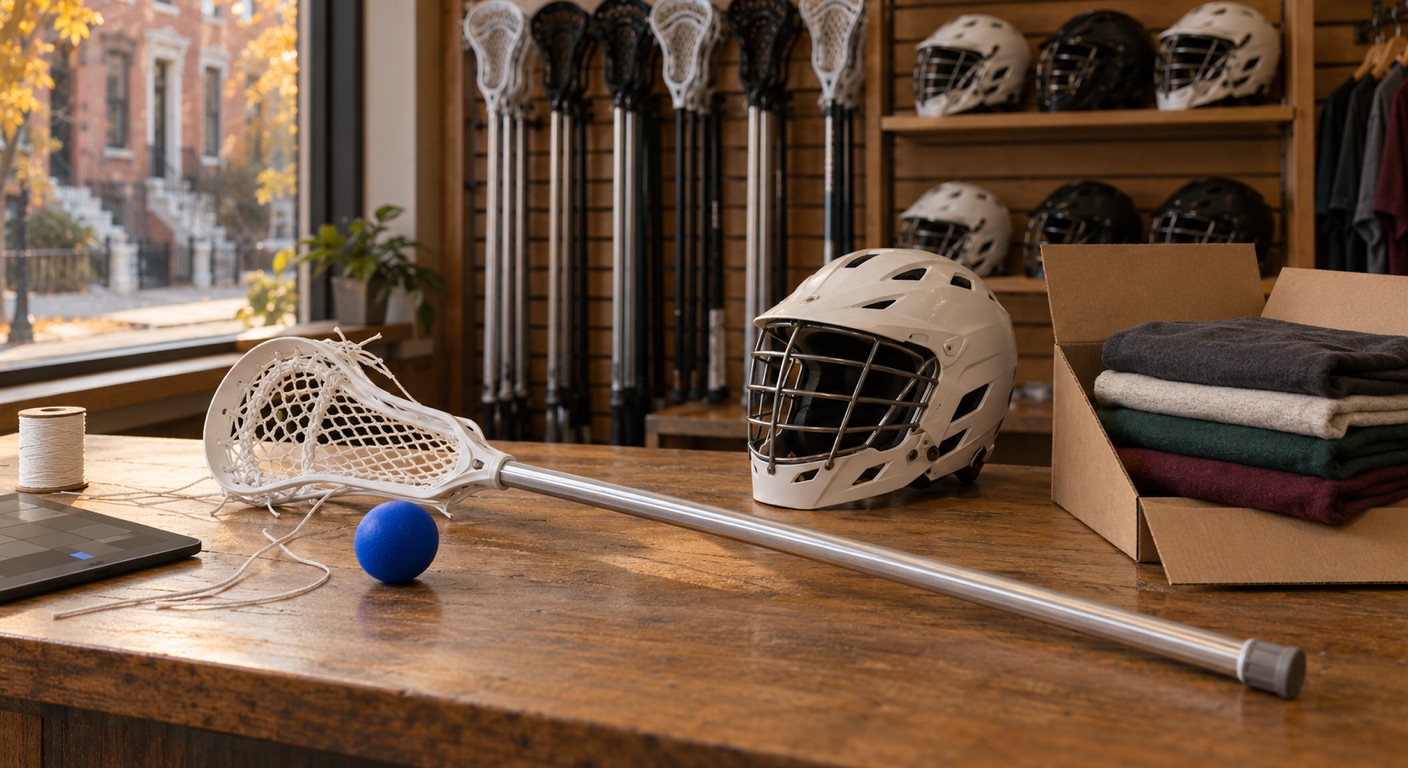
On a Saturday morning in October, a lacrosse shop in Baltimore County does four ordinary things before lunch. It sells a youth helmet to a family whose child starts lacrosse in the spring, takes in a used helmet an older sibling has outgrown, restrings a high school senior’s stick, and closes a two-week online team store for a high school girls’ team, whose parents have ordered forty hoodies with names on the back and whose booster club gets a share. All of it is routine, and each sale rests on a fact the shop’s software almost certainly does not hold.
The new helmet’s certification has a clock that started in the month it was made, which is printed on a label inside the shell, sometimes in a manufacturer’s code. If its model may not be recertified, the certification lasts at most five years from that month, so a helmet that sat in a warehouse for two years has three left. The used helmet is worth whatever remains of its own clock, and if its date has worn off, it can never be recertified. The senior’s stick is legal for Friday’s game, or not, depending on whether a ball in the pocket the shop just strung sits above the bottom edge of the sidewall. The hoodies are taxable, even though the booster club that gets a share of the money is exempt, because in Maryland the dealer that takes the parents’ money is the seller. And if the senior’s younger sibling leaves with a BBCOR bat for high school, it will be legal there indefinitely and in college only through the 2028 season, because USA Baseball took over the bat standard in July.
None of this is obscure. It is in NOCSAE’s published standards, league rule books, a Maryland tax regulation and a press release from this summer. Almost none of it is modeled by the software sporting goods stores run, and very little reaches the web. When we read the public catalogs of 25 team-sports retailers and used-gear stores, 69 of 194 lacrosse helmet listings named NOCSAE, and not one gave a date of manufacture, a recertification policy or a date when the certification ends. Only one lacrosse head or stick listing in five said anything about which rules it meets. In Baltimore itself, none of the 26 product pages we read on local shops’ sites mentioned a certification or a league, and none of the six team dealers we found sells through a checkout of its own.
It is a good moment to care. Bats with the new USA BBCOR mark go on sale next July. New stringing rules for girls’ high school lacrosse take effect for the 2027 season, white and orange balls leave boys’ high school lacrosse in 2029, and every nonprofit sales tax exemption certificate in Maryland expires on 30 September 2027. And every Shopify store now publishes a file that tells AI shopping agents how to search its catalog and build a checkout, so a product page is increasingly read by a machine before a parent sees it.
We build custom software for small businesses in Baltimore, so my interest here is practical. I am not a lawyer, and none of this is legal, tax or safety advice: check the rules that apply to your shop with the governing bodies, the manufacturers, the Comptroller of Maryland and your accountant. The question I want to answer is narrower. Which facts about a helmet, a bat, a stick and a team order does a store’s software need to know before it sells them, lists them online or takes them back in trade, and what does it cost to make sure it does?
The trade in Baltimore: small stores, and a lot of lacrosse
The Census Bureau’s County Business Patterns, which count only businesses with paid employees, found 10 sporting goods stores in Baltimore City in 2023, with 66 employees and $1.23 million of annual payroll, and 42 in Baltimore County, with 541 employees and $14.6 million. Of those 52 stores, 28 had fewer than five employees and another 13 had five to nine; roughly four in five are small enough that the owner still works the counter. Statewide there were 262 sporting goods stores with payroll, and nationally 20,373, half of them with fewer than five people. The wages are retail wages: about $18,700 per employee in the city, where the employment count carries the Census Bureau’s widest noise flag, $27,000 in the county and $29,400 nationally.
Beside them sits a larger crowd of one-person businesses. The Census Bureau’s Nonemployer Statistics for 2024 count 16 sporting goods retailers without employees in Baltimore City and 59 in Baltimore County, together about $6.2 million of receipts, averaging well under $100,000 each. And the team dealers, the businesses that outfit schools and clubs, often do not appear under retail at all. Many are classified as sporting goods wholesalers, NAICS 423910, of which Baltimore City had seven with 163 employees and an average payroll of about $73,000 per employee, nearly four times the retail figure.
What makes this market unusual is lacrosse. In the National Federation of State High School Associations’ 2024–25 participation survey, Maryland had 5,888 boys’ lacrosse players at 161 schools and 4,813 girls’ players at 150. That is 10,701 players, or 5.0% of all high school lacrosse players in the country, from a state with 1.5% of the country’s high school athletes. Lacrosse accounts for 8.5% of Maryland’s high school athletes against 2.6% nationally, and Maryland boys’ lacrosse, at 5,888 players, is bigger than Maryland boys’ baseball, at 5,141; nationally, baseball is four times the size of lacrosse. Add 13,273 football players, 4,173 softball players and 3,338 field hockey players, and the protective-gear and stick business here is out of proportion to the size of the state.
The industry around it is local too. USA Lacrosse, the sport’s national governing body, has its headquarters in Sparks, in northern Baltimore County. STX, one of the sport’s best-known stick and helmet brands, is a Maryland company with offices on Bush Street in South Baltimore. Under Armour, whose roots are in team sports, is headquartered on Performance Drive, also in South Baltimore, and according to Sporting Goods Intelligence, is moving most of its Portland staff to Baltimore and New York this year, during a restructuring that its May 2026 filing puts at about $305 million. The first store in the country devoted to lacrosse, LAX World, opened in Towson in 1988; it closed all sixteen of its stores in 2017. Its successors are chains: Lacrosse Unlimited, which had 55 stores in 15 states by March 2025 and runs one in Lutherville, and Lax.com, which bought Universal Lacrosse and its ten stores in 2024, including one in Timonium. Independents have been moving the other way: Princeton Sports, which had sold sporting goods in Baltimore since 1936, closed in 2025 when its owners retired, and its bike and ski managers opened a service shop of their own.
The big companies are consolidating. Dick’s Sporting Goods completed its acquisition of Foot Locker in September 2025 and opened a new store at Towson Place this May, and KKR bought Varsity Brands, the parent of BSN Sports, the country’s largest team dealer, in a deal reported at $4.75 billion in 2024. And lacrosse goes back to the Olympics in Los Angeles in July 2028, as six-a-side “sixes,” which the IOC confirmed in 2023. An independent shop here wins on what a chain cannot do well: stringing, fitting, knowing which league a family plays in, and answering the question before it is asked.
What the software costs, and what the meter counts
Sporting goods stores run on two kinds of software with different meters. The register and inventory system is priced per location and per register, with card processing on top; the team store platform takes a percentage of what parents pay. Here is what the vendors publish on their own pages, read on 1 October 2026, including where they publish nothing.
| Product | Published price | Card rates | Worth knowing |
|---|---|---|---|
| Square (Free, Plus, Premium) | $0, $49 or $149 per location a month | In person 2.6%, 2.5% or 2.4% + 15¢; online 3.3% + 30¢ on Free, 2.9% + 30¢ on paid plans | Above $250,000 a year, “talk to our team” |
| Lightspeed Retail (Basic, Core, Plus) | $89, $149 or $289 a month billed yearly ($109, $179, $339 monthly), plus $59 a month per extra register | Lightspeed Payments is required; the US rate is not clearly published | No price is listed for using it with another processor |
| Clover Retail Standard | $1,899 plus $84.95 a month, or $180 a month for 36 months | 2.3% + 10¢ in person; 3.5% + 10¢ keyed | One counter station; no online rate on the page |
| Shopify POS Pro | $89 per location a month, on top of a Shopify plan | Shopify Payments | Shopify’s pricing pages served us euro prices from our network, so we leave its US plan prices out rather than guess |
| Celerant Cumulus Retail | $125 a month (POS), $199 (specialty bundle), $350 (with e-commerce), $499 (with range and memberships), each for one register and five back-office users | Not published | Built-in team sales and “Player Packs”; training is an upfront fee of unpublished size |
| KORONA POS | $59, $79 or $99 per terminal a month | Bring your own processor | “There are no forced contracts” |
| RICS, Retail Pro, Epicor Eagle | No published price | — | RICS’s and Retail Pro’s /pricing pages return 404; Epicor’s blocks automated visitors |
The subscription is the small number. Take a lacrosse shop with two registers that sells $600,000 a year, $480,000 of it at the counter in tickets averaging $60 and $120,000 online in orders averaging $90. On Square Plus, the subscription costs $588 a year and card processing about $17,080, so the shop pays Square roughly $17,670, of which the subscription is about 3%. On Square’s free plan the shop would pay nothing for software and about $18,040 for processing, which is why the paid plan is cheaper above a fairly modest volume. Lightspeed with two registers costs $1,776 a year billed annually, plus processing at a rate its US pages do not state clearly. Every comparison of “POS software prices” that stops at the subscription is comparing the part of the bill that hardly matters.
| Platform | Published price | Card fees | Notes |
|---|---|---|---|
| OrderMyGear, pop-up stores | $1,899 once for unlimited pop-up stores, then 3.95% “Based on customer cart total” | Stripe, 2.9% + 30¢ | No contract; fee rebates of 10% to 30% above $250,000 of annual sales |
| Chipply | $1,000 once, then 3.5% of product and decoration | 2.9% + 30¢ | The fee does not apply to tax, fundraising amounts or optional personalization |
| InkSoft | $314 a month for up to 100 active stores, $419 for unlimited | Not published | The pricing page’s title still reads “Pricing 2024” |
| Shopify “Team Stores” app | $9 per team store a month, plus a Shopify plan | Shopify Payments | One review, rated 2 out of 5 |
| SquadLocker | No pricing page; the store is free to the club | “We take no fees. Not even credit card ones.” | SquadLocker is itself the dealer; the club’s fundraising is 5% to 20% added to the parent’s price (its FAQ says 5, 10 or 15%) |
| BSN Sports Sideline Store | Page blocked to automated visitors | — | Reported as a 10% credit toward future BSN purchases; we could not confirm it on the live page |
For a team dealer, the percentage is the whole story. Take forty school and club stores a season, $200,000 of sales in 3,333 orders of about $60. On OrderMyGear the platform fee is about $7,900 a year and card fees about $6,800, so roughly $14,700 a year after the $1,899 license. On Chipply it is about $13,800 after the $1,000 start, and less in practice, because its 3.5% skips tax and fundraising. On InkSoft, the flat $3,768 a year plus card fees comes to about $10,600, if its processing is at the usual rate, which it does not publish; a flat fee beats a 3.95% one above about $95,000 of annual sales and a 3.5% one above about $108,000. Two things those numbers do not include are the hours spent building forty stores, and the one decision none of these platforms makes for the dealer: whose sale it is for Maryland tax, which the Maryland section below explains.
Used gear has its own channels. SidelineSwap, where much of lacrosse’s used equipment changes hands, charges sellers 12% on their first five sales and 10% after, plus 2.9% and 30 cents for payment, and says it “doesn’t yet offer a live inventory management system or direct integrations,” so a shop lists there by hand. eBay takes 13.6% plus 40 cents an order in most categories; Amazon takes 15% in Sports and Outdoors plus $39.99 a month. On a $120 used helmet those come to roughly $16 to $18 each, so the difference between channels is not the fee but whether the listing can describe the helmet honestly.
The part no national platform models: equipment with a legal life
Three kinds of organization decide what a lacrosse or baseball shop is really selling, and none of them is the manufacturer. The first writes the standard: for helmets, chest protectors, shin guards and most other protective gear in team sports, that is the National Operating Committee on Standards for Athletic Equipment, NOCSAE, a nonprofit that says in every standard that it “does not approve, disapprove, certify, or recertify athletic equipment of any kind.” The second certifies: since 2015, a product may carry the NOCSAE mark only if the Safety Equipment Institute, an accredited certification body, has tested it and audits it every year. The third is the league. The NFHS, whose playing rules most American high schools use, the NCAA, USA Lacrosse, Little League and the rest each decide which marks they accept, from which date and for which age group. A product’s permission to be used in Saturday’s game is the intersection of all three, and it changes over time.
A helmet’s certification has an end date, and the date is on the helmet
The general NOCSAE standard that every helmet specification builds on, ND001, has had a section titled “Certification Expiration” since 2015. It says two things. Helmets that can be recertified must have a recertification interval set by the manufacturer, and “Helmets not recertified during the stated interval shall no longer be certified.” Helmets the manufacturer says may not be recertified must carry a permanent warning on the outside stating that fact and “The life of certification, which shall be no longer than 5 years from the date of manufacture.” The lacrosse helmet standard, ND041, repeats both rules and adds the one that matters most to a store: every helmet must carry “a permanent and legible label or mark that denotes the month and year of manufacture,” and if that mark “requires a ‘code’ to determine month and year, such code shall be made available upon request.”
NOCSAE’s plain-language page on recertification spells out the consequences. Recertification is not required, but if a helmet is not recertified within the manufacturer’s interval, “the existing certification expires,” and the clock runs on “years elapsed (not by use),” so a helmet that sat in a closet all season may still need it. NOCSAE recommends annual recertification for helmets made before January 2017, and the reconditioners’ association, NAERA, will not recondition or recertify helmets ten years old or older, which NOCSAE is careful to call NAERA’s policy rather than its own. Recertification itself takes six weeks or more.
Which lacrosse helmets can be recertified at all is not a field anywhere. The Safety Equipment Institute’s certified product search, the only public list, showed fourteen lacrosse helmet records on 1 October 2026: six Cascade, six Warrior and two STX. Whether each may be reconditioned appears only as a sentence in a free-text description, worded differently by each brand. Five Cascade models say the helmet “Can be reconditioned.” Two Warrior models say it “MAY be reconditioned,” two others that it “cannot be reconditioned.” STX’s adult model says “Not to be reconditioned.” The list has no certification date, no expiry, no date-of-manufacture range and no barcode, so a store can match it to its stock only by hand.
There is a subtlety a store should understand before it promises a parent anything. The NFHS boys’ rule asks for a helmet “which met the NOCSAE standard at the time of manufacture” and carries the exterior warning label (2024 rules changes). It does not, in that text, ask whether the certification is still current. “Allowed in a high school game” and “currently certified” are therefore two different facts about the same helmet, and a store that answers only one of them has answered half the question.
For a shop, three things follow. A helmet that cannot be recertified starts losing certified life the month it is made, not the day it is sold, so last year’s stock sells a shorter certification than this year’s, and only the label on each unit says by how much. A used helmet taken in trade is worth whatever is left of its certification. And the fact that matters lives on the unit, while every point-of-sale system we know of keeps the model. Football is solving this the hard way: in February 2026 NOCSAE’s board approved a public portal for its database of about 4.2 million football helmets carrying RFID labels, which will show each helmet’s manufacturing date, recertification dates and certification status. Nothing in the announcement covers lacrosse. For a lacrosse helmet, the record is still the sticker.
The helmet and the cage are certified as a pair
NOCSAE defines a helmet model as one “intended to be identical in every way, except for size,” and in a May 2024 statement it said that adding an item to a certified helmet “creates a new untested model,” whose certification the manufacturer and SEI may declare void. Size, color and graphics are allowed to change; almost nothing else is. The lacrosse standard goes further for the face: a faceguard must be tested on the same helmet model it is sold for. SEI’s one listed lacrosse face protector, an STX cage, is certified “For use with the STX Aero SR lacrosse helmet” and nothing else.
That is a compatibility rule, and store systems built for sizes and colors handle it badly. Cascade’s own web store sells its XRS Pro helmet as one product with 24 variants keyed on an option called “Mask,” which is the right instinct, but a shop that sells cages separately or swaps them at the counter is outside what any variant table checks. History shows why it matters. In November 2014, NOCSAE revoked the certification of Cascade’s Model R after an investigation found that it failed impact tests, and the fix created a new model, the R-M, recognizable only by a tamperproof label and a serial number. Every Model R on every shelf changed status overnight, and no product record changed with it.
A chest protector is certified for one kind of ball
Commotio cordis, cardiac arrest caused by a blow to the chest at exactly the wrong moment of the heartbeat, kills 15 to 25 athletes a year, most of them under 18, according to NOCSAE and USA Lacrosse. NOCSAE published the first chest protector standard against it, ND200, in 2017. USA Lacrosse was the first governing body to require it, for goalies in boys’ and girls’ lacrosse, and in 2022 extended the requirement to every field player in boys’ lacrosse. Under section 13 of the standard, the manufacturer designates the projectile it is tested with, “baseball or lacrosse ball,” and the protector carries a sport-specific seal. SEI lists 81 protector records certified with a lacrosse ball and 175 with a baseball. A baseball catcher’s chest protector that meets ND200 is not, for that reason, legal for lacrosse.
NOCSAE has also said that a revision “does not void an existing product’s certification to a prior version.” So the attribute a store needs is not a version number but a yes or no, per sport, from a seal on the shell.
Girls’ goggles are legal by list, and the list moved
In girls’ and women’s lacrosse, protective eyewear is mandatory, and its legality is defined by a website. The NFHS’s own history of its safety rule changes records that all eyewear on the field “must be SEI certified and listed on the SEI website starting January 1, 2020 and must bear the SEI mark for certification by January 1, 2025.” USA Lacrosse’s equipment page points to the same list. On 1 October that list held 16 records under the women’s eyewear standard, ASTM F3077, one of them already certified to a 2025 edition. The same page says chest protectors and shoulder pads need the NOCSAE logo and SEI mark “on both the packaging and the product to be legal for play,” which makes the box part of the product. For a store, the goggle on the wall is either on the list or not, a model that drops off does not announce it, and the list has to be checked against the shelf before each spring season.
The bat has a league
Bats are where the same object is most plainly legal in one game and illegal in the next. Little League’s Majors division and below require the USA Baseball mark and prohibit every bat stamped BPF 1.15, the travel-ball standard of USSSA. Its Intermediate and Junior divisions accept either the USA Baseball mark or BBCOR, and its Senior division requires BBCOR (Little League rule 1.10). Cal Ripken Baseball, the youth division of Babe Ruth League, also requires the USA Baseball mark but adds, in capitals, “NO BBCOR BATS OR USSSA BATS,” while Babe Ruth’s 16-to-18 division requires BBCOR. A BBCOR bat is therefore legal for a thirteen-year-old in Little League Juniors, illegal for a twelve-year-old in Cal Ripken, and mandatory for a seventeen-year-old in Babe Ruth.
Legality also changes with time, and 2026 is a big year for it. On 2 July, USA Baseball announced that it is taking over the BBCOR standard from the NCAA, with a new mark. Bats with the new “USA BBCOR” mark go on sale on 1 July 2027. The NCAA will accept bats with the current BBCOR mark through its 2028 season, and from 1 January 2029 “all non-wood bats must bear the USA BBCOR certification mark.” High school baseball, under the NFHS rule change for 2027, will keep accepting current BBCOR bats indefinitely and, from 1 January 2028, will also accept the new mark and youth USABat bats with drops of −4, −5 and −6. Little League says the change will not affect its 2026 tournaments or its 2027 seasons. A store selling a BBCOR bat in spring 2027 to a high school junior who plans to play in college is selling a bat with a known college expiry date, and nothing in the product record says so.
Bats also lose legality one size at a time. USA Baseball explains that “individual lengths and drops of a USABat are classified as unique designs,” so the only entry on USABat’s decertified list is the 30-inch, −10 Easton Ghost X; every other length remains approved. The NCAA has a separate list of BBCOR bats that are legal in high school but not in college because of the color of the barrel, down to the colorway: of one Adidas model, it says “A black version of this model is compliant. The white barrel is not compliant.” The notices travel the way they always have. When the NCAA decertified a 33-inch Louisville Slugger bat in February 2020, at the start of the college season, its notice went out by email to head coaches, conference commissioners, compliance officers and umpire coordinators; the stores that sold the bat were not on the list. And one withdrawal fans out: USSSA says any BBCOR bat withdrawn by the NCAA or NFHS, and any USA Baseball bat withdrawn by USA Baseball, is withdrawn for its tournaments too.
The store’s own services can change a bat’s status too. Babe Ruth League says rolling a bat, a break-in service some shops sell, is tampering that “would void the bat’s certification and make it illegal for play”; one large online bat retailer sells a heat-rolling add-on on its BBCOR bat pages and warns on the same page that it may cause decertification. Little League bans choke-up assists, which many shops stock beside the bats.
The lists are not built for a store’s computer. USABat’s approved list, which we parsed on 1 October, had 3,052 rows, one per model number and length, in an HTML table with affiliate “Shop Now” links and no barcode column; the NCAA’s BBCOR list had 1,877 model-number entries, also without barcodes. A store has to match model numbers to its own items by hand, and again whenever a list changes.
| Bat mark | Little League Majors | Cal Ripken | Little League Juniors | High school (NFHS) | College (NCAA) |
|---|---|---|---|---|---|
| USA Baseball (USABat) | Required | Required | Accepted | Not accepted until 2028; then −4, −5, −6 only | Not accepted |
| BBCOR .50, current mark | Not accepted | Banned by name | Accepted | Accepted indefinitely | Through the 2028 season |
| USA BBCOR, new mark (on sale 1 July 2027) | Not yet addressed | Not yet addressed | Not yet addressed; no change in 2026–27 | From 1 January 2028 | Required from 1 January 2029 |
| USSSA BPF 1.15 | Prohibited | Banned by name | Prohibited | Not accepted | Not accepted |
Softball adds its own twist. USA Softball’s 2026 rule book shows five certification marks. Three are “Allowed in all games.” Two, including a black home-plate mark that reads simply “USA SOFTBALL,” are allowed only in slow pitch and in men’s and boys’ fast pitch. A bat carrying the governing body’s own logo can be illegal in girls’ fast pitch, the division most youth softball families shop for. High school softball delegates the question: since 2020 the NFHS has accepted three marks, the two older ASA marks and USA Softball’s “All Games” mark, and excludes any bat on USA Softball’s list of non-approved bats, which USA Softball’s January 2026 comparison sheet put at 47.
The stringer decides whether the stick is legal
A lacrosse head is a molded piece of plastic; a stick becomes legal or illegal at the stringing bench. In boys’ lacrosse, the pocket has sagged too deep “if the top surface of a lacrosse ball, when the ball is placed in the crosse, is below the bottom edge of the sidewall,” shooting strings must sit within four inches of the top of the head, no string or leather may hang more than two inches, and no gap in the pocket may let through anything 1.68 inches across, the size of a golf ball. So says the appendix of USA Lacrosse’s 2026 boys’ youth rule book, which also accepts the old high school head specification at youth level, so a head that is illegal in high school can be legal for a twelve-year-old. Every one of those tests is passed or failed by how the stick was strung, and the pocket keeps changing after it leaves the shop, with use and with weather.
Girls’ and women’s lacrosse adds a list on top of the bench. A head is legal only if it appears on USA Lacrosse’s list of legal women’s sticks, which on 1 October had 268 entries from 23 manufacturers, last updated on 11 June 2026; a separate list of factory-sewn pockets warns that “Most pockets and mesh are not lab tested or listed here.” Under the NCAA’s women’s rules, the top of the ball must stay visible above both sidewalls, a stick may have no more than two shooting strings, beads and tubing are banned, sidewall stringing tied to the wrong hole “shall render the stick illegal,” and a head designed for a bent shaft is illegal on a straight one. For the 2027 high school season the NFHS has added new stringing requirements for girls’ pockets, covering how the pocket attaches to the head, shooting strings, runners, nylon and elastic materials.
So a store that sells a listed head with a custom pocket is selling two things: a product whose legality is a list lookup, and a piece of work that nobody certifies in advance and an official checks on game day. The shop’s stringing ticket is the only record that the work was done to a rule, which is a strong argument for treating stringing as a product with its own record: the head, the mesh, the pattern, the rule set, the checks done before it left the bench, and the stringer’s name. There is a stock-count lesson here too. From 2029, the NFHS boys’ rules will accept only fluorescent green or yellow balls, which means the white and orange balls a shop still stocks will stop being legal for high school play.
Used gear comes with its history, or without it
Used equipment is a large part of the trade, in shops such as Play It Again Sports and on marketplaces such as SidelineSwap, where lacrosse is a core category, and every rule above follows the item into its second life. A lacrosse helmet may be recertified only if its date of manufacture is legible, and the date has to stay legible through reconditioning (ND043); a recertified helmet carries a mark naming the firm and the year. A helmet whose date has worn off cannot be brought back. A bat whose certification mark is unreadable cannot be used in Little League at all. And the manufacturer’s warranty rarely survives the sale: Cascade’s helmet warranty, for example, requires the original receipt from an authorized dealer.
In Baltimore City, a store that buys used gear from the public also needs a license. Article 2, Subtitle 12 of the City Code covers anyone buying used “moveable personal property” for resale and excludes only “motor vehicles, records, tapes, compact discs, and books,” so sticks, skates, cleats and helmets are in. That means a $50 annual license for each location, a report of each purchase, a ten-day hold before resale, and one rule that matters more in this trade than in any other: “A dealer may not acquire any item in a transaction with a minor.” A thirteen-year-old cannot sell the shop an outgrown helmet; a parent has to. A booster club’s equipment swap is exempt if the club is a 501(c)(3) or (c)(4) organization. We went through the rest of the subtitle in our resale shop article.
None of this is a reason not to sell used gear. It is a reason to record at intake what a careful buyer would ask: the helmet’s month and year of manufacture, its model’s reconditioning policy, any recertification marks, the bat’s mark and model number, and a photo of each. A shop that writes those down can price the item honestly; a shop that does not is selling a helmet it cannot describe.
Maryland: the hoodie is the same, and the tax depends on who sells it
A team dealer’s most common transaction in Maryland is also its most confusing one. A high school lacrosse program wants hoodies. The school might buy them, the booster club might buy them or sell them, the parents might each buy one through the dealer’s online store while the club takes a cut, or the coach might put them on a personal card and get reimbursed. To the hoodie, nothing changes. To the Comptroller, nearly everything does, because Maryland’s sales tax turns on who is selling and who is buying. I am not a tax adviser; these are the rules as written, and the places where they leave a question open.
Who is selling decides the tax
Sales to the State and its political subdivisions are exempt under Tax-General §11–220. A nonprofit charitable or educational organization with a Maryland exemption certificate can buy tax-free what it uses “to carry on its work” under §11–204(a)(3), but not purchases by officials, members or employees “for their personal usage” (COMAR 03.06.01.22B(3)). And under §11–204(b)(6), a sale by a parent-teacher or other organization “recognized by an elementary or secondary school” is exempt (COMAR 03.06.01.46), so a school’s lacrosse booster club can sell spirit wear to parents without charging tax.
The sentence that matters for team stores comes right after. Such a sale “does not include a sale where the parent-teacher organization or other organization accepts payment on behalf of a third-party vendor, even if said organization receives some portion of the proceeds of the sale” (COMAR 03.06.01.46B). Read plainly, when the dealer runs the store, takes the parents’ money and sends the club a percentage, the dealer is the seller and the sale is taxable. The club’s exemption does not travel to the dealer’s checkout. A private travel team that no school recognizes has no special exemption at all; the Comptroller’s sales tax FAQ says nonprofit organizations “must collect tax on merchandise they sell.”
| Who buys, and how | Maryland sales tax | Why |
|---|---|---|
| A public school or school system pays by purchase order or its own card | None | Sale to a political subdivision, §11–220; the vendor records the certificate number on the sale |
| The coach pays on a personal card and is reimbursed | 6% | The Comptroller says a government employee paying personally owes the tax even if reimbursed; its examples are hotels and meals, and nothing suggests jerseys differ |
| A 501(c)(3) booster club buys uniforms it will own, with its own funds and an unexpired certificate | None | §11–204(a)(3); certificates may not be used for members’ personal purchases |
| A school-recognized booster club sells the jersey to a parent itself | None | §11–204(b)(6) and COMAR 03.06.01.46C |
| The parent buys through a dealer’s team store and the club gets a cut | 6% of $65 = $3.90 | The dealer is the seller (COMAR 03.06.01.46B); the name, number and required fundraiser are part of the price (03.06.01.08B); separately stated shipping is not |
Three details in that last row deserve a store’s attention. The name and number are taxable even as a separate line, because the regulation on taxable price counts “engraving, monogramming … customizing” as part of the price (COMAR 03.06.01.08B(1)(a)). A fundraising amount the store requires is part of the price too: the same regulation includes any “donation” that is “in fact required by the vendor as a condition of the sale.” A genuinely optional donation is, on the natural reading, a different thing, which is a reason to build the fundraiser as a separate, optional line. A separately stated delivery charge is excluded from the taxable price; “handling” is not. In tax-free week, clothing at $100 or less per item is exempt, but not protective gear, and the regulation’s own example is football pads (COMAR 03.06.01.37); whether a name and number added that week share the jersey’s exemption, the regulation does not settle.
The certificate number belongs on the sale, not on the customer
Most point-of-sale systems let you mark a customer as tax-exempt. Maryland asks for more. The vendor must see the certificate before completing the sale, “shall record the valid serial number of the exemption certificate on any record or evidence of each sale,” and may not honor an expired one (COMAR 03.06.01.22D(2) and E(5)). Government certificates carry no expiration date. According to the Comptroller, the current nonprofit certificates expire on 30 September 2027, for every booster club, private school and church in the state at once. A dealer whose records hold a checkbox instead of a certificate number and an expiry date will discover that date by accident. The Comptroller runs an online lookup to verify certificates, which is the kind of check a team store should run when a club account is created, not when an auditor asks.
One tension belongs with your accountant. The Comptroller lets an exempt organization buy “supplies used in fundraising activities” on its exemption certificate, but its resale certificate guidance says organizations may not use exemption certificates to buy items for resale. A booster club buying two hundred hoodies to sell at the spring tournament is, on the most natural reading, buying for resale, which means a sales tax license and a resale certificate. Which document the club hands over is a field a dealer’s system should ask for, not infer.
Selling to schools is a catalog problem, not a storefront problem
Maryland’s school systems must advertise for bids above $100,000 (Education §5–112), and may skip local bidding by buying through contracts that other public agencies or cooperative purchasing groups have already bid. The board documents show what that means. In February 2026, Baltimore County Public Schools approved a five-year, $2.3 million contract for athletics and physical education supplies. Thirty-two vendors asked for the bid documents, seven bid, and all seven were awarded, because the contract goes to every responsive bidder. Six are national companies, including BSN Sports. One, Time Out for Sports in Nottingham, is from Maryland. The previous contract had eight awardees and none from Maryland, and its award form explains the design: schools compare prices “within the CGI Financial system” order by order.
Getting on a multi-award contract is the entry ticket; each order is then won inside the district’s purchasing system, on price and on whether the item can be found there. That is a data problem: a clean price file, catalog numbers that match the manufacturer’s, and the ability to update both when a district changes its finance system, as Baltimore County is doing now. Anne Arundel County’s April 2025 award for football helmets and shoulder pads, $294,146 over two years, went out to 258 vendors and drew five answers; the district awarded each of the four valid bidders its own brands, line by line, from a $147 shoulder pad to a $645 helmet. Baltimore County’s contract to recondition football and lacrosse helmets, $405,962 so far, drew a single bid, from Riddell’s reconditioning arm in Ohio. Below the bid line the rules are lighter: under Baltimore City Public Schools’ procurement regulation, a purchase of $25,000 or less needs one acceptable quote. And under the State Board’s athletics regulation, a public school “may not provide school uniforms or equipment for students who attend a camp outside of the defined sports season” (COMAR 13A.06.03.04G(6)), so summer camp and off-season club gear is always a family’s purchase, at a taxable retail price.
What 46 Baltimore shops show a customer, or a machine
We built a list of sporting goods businesses in Baltimore City and Baltimore County from OpenStreetMap, web searches and the shops’ own sites, then read what each site lets a customer, or a search engine or AI assistant, see and do. We left out bike shops, which we covered in a separate article, and hunting and firearms stores. Of 51 businesses, 46 were still trading, and 14 of those are chains and big boxes, which we listed but did not analyze. Of the other 32, 22 are the core of this trade: seven running and specialty stores, six team dealers and uniform shops, four sportswear shops with no website, two lacrosse specialists, two used-gear stores and one general sporting goods store. Eighteen of the 22 are in the county.
Sixteen of those 22 are independently owned. Ten have a website we could find, and eight of those work. Four sell online through a real checkout: Charm City Run, Falls Road Running, Holabird Sports and Vu Skate Shop. The same four are the only ones whose product pages carry product structured data, and Holabird’s is the most complete we found in the whole census, with barcode, part number, SKU, brand and condition on every page we sampled. The home page of one long-established running store is still a Microsoft FrontPage site, a tool Microsoft retired in 2006, with its working shop on a separate subdomain.
The six team dealers are where the gap is widest. None sells through a checkout of its own. One takes requests through a quote form on a Drupal 7 site, which stopped receiving security updates in January 2025; one has an “Add to Quote” cart; one has a page built with Adobe GoLive and no cart; one site timed out; one dealer is on Facebook only. Time Out for Sports in Nottingham, the one Maryland company on Baltimore County’s $2.3 million athletics contract, runs a site whose web store still holds the twelve sample products that came with the template, and whose “Online Stores” page links to a demonstration team store. That is not a criticism; it tells you where a dealer’s business actually happens, in purchase orders, school catalogs and phone calls. It also means that when a parent or an AI assistant looks for who outfits a Baltimore County team, the dealers with the relationships are close to invisible.
Machines have other blind spots too. Ten of the sixteen independents are in OpenStreetMap, the open map data many apps and services draw on, but only two of those entries link to a website. Lacrosse Unlimited, Universal Lacrosse, Charm City Run, Falls Road Running and Holabird all have working sites, and all appear on the map without them. None of the seventeen working sites we read blocks AI crawlers in its robots.txt. The two lacrosse stores’ helmet pages both carry product structured data with a SKU and a brand, but neither has a barcode or a visible NOCSAE statement; on one, the word “NOCSAE” appears only in an upsell widget offering “NOCSAE Approved Lacrosse Balls.” Across the 26 product pages we read on twelve businesses’ sites, not one stated a certification or said which league a product is legal for.
What 6,676 listings on 25 team-sports web stores say
To see how stores describe this equipment today, we read the public catalogs of 40 team-sports web stores that run on Shopify, the same product data any browser can fetch: 23 retailers, from lacrosse specialists to bat shops and multi-sport dealers, two used-gear stores, and 15 manufacturers’ own stores, kept separate. Of their 82,796 products, 6,676 at the retailers and used-gear stores fell into the categories this article is about: helmets, chest protectors, goggles, lacrosse heads and sticks, bats and shin guards. We looked for the words that carry a certification or a league in each listing’s title, description, tags and variants. It is a keyword method, so a claim that appears only in a product photo is not counted, and a zero means “not stated in the text,” not “not certified.”
Helmets first. Of 194 lacrosse helmet listings, 69, or 35.6%, mention NOCSAE anywhere in their text, and only four of the nine stores that sell them ever do. Not one of the 194 gives a date of manufacture, a certification end date, a recertification policy or a useful life. Batting and catcher’s helmets do better on the name, 64.2% of 533 listings, and seven of them, all using Easton’s copy, state the rule plainly: the certified life is five years from the date of manufacture. Football helmets mention NOCSAE on one listing in 18. The five used lacrosse helmets for sale said nothing about NOCSAE, age or recertification. And 23 listings at seven stores spelled the standards body’s name wrong.
Chest protectors and goggles are better described, because the rules that made them mandatory are recent and the manufacturers put the standard in their copy. Of 312 lacrosse chest protector listings, 61.5% name NOCSAE or ND200, and two, both at one store, say in plain words that an older pad does not meet the 2022 standard and is not legal for organized play, which are the most useful sentences in the census. Of 88 women’s goggle listings, 61.4% cite ASTM F3077 and 65.9% mention SEI certification, which makes goggles the best-described category we measured; only two listings say the goggle appears on a governing body’s list.
Sticks and bats are where the gap is largest. Of 1,960 lacrosse head and complete-stick listings, 20.1% say anything at all about legality, 3.0% use the phrase “NFHS legal,” and none says “high school legal.” The manufacturers’ own stores say even less: STX’s 42 head and stick listings and Cascade Maverik’s 66 contain no legality statement at all, and because retailers paste brand copy, that silence spreads. Non-wood baseball bats almost always state their mark, 93.7% of 990 listings, but only 22.0% name a league the bat is approved for, and the word “decertified” appears in none of the 1,759 baseball bat listings. Softball bats are the extreme case: 96.2% of 1,608 listings name a stamp, usually several, and 13 listings, 0.8%, say which league or division the bat is legal in, although the mark that decides whether a bat can be used in girls’ high school fastpitch is exactly that kind of fact. The closest thing to a certification field we found anywhere was a set of tags such as cert-usssa at a few bat stores, which is a good instinct with nowhere standard to go.
The sample is not random; it is the larger, more visible Shopify stores we could find, and it misses the biggest retailers. But it matches what we found in Baltimore: the facts that decide whether equipment may be used are on the product, in the rule book and on a list, and almost never in the data a store publishes.
The e-commerce half: what a sporting goods web store is actually selling
Everything above happens at a counter, where someone can turn a helmet over and read the label. Online, the customer cannot, and more and more often the first reader of a product page is a search engine or an AI assistant answering a parent’s question: is this bat legal for Cal Ripken, is this used helmet still good? The answer will be assembled from whatever the product pages and feeds say. So a sporting goods web store has a job the register does not. It has to say, in words and in data, what each helmet, bat and stick is allowed to do, for whom, and until when.
Sell the permission, not just the product
For protective equipment and bats, the most useful thing a product page can say is something the manufacturer’s photo never shows. A bat page should list, in plain words, the leagues that accept the bat this season and the mark it carries; from July 2027 there will be two BBCOR marks on the shelf, and only one will be accepted in college play from 2029. A helmet page should name the standard, say whether the model may be recertified, and give the month in which the certification of the units in stock runs out, which means the store has to know the unit it will ship, not just the model it lists. A head should be sold with the rule its pocket must pass, and a stick the shop strung as what it is: a product whose legality was checked by a person on a date. None of this is clever: it is what a good counter clerk tells a parent, written down once and kept current, and it is the text an AI assistant can quote instead of a marketplace’s guess.
A team store is a pop-up with a deadline and a seller of record
The other half of the trade online is the team store: a web store a dealer opens for one club or school for a week or two, where parents order the jersey, the shorts and the hoodie in their child’s size, add a name and a number, and pay. Then the store closes, the dealer orders blanks, decorates everything in one batch and delivers it to the coach in labeled bags. It looks like ordinary e-commerce and is not. The catalog exists only for the order window, the price includes decoration and often a fundraising amount, numbers must be unique on the roster, the size run is the production order, and the delivery is one box to one coach. As the pricing section showed, the platforms built for it charge a percentage of every order, and as the Maryland section showed, the tax depends on who the seller is, not on what the hoodie is.
One more design choice has a legal edge. Team stores take a child’s name, number and size, and the federal children’s privacy rule, COPPA, was amended last year, with a compliance date of 22 April 2026. The FTC’s guidance says the rule does not apply to information about children collected from parents, which is how most team stores work. A store that lets players under 13 log in and pick their own numbers is a different case, which is a good reason to design the order form around the parent.
What Google, ChatGPT and AI shopping agents can read
There is now a standard way to say “this product is certified, by whom, and until when” in the structured data search engines read. Schema.org, the shared vocabulary for web markup, has a Certification type with an issuing organization, an identifier, a status, a validFrom date and an expires date, attached to a product through hasCertification. A helmet page could say in markup that the helmet meets NOCSAE ND041, certified through SEI, until March 2031. Almost nobody does.
The big shopping channels are less accommodating. Google Merchant Center’s certification attribute accepts only supported certifications, and on 1 October the list had four: the EU energy label database, two European vehicle CO2 classes, and Energy Star. What remains is Google’s free-form product_detail attribute, up to 100 lines of section, name and value, which Google says helps people find products “across AI-driven surfaces.” ChatGPT’s product feed specification requires nine fields and offers optional ones for size, color, material, gender and age group, but none for a certification, a standard or a league. In ChatGPT, a helmet’s standard can live only in the description.
Shopify has meanwhile opened a door most store owners do not know exists. Every Shopify store we checked, including four retailers from our census and Cascade Maverik’s own store, now publishes a file at /agents.md telling AI agents how to search the catalog and build a checkout through the Universal Commerce Protocol, with the buyer approving payment. In the protocol’s current product schema, version 2026-08-25, a product has a title, a description, categories, options, variants, media, a rating, tags and a field for business-defined custom data. There is no certification, no standard and no expiry. When an AI agent shops a Shopify store for a lacrosse helmet on a parent’s behalf, what it learns about safety is whatever the title, the description and the tags say, and Cascade’s own helmet catalog does not mention NOCSAE at all.
| Channel | Is there a field for it? | What a store can do |
|---|---|---|
| The product page itself | Only if you write it | A short “standards and leagues” block on every protective item and bat, in plain text |
| Schema.org structured data | Yes: hasCertification with issuer, identifier, status and expires | Mark up the standard and, where the store knows it, the end date of the units in stock |
Google Merchant Center certification | Only four supported certifications (EPREL, ADEME, BMWK, Energy Star) | Nothing, for sporting goods |
Google Merchant Center product_detail | Free-form section, name and value | “Safety: Standard: NOCSAE ND041 (SEI certified)”, “Leagues: Accepted in: NFHS boys” |
| ChatGPT product feed | No (nine required fields; size, color, material, gender and age group optional) | Say it in the description, the same way on every item |
| Shopify’s agent protocol (UCP) | No; title, description, tags and business-defined metadata | Description, tags and metafields that a custom integration can read |
The practical conclusion is unglamorous. Until the channels add a field, a certification travels as text, so the text has to be right, consistent and generated from the same record the register uses. A store that writes “NOCSAE certified” by hand on some pages and nothing on others will be described inconsistently by every machine that reads it, and a store whose helmet pages say nothing will be described by somebody else’s page.
A note for readers in Lithuania
We write mostly for Baltimore, but part of our team and many of our readers are in Lithuania, so we ran the same check on the European side. In the EU, a sports helmet is personal protective equipment under Regulation (EU) 2016/425, in the middle risk category, which means a notified body examines the type before it can carry the CE mark. The certificate itself expires: Annex V says a type-examination certificate is valid for no more than five years. Annex II has its own version of NOCSAE’s date label: if aging may significantly affect the equipment’s performance, “the month and year of manufacture and/or, if possible, the month and year of obsolescence must be indelibly and unambiguously marked on each item.” A shop selling helmets in Lithuania is a distributor under Article 11 and must check the CE mark, the documents and instructions in a language consumers there can easily understand. Nothing in the regulation puts the standard or the declaration of conformity on the web page, although the EU’s product safety regulation requires an online listing to show the manufacturer’s name, addresses and warnings, as we discussed in our toy store article.
We read 39 helmet product pages on six Lithuanian web shops on 1 October: sportland.lt, decathlon.lt, the pigu.lt marketplace, hockeypoint.lt, jojimoprekes.lt and sportuok.lt. Ten pages named an EN standard, nine of them at Decathlon, which named one on every page we read and on four gave a five-year replacement rule; on two ski helmets it reads „keisti ne rečiau kaip kas penkerius metus“, change it at least every five years. None linked to a declaration of conformity. Five showed a manufacturer’s postal address, all on pigu.lt, which has a structured field for it. The marketplace’s standards text was seller-written and sometimes wrong: one listing cited Directive 89/686/EEC, which the 2016 regulation replaced in 2018, and another “EN1079,” which is not a helmet standard. None of the six ice hockey helmets named any standard, although a new harmonized standard for hockey helmets, EN ISO 10256-2:2024, took legal effect in the EU on 16 June 2026. Twenty-two pages had product structured data; none of it carried a certification.
Nor do Lithuanian buying guides agree on the number: one retailer’s ski helmet guide says three to five years, a ski travel company up to ten, and a bank’s blog five to six for a bicycle helmet. The regulation sets no figure; it leaves the date to the label and the instructions, exactly where a web shop cannot see it.
The pattern is the same as in Baltimore. A retailer that writes its own product template, as Decathlon does for its own brands, carries the standard on every page; a marketplace carries the manufacturer fields it built a slot for; and specialist shops, which know the most about the equipment, carry the least of it online, because their product data comes from supplier feeds that never had a place for it.
What custom actually costs, and when it pays
We price every project at a fixed fee, agreed before we start, and publish the starting points on our pricing page. For a lacrosse or sporting goods shop, a team dealer, or a business that is both, they map onto the problems in this article like this.
| Package | Fixed price | What it would be for a sporting goods business |
|---|---|---|
| Prototype Sprint | $3,500 | A working audit of your catalog in about a week: every helmet, chest protector, goggle, bat and women’s head matched to the SEI list, the USABat and NCAA bat lists and USA Lacrosse’s stick list; the bats whose status changes with USA BBCOR between 2027 and 2029; the helmets in stock whose certification runs out within a season; and a product feed with the standards written the same way on every item |
| Online Store | from $6,000 | A store on your own domain and card account that sells the permission as well as the product: bats that list the leagues that accept them and for how long, helmets that name their standard, reconditioning policy and the certification end date of the unit you will ship, cages offered only with the helmets they were certified on, stringing as a configured product with its rule set, team stores with order windows, roster names and numbers, size runs and an optional fundraising line, and structured data and feeds generated from the same record |
| Custom App or Internal Tool | from $12,000 | A counter and intake tool: enter a helmet’s model and date code and get its certification end date and reconditioning policy; used-gear intake that records the date, the marks and photos and flags what should not be sold; stringing tickets that record the checks done before a stick leaves the bench; and a recertification tracker for the clubs whose helmets you send away each winter |
| Operations System | from $12,000 | A team dealer’s back office: forty stores a season with their windows, rosters and fundraising terms, the right seller of record for Maryland tax, exemption certificates with their numbers and expiry dates on every sale, batch production orders for decoration, delivery by team, and price files that match school contracts |
Most of our projects land between $6,000 and $30,000, and none requires you to drop the register, the card processor or the team store platform that already works; the demos page shows finished work. In Maryland, the state’s 3% tax on software and IT services applies to a custom build, as we explained in a separate post.
The honest case for building is not that the software is expensive. It is that money leaks where the software does not know who is selling, and two numbers show how much. Take the team dealer from the pricing section, with $200,000 a season across forty stores. If its checkout treats a booster club’s store as tax-exempt because the club is exempt, and the regulation quoted above says the dealer is the seller, it has under-collected about $12,000 a year of Maryland tax that it still owes, from its own margin, for every year an auditor can reach. And if the same dealer runs those stores on a percentage platform, the platform fee alone is $7,000 to $7,900 a year, before card fees, every year the business grows. A store and back office of its own, on its own card account, would cost a dealer of that size about one or two seasons of platform fees, and it would put the tax rule, the certificate and the fundraising line in the same record as the order. A dealer half that size should keep its platform and fix the tax setting by hand.
What we would build for a Baltimore sporting goods store
If a lacrosse shop or team dealer in Baltimore asked us to fix the problems in this article without replacing anything that already works, this is what we would build, roughly in this order.
- A record for the unit where the unit matters. For helmets, the model, the month and year of manufacture read from the label, the model’s reconditioning policy, the faceguard it was certified with and any recertification marks. For bats, the manufacturer’s model number, length, drop and certification mark. For chest protectors, the sport on the seal. Everything else in the store can stay a model with sizes and colors.
- A league table the shop owns. One small table of which marks each league accepts, for which age group, from which date to which date, maintained by the shop each season and joined to the products, so “legal for Cal Ripken” or “college through 2028” is computed rather than typed, and changes everywhere at once when a rule does.
- Stringing as a product. A ticket for every stick that records the head, the mesh, the pattern, the rule set it was strung to, the checks done before it left the bench and who did them, attached to the sale and printable for a coach.
- Team stores that know who is selling. Order windows, roster names and numbers that cannot be duplicated, size runs that become a production order, an optional fundraising line kept separate from the price, delivery by team, and a seller of record per store, with the club’s certificate number and expiry date on every exempt sale.
- Used-gear intake with a memory. The date, the marks and photos captured when the item comes in, a price that reflects its remaining certification, and a plain refusal for helmets whose date cannot be read.
- Pages and feeds a machine can read. A short “standards and leagues” block on every protective item and bat, the same facts in schema.org markup, Google’s product details and the descriptions ChatGPT and Shopify’s agent protocol read, all generated from the same record so they never disagree.
None of that is exotic engineering: a unit record, a lookup table, a ticket, a store with a few rules, an intake screen and a feed. It is also why, as far as we could find, nobody sells it as one product. The point-of-sale vendors are good at the register and the inventory count, the team store platforms are good at the pop-up and the decoration order, and the gap between them, where a helmet’s date, a league’s rule and a tax regulation meet, is too specific to one trade and one state to be anybody’s roadmap.
Build, buy, or leave it alone
Most Baltimore sporting goods stores should buy their software, and several products in this article are very good at their job. If you run one shop with a counter, a stringing bench and a modest web store, a general point-of-sale system will take cards faster and more cheaply than anything we could build. Keep it. Before the spring season, do a few things by hand. Read the date label on every helmet in stock and write it on the shelf tag. Check your women’s heads against USA Lacrosse’s list and your goggles against SEI’s. Add one plain sentence about leagues to every bat page, and one about the standard to every helmet page. Ask every club you sell to for its exemption or resale certificate, and write down the number and the expiry date.
If you are a team dealer running dozens of stores a season, or a shop that sells used gear in volume, the question is different. Your problem is not the register but the record: which seller, which certificate, which roster, which unit, which date. Do not migrate everything. Add the record and the rules around the systems you have, and replace the team store platform only when its percentage costs more each season than owning the store would, which for most dealers means somewhere around $200,000 of team-store sales a year.
Leave alone what is cheap and works: the card processor you have negotiated with, the manufacturer dealer portals, the decoration equipment’s own software, your accounting package and the marketplace accounts that sell your used gear. Build the few things nobody sells in this trade: the unit record that knows a helmet’s date, the league table that knows a bat’s future, the stringing ticket that proves a pocket was checked, and the team store that knows who the seller is. If you are not sure which of those is costing you money, a one-week prototype on last season’s sales, team stores and helmet stock is the cheapest way to find out.
Questions sporting goods owners and parents ask us
Do lacrosse helmets expire, and how long are they good for?
Their certification can expire. A helmet the manufacturer allows to be recertified stays certified only if it is recertified within the manufacturer’s interval, counted in years, not use. A helmet that may not be recertified must say so on the outside and give a certification life of no more than five years from the date of manufacture. NOCSAE recommends annual recertification for helmets made before January 2017, and the reconditioners’ association will not recertify helmets ten years old or older. High school rules ask only that the helmet met the standard when it was made.
Where is the date of manufacture on a lacrosse helmet?
NOCSAE’s lacrosse helmet standard requires a permanent, legible label or mark with the month and year of manufacture, readable without removing any permanent part of the helmet. It may be in a manufacturer’s code, which must be explained on request, and it is often inside the shell or under the liner. Recertified helmets also carry a mark with the reconditioning firm’s name and the year.
Can a used lacrosse helmet be recertified?
Only if its model allows it and its date of manufacture is still legible. Some models may be reconditioned and others may not; the Safety Equipment Institute’s list of certified helmets states this in each model’s description. Recertification is done by firms licensed by NOCSAE and takes six weeks or more. The CDC’s helmet safety sheet tells parents not to let a child use a used helmet that has not been recertified.
Do lacrosse chest protectors have to meet NOCSAE ND200?
Yes, for every goalie in boys’ and girls’ play since 1 January 2021, and for boys’ field players’ shoulder pads since 1 January 2022, under USA Lacrosse and NFHS rules; the NCAA requires it too. The protector must be certified with a lacrosse ball, because ND200 tests with either a baseball or a lacrosse ball and the seal says which. USA Lacrosse says the NOCSAE logo and SEI mark must appear on both the product and the packaging.
What is USA BBCOR, and will my BBCOR bat still be legal?
USA BBCOR is the new name and mark for the BBCOR standard, which USA Baseball took over from the NCAA in July 2026. Bats with the new mark go on sale on 1 July 2027. High school baseball will accept bats with the current BBCOR mark indefinitely and the new mark from 2028. The NCAA will accept the current mark through its 2028 season and, from 1 January 2029, only USA BBCOR.
Can you use a BBCOR bat in Little League or Cal Ripken?
Not in Little League’s Majors division and below, which require the USA Baseball mark. Little League’s Intermediate and Junior divisions accept USA Baseball or BBCOR bats, and its Senior division requires BBCOR. Cal Ripken Baseball bans BBCOR and USSSA bats outright, and Little League prohibits every bat stamped BPF 1.15, the USSSA travel-ball standard.
Is a bat with a USA Softball logo legal for girls’ fastpitch?
Not necessarily. Two of the five marks in USA Softball’s 2026 rule book, including a black home-plate mark reading “USA SOFTBALL,” are allowed only in slow pitch and in men’s and boys’ fast pitch. High school softball accepts the two older ASA marks and the “All Games” mark, and excludes bats on USA Softball’s non-approved list, which had 47 bats in January 2026.
How do I know if a lacrosse stick is legal for high school?
For boys, the head must meet the current specifications and the pocket must pass on-field checks: the top of the ball may not sit below the bottom edge of the sidewall, shooting strings must be within four inches of the top, and nothing may hang more than two inches. For girls, the head must also be on USA Lacrosse’s list of legal women’s sticks, and new stringing requirements apply from the 2027 high school season. Because the pocket decides most of it, ask your stringer which rules the stick was strung to.
Do parents pay sales tax on team store orders in Maryland?
Usually, yes. When a dealer runs the store and passes a share to the club, Maryland’s regulation treats the dealer as the seller, so the parent pays 6% even though the club is exempt. Sales made directly by a school-recognized booster club or PTA are exempt, as are purchases by schools and by qualifying nonprofits for their own use. Name and number charges and required fundraising amounts are part of the taxable price; separately stated shipping is not.
How much does team store software cost?
At published prices checked on 1 October 2026, OrderMyGear charges $1,899 once for unlimited pop-up stores and then 3.95% of the cart total, Chipply $1,000 once and 3.5% of product and decoration, each plus card fees of 2.9% and 30 cents, and InkSoft $314 a month for up to 100 active stores. SquadLocker and BSN Sports offer free stores to clubs, but they are dealers themselves. For a dealer selling $200,000 a season, the percentage platforms cost roughly $14,000 to $15,000 a year including card fees.
What is the best POS system for a sporting goods store?
For a single shop with a modest web store, a general system such as Square, Lightspeed, Clover or Shopify works well; on Square’s paid plan, card fees are about 97% of what a $600,000-a-year shop pays. Celerant sells a sporting goods system with team sales built in, from $125 a month. None of them stores a helmet’s date of manufacture, a bat’s leagues or a stick’s stringing as data, so keep those facts in a record the system can attach to the sale.
Is it worth building custom software for a sporting goods store?
For most single shops, no: buy a point-of-sale system and keep it. Custom work pays when money or risk leaks between systems, most often in team stores that do not know who the seller is, in percentage fees that grow every season, in used helmets and bats sold without their history, and in catalogs that search engines and AI assistants cannot read. Our fixed-price packages start at $3,500 for a one-week prototype and $6,000 for an online store, and most projects land between $6,000 and $30,000.