
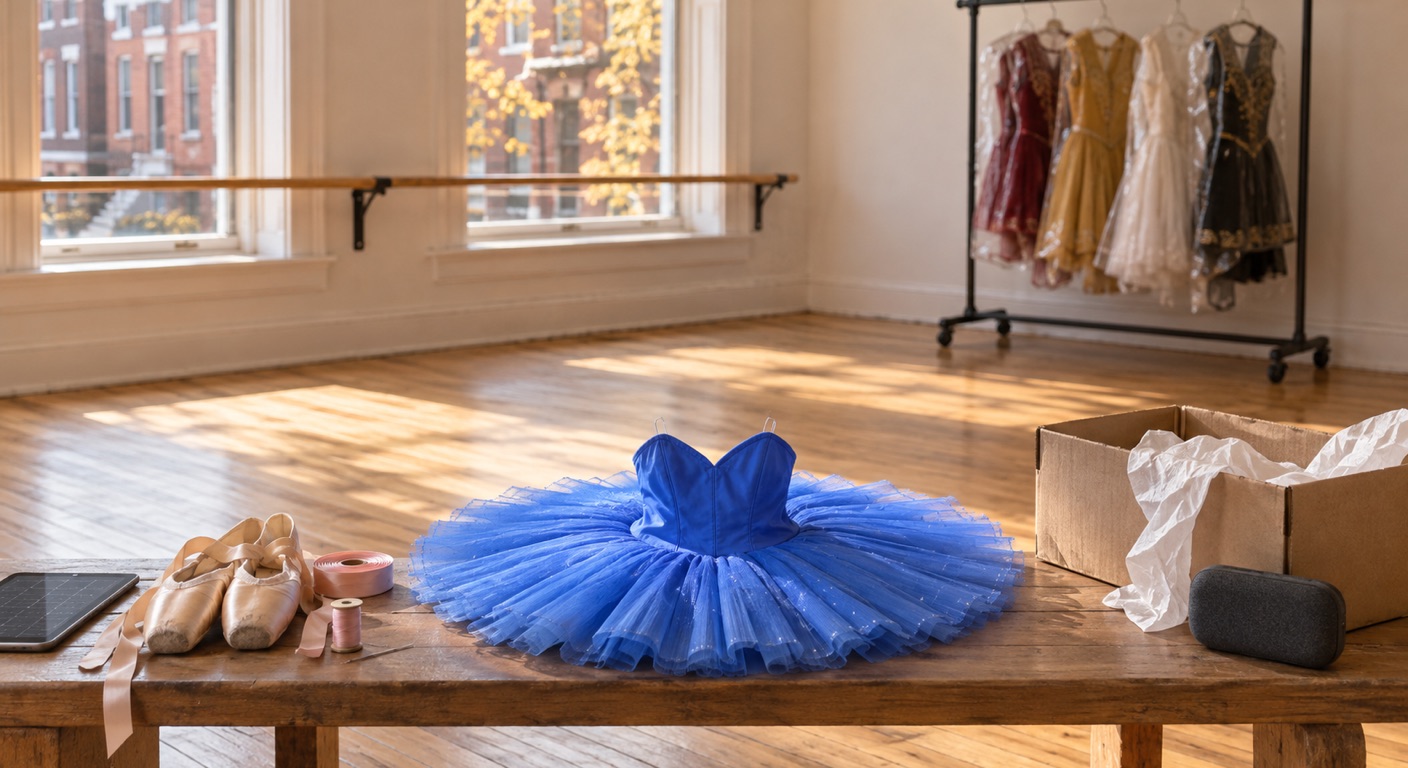
On a Tuesday morning in October, the owner of a dance studio on the second floor of a converted rowhouse in northeast Baltimore opens the laptop to four things. The costume company’s early-order discount for the spring recital closes at the end of November, and 41 families have not paid the $85 costume fee. A grandmother in Ohio asks whether she can buy last June’s recital video as a download. A father wants a receipt for his daughter’s two weeks of summer dance camp, with the studio’s tax ID on it, for the dependent care account his employer runs. And a letter from a performing rights organization asks whether the studio holds a license to play music in its classes.
Each of those touches a rule the studio’s software almost certainly does not hold. The costume fee is a retail sale of goods, which in Maryland means 6% sales tax and a sales and use tax license, even though the lessons themselves are not taxed at all. The recital video is a taxable digital product, and every song on it needs permission from the song’s publisher and the recording’s label, one song at a time, which no performing rights organization can grant. The camp receipt matters because a day camp can count toward the federal child and dependent care credit, which pays up to 50% of qualifying costs from 2026, while, in our reading, a weekly ballet class does not; the IRS wants the provider’s name, address and employer identification number, and a camp that runs seven days in three weeks may also need a youth camp certificate from the Maryland Department of Health. And the letter is not a scam. A for-profit studio that plays recorded music in class is performing it publicly, and the license for that exists, costs from under $100 to about $2,400 a year per organization depending on the studio’s size and style, and stops, in two cases out of three, at the studio door.
This article goes through those rules for Baltimore’s dance studios: ballet schools, competition studios, recreational studios, hip-hop and tap programs, and the recreation councils and nonprofits that run dance classes too. It starts with the market and with what the software costs and charges for. Then it covers the music licenses for class, recital and video, what the recital really sells and how Maryland taxes each piece, when a summer intensive becomes a youth camp, and where a studio may open in the City. After that it looks at what 19 dance studios in Baltimore City and Baltimore County and 134 studios across the country show parents and machines on their websites, at how to sell a recital online, and at what we would build. We are a software studio, not lawyers or accountants; where a rule is our reading of the text rather than an agency’s or a court’s statement, we say so.
Dance studios in Baltimore: 220,000 children, 63 schools with payroll, and big nonprofits in the City
Start with the families. In the Census Bureau’s American Community Survey for 2020 to 2024, Baltimore City had 84,692 children aged 5 to 17 and another 13,891 aged 3 and 4, the ages at which most studios start their youngest classes. Baltimore County had 136,827 and 20,014. Median household income was $62,177 in the City and $91,768 in the County, and the share of households with children under 18 was 22.2% and 29.0%. Nationally, the National Endowment for the Arts found that 2.1% of American adults took a dance class or lesson in 2022, and the Census Bureau’s last survey of children’s activities found that 30% of children aged 6 to 17 took lessons of some kind outside school.
The schools are harder to count. County Business Patterns, the Census count of businesses with paid employees, files dance studios under NAICS 611610, fine arts schools, together with music, drama and art schools, so every number in this section includes some of those. In 2023 the code had 31 establishments in Baltimore City, with 274 employees and $13.6 million of payroll, and 32 in Baltimore County, with 170 employees and $3.2 million. Most are small: 17 of the City’s 31 and 20 of the County’s 32 had fewer than five employees. As always with this source, sole proprietors are not counted at all, and dance is a trade full of them: the teacher who rents a church hall on Saturday mornings, the choreographer who teaches at three studios on contract, the owner who is also the only employee and does not run payroll. Those businesses are invisible here, so every count in this section is a floor.
| Measure | Baltimore City | Baltimore County | Source |
|---|---|---|---|
| Children aged 5 to 17 | 84,692 | 136,827 | ACS 2020–2024, B09001 |
| Children aged 3 and 4 | 13,891 | 20,014 | ACS 2020–2024, B09001 |
| Median household income | $62,177 | $91,768 | ACS 2020–2024, B19013 |
| Fine arts schools with paid employees (NAICS 611610) | 31, with 274 employees | 32, with 170 employees | CBP 2023 |
| … of which with fewer than 5 employees | 17 | 20 | CBP 2023 |
| Annual payroll | $13.6 million ($49,646 per employee) | $3.2 million ($18,565 per employee) | CBP 2023 |
| Children aged 5 to 17 per school | 2,732 | 4,276 | Our arithmetic |
| Receipts of fine arts schools | $23.9 million (26 establishments) | $8.8 million | Economic Census 2022 |
Two things in that table are worth a second look. The first is the payroll per employee, which is more than two and a half times higher in the City. The 2022 Economic Census suggests why: of the City’s 26 fine arts schools, the 10 that are tax-exempt nonprofits paid 88.8% of the payroll and employed 79% of the staff. Baltimore’s arts-education economy is anchored by institutions, not by storefronts. The Baltimore School for the Arts runs TWIGS, a tuition-free after-school arts program whose disciplines include dance, for more than 500 City children in grades 2 to 8 who pay only a $50 registration fee, and about half of the high school’s incoming class trained there. Peabody Preparatory, part of Johns Hopkins, teaches dance at six locations, runs a tuition-free training program for boys and says it awards nearly $200,000 a year in scholarships. Baltimore County Public Schools has dance magnet programs at Carver Center in Towson, Milford Mill Academy and Patapsco High School, and Towson University’s dance department has been accredited by the National Association of Schools of Dance since 1984. A private studio in the City is competing, for some of its families, with programs that cost little or nothing.
The second is how many children each school serves. With 2,732 children aged 5 to 17 per employer fine arts school in the City and 4,276 in the County, against 1,822 in Howard County and 2,166 in Montgomery, the County in particular has fewer studios with payroll per child than its wealthier neighbors. That is not proof of unmet demand, since sole proprietors, recreation councils and the schools just over the county line all teach County children, but it is the opposite of a saturated market. The region also supports the competition circuit that many studios build their year around: the Rainbow Dance Competition holds its Baltimore regional at Goucher College’s Kraushaar Auditorium on February 12 to 14, 2027, the 24 Seven Dance Convention comes to the Hilton Baltimore Inner Harbor on April 23 to 25, Turn It Up runs a one-day convention on November 15 and two regionals next spring, and StarQuest is in Ocean City on May 7 to 9.
Nationally, the 2022 Economic Census counted 16,398 fine arts schools with payroll and $6.88 billion of receipts, an average of $419,000 each. Seventy-two percent took in less than $500,000, 45% had fewer than five employees, and the 50 largest firms had only 9.4% of the revenue, so this is a trade of independents. The Census Bureau’s newer annual survey put the industry’s revenue at $7.54 billion in 2024. Classes in dance, music and theater were 73.9% of 2022 receipts. Admissions to performances, the recital line, were only $99 million, reported by one establishment in six, and costume sales were $10 million at 257 establishments. Those last two numbers are almost certainly too small, and the reason is the subject of the rest of this article: a studio’s recital money usually arrives as a “recital fee” or a “costume fee” on a tuition account, or goes straight to a ticketing platform, so it rarely gets reported as what it is.
What dance studio software costs, and what the meter counts
A dance studio usually runs three kinds of software. The first is a studio management system that registers students, bills tuition, takes attendance and, in the dance-specific products, sizes costumes and plans the recital. The second is a ticketing service for the recital, and the third, for some studios, is a streaming or video service. We read the published price of every product below on October 7, 2026, from each vendor’s own page. A few vendors, Stripe among them, show prices in euros to our network in Lithuania, so we checked the US prices from a US address. Where a vendor publishes no price, we say so.
| Product | Published price | What the meter counts |
|---|---|---|
| Jackrabbit Dance | $49 a month up to 100 students, $89 to 250, $129 to 500, $169 to 1,000, $209 to 3,000 and $245 above that; a branded-app plan from $93 a month plus a $169 setup fee; no processing rate published | All students on file, inactive ones included |
| Studio Pro (formerly DanceStudio-Pro) | $49, $79 or $165 a month with unlimited students; its own payments from 2.66% + 25¢; a 1.35% fee on every transaction if you connect another processor | The plan, and every payment |
| The Studio Director | For 101 to 250 students, $119 a month for the software alone or $79 if you use its payments; for 251 to 500, $169 or $119; cards 2.50% + 30¢, plus 1% when the card is not present, $0.75 a day in batch fees and $5.95 a month for compliance | Students, and every payment |
| Akada | $60 a month, one plan; payments through Stripe at a rate it does not publish | Nothing; flat |
| Dance Studio Manager | $40 a month; branded app $50 more; you bring your own payment processor | Nothing; flat |
| ClassJuggler | $44.95 to $99.95 a month, plus a maintenance fee of $79 to $219 a year that its terms say may rise 3% to 7% a year | Student records, active and inactive |
| iClassPro | $139, $199 or $299 per location a month; cards 2.9% + 50¢, plus a $10 monthly gateway fee | Locations, and every payment |
| Mindbody | From $79 per location a month; processing rate not published | Locations |
| Amilia SmartRec | $99 a month; cards 2.85% + 30¢ plus a 1% service fee on every invoice; implementation from $899 | Accounts, and every invoice |
| Gymdesk | $100 to $240 a month by size, or $75 to $200 if you use its payments at 2.9% + 30¢ | Active members only |
| TutuTix, DRT Performance Tix | Free to the studio; parents pay 5% + $1 a ticket at TutuTix, and $1.60 on a $10 ticket or $2.10 on a $20 ticket at DRT | Every ticket, paid by the family |
| Eventbrite | 3.7% + $1.79 a ticket plus 2.9% of each order, paid by the buyer unless the studio absorbs it | Every ticket and order |
| BoxCast, Vimeo | BoxCast streaming from $109 a month billed yearly; Vimeo live streaming on its $75-a-month plan | The plan |
Read the meters before the prices. Jackrabbit, the most common platform in our Baltimore census and tied for first in our national one, bills on the total number of students in the database at the end of the month, inactive students included, so a studio with 250 active dancers that has not archived last year’s families can find itself on the $129 tier rather than the $89 one. ClassJuggler counts inactive records too, while Gymdesk counts only active members and Amilia counts accounts invoiced in the last two years. Mindbody, iClassPro and Pike13 charge by the location whatever its size. None of that is hidden; it is on the pricing pages. But the number that decides a studio’s year is not on any of them.
To be fair to the incumbents first: the dance-specific products do the hard, unglamorous part well. Jackrabbit sizes costumes from the costume company’s own chart, collects costume fees and deposits, and says on its pricing page that its standard plans come with no contract and no setup fee and that you can export your data free if you leave. Studio Pro puts costume management, recital planning and ticket sales in its cheapest plan. The Studio Director assigns, measures, sizes, orders, labels and charges for costumes. A studio with one location and a few hundred families should look hard at these before it pays anyone to build anything.
The subscription is the small number
Here is the arithmetic for a model single-location Baltimore studio with 250 students paying an average of $95 a month for ten months, 1.6 costumes per student at $90, a $40 recital fee, two recital shows selling 1,200 tickets at $25, and 120 recital videos at $35. Tuition is $237,500, costumes $36,000 and recital fees $10,000, so $283,500 runs through the studio’s billing system; the tickets add $30,000 and the videos $4,200, for $317,700 in all. The recital alone, meaning costumes, recital fees, tickets and video, is $80,200, a quarter of the year’s money. We assumed 3,000 card payments a year and, where a vendor does not publish its processing rate, used Stripe’s US list price of 2.9% + 30¢.
| Platform and plan | Subscription a year | Card processing a year | Rate used |
|---|---|---|---|
| Jackrabbit, 101 to 250 students | $1,068 ($1,548 if inactive families push it to the next tier) | $9,122 | Not published; Stripe list price |
| Studio Pro Essentials, its own payments | $588 | $8,291 | 2.66% + 25¢ |
| Studio Pro Essentials, your own Stripe account | $588 | $12,949 | Stripe plus the 1.35% fee |
| The Studio Director, with its payments | $948 | $11,029 | 2.50% + 30¢, plus 1% card not present, batch and compliance fees |
| Akada | $720 | $9,122 | Not published; Stripe list price |
| Dance Studio Manager | $480 | $9,122 | Your own processor at Stripe list price |
| iClassPro Signature | $1,668 | $9,842 | 2.9% + 50¢, plus a gateway fee |
| Amilia Standard | $1,188 | $11,815 | 2.85% + 30¢, plus 1% per invoice |
| Gymdesk, with its payments | $2,400 | $9,122 | 2.9% + 30¢ |
Processing costs between about four and twenty-two times the subscription, depending on the row. Most of that money is not the software company’s: it is interchange paid to the banks that issued the parents’ cards, and a studio would pay most of it with any processor. The honest question is how much of it the vendor keeps, and only a few say. Studio Pro charges 1.35% on every transaction if you use an outside processor, which on this studio’s volume is $3,827 a year against a $588 subscription. Amilia’s 1% fee on every invoice comes to $2,835 against $1,188. The Studio Director prints two prices for the same software on its pricing page, one for studios that use its payments and one $40 a month higher, at this studio’s size, for studios that do not, and its 1% surcharge on cards that are not present, which covers almost every autopay tuition charge, puts this studio $1,907 above Stripe’s list price. Jackrabbit does not publish its rate; its help center says merchants typically pay an effective rate of about 3%. In March 2024 it announced an option called PayPath that let studios skip the monthly subscription by adding a technology fee to the online payments their families make; the help page that described it now returns a 404, and no current pricing page mentions it. The counterexample is Dance Studio Manager, at $40 a month with whatever processor you choose, which keeps none of the processing at all.
Two other levers matter more than the choice of platform. Bank debit is the first: moving half of the tuition from cards to ACH, which Stripe prices at 0.8% capped at $5, cuts this studio’s bill at Stripe’s list price from $9,122 to $6,253. The second is the recital. Ticketing services for dance recitals cost the studio nothing because the parents pay: on 1,200 tickets at $25, the fees families pay on top run from $1,650 at Stage Stubs ($0.50 plus 3.5% a ticket) to about $2,700 at TutuTix and about $4,200 at Eventbrite, and a studio that absorbs them instead gives up the same amount. Card processing on the recital store alone (costumes, recital fees, tickets and video) would be $2,632 at Stripe’s list price, more than any yearly subscription in the table above.
It is also worth knowing who is on the other end of the payments. Mindbody’s parent company, Playlist, which also owns ClassPass, completed a merger with EGYM on March 31, 2026, at a combined enterprise value of $7.5 billion. Pike13 has belonged to Jonas Software, part of Constellation Software, since 2018, and Sawyer has been part of DaySmart since November 2023. Jackrabbit, founded in Charlotte in 2004, is still run by its founders and says it serves more than 7,000 clients; Studio Pro makes the same 7,000 claim for dance studios, and The Studio Director says it works with more than 2,000. None of that is a reason to leave a platform that works. It is a reason to know which of your numbers (tuition, costumes, tickets, video) pass through whose hands, and at what rate.
Do dance studios need a music license? Three licenses, three places, and none for the video
The short answer is yes, if the studio is a business and plays recorded music in class. The Copyright Act gives the owner of a song the exclusive right to perform it publicly, and it defines performing publicly as doing so “at a place open to the public or at any place where a substantial number of persons outside of a normal circle of a family and its social acquaintances is gathered” (17 U.S.C. §101). A ballet class open to anyone who registers is that place. The exemption most studio owners have heard of, §110(1), covers “face-to-face teaching activities of a nonprofit educational institution,” which leaves out every for-profit studio; whether a particular nonprofit community program counts as an educational institution is a question for its lawyer, not for us.
There is one piece of good news in the statute. A recording, as distinct from the song on it, has no general public performance right in the US: the rights in a sound recording “do not include any right of performance under section 106(4)” (§114(a)), apart from a narrow right in digital audio transmissions. So when a teacher plays a track in the room, the record label has no claim. Only the songwriters and publishers do, and they license public performances in bulk through four organizations: ASCAP, BMI, SESAC and Global Music Rights. Because a single pop song often has co-writers belonging to different organizations, a studio that plays the charts needs a license from each of them.
What those licenses cost is normally quoted on request, but Colorado makes ASCAP, BMI and SESAC file their standard contracts with its Secretary of State every year, and the 2026 filings include each organization’s dance-school license with its rate schedule. ASCAP prices by the average number of students a week: a studio teaching the usual mix of ballet, jazz, tap, modern and hip-hop pays $138.22 a year for up to 75 students, $276.43 for up to 150, $414.68 for up to 300 and $552.90 above that, with ballet-only schools paying two-thirds of those amounts and ballroom studios a third more; a student taking five or more hours a week counts as two. BMI prices by the number of different students a week, from $224 for fewer than 60 to $1,180 for 375 or more, and charges more if music also plays in the lobby. SESAC charges a flat $213 per location, rising each January by inflation or 5%, whichever is greater. Global Music Rights lists dance schools on its license form but publishes no rate.
| License | How it is priced | 2026 price | Does it cover the recital? |
|---|---|---|---|
| ASCAP, dancing schools | Average students a week | $138.22 to $552.90 for mixed styles; $92.16 to $368.59 ballet only; $184.31 to $737.17 ballroom | Only at the place where the studio teaches, for one student recital a year (our reading of the contract) |
| BMI, dance classes | Different students a week, and whether music plays outside the studio rooms | $224 to $1,180; $352 to $2,361 with lobby music | Only on the studio’s premises, and only if no admission is charged |
| SESAC, dance, cheer and gymnastics facilities | Per location | $213 | Yes, including venues the studio engages for its students’ recitals |
| Global Music Rights | Not published | Not published | Not published |
| All of them | Recital video, livestream, edited or mashed-up tracks | Never; those need the publisher and the label | |
For a studio with 150 students, that is $276.43 to ASCAP, $665 to BMI and $213 to SESAC, or about $1,150 a year before Global Music Rights, and about $1,550 if music plays in the lobby too. There are discounts: BMI says it has partnered with Dance Masters of America on discounted rates, through a discount form the association says reopens in January 2027, and the Chicago National Association of Dance Masters says its group contracts with all three organizations save members 35% to 50%. One shortcut does not work. The license a background music service holds for the shops it plays in does not carry over to a dance class; BMI’s own contract for those services says its coverage does not extend to dance studios.
The recital happens somewhere else
The license that covers Tuesday’s jazz class usually does not cover June’s recital, and the reason is geography. ASCAP’s dance license is granted for the place where the studio gives instruction and not elsewhere, with an extension for one recital by the studio’s students a year; read together, we take that to mean one recital at the studio. ASCAP’s online version of the same license lists recitals at the premises. BMI’s dance license is limited to the licensed premises and reaches student recitals only when no admission is charged. SESAC’s is the exception: it expressly covers locations the studio engages for recitals featuring its students. So a ticketed recital in a rented high school auditorium is inside one of the three dance licenses and outside the other two.
That gap has two practical fixes. The first is the venue: a performing arts center that hosts outside events may hold its own blanket licenses that cover what happens on its stage, and a school auditorium may not, so ask in writing before you sign the rental agreement, and keep the answer with the recital file. The second is the organizations themselves. ASCAP already sells the right product to a different trade: its music school license covers student recitals at venues of up to 1,000 seats, anywhere, for $322 a year plus $27 for each ticketed recital. It has a concert license priced at 0.80% of net ticket revenue for venues up to 2,500 seats, with a $319 minimum, and BMI has a $449 license for paid events where music is not the main attraction, although a dance recital may not qualify for either. Ask both for a written recital rider before the tickets go on sale. It is the cheapest problem in this article to fix in advance.
A nonprofit studio has one more option. Section 110(4) of the Copyright Act exempts a performance, other than a transmission to the public, given “without any purpose of direct or indirect commercial advantage and without payment of any fee or other compensation for the performance to any of its performers, promoters, or organizers,” if there is no admission charge, or if the net proceeds are used “exclusively for educational, religious, or charitable purposes and not for private financial gain.” Even then a copyright owner can object by serving a signed notice at least seven days before the show (37 CFR 201.13), and the exemption does not reach a livestream. Note also what the blanket licenses leave out. Each covers only non-dramatic performances, and ASCAP’s contract treats songs performed with dance as part of a story or plot, and music from a ballet performed with dance, as dramatic; BMI and SESAC exclude what the industry calls grand rights. A recital built as a musical with a plot, or a story ballet set to copyrighted music, may need the publisher’s direct permission. The University of Maryland, Baltimore County’s dance department in Catonsville publishes guidance that tests for a plot, characters, costumes and scenery.
The Nutcracker is the friendly exception. Tchaikovsky’s score is in the public domain in the US, as is every musical composition published in 1930 or earlier as of 2026 (recordings follow different rules), so a studio staging its own Nutcracker to a recording of the original orchestration owes nothing to anyone for the music when it plays that recording in the theater. The recording itself is another matter, but only once it goes on video.
The video is a different right, and nobody sells it by the year
It is easy to assume the recital video is covered by whatever covers the recital. It is not, and no license on the market covers it in bulk. When a song is copied onto a DVD, a download or a stream, the right involved is no longer public performance but reproduction, and the compulsory license in §115, which lets anyone record a cover version for a set royalty, applies only to phonorecords, which the statute defines as excluding “sounds accompanying a motion picture or other audiovisual work.” As the Copyright Office put it in its 2015 report on music licensing, the licensing of music for audiovisual works, “unlike that for other uses, occurs in the free market for both musical works and sound recordings,” with the song’s publisher and the recording’s label usually paid about equally. A recital video with 40 routines can need 80 separate permissions. ASCAP and BMI both say they do not license this use, and all three dance licenses exclude transmissions to people outside the premises.
Livestreams fail more visibly. YouTube’s help center says every livestream is scanned for third-party content and that a match can replace the stream with a placeholder or end it, even when the music is licensed, unless the rights owner has cleared the channel; archived streams are scanned again afterward. Meta’s music guidelines prohibit using music for commercial or non-personal purposes without the necessary licenses and apply that to live video. The streaming services studios use for recitals put the problem back on the studio: BoxCast’s terms have the customer represent that it owns or controls all rights in what it streams, and Vimeo’s let you upload only what you have the right to share. Australia shows what a market solution can look like, with a collective dance-school license that includes a video recording package. Nothing like it exists in the US.
So a studio that sells recital videos has three honest choices. It can choose music for the routines it plans to sell from production libraries that license video use, or commission or record its own. It can license the specific songs on the video from their publishers and labels, which is slow and rarely cheap. Or it can stop selling video of routines set to unlicensed songs. None of the 134 studio websites in our national census and none of the 19 in Baltimore said a word about music licensing; 16 of the 134 and three of the Baltimore studios sell or bundle a recital video. In software terms, every routine needs a music record, with the song, its writers and publisher, the recording and its label, and a license status for class, stage and video, and the video store should offer only the routines whose status says it may.
Your choreography is yours, mostly
The routine itself is a different story, and a better one for studios. Choreography is protected by copyright under §102(a)(4), with limits. The Copyright Office’s Circular 52 says “choreographic works do not include social dance steps and simple routines,” and that individual steps such as “the basic waltz step, the hustle step, the grapevine, or the second position in classical ballet” are not protected either. But in Hanagami v. Epic Games, decided November 1, 2023, the Ninth Circuit revived a choreographer’s claim over four counts of a roughly five-minute routine used as a video game emote, holding that “Short does not always equate to simple.” An original routine is usually the studio’s own work when its employees created it or a contract choreographer assigned the rights in writing, which is a reason for its video store to use private, expiring links rather than open downloads, and for its policies to say who may post rehearsal footage. In our national census, the only studio that cited copyright in a recording policy was an Arkansas studio asking parents not to post class videos, and it was protecting its choreography, not anyone’s music.
Maryland’s rules for the people who send the letters
Maryland is one of the states that regulate how these organizations sell. Under Commercial Law §11-1402, a performing rights society may not sign a contract with a business unless, “no later than 72 hours prior to the execution of the contract,” it gives the owner in writing its schedule of rates and terms, the rates it charges comparable businesses within 25 miles (the “area,” as §11-1401 defines it), a toll-free number, any discounts it offers locally, and notice that failing to provide all this “may render a contract unenforceable.” It must offer a one-year contract. Its agents must say whom they work for before discussing a contract, and it may not charge a royalty “which is unreasonable in comparison to the royalties for similar licenses in the same area” (§11-1403). A business harmed by a violation can recover its damages and attorney’s fees. The law does not reach the owners of audiovisual works, so it gives no help with the video. Our reading is that a dance studio, a place of business where the public assembles and music is performed, fits the statute’s definition of a proprietor.
The letter is worth answering. We found no case on CourtListener in which ASCAP, BMI or SESAC sued a dance studio, but the nearest Baltimore example shows what silence costs. In BMI v. Disorder LLC, BMI wrote to the Ottobar, the music bar on North Howard Street, on October 5, 2023, sent ten more letters and emails by mid-December, had an investigator record there in 2025, and then sued over three songs. On June 23, 2026, after the owners conceded the infringement was willful, the court awarded $12,048.75, two and a half times the $4,819.50 annual license fee, plus $6,500 in attorney’s fees, noting that “Courts have generally found statutory damages equal to approximately two or three times the amount a plaintiff would have received in licensing fees.” The statute allows from $750 to $30,000 per song, and up to $150,000 for willful infringement (§504(c)). For a studio, the license is the cheap option.
The recital is the store: costumes, tickets and the video
In the model studio above, the recital brings in a quarter of the year’s money, and it sells on a calendar the studio does not control. Costume deposits are due in November and the balances in January, the costumes arrive in the spring, the shows are in June, and the videos go out over the summer. Each of those steps is a sale with its own deadline, its own refund rules and its own tax line, which is why a recital run from a tuition ledger and a spreadsheet goes wrong in the same places every year.
Costumes: a deposit in November for a show in June
The costume companies sell to studios, not to families. Weissman and Costume Gallery both say on their sites that they do not take orders from parents or students, so the studio is the buyer of record and every costume it hands to a child is a resale. The ordering calendar is set by the suppliers. Costume Gallery takes an extra 5% off orders placed with at least half paid by November 30, 2026, adds bulk discounts of 3%, 5% and 8% at $3,500, $5,000 and $6,500, wants the balance by January 29, 2027, and treats deposits as non-refundable. A Wish Come True asks for a 50% deposit with the order, calls December and January its heavy season, and warns that styles may not be available to reorder and that dye lots can vary. A studio in Elkton, in Cecil County, explains the consequence to its parents in its 2026 recital packet: every studio in the country orders in the same window, so sizes sell out; delivery takes 8 to 16 weeks and a size exchange up to 12 more; the costume costs $96 if ordered by December 19 and $111 after; there are no refunds once it is ordered; and a child in both jazz and tap needs two. Its youngest dancers can rent a costume for $56 or rent-to-buy for $76 instead of buying it for $96; the studio says the $96 price includes sales tax and a $21 recital fee.
Sizing is a data problem, and the suppliers say so. Costume makers use their own size codes, which is why parents search for terms like “dance costume size IC”: Costume Gallery’s child sizes run from XSC to XXLC and its adult sizes from SA to XXLA, and its 2026 order form asks for the date the costumes should arrive, warning in capitals that this is not the recital date. Weissman tells studios to size one-piece garments by girth, to choose the larger of two sizes when measurements disagree, to allow an inch and a half to two inches of girth for growth, and, if the studio uses class management software, to download its current size charts into it before entering any measurements. A measurement taken in September for a costume worn in June is a record with a date on it, and the software should treat it like one.
What studios charge for all this is harder to find. Of the 134 studios in our national census, 66 mention costume fees, but only 20 state a dollar amount per costume, and 25 call the fee non-refundable. The amounts ran from $40 to $142.50, with a median of $85 and the middle half between $72 and $99. In Baltimore, six of the 19 studios we checked state a costume amount, between $40 and $150 including deposits, and Hampden Dance Arts builds an $82 costume fee into the online price of its children’s classes.
Reselling costumes to parents also makes the studio part of the federal children’s product chain. A costume for a child 12 or under is a children’s product, which must be tested by a third-party lab and covered by a Children’s Product Certificate. The manufacturer or importer issues the certificate, and under 16 CFR 1110.13(b) it “must furnish the required finished product certificate to each distributor or retailer of the finished product.” A studio that buys costumes to hand on to families fits the statute’s definition of a retailer, “a person to whom a consumer product is delivered or sold for purposes of sale or distribution by such person to a consumer” (15 U.S.C. §2052(a)(13)), and a retailer that “holds a certificate issued in accordance with section 2063(a)” is protected from the main prohibitions “unless such person knows that such consumer product does not conform” (§2068(b)). None of the costume makers’ public policy pages we read mentions certificates at all. Ask for them with the order and keep them with the costume record; it costs nothing, and it is the document that protects you. We covered the rest of this regime in our toy and game store post.
Tickets: the parents pay the platform, and the county taxes the seat
Thirty of the 134 studios in our national census sell recital tickets online, and the ticket platforms studio sites link to most often are Eventbrite, Etix, Ticketmaster and Arts People; the ten studios that state a price charge a median of $20, between $12 and $25. In Baltimore, five of the 19 studios sell show tickets online, one of them through the theater’s own box office; the others that mention tickets sell them at the front desk, on paper forms or inside a fee. As the pricing section showed, the recital ticketing services charge the studio nothing and the families a dollar or two a ticket, and they pay out weekly or after the show.
The venue is the bigger cost, and some publish their terms. Baltimore City Public Schools charges a group that collects admission $386 a day for a school facility, plus staff by the hour, $32 for a custodian, $42 for an engineer and $70 for school police, billed from an hour before the event to an hour after; its rules require $1 million of liability insurance naming the Board and the City, payment five business days ahead, and an application that states the admission charged and how the proceeds will be used, and it says it waives fees for no one. Baltimore County Public Schools asks for applications at least 45 days ahead and charges from a schedule kept by its facilities department, which we could not find online. The Gordon Center in Owings Mills seats 550, lists a Marley dance floor as required in its rental questionnaire and allows no ticket sales before the contract is signed and the deposit paid. Chesapeake Arts Center in Brooklyn Park seats 751 and takes show music only as MP3 or MP4 files on a USB drive. Towson University’s Stephens Hall seats 680 and Howard Community College’s Smith Theatre 424. Every one of those is a seating map a reserved-seat box office has to know.
Then the tax. In Maryland a recital ticket is a charge for “admission to a place” under the admissions and amusement tax (Tax-General §4-101(b)(1)(i)), which Baltimore City and Baltimore County both levy at 10%, and a sale of an admission subject to that tax is outside the sales tax (§11-221(a)(1)). The lessons are not admissions: the Comptroller’s Business Tax Tip #24 names dance schools among the schools whose ongoing classes are exempt. Two exemptions in §4-103(b) matter for recitals. One covers admission to “a concert or theatrical event presented or offered by a nonprofit group” that is “organized and operated for a cultural purpose and receives a grant directly or indirectly from the Maryland State Arts Council.” The other covers receipts “used exclusively for” a charitable, educational or religious purpose. Our reading is that a for-profit studio’s recital is taxable at 10%, a nonprofit youth company with a State Arts Council grant is not, and the ticketing platform will not file the return for you. Our entertainment center post walks through how the tax works.
The video: a digital product, sometimes hidden inside a fee
The recital video is the easiest product in the store to sell and the hardest to sell correctly. Maryland taxes it at 6%. The definition of a taxable digital product includes “a series of related images that, when shown in succession, impart an impression of motion,” expressly including “live events” (§11-101(c-4)), and COMAR 03.06.01.16 says the sale of a photograph is taxable whether it is delivered electronically or in tangible form. A recital video on a USB drive is taxable as goods. For a download, the Comptroller’s Business Tax Tip #29 says separately charged production services for electronically delivered products are not taxable, so our reading is that a separately invoiced filming fee may escape the tax while the copy itself does not.
Many studios do not sell the video separately; they fold it into a fee. Ten of the 16 studios in our national census that offer a video bundle it into a charge every family pays, such as a recital fee of $85 that covers a T-shirt, a medal, photos and a video download, or a required $25 media fee. In Baltimore, one studio includes a video download in its all-inclusive concert fee, another puts a family’s recital download inside a $40 registration and technology fee, and a third posts a $30 recital video fee to the family’s account. Bundling does not make a taxable product untaxable, in our reading, and it bundles the music problem described above into a fee that every family has paid. Recording rules tell a similar story. Ten of the 134 studios have any rule about recording, three of them banning audience video at performances. Where a reason was given, it was distraction or safety, although a Tennessee studio that bans audience video at its recital, like a Michigan township recreation program that does the same, sells a video of its own. One Baltimore County ballet school warns of a $2,500 fine for filming a closed dress rehearsal. A recording ban protects the studio’s video sales; it does nothing about the soundtrack.
What Maryland adds: the costume tax, summer camps and the zoning map
Most of what the state asks of a dance studio is not about dance. It is about the goods the studio sells, the camps it runs in the summer and the building it teaches in, and most of it is left to the studio to get right. This is the part of the article we would read twice.
Lessons are not taxed; almost everything sold around them is
Maryland’s sales tax applies to goods, digital products and a closed list of services, and instruction is not on the list (Tax-General §11-101). Tuition, private lessons and a drop-in class carry no tax. A costume billed as a separate fee is different: it is a retail sale of goods, taxed at 6%, and a studio that makes such sales must be licensed by the Comptroller first: §11-702 requires a license before a person may “engage in the business of a retail vendor.” The license is what lets the studio buy costumes without paying tax to the supplier. Under COMAR 03.06.01.14, a resale certificate needs no particular form but must give the buyer’s name, address and eight-digit Maryland registration number and say the purchase is for resale; a blanket certificate can cover every order, and a supplier may not accept one for a purchase under $200 paid in cash or by card or check unless the goods are delivered to the buyer’s place of business. One of the large costume makers says on its site that it charges sales tax unless the studio has a resale certificate on file.
Folding the costume into tuition does not make the question go away; it changes who owes the tax. Section 11-219(a) exempts a personal service that “involves a sale as an inconsequential element for which no separate charge is made,” and in that case COMAR 03.06.01.01 makes the provider pay tax on the materials it transfers as part of the service. Neither text defines “inconsequential.” Our reading is that a $90 costume a child takes home is hard to describe that way, so a studio that bundles costumes into a recital fee is inviting an argument it may lose, and the cleaner course is to bill the costume as its own line and collect 6% on it. A costume rental is a sale too, since the statute’s definition of a sale includes a transfer “by lease, rental, royalty agreement, or grant of a license for use,” so the Elkton studio’s $56 rental is taxable in the same way as its $96 purchase.
The rest of the store follows the same logic. Leotards, tights and dance shoes are clothing and footwear and taxable at 6%; Shop Maryland Tax-Free Week, which the statute fixes as the second Sunday in August through the following Saturday, will run from August 8 to 14, 2027, for items priced at $100 or less, although the Comptroller has not yet posted those dates. A nonprofit studio buys tax-free for its own work but, in our reading of §11-204, still collects tax when it sells costumes, because sales by nonprofits are exempt only in listed categories that do not include this one. Prerecorded online classes sold by a for-profit studio are taxable digital products, since the exclusion for instruction covers only schools and colleges and live instruction for a buyer’s profession. And since July 1, 2025, the studio’s own software and website services carry Maryland’s 3% tax on technology services, which we explained in a separate post.
When a summer intensive becomes a youth camp
Summer is where studios earn the money that carries them through the slow months, and it is where a studio can become a regulated camp without noticing. Maryland’s youth camp rules, in COMAR 10.16.06.02, define a youth camp as a program that accommodates seven or more unrelated campers in a calendar year and provides primarily recreational activities, meaning they fill at least half of a camper’s time. A day camp is one that is “conducted for at least 7 calendar days during a 3-week period” and provides “three or more recreational activities or any one specialized activity or program.” Dance is on the list of recreational activities, alongside music, drama, art, crafts, games and “instruction or skill development” in any of them. It is not on the separate list of specialized activities, which runs from archery and aquatics to horseback riding and artistic gymnastics. The rules leave out programs that run before or after the school day, which keeps a studio’s ordinary after-school classes outside them, and they leave out short daily instruction only for the specialized activities, so that exclusion does not help a dance program.
Put that against a studio’s summer calendar. A single five-day intensive is not a day camp, because it does not reach seven days. A six-week summer camp that mixes dance with crafts and games is a day camp and needs a certificate, and several Baltimore studios advertise camps that run for six weeks or all day. The hard case is a ballet intensive that runs two weeks of nothing but technique, pointe and variations, because whether those count as one recreational activity or three is a question the Maryland Department of Health has not answered in anything we could find. Our reading is that back-to-back weekly sessions count as days the camp operates, whichever week a child attends.
The certificate itself is not expensive. A new day camp applies at least 60 days before it opens, or 30 days for a renewal, and pays a fee set by camper days: $190 for up to 500, $500 up to 2,000, $665 up to 5,000 and $855 above that, falling to between $45 and $215 for camps in good standing, plus $20 for each background check. What it requires is the expensive part, and almost all of it is data. Staff need fingerprint-based checks through the department and a child protective services clearance. The director must be at least 21, two adults certified in CPR and two in first aid must be on duty at all times, and the youngest campers, aged three and a half to five, need one adult for every eight. A written health program must be approved every year by a physician, nurse practitioner or registered nurse; each camper needs a health record on file at admission with the name of the child’s health care provider, any health problems, two emergency contacts and proof of immunization; and medication is kept locked and given only with a signed authorization. The state’s camp database lists 129 certified camps and programs in Baltimore County and 58 in the City, at least six of them with “dance” in the name, Baltimore Dance Tech’s summer dance camp among them, so local studios do get certified. None of the 11 studios in our Baltimore census that advertise a camp or intensive mentions a certificate on its website, but one of them, Baltimore Dance Tech, is in the state’s database anyway, so that silence proves nothing. A studio running its camp in a City school building pays the school system $78 a day for the space, the rate City Schools charges summer camps that charge families.
The receipt a parent needs for a day camp
The same camp has a federal side that parents care about more than the studio does. IRS Publication 503 says that “the cost of sending your child to a day camp may be a work-related expense, even if the camp specializes in a particular activity, such as computers or soccer,” while overnight camps do not count and “Summer school and tutoring programs aren’t for care.” A dance day camp can therefore count toward the child and dependent care credit, which the IRS says rises from a maximum of 35% to 50% of qualifying expenses beginning with tax year 2026, on up to $3,000 of expenses for one child or $6,000 for two or more. It can also be paid from an employer’s dependent care account, whose limit rose from $5,000 to $7,500 in 2026. A weekly ballet class, in our reading, is a lesson rather than care and does not count.
For the parent to claim any of it, the IRS wants the provider’s name, address and taxpayer identification number, which for a business is its employer identification number. Publication 503 lists “a recently printed letterhead or invoice that shows the provider’s name, address, and TIN” as an acceptable source and warns that “Care providers can be penalized if they don’t provide this information to you or if they provide incorrect information.” It also says the expenses for care do not include amounts paid for “food, lodging, clothing, education, and entertainment,” so a camp T-shirt or a costume should sit on its own line. A studio’s software should produce a camp invoice with the EIN printed on it, the child’s name, the dates of care and the care amount separated from everything else, and a year-end statement for each family, and it should never label a weekly class as care. It is a small feature that a parent remembers in April.
Where a dance studio may open in Baltimore City
Baltimore City’s zoning code names the use outright. An “arts studio” is “an establishment in which an art, a type of exercise, or an activity is taught, practiced, or studied, such as dance, martial arts, photography, music, painting, gymnastics, or yoga,” and it includes “performance-space related to the classes taught on-site” (Zoning Code §1-302(u)). It is permitted in every commercial district from C-1 to C-5. It is not on the list of uses for the rowhouse and multifamily districts, R-5 through R-10, where only listed uses are allowed. The way into a rowhouse neighborhood is a conditional use called a neighborhood commercial establishment, which needs Board of Municipal and Zoning Appeals approval, is available only in certain existing buildings, and lists arts studios among the uses it may contain (§14-328). Teaching from home is limited by the home occupation rules to “no more than 3 a day and 10 a week” client visits (§15-507), which rules out a basement studio with a class schedule. We did not research Baltimore County’s zoning for this article.
A few more Maryland rules come up often enough to mention. The Health Club Services Act, which we covered in our fitness studio post, reaches agreements for services lasting more than three months, with more than three months paid in advance, at health spas, figure salons, weight reduction centers, self-defense schools and “other physical culture service enterprises”; dance is neither named nor excluded, so monthly billing stays clearly outside it and a season paid in full up front may not. A printed class card or gift certificate may not expire or carry fees for four years (Commercial Law §14-1319). Maryland recognizes a claim for using someone’s likeness, and in Lawrence v. A.S. Abell Co. (1984), a Baltimore case about the Sunpapers reusing a festival photo of two infants in their own advertising, the court found the reuse incidental, noting that the children were not famous; a studio ad built around a student is a more direct use, so get a written release from a parent. Teachers paid as independent contractors face Maryland’s unemployment test, under which work is excluded only if it is outside the usual course of the business or performed outside any place of business (Labor and Employment §8-205), and in our reading a contractor teaching in the studio’s own rooms rarely fits. The minimum wage is $15.00 an hour, and employees under 18 may be paid 85% of it, $12.75.
What 19 Baltimore dance studios show a parent, or a machine
On October 7 we read the websites of 19 youth dance studios, recreational and competition, six in Baltimore City and 13 in Baltimore County, along with four recreation-council dance programs and seven adult ballroom and social studios that we counted separately. For each site we read the home page, up to 22 linked pages and any linked PDFs, and recorded what a parent could learn and what a machine could read. Search engines and most directories refused automated searches, so the list is not every studio in the two jurisdictions, and “not found” means not found on the pages we read.
| What we looked for | Baltimore City (6) | Baltimore County (13) | Total (19) |
|---|---|---|---|
| Dedicated studio software (Jackrabbit, DanceStudio-Pro, The Studio Director) | 4 | 9 | 13 |
| Class prices published | 3 | 7 | 10 |
| Costume amount stated | 2 | 4 | 6 |
| Recital or show tickets sold online | 1 | 4 | 5 |
| Recital video or photos sold | 1 | 2 | 3 |
| Livestream offered | 0 | 0 | 0 |
| Music licensing mentioned | 0 | 0 | 0 |
| Summer camp or intensive advertised | 5 | 6 | 11 |
| Youth camp certificate mentioned | 0 | 0 | 0 |
| Refund or withdrawal policy published | 2 | 8 | 10 |
| Structured data on the home page | 4 | 9 | 13 |
| Recital marked up as an event | 0 | 0 | 0 |
| AI crawlers blocked in robots.txt | 0 | 0 | 0 |
| An llms.txt file | 1 | 7 | 8 |
Two platforms dominate. Jackrabbit runs seven of the 19 studios and DanceStudio-Pro five, one of them already linking to the new Studio Pro address, with The Studio Director at one more. The other six take registrations through Google Forms, PDF forms, a WooCommerce store or the front desk. None of the 19 studios uses Mindbody, Akada, Sawyer, iClassPro or Pike13, and the only Mindbody studio we found was just over the line in Howard County. Prices are published by about half: Baltimore Ballet in Cockeysville lists its per-session tuition, the Mid-Atlantic Center for the Performing Arts in the City lists $750 a year, and Hampden Dance Arts lists $263 for a fall period of an hour a week. The refund policies that exist are firm; Hampden’s says all payments are final, and Baltimore Ballet charges a $50 fee to withdraw.
The recital store is mostly invisible. Six studios state a costume price, five sell tickets online (through Etix, DanceStudio-Pro’s ticketing, a theater box office or the studio’s own order form or web store), and the three that sell a recital video bundle it into a fee, as described above. Nobody livestreams and nobody mentions music licensing. Eleven advertise a summer camp or intensive, some running six weeks or from 7:30 in the morning to 6 at night, and none of them mentions a youth camp certificate. The recreation councils are the clearest about money: Carroll Manor’s dance program charges $340 with one costume and $280 without, and bans videotaping at its recital.
What machines see is thinner still. Thirteen of the 19 home pages carry structured data, but most of it is the generic website and web page markup that site builders add, and only four describe the studio as a local business. Not one studio marks up its recital or its Nutcracker as an event; the only event markup in all the sites we crawled belonged to an adult ballroom studio. None blocks AI crawlers, and eight have an llms.txt file, the plain-text summary some AI tools read, but every one of those files was generated by a website builder or an SEO plugin rather than written by the owner, and one is titled with nothing but the studio’s initials. The class schedules, prices and openings that a parent asking an AI assistant for “ballet classes for a six-year-old near Towson” actually needs live inside the registration platforms, behind the studio’s own site. Seven studio addresses we found in directories led to sites that were dead, parked, expired, redirected elsewhere or taken over by spam, and directories list at least a dozen more Baltimore-area dance programs for which we could find no website at all.
The positive examples are worth naming. Hampden Dance Arts publishes its prices and sells children’s classes through its own store with the costume fee already included. Baltimore Dance Tech prices its concert as one all-inclusive fee and runs a summer camp that appears in the state’s certified camp database. The Moving Company Dance Center in Cockeysville and White Marsh Ballet Academy both describe themselves to search engines as local businesses, and White Marsh sells its tickets through a real box office. Each does one part of the job well; none of them does all of it.
What 134 studios across the US sell around the recital
To see whether Baltimore is typical, we built a national sample the same day. OpenStreetMap lists about 900 dance schools in the US with a website; we set aside Maryland, ballroom, salsa, pole and fitness studios and the national chains, drew a random sample of up to six studios per state, and read each site’s home page and up to 26 linked pages, including recital handbooks and policy documents posted as PDFs or Google Docs. After dropping dead sites, thin sites and businesses that turned out not to teach children, 134 studios in 44 states and the District of Columbia remained.
Most studios talk about the recital, and most say very little about what it costs. Ninety-four of the 134 mention a recital or year-end show and 85 publish their tuition, with a median of $70 a month for an hour a week among the 17 that state a clear monthly price, but only 13 state a recital fee, a median of $50, and only 20 a price per costume. An Ohio competition studio’s handbook commits parents to a non-refundable costume fee of $125 per class, due before Thanksgiving; a Kentucky studio says its costumes averaged $78 plus tights; a Missouri studio sells recital videos at $30 for one show or $50 for both and lets parents take photos from their seats without a flash. Three studios offer a livestream. Not one of the 134 mentions music licensing, rights or copyright in connection with music; the two studios that claimed any rights at all were claiming them in their own choreography.
The platform picture matches Baltimore’s. Jackrabbit and DanceStudio-Pro were tied at 31 studios each, The Studio Director had 17, iClassPro two, and Mindbody, Pike13 and Punchpass one each; 50 studios showed no studio platform at all on their public pages. We found no Akada, Sawyer, Amilia, Gymdesk, Momence, WellnessLiving or Glofox. The websites themselves were built mostly on Wix (37), WordPress (35) and Squarespace (26). For machines, the numbers are another reminder that most robots.txt and llms.txt files on these sites are written by site builders rather than owners: one studio blocks OpenAI’s crawler, 34 block only PetalBot, the crawler of Huawei’s search engine, because Wix’s default robots.txt does, and 50 have an llms.txt file, 32 of them on Wix.
One caveat goes beyond the note under the chart: a sample drawn from a map favors studios someone bothered to map. Even so, the gap is the same in both censuses and it is not small: the recital is the biggest once-a-year sale most studios make, and almost none of them describes it the way a store would.
How to sell a recital online: one store, four deadlines
If a studio asked us to turn its recital into an online store, the result would look less like a shop and more like a calendar with a checkout attached. Registration opens in late summer, costume deposits fall due in November and balances in January, tickets go on sale in the spring, the shows happen in June and the video ships in July, and the summer camp, with its own paperwork, overlaps the end of all of it. Each deadline belongs to a product, and each product needs facts that a generic store or a tuition ledger does not keep.
The catalog: classes with prerequisites, costumes with size codes
A class is a product with conditions. It has an age range measured on a fixed date, a level that a teacher may have to approve, a room with a capacity, a weekly time and a price by the month or the session, and it should know which recital routine, which costume and which music it leads to. Tuition is a subscription, and the cheapest way to collect it is by bank debit rather than by card, which is worth offering at checkout with the saving explained. A family is a household with several dancers, guardians, a photo release that says yes or no, and a payment method, and the store should treat it as one account rather than as a pile of student records.
A costume is a variant product that belongs to a class. It carries the supplier’s style number and size codes; the dancer’s measurements with the date they were taken; a deposit date and a balance date that follow the supplier’s calendar rather than the studio’s; the statement, before payment, that the costume is final sale once ordered; the 6% Maryland tax line; and, behind the scenes, the resale certificate on file with the supplier and the children’s product certificate the supplier sent. Where the studio rents costumes, the rental is its own taxable product with a return date. Dancewear and shoes are ordinary sized products, with the one Maryland wrinkle that items priced at $100 or less are tax-free for a week each August.
Tickets, video and camp: who may buy what
The box office needs the venue’s seating map, a show for each performance, a limit per family when seats are scarce, and a tax setting that knows whether the studio owes the 10% admissions tax or qualifies for an exemption. It should not open until the venue contract is signed, which at least one Baltimore County theater makes a condition of the rental, and it should know who is paying the ticket fees. The video store is the subtle one. It sells routines rather than shows, and each routine’s music record decides whether that routine may appear in the video at all; a routine set to an unlicensed song is simply not offered. Downloads and streams are taxable digital products, a separately invoiced filming fee is its own line, the links should be private and expire, and the families who declined the photo release should not find their children on a public page.
The camp is a registration form with a regulator behind it. It needs the health record fields Maryland requires at admission (the child’s health care provider, any health problems, two emergency contacts and proof of immunization), plus a signed medication authorization where one applies; capacity limits set by the staff ratios for each age group; and a receipt that prints the studio’s employer identification number, the child, the dates and the care amount on separate lines from the T-shirt. Every one of those is a field in a form a studio already uses; the difference is whether the software knows what each field is for.
What Google and AI assistants can read about your classes
Search engines and AI assistants read a studio’s classes much less well than parents do, and the structure of the web is part of the reason. Schema.org, the vocabulary that search engines use for structured data, has no type for a dance school; the address schema.org/DanceSchool returns a 404. It does have types for a dance event, a children’s event, an event series, a course and a course instance. Google stopped showing Course Info results in 2025, so marking classes up as courses earns nothing visible in Google Search, but its event structured data is still supported, which means every recital and every Nutcracker performance can be described to Google with its date, its venue and a link to buy tickets. None of the 19 Baltimore studios does that.
The class schedule is the bigger problem. In most studios it lives inside the registration platform rather than on the studio’s own site, in a portal or an embedded table that the site’s structured data cannot describe, and at least one platform, Amilia, asks search engines in its robots.txt not to crawl its hosted pages for activities, programs and memberships. AI assistants are only starting to book anything themselves: Google said in August 2025 that its AI Mode would start with restaurant reservations and expand to local service appointments and event tickets, with partners such as OpenTable, Ticketmaster, StubHub, SeatGeek and Booksy, and a dance studio’s class registration is not on that list. For now, an assistant answering a parent’s question about ballet for a six-year-old reads what is on the open web. A studio that wants to be in the answer should publish an ordinary page listing every class with its ages, days, times and price, generated from the registration system so it is never out of date; describe each performance as an event; and replace the llms.txt its site builder generated with one it actually wrote, saying in plain language what the studio teaches, to whom, where, for how much, and what its policies are.
A note for readers in Lithuania
Part of our team works from Lithuania, where a dance studio faces the same three questions (music, money and paperwork) with different answers. Music is simpler to license and priced by the class. LATGA, the authors’ collecting society, has its own tariff line for dance lessons in the schedule its council approved on September 18, 2026: €1.00 per class for up to 50 classes a month, €0.90 for 51 to 100, €0.80 for 101 to 150 and €0.70 above that, plus VAT, so a studio teaching 120 classes a month pays about €96 before VAT. Applying at least ten business days before the music starts earns 15% off the first year, and applying after it has started costs 15% to 20% more. Performers and record producers are licensed separately through AGATA, whose online form lists dance schools as a category but whose published price for them we could not find. For a ticketed recital, LATGA charges a school 1% of net ticket revenue, at least €25 a concert, against 6% for everyone else. The free-use exception in Article 22(4) of the Law on Copyright and Related Rights covers only non-commercial concerts of formal and non-formal education schools that are part of their teaching, and in our reading it reaches neither a commercial studio’s paid classes nor a ticketed recital. On the video, LATGA publishes tariffs for recordings on discs and USB drives and for simultaneous livestreams, 5% of access fees with a €50 minimum per event, though it also says it does not license music used inside other works such as films, so a studio should ask LATGA which of the two it considers a recital video to be.
Money is where Lithuania is most different, because the state helps pay. Through the non-formal children’s education voucher, the NVŠ krepšelis, a municipality pays an accredited provider a fixed amount for each enrolled child, and the provider must cut the family’s fee by the full amount. Kaunas pays €15 a month for most programs, dance included, for pupils in grades 1 to 8, and €25 for STEAM programs and older pupils; Šiauliai lists vouchers of €17 to €50; Vilnius studios’ own pages show reductions of €20 to €25. Dance is a sizable share of what the voucher buys: 55 of the 503 programs Kaunas funded in 2026 and 31 of the 216 in Šiauliai. The conditions are software conditions. The provider must be in the register of education institutions, the program in the national non-formal education program register and assessed by the municipality, and it must run at least six months with at least eight teaching hours a month per pupil. Under the contract template Šiauliai publishes, each child must be entered in the national pupil register within five business days of signing and removed within three of leaving, payment follows the register on the last business day of each month, attendance must be recorded and handed over on request, copies of parent contracts are due by the end of the next month, and reports are due twice a year. From the 2026–27 school year some municipalities have also moved admissions into a central system, mokausi.lt.
Tax and consumer law follow. Under Article 22(1) of the VAT law, non-formal education of children is exempt when the provider is a legal entity entitled to provide it, while adult classes carry the standard 21% once a studio passes the €45,000 registration threshold; recital tickets take the reduced 12% rate, or no VAT when a nonprofit sells them, and costumes and dancewear are taxed at 21%. Since June 19, 2026, every EU online store has had to offer an online withdrawal function, which the Lithuanian Civil Code says must be labeled “atsisakyti sutarties čia.” A ticket for a dated recital falls under the exception for leisure services on a specific date, but a monthly or term subscription sold online is, in our reading, outside it, which means a 14-day right to withdraw, the button, and the parent’s express request on a durable medium if classes start within those 14 days. We read 14 Lithuanian studio websites on October 7: nine publish prices and six say they accept the voucher, though none of those shows a program code; none mentions LATGA or AGATA, none sells a recital video, and none has a withdrawal button.
What custom actually costs, and when it pays
We price every project at a fixed fee, agreed before we start, and publish the starting points on our pricing page. For a dance studio, a competition program or a recreation council’s dance division, they map onto this article like this.
| Package | Fixed price | What it would be for a dance studio |
|---|---|---|
| Prototype Sprint | $3,500 | A one-week working prototype on your own data: last spring’s recital rebuilt as a store, with costume orders by class, sizes and deposit dates, tickets for one show on a real seating map, and every routine listed with its song and license status, that you can put in front of your staff and a few families before you commit to anything |
| Online Store | from $6,000 | A class and recital store on your own site: classes with ages, levels and prices; costumes with the supplier’s size codes, deadlines, a final-sale notice before payment and the 6% tax line; rentals; a box office with seating maps and the right admissions tax setting; a video store that offers only cleared routines; dancewear; camp registration with the health record Maryland requires; and a class schedule page with event markup that search engines and AI assistants can read |
| Custom App or Internal Tool | from $12,000 | A staff tool for the work in between: measurements taken and exported in each supplier’s order format, a music register for every routine with its publisher, label and license for class, stage and video, camp staff certifications and ratios, camp receipts with your tax ID, and the reports your accountant needs for sales tax and admissions tax |
| Operations System | from $12,000 | One system behind registration, tuition, costumes, the recital, the camp and the books: tuition by bank debit, family accounts with siblings and guardians, consents and photo releases, costume and ticket revenue kept apart from tuition, and data you own, replacing your current platform only when its workarounds cost more than it does |
Most of our projects land between $6,000 and $30,000, and none requires you to drop a registration system, a ticketing service or an accounting package that already works; the demos page shows finished work. In Maryland, the state’s 3% tax on software and IT services applies to a custom build, so the Online Store package starts at $6,180 with tax.
Here is when it pays, using the model studio from the pricing section. The software subscription is not where the money is; at $480 to $2,400 a year, replacing it saves little. The processing is: $9,122 a year at Stripe’s list price on tuition, costumes and recital fees, of which moving half the tuition to bank debit saves about $2,870 a year on any platform that offers it, and a studio paying a platform fee on top of processing, such as Studio Pro’s 1.35% for outside processors or Amilia’s 1% per invoice, pays $2,800 to $3,800 a year more than it needs to. Against that, a one-time $6,180 store would take about two years to pay for itself from the bank-debit saving alone, and less where it also removes a platform fee. But most platforms already offer bank debit, so for a single studio with a few hundred students on a platform that works, processing is not a strong enough reason to rebuild, and we would tell you so. The stronger reasons are the ones that are harder to price: a recital video with unlicensed songs sold to 120 families, years of costume fees collected without sales tax, a seven-day camp running without a certificate, a parent who cannot claim a credit because the receipt has no tax ID. Software that knows those rules is cheap insurance against all four.
What we would build for a Baltimore dance studio
If a Baltimore studio asked us to fix the problems in this article without replacing anything that already works, this is what we would build, roughly in this order.
- A music register for every routine. The song, its writers and publisher, the recording and its label, which performing rights organization represents it, and a license status for class, stage and video, with the studio’s own licenses and their renewal dates on file. The recital program, the venue checklist and the video store all read from it, so a routine whose song is licensed for the stage but not for video can be danced but never sold on video.
- A costume store that follows the supplier’s calendar. One costume per class with the supplier’s style number and size codes, measurements with the date they were taken, deposits and balances on the supplier’s dates, final sale stated before payment, Maryland’s 6% tax on every costume and rental line, the resale certificate and the children’s product certificate attached, and an order exported in the format the supplier wants.
- A box office that knows the venue and the tax. Seating maps for the theaters you use, shows, family limits, ticket fees set by who pays them, and the 10% admissions tax applied or exempted correctly, with the venue’s rental contract and license answer kept with the event.
- A video store sold by the routine. Downloads and streams as taxable digital products, filming fees on their own line, private links that expire, only cleared routines offered, and families who declined the photo release kept out.
- A camp module that a health inspector would recognize. The certificate and its dates, staff checks and certifications, ratios by age group, the camper health record and medication authorizations Maryland requires, and receipts that print the studio’s tax ID with the care amount separated from everything else.
- One set of facts for parents and machines. A class schedule page generated from the registration system with ages, days, times and prices, every performance marked up as an event with a ticket link, and an llms.txt the owner wrote rather than the site builder.
For a studio that already runs Jackrabbit, Studio Pro or The Studio Director, most of this sits beside what it has. The platform keeps registering students and billing tuition, the costume companies keep their portals, the ticketing service keeps selling seats if the studio prefers it, and the accounting package keeps the books; the music register, the costume and video stores, the camp module and the public schedule are the parts we would build and hand back to you to own.
Build, buy, or leave it alone
Most Baltimore dance studios should buy their software, and the dance-specific platforms do the core of the job well. If you run one location with a few hundred students, Jackrabbit, Studio Pro or The Studio Director will register students, bill tuition and size costumes for less than anything we could build, and Dance Studio Manager is worth a look if you want to keep your own payment processor. Keep them, and do a few things by hand this month. Get licenses from ASCAP, BMI and SESAC, about $1,150 a year for a 150-student studio, and ask Global Music Rights what it charges; if you belong to Dance Masters of America, ask about its group discount. Ask your recital venue in writing whether its own licenses cover your show, and if they do not, ask ASCAP and BMI for recital coverage before tickets go on sale. Stop selling video of routines set to songs you have not licensed for video, or license them. If you charge costume fees, get a sales and use tax license, bill the costume as its own line and collect the 6%. Find out whether your recital tickets owe the admissions and amusement tax and file it if they do. Count the days of your summer camp against the seven-day rule and apply to the Department of Health 60 days before it opens if it qualifies. Print your employer identification number on every camp receipt. Mark up your recital as an event, and write your own llms.txt.
If you run several locations, a competition program and a summer camp, the question is different. Your problem is not one tool but the record that should pass between them: which dancer, in which class, wearing which costume in which size, ordered by which date and taxed how, performing which routine to which song under which license, filmed for which families, at which camp with which health form on file. Do not migrate everything. Add the music register, the costume and video stores and the camp module around the platform you have, and replace the platform only when its workarounds (the spreadsheets of costume sizes, the recital fees that hide a video, the camp forms in a shared drive) cost you more than owning the record would.
Leave alone what is cheap and works: the platform’s billing if your families are used to it, the costume companies’ ordering portals, the ticketing services that cost you nothing, and your payroll provider. Build the few things we could not find in any platform’s published features: the music register that decides what the video store may sell, the costume store that charges the right tax and keeps the certificates, the camp module that produces a receipt a parent can use, and the public schedule that a search engine and an AI assistant can actually read. If you are not sure which of those is costing you money, a one-week prototype on last year’s recital is the cheapest way to find out.
Questions dance studio owners ask us
Do dance studios need a music license?
Yes, if the studio is a business and plays recorded music in class. A class open to the public is a public performance under the Copyright Act (17 U.S.C. §101), and the exemption for teaching in §110(1) covers only nonprofit educational institutions. The licenses come from the four organizations that represent songwriters (ASCAP, BMI, SESAC and Global Music Rights), and because many songs have writers in more than one of them, a studio that plays popular music needs all four. The record label has no claim when a recording is played in the room, because US sound recordings have no general public performance right (§114(a)); the label matters only when the music goes on video.
How much does a music license for a dance studio cost in 2026?
Based on the 2026 rate schedules ASCAP, BMI and SESAC filed in Colorado: ASCAP charges $138.22 to $552.90 a year for a studio teaching mixed styles, depending on the average number of students a week, with ballet-only schools paying from $92.16 and ballroom studios up to $737.17. BMI charges $224 to $1,180 by the number of different students a week, and $352 to $2,361 if music also plays outside the studio rooms. SESAC charges $213 per location. Global Music Rights publishes no rate. A studio with 150 students pays about $1,150 a year to the first three, before any discount through an association such as Dance Masters of America.
Does a dance studio music license cover our recital?
Usually not if the recital is somewhere else. ASCAP’s and BMI’s dance licenses are limited to the studio’s own premises, and BMI’s covers even an in-studio recital only when no admission is charged. SESAC’s dance license covers venues the studio engages for its students’ recitals. Ask the venue in writing whether its own licenses cover outside events, and ask ASCAP and BMI for recital coverage before tickets go on sale. A nonprofit studio may be able to rely on §110(4) of the Copyright Act if nobody is paid for the performance and admission proceeds go only to educational or charitable purposes, but a copyright owner can object in writing at least seven days before the show.
Can a dance studio sell recital videos with copyrighted music?
Not without permission from both the publisher of each song and the label that owns each recording. No performing rights organization licenses music for video, and the compulsory license for cover recordings in §115 does not apply to audiovisual works, so the permissions have to be negotiated song by song. A studio that sells recital videos can use music licensed for video use, commission or record its own, license the specific songs, or stop selling video of routines set to unlicensed songs. In Maryland the video is also a taxable digital product at 6%.
Can we livestream our dance recital?
The dance licenses from ASCAP, BMI and SESAC all exclude transmissions to people outside the premises, and the platforms will act on their own: YouTube scans every livestream for third-party music and can interrupt or end it even when music is licensed, unless the rights owner has cleared the channel, and Meta’s music guidelines prohibit using music for commercial purposes without licenses, including in live video. A private stream of routines set to music you have licensed for video, or to music you own, is the safe version.
Is choreography protected by copyright?
Yes, with limits. Choreographic works are protected under 17 U.S.C. §102(a)(4), but the Copyright Office says social dance steps, simple routines and individual steps such as the basic waltz step or second position in ballet are not. In Hanagami v. Epic Games (9th Cir. 2023) the court revived a choreographer’s claim over four counts of a roughly five-minute routine, holding that short does not always mean simple. A studio’s original routines are usually its own work, if its employees made them or the choreographer assigned the rights in writing, which is a good reason to sell recital video through private links rather than open downloads.
Do I charge sales tax on dance costumes in Maryland?
Yes, when the costume is billed as a separate fee. Dance instruction is not taxable in Maryland, but a costume is tangible personal property, so a separately charged costume fee is a retail sale taxed at 6%, the studio needs a sales and use tax license, and it can buy costumes from the supplier tax-free with a resale certificate. A costume rental is also a taxable sale. Folding the costume into tuition with no separate charge is risky: the exemption for an inconsequential sale inside a service is undefined, and in our reading a costume the child keeps is hard to call inconsequential.
Are dance recital tickets taxed in Maryland?
Yes, but by the admissions and amusement tax rather than the sales tax. A recital ticket is a charge for admission to a place under Tax-General §4-101, Baltimore City and Baltimore County both tax admissions at 10%, and a sale subject to that tax is outside the sales tax (§11-221). The lessons themselves are not admissions. Section 4-103 exempts concerts and theatrical events presented by nonprofit cultural groups that receive a Maryland State Arts Council grant, and receipts used exclusively for charitable, educational or religious purposes. Our reading is that a for-profit studio’s recital is taxable.
Is a summer dance intensive a youth camp in Maryland?
It depends on its length and content. Under COMAR 10.16.06.02, a day camp is a program for seven or more unrelated campers that runs at least seven calendar days within a three-week period, is primarily recreational and offers three or more recreational activities, and dance is one of them. A single five-day intensive is not a day camp; a multi-week camp with dance, crafts and games is, and needs a certificate from the Maryland Department of Health, applied for at least 60 days before opening, at a fee starting at $190. Whether a technique-only intensive counts as one activity or several is a question the department has not answered in anything we could find.
Can parents use a dependent care FSA or the child care credit for a summer dance camp?
Often, yes. IRS Publication 503 says a day camp may be a work-related care expense even if it specializes in one activity, while overnight camps, summer school and tutoring do not count, and in our reading neither do weekly dance classes. From tax year 2026 the child and dependent care credit can be worth up to 50% of up to $3,000 of expenses for one child or $6,000 for two or more, and the limit on an employer’s dependent care account rose to $7,500. Parents need the provider’s name, address and employer identification number, so the studio should print its EIN on camp receipts and list costumes and T-shirts separately from the care.
How much does dance studio software cost?
The published subscriptions start at $39 a month for The Studio Director’s smallest tier if you use its payments ($65 if you do not), $40 for Dance Studio Manager, $49 for Jackrabbit’s and Studio Pro’s smallest plans and $60 for Akada, and run up to $245 a month for Jackrabbit’s largest tier and $139 to $299 per location for iClassPro. The subscription is the small number: card processing on a 250-student studio’s tuition, costumes and recital fees comes to about $8,300 to $12,900 a year at the rates these platforms publish or at Stripe’s list price, four to twenty-two times the subscription. Bank debit instead of cards is the biggest saving available on most platforms.
How much do dance recital costumes cost?
Among the 20 studios in our national census that state a price, the median costume fee was $85, with a range of $40 to $142.50, and many studios charge one costume per class, so a child in jazz and tap needs two. Costume companies sell to studios rather than parents, take deposits in November and balances in January for spring recitals, treat deposits as non-refundable and do not guarantee reorders, which is why many studios, 25 of the 134 we read, call costume fees non-refundable.
Can I open a dance studio in a Baltimore rowhouse?
Not easily. Baltimore City’s zoning code treats a dance studio as an arts studio, which is permitted in the C-1 to C-5 commercial districts but is not a listed use in the R-5 to R-10 rowhouse and multifamily districts. The route in is a neighborhood commercial establishment, a conditional use that needs approval from the Board of Municipal and Zoning Appeals and applies only to certain existing buildings. Teaching from home is limited to three client visits a day and ten a week, which rules out a regular class schedule.
Should I replace Jackrabbit or Studio Pro with custom software?
Usually not. For a single studio with a few hundred students, the dance platforms do registration, billing and costume sizing well and cost less than a build. What none of the platforms we reviewed advertises is a music license status for each routine or a video store that checks it, and Maryland’s tax on costumes and tickets, a certified camp’s records and receipts, and a schedule that search engines and AI assistants can read are left largely to the studio. Those are the pieces worth building around the platform you have.