
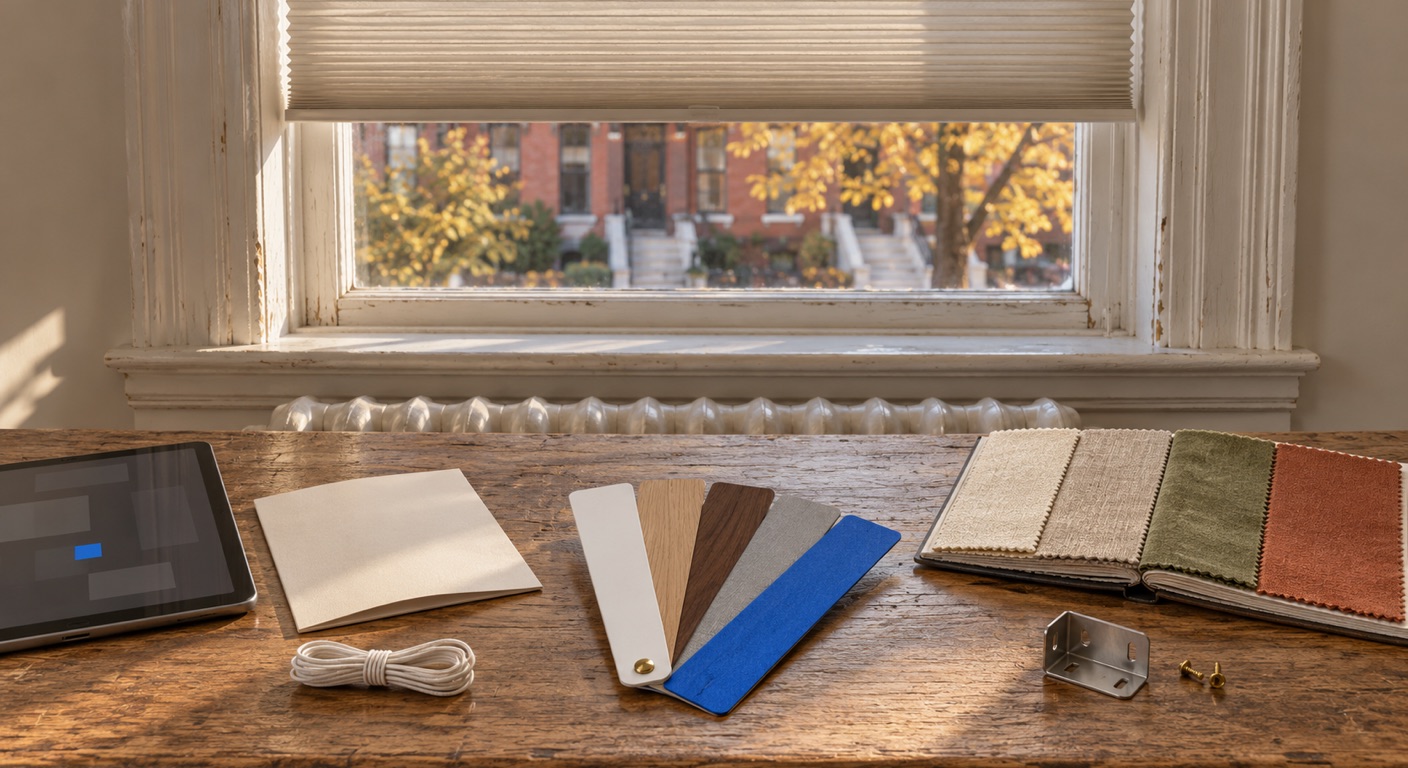
On a Saturday morning, a consultant from a Baltimore window treatment company measures nine windows in a Canton rowhouse, spreads sample books across the kitchen table and writes up an order: cellular shades for the bedrooms, a motorized roller shade for the tall window over the stairs, and a Roman shade above the kitchen sink that a drapery workroom will sew from fabric the owners bought themselves. The shades come to $4,180 and the installation to $360. The owners sign on a tablet and pay half, $2,270, by card. That evening the consultant sends the order to the factory. On Tuesday, the owners email to cancel.
Every step of that ordinary sale touches a rule the company’s software almost certainly does not hold. Because the order was signed in the owners’ home, it is a door-to-door sale under both the Federal Trade Commission’s Cooling-Off Rule and Maryland’s own Door-to-Door Sales Act, even though the owners invited the consultant. They can cancel until midnight of the third business day and must get every dollar of the deposit back within ten business days; the shades already ordered are the company’s problem, and so is the card fee. The Roman shade is a custom window covering, so the workroom must label its headrail with its name, the month and year and a C for custom, and under the industry’s standard since 2024 it can no longer have a free-hanging lift cord; under a proposal the Consumer Product Safety Commission published on September 24, 2026, such a cord would make the shade a substantial product hazard. The workroom owes Maryland sales tax on sewing fabric the owners supplied, and the installation escapes tax only because it was printed as its own line. Had the owners run a licensed family child care home, Maryland law would have required every one of those shades to be cordless, under a definition stricter than the industry’s.
This article goes through those rules for Baltimore’s blinds, shades, shutters and drapery businesses: the federal cord rules and what changed on September 24, the cancellation rules for sales made at home, Maryland’s tax and child care rules, what the software costs, what 31 businesses serving Baltimore and 5,459 listings on 39 web stores show a customer or a machine, how to sell custom blinds online when every order has its own size, and what we would build. We are a software studio, not lawyers; where a rule is our reading of the text rather than an agency’s statement, we say so.
The trade in Baltimore: a few storefronts, a lot of vans, and a city of old windows
Window treatment stores have an industry code of their own, which makes this trade easier to count than most. In County Business Patterns for 2023, the latest year, Maryland had 31 window treatment stores with paid employees, 118 employees between them and an average payroll of $46,186 per employee. The Baltimore metro area had 13 of them, Baltimore County five, with about 27 employees. Baltimore City’s own figure is withheld for confidentiality, but subtracting the published lines from the total for home furnishings stores leaves exactly one. Nationally there were 2,209, up 14.9% since 2019, and Maryland’s count rose from 25 to 31, while the wider category of home furnishings stores lost more than a tenth of its establishments nationally over the same years.
Those storefronts are a small part of the trade. Drapery workrooms that sew from purchased fabric are counted as “curtain and linen mills”: three establishments with about 26 employees in Baltimore City and nine in the metro area. Installers are filed with the building finishing contractors, a category that also holds waterproofers and closet fitters and cannot be used to count them. And most of the businesses have no employees at all. The Census’s nonemployer statistics for 2024 do not separate window treatments from other home furnishings, but that combined group had 37 one-person businesses in Baltimore City, with average receipts of about $30,600, and 107 in Baltimore County, at about $41,900. The consultant whose van is parked outside with sample books in the back may well be in those counts, or may work for a franchise territory based in the county.
| Area | Window treatment stores with employees | Their employees | Drapery workrooms and curtain makers with employees | One-person home furnishings retailers | Their average receipts |
|---|---|---|---|---|---|
| Baltimore City | 1 (derived) | about 5 | 3 | 37 | $30,600 |
| Baltimore County | 5 | about 27 | – | 107 | $41,900 |
| Baltimore metro area | 13 | about 58 | 9 | 312 | $33,700 |
| Maryland | 31 | 118 | 15 | 706 | $40,800 |
| United States | 2,209 | 8,671 | 1,059 | 43,515 | $63,800 |
The code changed in the 2022 revision of the industry classification, and the change says something about where the trade is going. “Window treatment stores” became “window treatment retailers,” code 449122, and the Census’s concordance moves two other groups into it: electronic shopping and mail-order houses, and other direct selling establishments. In the 2017 system, a web store selling blinds was counted as electronic shopping and a consultant selling them in customers’ homes as direct selling, not as window treatment stores. From 2022 on, both are window treatment retailers, like the storefront.
The 2022 Economic Census, the most detailed count there is, found that Americans bought $9.63 billion of window treatments at retail that year, rods and fixtures included. Specialist window treatment retailers sold 47.7% of it and home centers 29.2%. In the Baltimore metro area it counted 20 window treatment retailers with employees, more than the 13 in County Business Patterns because the new code includes web and in-home sellers, with $26.0 million in sales and 103 employees between them. The Consumer Product Safety Commission, citing Euromonitor, estimates that about a quarter of the market is now sold online. The manufacturers behind the sample books are few, large and mostly owned by investment firms. 3G Capital took control of Hunter Douglas, which calls itself the world market leader in window coverings, in 2022; the company’s last public annual report, for 2021, showed $2.27 billion of North American window covering sales and listed Levolor and 3 Day Blinds among its wholly owned subsidiaries. Springs Window Fashions, the maker of Bali and Graber, was bought by Clearlake Capital in 2021. Norman belongs to Nien Made of Taiwan, whose 2025 annual report says it sells through more than 4,500 retailers and designers in North America and that the market there “has largely transitioned to cordless window coverings.” Home Depot has owned Blinds.com since 2014, when it called it the world’s largest online window coverings retailer.
What makes Baltimore unusual is the windows. In the Census Bureau’s American Community Survey for 2020 to 2024, 41.5% of Baltimore City’s 295,032 homes were built in 1939 or earlier, three and a half times the national share of 11.7%; 53.0% predate 1950; and 50.4% are single-family attached houses, which in Baltimore mostly means rowhouses. Old plaster openings are rarely square, windows that look identical often are not, and deep sills and radiators decide what can be mounted where. Only 47.5% of occupied homes are lived in by their owners, so landlords and property managers are a large part of the market. That combination, odd sizes, many rental units and a lot of measuring, is why so much of the trade sells custom products in people’s homes.
What window treatment software costs, and what the meter counts
A Baltimore window treatment business usually runs four kinds of software: something to measure, price and order with; the manufacturers’ own dealer portals; a general field-service or sales tool for appointments, installers and invoices; and, increasingly, a web store with a size configurator. We read the published prices of each on October 5, 2026, from the vendors’ own pages. Some of the trade’s specialists are Australian or British and price in their own currencies, several well-known names publish no prices at all, and the meters count different things: users, licenses, installers, products, orders, signatures and, in one case, the customers in your own database.
| Product | What it does | Published price | What the meter counts |
|---|---|---|---|
| BlindsBook | Quotes from your own price charts, purchase orders to manufacturers, work orders, scheduling | $199, $299 or $399 a month | The company |
| Quoterite (Australia) | In-home quoting with a laser measure, signature and deposit on the tablet, supplier orders | $195 a month for the first user, $110 for each extra user, $550 setup (the page’s US-dollar figures) | Users |
| BlinQ (Australia) | Quoting from imported price grids | $150 per license a month, minimum three (currency not stated) | Licenses |
| QuoteIQ | General contractor CRM with a blinds page; prices per window, not by size | $29.99 to $699 a month | Users and AI credits |
| MyBlindCo | Retail quoting with manufacturer catalogs | Not published | – |
| The Workroom Pro | Drapery workroom management | $195, $295 or $495 a month | Users and the number of client records |
| Ledgez | Workroom and design business management | $195, $395, or from $695 a month | Users and modules |
| Hunter Douglas The Link and Brite; Norman dealer app | Each brand’s own quoting and ordering | Free apps for authorized dealers; Brite unpublished | One brand each |
| Housecall Pro | Field service: scheduling, invoices, payments | $59, $149 or $299 a month billed annually | Users |
| Jobber | Field service: quotes, scheduling, invoices | From $29 a month billed annually | Users |
| Leap | In-home sales presentations and contracts | $79 a month for one user; teams from $298; remote signatures from $750 | Users |
| Builder Prime | Home improvement CRM | $300 a month plus $60 per office user and $10 per field user | Platform, office and field seats |
| ServiceTitan, Workiz | Field service | “Request pricing” | – |
| Shopify | Web store | $29, $79 or $299 a month billed yearly; Plus $2,300 a month | The plan |
| Size-calculator apps for Shopify | Price by width and height | $9.99 to $149.99 a month; the one app built for curtains and blinds, $99 | Products, custom orders or order items, by app |
| DocuSign, Dropbox Sign | Electronic signatures | From $11 and $15 a month | Users and envelopes |
Three things stand out. The manufacturers’ tools are free, and each knows one brand. A dealer who sells Hunter Douglas, Norman and Graber measures a house once and enters the windows three times, or pays a third-party tool to hold all three price books. Many of the trade-specific quoting tools are built abroad: two of the six we looked at are Australian, a third, BlindMatrix, is British and showed us only euro prices, and a library of preloaded manufacturer price grids helps only if it includes the American manufacturers a Baltimore dealer actually orders from. And the general field-service tools that many dealers use for scheduling and invoicing, Jobber, Housecall Pro and their peers, keep a flat price book of line items; none of them models a price that depends on a width and a height.
Not one of the products in the table, as far as their own pages and app listings say, holds an order until the cancellation period has passed, knows whether a product is stock or custom, or treats the cord system as a regulated attribute. Our sweep of 16 Shopify apps that price products by size found four that accept a two-dimensional price grid, one built specifically for curtains and blinds (with one review), none that mentions eighths of an inch, none with a field for cord type or child safety beyond whatever option the merchant invents, and none with any kind of cancellation hold. The vendor of the best-reviewed grid app documents its own trade-offs candidly: its older method created a new hidden variant for every configured order, which could leak into product feeds and Google Shopping, and its newer one shows the base price in the cart until checkout and falls back to the base price after about 15 configured items in one cart.
The deposit has a price too
The payment rail is a bigger line than it looks. On a $4,000 job with a 50% deposit, taking the $2,000 deposit by card online at the common 2.9% plus 30 cents costs $58.30; by a Square invoice on its free plan, at 3.3% plus 30 cents, $66.30; by PayPal’s Pay Later on an invoice, $100.29; and by a bank transfer through Stripe, whose ACH debits are 0.8% capped at $5, five dollars. The cancellation rules make the difference sharper. A deposit refunded within the three business days still costs the dealer the fee; Square, for example, says that when you refund a payment, “the processing fees for the payment aren’t refunded back to you.” A dealer who takes card deposits at the kitchen table pays for every customer who changes their mind, and a dealer whose software sends a bank-transfer link with the contract pays almost nothing.
Where the customers come from, and what they expect
Leads cost more than software, and one of Google’s main local lead products is closed to this trade. Google’s Local Services Ads, the badged listings at the top of local searches, cover 204 business categories in the United States, and blinds, shades, shutters and window treatments are not among them; the nearest are handyman and window repair, and interior designers are eligible only in California and Florida. Yelp Ads start at $150 a month. Houzz Pro costs $99 to $399 a month for its software, with its advertising package from $499 a month on top. Thumbtack and Angi publish no price per lead. Budget Blinds, the franchise with the most territories in our census, lists an initial franchise fee of $49,500 to $89,500 and a total investment of $100,500 to $211,250 on its own franchise page.
The national web sellers set customers’ expectations about measuring. Blinds.com’s SureFit guarantee remakes a blind the customer measured wrong at no cost, once per item and for up to four items per household for life, within 30 days, with draperies excluded, and SelectBlinds offers a similar free remake for measuring errors. A Baltimore dealer that measures for its customers carries that risk itself, which is one reason its software should record who measured each window, with what, and when.
Are corded blinds illegal? Every blind is stock or custom, and the headrail has to say which
The Consumer Product Safety Commission has counted the children killed by window covering cords one by one for decades. In its 2022 rule, the Commission’s staff found 209 reported strangulations and near-strangulations of children aged eight or younger on window covering cords between 2009 and 2021, 100 of them fatal. Its newest proposal counts 73 incidents from 2018 through 2025, among them the deaths of 18 children, aged 12 months to four years, on the pull cords of horizontal blinds. The federal rules that came out of those numbers do not ban corded blinds outright. They divide every window covering into two legal categories, stock and custom, and apply different requirements to each, and the category is something a dealer’s software can get wrong.
Stock means built before anyone asked
The definition is in the Commission’s regulations, at 16 CFR 1120.2(f), borrowed from the industry’s voluntary standard, ANSI/WCMA A100.1. A stock window covering is one that is “completely or substantially fabricated prior to being distributed in commerce and is a specific stock-keeping unit.” The regulation then closes the obvious loopholes: “Even when the seller, manufacturer, or distributor modifies a pre-assembled product by adjusting to size, attaching the top rail or bottom rail, or tying cords to secure the bottom rail, the product is still considered stock. Online sales of the product or the size of the order such as multi-family housing do not make the product a non-stock product.” The Commission’s business FAQ puts it in one phrase: fabricated “before any specific consumer request for that product.” Custom is simply everything else.
In practice that sorts a Baltimore dealer’s catalog in ways the product names do not. A faux-wood blind cut down from 36 inches to 34⅜ inches in the back room is stock. A roller shade sold on a web store in “custom sizes” but trimmed at the warehouse from a pre-assembled shade is stock. A cellular shade built from scratch by the manufacturer to the dealer’s order is custom, and so is a Roman shade sewn by a local workroom for one window. “Custom” in the marketing copy and “custom” in the regulation are different words, and only the second one decides which rules apply.
What is already a substantial product hazard
Since December 28, 2022, three characteristics of a stock window covering have been on the Commission’s substantial product hazard list under section 15(j) of the Consumer Product Safety Act, at 16 CFR 1120.3(e): an accessible operating cord longer than 8 inches in any position, an inner cord that can form a loop big enough for a child’s head, and the absence of the manufacturer’s label. For custom products, only the last two apply. The 8-inch figure is not arbitrary; the Commission explains that it is the neck circumference of a fifth-percentile child aged six to nine months.
A 15(j) listing is not a product standard, and it does not require testing or certificates. What it does is take the argument out of the statute’s reporting duty. Section 15(b) requires every manufacturer, distributor and retailer who obtains information reasonably supporting the conclusion that a product could create a substantial product hazard to “immediately inform the Commission.” Once a characteristic is on the list, a retailer who knows a product has it knows it is reportable. The penalty for failing to report is up to $120,000 per violation and $17.15 million for a related series, under the amounts in force since 2022. The Commission can order the retailer, not just the manufacturer, to repair, replace or refund, and listed products are refused entry at the border.
The label is the characteristic that turns a safety rule into a data problem. The standard’s section 5.3, which the Commission summarizes in its FAQ, requires a permanent label within the headrail or on the roller tube showing the name, city and state of the manufacturer, importer or fabricator; the month and year of manufacture; the designation “Custom” or “Stock,” or simply C or S; and, for custom products, customer order information such as the customer’s name or order number. For a manufacturer this is a line on the production ticket. For a Baltimore drapery workroom that sews and assembles a Roman shade, the label is the workroom’s job as the fabricator, a custom shade without it is on the hazard list, and the workroom’s order system either prints the label from the order or someone writes it by hand, every time.
A court threw out the custom rule, and the industry wrote its own
On the same day in 2022, the Commission published a second rule, a mandatory safety standard for custom window coverings at 16 CFR part 1260, which would have held custom products to the stock requirements: cordless, inaccessible cords, or cords of 8 inches or less. The Window Covering Manufacturers Association challenged it, and on September 12, 2023, the U.S. Court of Appeals for the D.C. Circuit vacated it. The court held that the Commission “breached notice-and-comment requirements, erroneously relied on certain data in its cost-benefit analysis, and selected an arbitrary effective date.” The data problem is a lesson in itself: the cost estimate for a rule about custom products was built on prices from the online catalogs of two large retailers, and “virtually all of the products surveyed in this study were stock products.” As of this month, the vacated part 1260 still appears in the electronic Code of Federal Regulations, and the text we retrieved carried no note that a court had thrown it out. Anyone who reads the CFR without knowing the case will think it is in force.
The industry did not wait. The 2022 edition of ANSI/WCMA A100.1, in effect since June 1, 2024, removed free-hanging operating cords, free-hanging tilt cords and multiple cords running into one connector from all custom products, banned continuous cord loops and bead chains on custom horizontal blinds, and redefined roll-up shades as having no cords. It still allows two corded systems on custom products: a continuous loop on shades and other non-horizontal products, if a tension device or another restraining device is attached, and a single retractable cord with a pull of no more than 36 inches. The earlier, 2018 edition had let custom buyers change the safe default options, and the court quoted the Commission’s finding that firms “typically allow consumers to easily change the default options during the custom order process.” A dealer whose quoting tool still offers a free-hanging tilt cord or an ordinary cord lift on a custom blind is quoting a product the 2022 standard no longer allows.
The proposal of September 24, 2026
Eleven days before we published this article, the Commission published a proposed rule that would bring custom products back under federal enforcement through the substantial product hazard list instead of a standard. It would update the list to the 2022 edition of ANSI/WCMA A100.1 and add seven characteristics: accessible free-hanging operating cords longer than 8 inches on custom products; exposed continuous loops on custom horizontal blinds, with or without a tension device; exposed continuous loops without a tension device on other custom products; single retractable cords with a pull longer than 36 inches; cord loop lifts on stock or custom roll-up shades; and a missing warning label and warning tag on custom products with a tension-device loop or a retractable cord. The Commission voted 3–0 on September 22, two weeks after two new commissioners were sworn in and restored its quorum; comments are due by November 23, 2026, under docket CPSC-2026-0463; and the proposal would take effect 30 days after a final rule is published. The first comments posted to the docket include one from Reese’s Purpose, a child-safety group, which urges the Commission to finish the rule quickly but argues that the 2022 standard still depends on tension devices, installation and warnings that can be removed, broken or lost when a house changes hands.
The proposal does not mention the court case, which we checked by searching its full text. It does contain a sentence that answers the question the stock-and-custom split raises: “Product classification of stock or custom does not alter the risk of injury from accessible cords longer than 8 inches.” And it is candid about labels: “most of the window coverings involved in incidents contained the permanent warning labeling required by the ANSI/WCMA standard.” There is an irony the proposal leaves unremarked. The tension devices and the 36-inch retractable cord that it would adopt as the federal benchmark are the features the Commission called inadequate in 2022, when the vacated rule would have capped a retractable cord’s pull at 12 inches. For installers, one detail matters at once: a hold-down clip that can be removed from the loop is “not considered a tension device,” so a continuous loop installed with one would be a substantial product hazard.
The Commission expects the burden to fall on manufacturers. Of 2,128 blind and shade manufacturers and retailers it counted in 2021, it classed 274 manufacturers as small, most with fewer than ten employees, and assessed that their products are custom “because many are handcrafters, and they produce products to a specific customer order”; it estimates that fewer than ten of them will face a significant cost. A drapery workroom that sews Roman shades to order is exactly that kind of handcrafter. Retailers, the proposal says, are not expected to be significantly affected, “because any potential costs to conform will be borne by manufacturers.” The reporting duty, however, is not a cost that a manufacturer can bear for the retailer.
| Characteristic | Stock products | Custom products |
|---|---|---|
| Accessible operating cord longer than 8 inches | Substantial product hazard since December 28, 2022 | Removed by ANSI/WCMA A100.1-2022 since June 1, 2024; a hazard if the September 2026 proposal is finalized |
| Continuous cord or bead-chain loop | Allowed only if it meets one of the three stock options: cordless, a cord of 8 inches or less, or an inaccessible cord | Not on horizontal blinds; on other products only with an attached tension device or other restraint (2022 standard; proposed for the hazard list) |
| Single retractable cord | As above | Pull of 36 inches or less, with warning label and tag (2022 standard; proposed for the hazard list) |
| Cord loop lift on a roll-up shade | Not allowed; proposed as a listed hazard | Not allowed under the 2022 standard; proposed as a listed hazard |
| Inner cords that can form a loop | Substantial product hazard since 2022 | Substantial product hazard since 2022 |
| Manufacturer label: name, city, state, month and year, C or S | Required; a missing label is a hazard since 2022 | Required, with the customer’s order; a missing label is a hazard since 2022 |
| Cord warning on the website | Not addressed | Asked by the 2022 standard for tension-device loops and retractable cords, in English and Spanish; not part of the federal proposal |
Every cord recall of 2025 was a web listing
The hazard list is already being enforced, and so far it has landed on web stores. In CPSC’s recall records, 11 window covering products were recalled for their cords in 2025, about 288,195 units in all, and every one of them was sold only online: eight on Amazon and one each on Wayfair, SHEIN and Walmart.com, mostly roller and roll-up shades with long operating cords, at prices from $11 to $344. None has been announced in 2026 so far. The largest, Persilux zebra blinds, about 133,000 units sold on Amazon for $40 to $124, came in widths from 22 to 73 inches, and CPSC calls them “recalled stock blinds.” A size menu on a product page did not make them custom. The Commission’s own survey in the new proposal points the same way: of 249 custom horizontal blinds offered online by five retailers, 246 were cordless or motorized, and every non-compliant roll-up shade staff found was on the websites of online-only sellers, which hold about a quarter of the market.
For a retailer, the stakes of the reporting duty are not theoretical. In August 2026 a treadmill importer agreed to pay $16.875 million for failing to report a hazard immediately, and the settlement requires it to keep procedures to make sure that “incident and injury data is reviewed and analyzed” for reporting. A dealer’s customer complaints, remake requests and installer notes are exactly that kind of data, if anyone looks at them.
The warning is meant for the web page as well
One requirement of the 2022 standard reaches the dealer’s website directly. For custom products with a continuous loop and tension device, or a single retractable cord, section 5.1.3 asks for a warning label, with a pictogram of a cord around a child’s neck, on merchandising materials, naming “the sample book and the website” where a site is used to promote or sell the product online, and for the United States it must be in English and Spanish. The Commission’s proposal would make a missing warning label and tag on the product itself a substantial product hazard; it says nothing about websites, so the web warning remains a requirement of the voluntary standard, not of federal law. It is also one of the few places where a safety rule tells a web store what its product page should say; toy warnings, as we found in our post on toy and hobby stores, mostly never make that trip. We measured how many window covering stores make it in our census below.
The motor fixes the cord and adds a battery
Motorized shades remove the cord, which is why the standard counts them as cordless, but their remote controls often run on coin cells, and those fall under Reese’s Law. Since October 23, 2023, 16 CFR part 1263 has required any consumer product “containing or designed to use” a button or coin battery to meet the UL 4200A standard, with a battery compartment that needs a tool or two simultaneous movements to open and warnings on the product, the packaging and the instructions, and unlike the cord rules it requires testing and a certificate. It reaches window treatments: in February 2025, Pella recalled windows and sliding patio doors with automated shades, including remote controls sold on their own, because their button cells “can be easily accessed by children” and the products lacked the required warnings. A remote sold as a spare part on a dealer’s web store is a regulated product in its own right.
The FTC 3-day rule: the kitchen table is a door-to-door sale
Much of this trade does not sell from a showroom. Hunter Douglas, the largest manufacturer, said in its last public annual report that “Most of our retail dealers offer shop-at-home consultations,” and the franchise territories that serve Baltimore promise to bring the showroom to the customer. The customer fills in a form or calls, a consultant comes to the house with sample books and a measuring tape, and the order is signed at the kitchen table with a deposit, often half the price. It feels like a visit the customer asked for, and in law that makes no difference. Maryland’s Door-to-Door Sales Act defines a door-to-door sale as one of $25 or more in which the seller “personally solicits the sale, including a solicitation in response to or following an invitation by the buyer,” and the buyer agrees to buy somewhere other than the seller’s place of business. The Federal Trade Commission’s Cooling-Off Rule uses almost the same words, with the same $25 threshold at the buyer’s home and $130 at other temporary locations such as a hotel room or a fairground booth. The free in-home measure is the solicitation, and the kitchen table is the place.
Both rules give the buyer until midnight of the third business day after the sale to cancel, “without any penalty or obligation,” and both require the seller to refund every payment, deposit included, within ten business days of receiving the cancellation. Neither has an exception for goods made to the buyer’s measurements. A dealer who sends a custom order to the factory on Saturday night, and receives a cancellation on Tuesday, owns the shades and owes the deposit back. The only safe moment to release a made-to-measure order is after the cancellation period has run out, and the software that releases it has to know when that is.
Three business days, counted two ways
Counting to three is harder than it sounds, because the two rules count differently. Under both, Saturday is a business day and Sunday is not. The FTC rule also skips “any federal holiday.” Maryland’s statute skips a fixed list of nine: New Year’s Day, Washington’s Birthday, Memorial Day, Independence Day, Labor Day, Columbus Day, Veterans’ Day, Thanksgiving Day and Christmas Day. Martin Luther King Jr. Day and Juneteenth are federal holidays that are not on Maryland’s list, so on those days the federal clock stops and the state clock keeps running. A Baltimore dealer has to satisfy both, which in practice means using the later of the two deadlines.
Take an order signed on Saturday, October 10, 2026. Sunday does not count, and Monday, October 12, is Columbus Day under both rules. The three business days are Tuesday, Wednesday and Thursday, and the customer can cancel until midnight on Thursday, October 15. A system that simply adds 72 hours would release the order to the factory on Tuesday morning, two days early. Sign on Saturday, January 16, 2027, and the federal deadline falls on Thursday, January 21, because Martin Luther King Jr. Day is a federal holiday; Maryland’s deadline is Wednesday. None of this is complicated for a computer, but it has to be written down once, correctly, and not left to whoever is placing orders that week.
| Question | FTC Cooling-Off Rule (16 CFR 429) | Maryland Door-to-Door Sales Act |
|---|---|---|
| Which sales | $25 or more at the buyer’s home, $130 or more at other temporary locations, including visits the buyer asked for | $25 or more anywhere other than the seller’s place of business, including visits the buyer asked for |
| Time to cancel | Until midnight of the third business day | Until midnight of the third business day; fifth for a home improvement contract, seventh if the buyer is 65 or older |
| Days that do not count | Sundays and all federal holidays | Sundays and nine listed holidays, which do not include Martin Luther King Jr. Day or Juneteenth |
| Refund | Every payment within 10 business days | Every payment within 10 business days |
| Exception for custom-made goods | None | None |
| Sales made only online | Not covered if there was no in-person contact before delivery | Not covered if made entirely by mail, phone or electronic communications with no other contact |
| Penalty | Up to $53,088 per violation | Civil fines up to $10,000 per violation ($25,000 for a repeat), damages and attorney’s fees; a willful violation is a misdemeanor |
What has to be on the paper
Maryland’s list of seller obligations, in section 14-302 of the Commercial Law Article, reads like the specification for a contract template. The receipt or contract must be fully completed at signing, dated, with the seller’s name and address, and written “in the same language as that principally used in the oral sales presentation,” so a consultation conducted in Spanish needs a contract in Spanish. Next to the buyer’s signature, in bold type of at least 10 points, it must say that the buyer may cancel at any time before midnight of the third business day. Attached to it, in duplicate and easily detachable, must be a form captioned “Notice of Cancellation,” filled in with the seller’s name and address, the date of the sale and the date by which the buyer may cancel, which may not be earlier than the third business day. The seller must also tell the buyer about the right to cancel out loud. The contract may not waive the right, and the seller may not sell the buyer’s financing note to a finance company before midnight of the fifth business day.
Tablets complicate this. Maryland’s version of the Uniform Electronic Transactions Act, section 21-104, says that a provision agreeing to do business electronically may not sit in a standard form contract “unless that provision is conspicuously displayed and separately consented to,” so an e-signature flow needs its own consent step, not a sentence in the terms. And the Notice of Cancellation is supposed to be a form in duplicate, attached and easily detachable. When the FTC amended its rule in 2015 it declined to drop the duplicate copies and said that whether electronic delivery could satisfy them would “depend on a case-by-case analysis.” Until a court or regulator says otherwise, the cautious practice is to hand the customer paper, or a printout, at the table.
The penalties make the paperwork worth getting right. Every one of those failures is an unfair or deceptive trade practice under Maryland’s Consumer Protection Act, which carries civil fines of up to $10,000 per violation, or $25,000 for a repeat. The seller is liable for the buyer’s damages and attorney’s fees, a willful violation is a misdemeanor punishable by a fine of up to $1,000 and a year in jail, and on the federal side the FTC’s maximum civil penalty for violating a trade regulation rule such as the Cooling-Off Rule is $53,088 per violation. And under section 14-303, a buyer whose paperwork was defective may cancel “in any manner and by any means”; the statute gives that right no end date. By our reading, a dealer who forgets the cancellation form has not shortened the customer’s window to three days but opened it indefinitely, for an order that has already been made to the customer’s windows.
The showroom, the web store and the change order
Three exclusions in section 14-301.1 matter to this trade, and each one turns on a fact the dealer’s records either hold or do not. The first covers sales made “pursuant to prior negotiations” during the buyer’s visit to a store with a fixed, permanent location where the goods are on display. A customer who chose fabrics and agreed on a price in the showroom, and then had the windows measured at home, may be outside the act; one who browsed for five minutes and then received a new quote at home probably is not. The statute does not define how much negotiation is enough, and only a record of what was quoted, when and where, will show which side of the line a sale was on.
The second excludes a sale “conducted and consummated entirely by mail, telephone, or electronic communications” with no other contact before delivery. A pure web-store order is outside the act. The FTC reads its own rule the same way, and in its 2015 amendment said the exclusion applies to internet sales “as long as there is not any other in person contact between the buyer and seller or its representative prior to the delivery of goods.” A web order placed after a consultant has measured the windows has had that contact. The third concerns change orders: a customer who upgrades to motorized shades halfway through a job can waive the cancellation right for that change only with a separate statement, dated, signed and in the buyer’s own handwriting, that describes the change. A checkbox or a tap-to-sign waiver on a tablet is not that, and without the statement the change order is, by our reading, a new door-to-door sale with its own three days.
Awnings are home improvement; blinds are decorating
Whether a window treatment job is a “home improvement” under Maryland law changes the license, the deposit and the cancellation period. Maryland’s Home Improvement Commission answers the question directly in its licensing FAQ: no license is required for interior window treatments, “such as installing curtains or blinds,” because “This service is considered decorating.” Awnings are different. The statutory definition of home improvement expressly includes the installation of “an awning, fire alarm, or storm window.” A dealer who sells retractable awnings, or exterior work that alters the building, needs a contractor license from the Commission and may not take a deposit of more than one third of the contract price under section 8-617. The contract must be in writing, with the Commission’s notices and the license number, and when the sale is made at the customer’s home the buyer gets five business days to cancel instead of three, or seven if 65 or older, on a separate form with a signed acknowledgment that has a checkbox for the buyer’s age. We covered those home improvement rules in detail in our post on home improvement contractors.
The usual industry deposit of 50% is therefore fine on a living room of cellular shades and a violation on an awning, and the same consultant may sell both in one visit. A quote that mixes them needs two contracts, two deposit limits and two cancellation dates, and the software has to know which product is which, and how old the buyer is, before the consultant presses “sign.” Work on apartment buildings with four or more units is outside the home improvement definition altogether, and a sale to a business is outside the door-to-door rules, which cover only consumer goods. The landlord ordering blinds for a 40-unit building is a third kind of customer again.
Maryland sales tax and safety rules: the installation line, a stricter kind of cordless, and old paint
Maryland’s 6% sales tax applies to the blinds and shades, and the dealer collects it: bracket-mounted window treatments can be taken down and keep their character as goods, which by our reading of the Comptroller’s real property regulation makes the dealer a retailer, not a contractor who pays tax on materials. The regulation lists “Doors, windows, molding, built-ins, and kitchen cabinetry” as realty; the window is real estate and the shade hanging in it is not. Custom shutters built into the frame are the closest call, and we found no ruling on them.
Three lines on the same invoice, three answers
Installation is where the invoice layout decides the tax. The statute’s definition of taxable price, in section 11-101 of the Tax-General Article, excludes “a labor or service for application or installation” only when it is “stated as a separate item of the consideration.” The regulation adds that the charge must be clearly identified, separately stated “by documentary evidence in existence and made known to the buyer at the time of sale.” A quote that says “nine shades, installed, $4,540” is taxable on the whole $4,540. The same quote with installation as its own line of $360 is taxable on $4,180, a difference of $21.60 to the customer and, across a year of jobs, a real number for a dealer whose competitors print the line.
Not everything labor-shaped qualifies. The same regulation keeps in the taxable price, even when separately stated, any charge “to bring the subject of a sale to its finished state ready for delivery and in the condition specified by the buyer,” naming assembly, fabrication, alteration and customizing. Cutting a stock blind down to the customer’s width is, by our reading, exactly that, so a “cut-down fee” is taxable however it is printed. Delivery works the same way in two directions: a separately stated charge for delivering the shades to the customer’s home is not taxable, but a charge passing on the freight from the manufacturer to the dealer’s warehouse is, because the regulation excludes transport “from a third party to any location of the vendor.” A “freight” line and a “delivery” line look alike on an invoice and are taxed differently.
We found no Maryland rule on the measuring or design fee that many dealers charge and then credit against the order. Credited against a sale of goods, it is part of what the customer pays for the goods, and by our reading taxable; billed on its own for a consultation that leads nowhere, it is a service Maryland does not list as taxable. That is a question for your accountant, and the answer should end up as a setting in the quoting software rather than in the memory of whoever writes the invoice.
The drapery workroom pays tax on its sewing
Workrooms that sew draperies, Roman shades and valances have a rule of their own. Maryland taxes “fabrication, printing, or production of tangible personal property ... by special order” as a taxable service, and COMAR 03.06.01.30 says the tax is charged on the full price “even though charges for labor are segregated from the cost of the materials.” The regulation’s own examples include “the making of drapes or slipcovers from materials furnished by the customer.” A workroom that sews a pair of lined panels from fabric the client bought elsewhere sells no materials at all and still charges 6% on its whole labor bill. Installing a finished shade is not fabrication, because the regulation treats a “complete, separable, and functioning unit” set up on site as installation, and repair that restores a blind to its original condition, such as restringing it, is untaxed repair labor. The same workroom may therefore charge tax on making a Roman shade, no tax on hanging it and no tax on restringing an old one, and its invoices have to say which is which.
Most of these distinctions are invisible to general-purpose software, which knows a product, a quantity and a tax rate. A window treatment invoice needs line types: goods, fabrication, installation, repair, delivery to the customer, freight in, design fee. Each type carries its own tax answer, and the person writing the quote should not have to remember any of them.
Daycares and foster homes need Maryland’s own kind of cordless
Maryland wrote its own cord rule long before the federal one, for a narrow set of customers. Under section 5-505 of the Family Law Article, “All new and replacement window coverings installed on or after October 1, 2010, shall be cordless window coverings” in child care centers, family child care homes, large family child care homes and foster homes. The law is known as Angel’s Law. According to the legislature’s fiscal note, two-year-old Angel Duenas died in November 2009 after strangling on window blind cords in his foster home, and a second Maryland child died that month after becoming entangled in a drapery cord. The bill passed 139 to 1 in the House and 47 to 0 in the Senate, and the state’s child care regulations, such as COMAR 13A.16.10.04 for centers, repeat it.
What makes the law matter to a dealer’s software is that it defines “cordless” in its own words, product by product. A horizontal blind or cellular shade qualifies only if it has no draw cord and its internal lift cord cannot form a loop larger than 7.25 inches; a Roman, roll-up or woven shade only if its lift cord is completely enclosed; a vertical blind only if it runs on a wand with no beaded chain, corded pulley or other loop; a roller shade only if it has no cord or beaded chain at all. That is stricter than the industry’s 2022 standard. A custom roller shade with a bead chain and a tension device meets ANSI/WCMA A100.1-2022 and would be allowed under the Commission’s proposal, and it is not a cordless window covering under Maryland law. A quote for a licensed child care home, a daycare center or a foster family therefore needs a different product list, and the dealer needs to know, before the consultant opens the sample book, what kind of customer is at the table.
Brackets in old paint
Baltimore’s old windows bring Maryland’s lead rules with them. The Department of the Environment’s regulations presume lead paint in any residential building built before 1950, which describes more than half of Baltimore City’s homes, unless someone shows otherwise. The stakes are not abstract: in 2024, Baltimore City accounted for 1,100 of the 2,351 Maryland children under six newly found with elevated blood lead levels, 47%, though fewer than one in ten of the state’s young children live there, according to the Department’s annual surveillance report. Drilling a few holes for brackets is not the kind of work those rules are aimed at: COMAR 26.16.01.03 excludes disturbances of 3 square feet or less of painted surface in a room, other than removing or replacing a window, and does not apply to work in an owner-occupied home at all, and the federal renovation rule’s threshold for “minor repair and maintenance” inside a home is 6 square feet per room. But an installer working in a rented home built before 1950 must still remove all visible debris before leaving, and a bigger job, such as stripping a painted casing so that shutters fit inside the frame, can cross the line into work that needs accredited contractors. A job sheet that records the year the house was built, whether it is rented and roughly how much painted surface the job disturbs costs nothing to add and answers the question before the drill comes out.
Blinds and lead have met in Maryland before. In June 1996, the Consumer Product Safety Commission announced that some of the 25 million vinyl miniblinds imported each year had lead added to stabilize the plastic, and that the plastic deteriorated in sunlight and heat into lead dust on the slats. The laboratories that confirmed how the dust formed, with electron microscopes, were at NASA’s Goddard Space Flight Center and the Army’s Aberdeen Test Center, both in Maryland. Manufacturers removed the added lead that summer, and the cartons began to say “no lead added.”
What 31 businesses selling blinds in Baltimore show a customer, or a machine
On October 5 we listed every window treatment business we could find that is operating and serves Baltimore City or Baltimore County, using OpenStreetMap, web search, manufacturer dealer pages and franchise locators, and read their websites the way a customer or an AI assistant would: the home page and up to seven other pages each, plus the files that tell machines what they may read. We found 31. Seven are based in the city: two showrooms and dealers, The Blinds Side in Federal Hill and Reliance Blinds, which works from a home address in Cheswolde; two drapery workrooms, WDI Works, formerly Wilhide Draperies, and Drapery Contractors, Inc., which sells to the trade; Olympic Upholstery on Belair Road, which has sold blinds alongside upholstery since 1980; and two Budget Blinds franchise territories. Ten are in the county, including Mitchell’s Blind & Shade near Golden Ring, Alexander Blank Fabrics & Design in Timonium, Grand York in Lutherville, two more franchise territories and two Lowe’s stores that sell installation. Fourteen more come in from outside, among them every shutter specialist we found. Budget Blinds’ own locator lists 25 franchise listings in Maryland, five of which name Baltimore in their service areas, and The Shade Store’s nearest showrooms are in Bethesda, Potomac and Annapolis. Next Day Blinds, still mapped at White Marsh, is not in the count: the Jessup-based chain went out of business in 2020, and its website no longer answers.
Not one of the 14 city and county websites we could read lets a customer buy anything. All 14 lead to a consultation, a quote or a phone number. One, The Blinds Side, offers a real booking calendar; eleven use request forms; the two trade workrooms list only a phone number and an email address. None publishes a price for a window. Three publish any money figure at all: a $75-per-shade Hunter Douglas rebate, a 10% new-customer discount and a 25%-off promotion. The only web store with a working size configurator that serves Baltimore belongs to a dealer in Beltsville, which sells a honeycomb shade online to the eighth of an inch, at $79.25 cordless and $110.85 corded.
The terms customers ask about are missing too. None of the 14 sites states a cancellation right, deposit terms, a lead time or an explicit remake guarantee for measuring errors; four mention a warranty. Six mention child safety or cordless products, and none mentions the industry’s Best for Kids certification. Across all 25 readable sites, inside and outside the area, one franchise’s terms page mentions a right to cancel, “within a certain period of time depending on the location,” which in Maryland is three business days and could have said so.
The machine-readable picture is thin in a different way. None of the 25 readable sites blocks AI crawlers in its robots file; one franchise’s file says it aims to “maximize eligibility to be surfaced & cited in ChatGPT, Claude.” Yet five of the eight chain and big-box websites refused a plain request outright, behind Cloudflare or Akamai firewalls or a refused connection, which keeps an AI agent out as effectively as any robots rule. Seven local sites publish an llms.txt file for AI systems, and every one was written by a website platform or a franchisor rather than by the business; one Wix-generated file advertises an “AI Agent Access” endpoint the owner may not know exists. Five sites carry LocalBusiness structured data, two of them franchise territories that give “Baltimore 21230” as their only address. OpenStreetMap, the open map that many apps build on, knows two of the 17 city and county businesses, one of them at an address it has since left, and still shows the Next Day Blinds store. Only one city or county site names a Baltimore neighborhood it serves. One showroom’s live page shows a 10%-off offer beside a paragraph of “Lorem ipsum” placeholder text, and an out-of-area dealer was still advertising a promotion that “Expires June 30” in October.
Put together, an assistant asked which Baltimore businesses sell cordless shades for a rowhouse in Hampden, what they cost and how long they take has almost nothing on these sites to quote: no price, no lead time, no terms and no neighborhoods. The dealer whose site states those things in plain text, and marks them up as structured data, would be the easiest one in the city to cite.
What 5,459 listings on 39 web stores say about sizes and cords
To see how window treatments are sold online, we read the public product catalogs of 47 Shopify web stores that sell them, found among 100 domains we tried, on October 5: 31,009 products in all, of which 5,459 were window-covering listings at 39 stores, 3,092 curtains and drapery panels, 1,896 shades, 301 valances, 162 blinds and 8 shutters. The stores range from made-to-measure blind sellers and drapery brands to home-decor stores with a window aisle; most list an American address in their store settings, and about a fifth of the window-covering listings come from brands registered in Hong Kong or mainland China, among them the web store of a brand whose corded shades, sold on Amazon, were recalled in 2025. We classified every listing with text rules on its title, product type, tags, options and description, opened one product page per store to see how sizes are entered, and read 27 more product pages in full to see what a shopper sees. We checked the rules by hand on 30 random listings; after we fixed the four systematic errors that check turned up, one of the 30 remained misclassified, a swag topper counted as a curtain.
Sizes first. For the 2,066 blind, shade and shutter listings, the catalog data alone is a poor guide to what the customer is buying: 35.0% carry traces of a product-options app, 21.4% say made to measure in their text with no size field at all, 4.8% sell preset sizes as ordinary Shopify variants and 1.4% come in one size, and for 37.4% the data does not say. One product page per store fills most of the gap: 93.8% of these listings take their sizes through an options app or the store’s own configurator. By the same evidence, 93.7% are made to order, which makes them custom products under the federal definition, and 6.2% are stock, sold in preset or single sizes or trimmed by the customer at home. Only 2.8% of the 4,385 made-to-order listings across all window coverings mention eighths of an inch, the unit American blinds are ordered in, and in the rendered pages we found the fingerprints of at least six different options apps, each storing the size its own way. Curtains are the exception: 34.2% of curtain and valance listings sell fixed sizes as variants, and one linen brand alone has 752 such listings, some in 195 sizes each.
On cords, the trade has mostly moved: 50.6% of blind, shade and shutter listings offer only cordless or motorized operation, 11.1% offer a corded option, and 37.8% do not say. Any child-safety statement at all, counting the word “cordless,” appears on 45.2% of them and an explicit one on 24.8%. Across all 5,459 window-covering listings, the words “strangle” and “strangulation” appear on none, the industry’s Best for Kids certification on 13, at two stores, and no listing carries a warning in Spanish. The 173 listings that offer a continuous cord loop or bead chain, the systems for which the 2022 standard asks for a warning on the website, sit at two stores, and none has a cord warning in its catalog data; 141 of them mention a “safety anchor clasp,” which is a tension device. On the 15 of those product pages we opened, the loop or chain option was visible on 14 and a cord warning on none, in English or Spanish, as text or as an image. Of 12 more shade pages at other stores, one showed a warning in its configurator, SelectBlinds’ line that “Corded lifts with accessible cords pose a strangulation hazard to young children,” and that line is not in its catalog data, where an AI agent would read it.
Motorized products, the safest on cords, say little about their batteries. Of 539 motorized listings, 14.8% name the battery type, none mentions a coin or button cell and none carries a battery warning; none of the 31 remote controls sold on their own mentions a coin cell or a warning either. And the terms a custom buyer most needs are rarely on the listing: of the 4,385 made-to-order listings, 1.0% state a return, final-sale or remake policy in text a customer can see, and 6.0% a lead time. Many stores keep both on separate policy pages, and one drapery store keeps its return rules for 335 listings only in hidden tags, where a shopper never sees them and a machine may. Where a size and a price could be parsed from fixed-size blinds and shades, the median price was $4.45 a square foot. Made-in-USA claims appear on 149 listings, 142 of them at a single drapery store; the FTC’s labeling rule treats such a claim on a web page like one on a label.
The numbers are floors. A store may show more in images, in a configurator or on pages outside its catalog, and SelectBlinds, whose catalog descriptions are empty, is the clearest case. But the catalog is what Google’s shopping systems, ChatGPT’s product feeds and Shopify’s own agent protocol read. In that data, a made-to-measure shade is often a title, a starting price and options that only an app understands; the stock or custom status, the legality of the cord system and the warning are mostly absent.
How to sell custom blinds online: what a made-to-measure web store is actually selling
A web store for window treatments sells something most e-commerce software was not designed for: a product whose price is a function of two measurements, whose legal category depends on when it was built, and whose safety depends on an option the customer picks in a dropdown. Each of those is a field the store either holds or fakes.
The price is a grid, and the size is two numbers in eighths of an inch
Manufacturers price custom blinds and shades from a grid: a width bracket across the top, a height bracket down the side, a price in each cell, and surcharges for the lift system, the valance, the motor and the fabric grade. Dealers apply their own multiplier to the grid. The customer, meanwhile, gives a width and a height to the nearest eighth of an inch, says whether the shade mounts inside or outside the window frame, and expects the price to update as they type. In the showroom, the consultant’s quoting tool does this from the manufacturer’s price book. On a web store it has to happen in the browser, at the same price, or the store and the consultant will quote different numbers for the same window.
Shopify, which runs every web store in our national census below, models a product as a set of variants, and on October 15, 2025 it raised the limit from 100 variants per product to 2,048, still across a maximum of three options. That is generous for a T-shirt and nowhere near enough for a roller shade, the same wall we described for fabric sold by the yard. Widths from 12 to 96 inches in eighths of an inch are 673 values; heights from 12 to 120 inches are 865; together they make 582,145 sizes, 284 times the limit, before color or lift system. Every made-to-measure store on Shopify therefore sells its sizes through an app or a workaround: the width and height ride along as text attached to the cart line, and the price difference is added by a hidden “fee” product or by a price override. Shopify allows an app to override the price of a cart line only on its most expensive plan; its developer documentation says that “Only development stores or stores on a Shopify Plus plan can use apps with lineUpdate operations.” In our census below, the catalog data alone shows an options app on 35.0% of blind and shade listings, and one product page per store raises that to 93.8%; the rendered pages carried the fingerprints of at least six different apps.
Stock or custom is a field, and so is the cord
The configurator also decides the legal category. A store that lets a customer type 34⅜ inches and then trims a pre-assembled shade at the warehouse is selling a stock product, whatever the product page calls it, and every cord option on it has to meet the stock rules. A store that sends the same dimensions to a factory that builds the shade is selling a custom product, which for now follows the 2022 edition of the voluntary standard and, if the September proposal is finalized, the federal hazard list as well. A product record that holds “stock” or “custom” as a field, rather than as a word in the title, can enforce the difference: no continuous loop on a custom horizontal blind, a tension device on every custom loop, a retractable cord of 36 inches or less, no cord loop lift on any roll-up shade, and the bilingual warning on the page wherever a loop or retractable cord is on offer.
Returns follow the same field. Most dealers sell custom products as final sale, with a remake policy for measuring mistakes, and that is lawful for a web order, which has no federal or Maryland cooling-off right when it is made entirely online. It is not lawful for an order signed at the customer’s home, which carries three business days to cancel whatever the return policy says. The same product can therefore be final sale in one channel and cancelable in another, and the order record needs to know which channel it came from. Maryland added a second distinction this summer. Since July 6, 2026, the Attorney General’s refund policy regulation has required an online store to disclose its refund and exchange terms, including a policy of no refunds, “on a webpage the consumer must view before completing the transaction,” and the regulation exempts “goods which are custom made.” A store that sells custom shades alongside stock rods, cleaning kits and ready-made curtains needs the policy step in its checkout for the stock items, and a cart that knows which items are which. Store credit issued for a return counts as a gift certificate under section 14-1319 of the Commercial Law Article and may not expire or carry a fee for four years.
What Google, ChatGPT and AI shopping agents can read
The machines that now read product catalogs on behalf of shoppers are built for products with one price and one size. ChatGPT’s product feed specification asks a merchant to “Submit one row per purchasable item or variant,” with nine required fields and a price on every row; there is an optional dimensions field and a way to flag a product as final sale, and there is no field for a cord, a child-safety warning or a size range. Google Merchant Center accepts one product width and one product height per item, and up to 100 free-form product detail pairs of up to 150 characters each, which Google says help products appear “across AI-driven surfaces, like AI Mode in Google Search.” A made-to-measure shade fits none of these cleanly. The practical answer is to publish a handful of real, priced reference sizes as items, each linking to the configurator, and to put the lift system, the stock or custom status and the warning in the product details and on the page as plain text.
Shopify’s standard product taxonomy, version 2026-08, shows how far the shared vocabulary goes. Its “Window Blinds & Shades” category has a “Lift mechanism” attribute whose values include Cordless, Corded, Continuous-loop cord, Motorized and Wand tilt, so a store can tell a machine that a shade has a cord. It has no attribute for stock or custom, none for a tension device and none for width or height, and its “Mounting type” values are generic ones such as Wall, Ceiling and Floor, with no inside or outside mount. An AI agent reading a Shopify catalog can learn that a roller shade is corded, but not whether the cord is lawful, because the fact that decides it is the one the vocabulary leaves out.
Shopify itself has moved faster than the vocabulary. Both Shopify blinds stores we checked for it, SelectBlinds, which says it has covered more than 18 million windows, and Chicology, now publish an agents.md file and a Universal Commerce Protocol profile, version 2026-08-25, that invite AI shopping assistants to search the catalog and check out on a buyer’s behalf. In SelectBlinds’ public product data, though, every one of the first 250 products we read has a single option, its color, a starting price and an empty description; width, height and mount are chosen in a configurator that sits outside the catalog an agent reads. An assistant can find the shade and quote a price for it, but the price is not for anyone’s window. The store whose catalog carries real sizes, real prices and the cord facts in plain text is the one an assistant can actually sell.
A note for readers in Lithuania
Part of our team works from Lithuania, where roller blinds and day-and-night shades are sold online to the millimeter, and the same products sit under rules that point the other way on two questions: where the warning belongs, and whether a custom order can be canceled.
The warning first. The EU’s requirements for internal blinds come from Commission Decision 2011/477/EU, which tells the standards bodies that cords, chains and ball chains “shall not form a hazardous loop” and that warnings must be given “in a clear and conspicuous way at the point of sale, on the package, on the product and in the information for use,” beginning with “Young children have been strangled by loops in pull-cords, chains and tapes, and cords that operate the product.” The resulting standards, EN 13120, EN 16433 and EN 16434, were listed again under the new product safety regulation by Implementing Decision (EU) 2026/901 in April 2026. They are voluntary, and meeting them gives a presumption of safety. What is not voluntary, since December 13, 2024, is Article 19 of the General Product Safety Regulation: every online offer must show the manufacturer’s name with a postal and an electronic address, a picture and identifier of the product, and “any warning or safety information to be affixed to the product or to the packaging,” in a language consumers in the country can understand. In Baltimore, the cord warning on a configurator page is a request of the voluntary standard, in English and Spanish. In Vilnius it is the law, in Lithuanian.
On October 5 we opened 21 product pages at seven Lithuanian web shops that sell made-to-measure roller and pleated blinds. Seventeen had a width and height configurator, mostly in millimeters, and 15 stated a production time, from one or two working days to as many as 14. Seven pages, at three shops, said that made-to-measure products cannot be returned. Child safety came up on five pages at three shops, and an explicit warning that a blind’s chain can be dangerous for small children on one. None showed the minimum warning wording the EU decision sets out, and none named a manufacturer with a postal and an electronic address as Article 19 asks; three shops show their own company name, address and email and present themselves as the makers, which may meet the requirement in substance. Six of the seven shops offered chain operation, and none mentioned a spring or cordless system.
Cancellation runs the other way. In the EU, a consumer normally has 14 days to withdraw from a distance contract or an off-premises contract, including one signed in the living room after a measuring visit. But Article 16(c) of the Consumer Rights Directive excludes “goods made to the consumer’s specifications or clearly personalised,” and the directive’s recital 49 gives “tailor-made curtains” as its example. The EU Court of Justice held in Möbel Kraft (C-529/19, 2020) that the exception applies to an off-premises sale “irrespective of whether the trader has begun to produce those goods.” Lithuania applies it through Article 6.22810(2) of the Civil Code, and the consumer protection authority, VVTAT, explains that it covers goods made to the consumer’s own specifications, such as furniture dimensions or a fabric size, but not a product assembled from the seller’s standard preset options. A roller blind made to a customer’s measurements in Kaunas cannot be canceled on a whim once ordered; the same blind ordered at a Baltimore kitchen table can be canceled for three business days. The defaults are opposite, and a business selling in both places needs the rule per market and per product.
The rest is simpler. Blinds and their installation are not on Lithuania’s reduced-rate lists, so by our reading both carry the standard 21% VAT. The national price indication rules require a unit price, such as a price per square meter, only for sales that are neither distance nor off-premises sales, so an online configurator owes the customer the total price for the size entered and need not show a rate per square meter. Lithuanian buying guides, like American ones, spend most of their words on fabric, light and measuring. A 2021 guide on tv3.lt recommended booking the maker’s own measurer, „Jei nenorite prisiimti atsakomybės dėl klaidingai išmatuotų roletų“ (if you don’t want to take responsibility for wrongly measured blinds), which is the custom-goods rule in one sentence: under EU law the measuring risk is the buyer’s, and the shop’s best product is a measuring visit. One Lithuanian installer’s 2026 guide describes EN 13120 as mandatory everywhere in the EU, which it is not, a mirror image of the American blogs that call corded blinds banned nationwide.
What custom actually costs, and when it pays
We price every project at a fixed fee, agreed before we start, and publish the starting points on our pricing page. For a blinds, shades and drapery business, they map onto this article like this.
| Package | Fixed price | What it would be for a blinds, shades or drapery business |
|---|---|---|
| Prototype Sprint | $3,500 | A one-week working prototype on your own data: last year’s quotes turned into a pricing engine that reads your manufacturers’ grids, or a kitchen-table contract flow that computes the cancellation date and holds the order, that you can try on real jobs before you commit to anything |
| Online Store | from $6,000 | A made-to-measure web store: width and height to the eighth of an inch, inside or outside mount, prices from the same grids your consultants use, stock or custom and the lift system on every product, the bilingual warning wherever a loop or retractable cord is offered, a measuring guide and remake policy, and structured data an AI shopping agent can read |
| Custom App or Internal Tool | from $12,000 | An in-home sales and ordering app: one measure entered once for every brand you sell, the contract and the Notice of Cancellation filled in from the order, a bank-transfer deposit link, factory orders released automatically after the third business day, and the manufacturer label printed for anything your workroom makes |
| Operations System | from $12,000 | One system behind the showroom, the vans, the workroom and the web store: quotes, orders, purchase orders, installs and remakes, the tax type of every invoice line, landlord and property-manager accounts with their own pricing, and a record of what was sold where that answers a recall |
Most of our projects land between $6,000 and $30,000, and none requires you to drop the manufacturer portals, the card processor or the accounting package that already work; the demos page shows finished work. In Maryland, the state’s 3% tax on software and IT services applies to a custom build, as we explained in a separate post, so the Online Store package costs $6,180 with tax.
Here is when it pays, using the payment figures above. A dealer who installs 150 jobs a year at $4,000 each and takes the 50% deposits by card online, at 2.9% plus 30 cents, pays $8,745 a year in fees on the deposits alone, and as much again if the balances are paid the same way. The same deposits by capped bank transfer cost $750. A contract flow that sends a bank-transfer link with every signed order therefore saves about $8,000 a year on the deposits, more than the Online Store package costs with tax, before counting the fees that are not returned when a customer cancels. The other saving is harder to put a number on and probably larger: the first custom order that goes to the factory on a Saturday night and is canceled on Tuesday costs the dealer the factory price of shades made for someone else’s windows. A dealer with a few dozen jobs a year should not build anything. A dealer with a showroom, several consultants and a web store is paying for this software already, in fees, re-keying and the occasional order nobody can use.
What we would build for a Baltimore blinds, shades and drapery business
If a Baltimore window treatment business asked us to fix the problems in this article without replacing anything that already works, this is what we would build, roughly in this order.
- A window record, measured once. Room, window, width and height to the eighth of an inch, inside or outside mount, obstructions, photos, who measured it and when, and for the house, the year it was built and whether it is rented. Every brand’s quote, order and remake reads from the same record, so nobody types a window three times or argues later about which number was on the tablet.
- A product record that knows the rules. Stock or custom, from how the product is actually built rather than what the page calls it; the lift system; tension device or not; the pull length of a retractable cord. The configurator and the quoting app refuse the combinations the 2022 standard no longer allows, the web page shows the English and Spanish warning wherever a loop or retractable cord is on offer, and a customer marked as a child care home or foster family sees only products that meet Maryland’s own definition of cordless.
- A contract that counts business days. Where it was signed, showroom, home or web; the buyer’s language; product types and, for awnings or exterior work, the buyer’s age. From those, the right contract, the right Notice of Cancellation in duplicate with the date filled in, the right deposit limit, and a factory order that is released automatically after midnight of the last day, under whichever of the federal and Maryland calendars ends later.
- An invoice with line types. Goods, cut-down and fabrication, installation, repair, delivery and freight, each with its Maryland tax answer, so the installation line stays untaxed because it is printed as its own line, and the workroom charges tax on sewing and not on hanging.
- A label for everything the workroom makes. Name, city and state, month and year, C for custom and the customer’s order number, printed from the order for every Roman shade and valance that leaves the bench, with a copy kept against the order for the day a recall notice arrives.
- One feed for every machine. Reference sizes with real prices for Google and ChatGPT, the lift system and stock or custom status in plain text and in product details, and the same facts on the quote and the invoice, so that a search engine, an AI assistant and a customer all read the same record.
For a dealer who already runs a manufacturer’s portal, a field-service tool and Shopify, most of this sits beside them. The portals keep taking orders and the field-service tool keeps scheduling installers; the window record, the rules, the contract flow and the feed are the parts we would build and hand back to you to own.
Build, buy, or leave it alone
Most Baltimore window treatment businesses should buy their software, and several of the products in this article do their jobs well. If you sell one or two brands from a van, the manufacturers’ own apps and a field-service tool such as Jobber or Housecall Pro will quote, schedule and invoice for less than anything we could build. If you run a drapery workroom, a workroom system will calculate yardage, repeats and fullness better than a general one. Keep them, and do a few things by hand this month. Print installation as its own line on every invoice. Add Maryland’s cancellation statement and a Notice of Cancellation, in duplicate, to every contract you sign in a customer’s home, and do not send the factory order until the cancellation period has run out. Take deposits by bank transfer where the customer will accept it. Check that nothing you quote for a custom product has a free-hanging cord, that every continuous loop leaves with a tension device actually attached, not a clip, and that daycares and foster families are quoted only products that meet Maryland’s own definition of cordless. And if your workroom makes shades, look at the label inside the headrail and make sure it gives your name, city and state, the month and year, a C, and the customer’s order.
If you run a showroom with several consultants, sell three or more brands, take orders on a web store, or sell to landlords and to homeowners from the same staff, the question is different. Your problem is not any one tool but the record that passes between them: which window, which product, stock or custom, signed where, cancelable until when, taxed how. Do not migrate everything. Add the window record, the contract flow and the product rules around the systems you have, and replace the web store only when its workarounds, hidden fee products, quote forms and a size field the cart cannot price, cost you more than owning the store would.
Leave alone what is cheap and works: the manufacturer portals, your card processor if you have negotiated a good rate, the accounting package, and the lead sources that bring you customers you could not reach yourself. Build the few things nobody sells in this trade: the window measured once, the product that knows whether its cord is lawful, the contract that knows its own deadline, and the feed that tells Google and every AI agent what you actually sell. If you are not sure which of those is costing you money, a one-week prototype on last year’s quotes and orders is the cheapest way to find out.
Questions blinds, shades and drapery businesses ask us
Are corded blinds illegal?
Not across the board. Since December 28, 2022, a stock blind or shade with an accessible operating cord longer than 8 inches has been a “substantial product hazard” under 16 CFR 1120.3, which means a manufacturer or retailer who knows of one must report it to the Consumer Product Safety Commission and it can be recalled; a stock product is anything substantially built before a customer ordered it, even if it is cut to size in the store or sold online. Custom products follow the industry’s ANSI/WCMA A100.1-2022 standard, in effect since June 1, 2024, which removed free-hanging operating cords from them but still allows tension-device loops on shades and single retractable cords of up to 36 inches. A federal rule for custom products was vacated by a court in 2023, and a new proposal was published on September 24, 2026.
Can you still buy corded blinds?
You can buy some corded systems, but not the free-hanging cords most people mean. Stock products must be cordless, motorized, or have cords that are 8 inches or shorter or inaccessible to a child. Custom products under the 2022 standard may use a continuous cord or bead-chain loop with a tension device attached, except on horizontal blinds, or a single retractable cord with a pull of no more than 36 inches, and both must carry warning labels and tags. The Commission counts 14 recalls of window coverings with hazardous cords from 2018 through 2025, more than 300,000 units in all.
What did the CPSC propose for window covering cords in September 2026?
On September 24, 2026, the Consumer Product Safety Commission proposed adding seven characteristics of window coverings to its substantial product hazard list, most of them on custom products: accessible free-hanging operating cords longer than 8 inches, continuous loops on custom horizontal blinds, loops without a tension device on other custom products, retractable cords with a pull longer than 36 inches, cord loop lifts on any roll-up shade, and missing warning labels and tags on loops and retractable cords. It would also update the list to ANSI/WCMA A100.1-2022. Comments are due by November 23, 2026, under docket CPSC-2026-0463, and the change would take effect 30 days after a final rule.
What does the Best for Kids certification mean?
Best for Kids is a voluntary, third-party certification program that the Window Covering Manufacturers Association launched in 2015 to identify products suited to homes with young children, essentially those with no accessible cords. It is a marketing label, not a legal requirement, and a product without it can still comply with the federal rules and the industry standard.
What is the FTC cooling-off rule?
The FTC’s Cooling-Off Rule, 16 CFR part 429, gives a buyer until midnight of the third business day to cancel a sale of $25 or more made at the buyer’s home, or $130 or more at a temporary location such as a hotel or fair, including when the buyer invited the salesperson. The seller must give a written contract with a cancellation statement and two copies of a Notice of Cancellation, tell the buyer about the right orally, and refund every payment within 10 business days of a cancellation. Maryland’s Door-to-Door Sales Act, Commercial Law section 14-301 and following, adds its own nearly identical requirements, and neither has an exception for custom-made goods.
Does the cooling off period include weekends?
Saturdays count and Sundays do not. Under the FTC rule a business day is any day except Sunday and federal holidays; under Maryland’s act it is any day except Sunday and nine listed holidays, which leave out Martin Luther King Jr. Day and Juneteenth. An order signed in a Baltimore home on Saturday, October 10, 2026, can be canceled until midnight on Thursday, October 15, because Columbus Day falls on the Monday.
Can the cooling off period be waived?
Only in a genuine emergency, and not with a checkbox. Both the FTC rule and Maryland’s act allow a waiver when the buyer initiated the contact and needs the goods to meet a bona fide immediate personal emergency, and the buyer gives a separate, dated, signed statement in their own handwriting describing the emergency and waiving the right; Maryland also requires the seller to make a substantial start on the work. A contract clause waiving the right is itself a violation. New window treatments are rarely an emergency.
Can you return custom blinds?
Usually not after the cancellation period, and that is lawful. Most dealers and web stores sell custom blinds and shades as final sale, often with a remake policy for measuring errors, and an order placed entirely online has no federal or Maryland cooling-off right. An order signed in your home is different: in most cases you can cancel it for any reason until midnight of the third business day and get every payment back within 10 business days, even though the blinds are made to your measurements.
Do you need a license to install blinds in Maryland?
Not for interior window treatments. Maryland’s Home Improvement Commission says in its licensing FAQ that installing curtains or blinds “is considered decorating” and needs no home improvement license. Awnings are different: the statute names the installation of an awning as a home improvement, so a dealer who installs awnings needs a Commission license, may take no more than one third of the price as a deposit, and must give a buyer at home five business days to cancel, or seven if the buyer is 65 or older.
Is blind installation taxable in Maryland?
Installation labor is not taxable if it is stated as a separate item on the invoice and made known to the buyer at the time of sale; folded into an “installed price,” the whole amount is taxed at 6%. Charges for cutting down, assembling or customizing a product stay taxable even if listed separately, delivery to the customer is not taxable but freight from the manufacturer to the dealer is, and a drapery workroom owes tax on its full labor charge for sewing draperies, even from fabric the customer supplied.
What is the best window treatment software?
It depends on how many brands you sell and where you sell them. Manufacturers’ own tools, such as Hunter Douglas’s app and Norman’s dealer app, are free for authorized dealers but cover one brand each; BlindsBook costs $199 to $399 a month for quoting from your own price charts; Quoterite lists $195 a month for the first user; drapery workrooms use tools such as The Workroom Pro, from $195 a month. As far as their own pages say, none holds an order until the cancellation period ends or treats stock or custom and the cord system as regulated fields.
How do you sell blinds online?
With a configurator that prices width and height to the eighth of an inch from your manufacturers’ grids, a clear measuring guide and remake policy, and product records that say whether each item is stock or custom and what lift system it has. On Shopify, a product is limited to 2,048 variants across three options, far fewer than the sizes a custom shade comes in, so stores use a size-pricing app, and only Shopify Plus stores can let an app override a cart line’s price directly. Publish a few real reference sizes with prices for Google and AI shopping agents, which expect one price per item.
Where can I buy blinds and window treatments in Baltimore?
In the city, The Blinds Side has a showroom in Federal Hill and Olympic Upholstery on Belair Road has sold blinds alongside upholstery since 1980; WDI Works and Drapery Contractors, Inc. are drapery workrooms, the second selling to the trade. In Baltimore County, Mitchell’s Blind & Shade is near Golden Ring, Alexander Blank Fabrics & Design is in Timonium and Grand York is in Lutherville, and Budget Blinds and Gotcha Covered franchise territories send consultants across the area. The Shade Store’s nearest showrooms are in Bethesda, Potomac and Annapolis, and the Lowe’s stores in White Marsh and Catonsville sell installation. This list comes from our census of October 5, 2026; we have no commercial relationship with any of these businesses.