
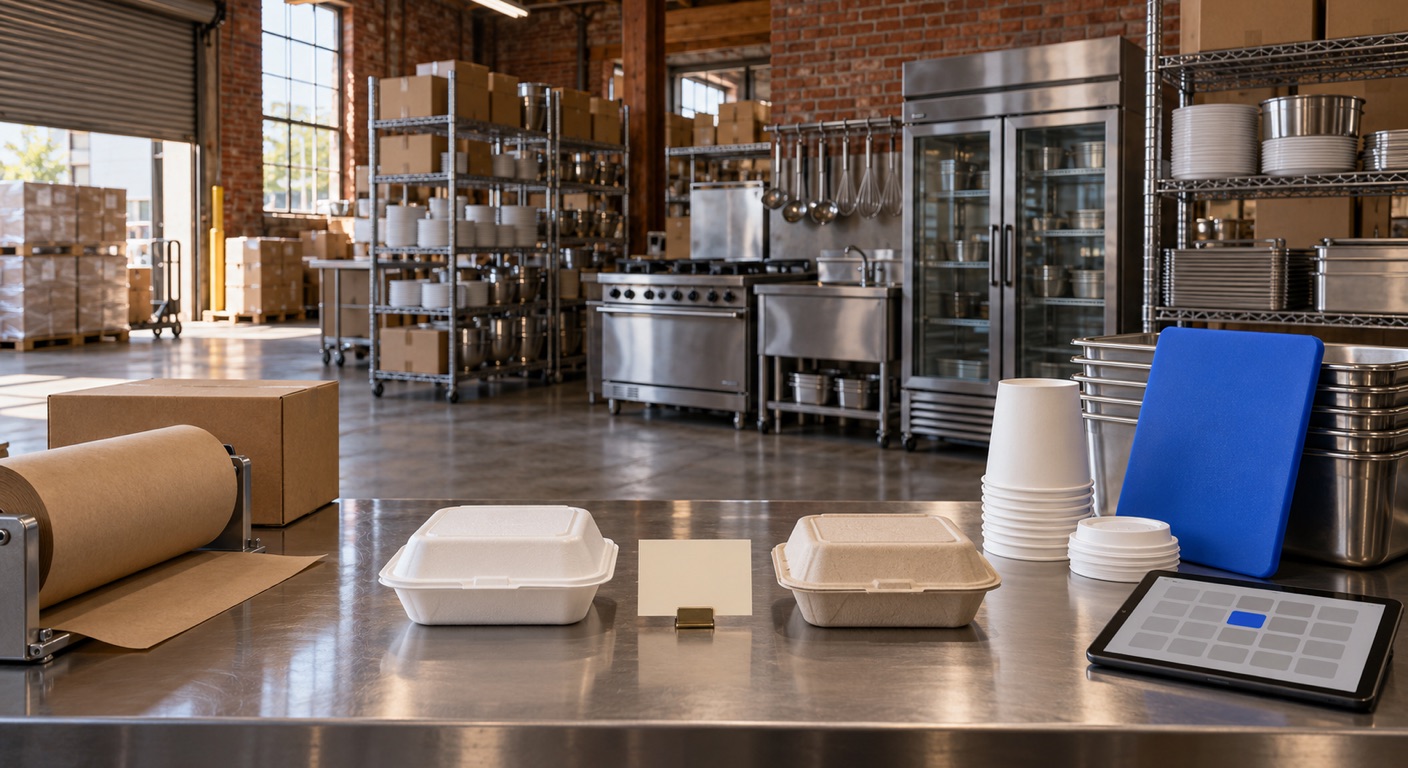
A caterer from York, Pennsylvania, pulls up to a cash-and-carry on Baltimore’s west side at seven on a Saturday morning, as she has for years, and asks for four cases of the white foam clamshells she always buys. The store has them. They sit on a pallet in the back, waiting for Tuesday’s delivery run across the state line, and the clerk cannot sell them to her. Maryland has barred anyone from selling foam food containers in the state since July 1, 2020, and lets a business keep them only “for later distribution outside the State.” The pallet can go to York on the store’s truck. As we read the law, it cannot go to York in her van, because a sale across a Baltimore counter is a sale in Maryland. She leaves with fiber clamshells instead, and asks a fair question on the way out: why did the website say the foam ones were in stock?
Across the county line, an equipment dealer is quoting the kitchen for a carry-out that opens in Highlandtown in January. The owner wants two fryers, a combination oven, a reach-in freezer, an ice machine and a three-compartment sink, and wants to know what BGE will pay toward them. The quote has to carry each item’s sanitation listing, numbered to match the floor plan, because Maryland’s plan review form asks for spec sheets numbered that way. The freezer and the ice machine need their refrigerant and year of manufacture on the listing, because a federal rule now says so for anything sold online. If the dealer is one of BGE’s participating distributors, the fryers, the oven and a medium solid-door freezer are all electric and ENERGY STAR certified, and the restaurant’s account is on a commercial rate, BGE will take $2,737.50 off the price at the counter, but its programs are approved only through December 31, and nobody can promise the owner what January will bring. Then there is the sink, and the question of where it drains.
And on a Friday afternoon, a used-equipment buyer stands in the kitchen of a restaurant that served its last meal on Wednesday. The owner wants cash for the ice machine, two reach-ins and a mixer. The ice machine is collateral for a loan recorded with the state, and Maryland law lets that lien follow it into the next restaurant’s kitchen. The landlord is owed two months’ rent and can ask a court to seize anything still on the premises, whoever has paid for it. And the City wants each item’s serial number and the seller’s identification in an electronic report by noon on Monday, followed by ten days on a shelf before anything can be resold.
None of these three businesses has a software problem in the usual sense. Each has a point of sale, a website and an accounting package that work. What none of those tools knows is the thing each of them got stuck on: in Maryland, a restaurant supply product’s legal status can depend on where it is going, what the customer will do with it, who vouched for it and whose name is on its paperwork. The cheapest thing such a store sells, the take-out container, turns out to be the most regulated thing in the building.
We start with the trade in numbers and what its software costs, then work through the rules one layer at a time: the foam ban, the PFAS ban on fiber packaging, Maryland’s new packaging producer responsibility law, the rules in the states a Baltimore supplier delivers to, sales tax, equipment approvals, utility incentives and used equipment. Then we look at what six Baltimore supply businesses show customers and machines today, what an online store has to do differently, how the same questions land in Lithuania, and what we would build, with prices. If you came for one answer, the questions at the end are phrased the way people type them into Google.
What Baltimore’s restaurant supply trade looks like in the numbers
There is no federal category called “restaurant supply store.” The 2017 industry classification that the Census Bureau’s County Business Patterns still uses puts restaurant equipment, commercial cooking and dishwashing equipment and commercial kitchen utensils in NAICS 423440, a wholesale code; refrigerators, display cases and “ice making machines” in 423740; and disposable cups, plates, cutlery and “sanitary food containers” in 424130, the paper and disposable plastics wholesalers. The code that sounds closest, 423850, service establishment equipment, expressly excludes “specialized equipment and supplies used in offices, stores, hotels, restaurants.” Used restaurant equipment dealers have no code of their own, and a cash-and-carry store that invites walk-in shoppers can end up classified as retail instead of wholesale. So any count is a count of pieces.
The pieces are small. In County Business Patterns for 2023, Baltimore City had 6 establishments in 423440 with 106 employees between them, and Baltimore County had 7 with 57. The whole Baltimore-Columbia-Towson metro had 30, and none of them employed 100 people or more. The city had no refrigeration equipment wholesaler with employees; the county had 3. Paper and disposables did better: 8 establishments with 210 employees in the city, 8 in the county, 34 across the metro.
Their customers are far more numerous. The same Census file counts 1,446 food service and drinking places in Baltimore City and 1,753 in Baltimore County, which is about 241 restaurants, bars and caterers for every equipment wholesaler in the city. They are also small: 498 of the city’s 1,184 restaurants, or 42.1%, had fewer than five employees. Baltimore City does not publish a current count of its licensed food facilities in a form we could use; the “Restaurants” layer on Open Baltimore holds 1,327 records whose edit dates are all from 2008 and whose own description says it has not been updated since 2022.
| NAICS code | Baltimore City | Baltimore County | Baltimore metro | Maryland |
|---|---|---|---|---|
| 423440 Commercial equipment, including restaurant equipment | 6 / 106 | 7 / 57 | 30 / 458 | 55 / 739 |
| 423740 Refrigeration equipment | none listed | 3 / 13 | 7 / 44 | 17 / 85 |
| 424130 Paper and disposable plastics | 8 / 210 | 8 / 57 | 34 / 828 | 53 / 1,132 |
| 722 Food services and drinking places (the customers) | 1,446 / 19,622 | 1,753 / 29,848 | 5,901 / 106,699 | 11,930 / 216,002 |
Disposables are the bigger business, and the national players are already in town
The 2022 Economic Census, the most recent one with product detail, shows which half of the trade carries the volume. Across the United States, wholesalers sold $50.5 billion of disposable paper and plastic cups, plates and food containers, against $35.3 billion of restaurant, food service and hotel equipment. The disposables did not all go through specialists: paper and disposables wholesalers sold 36.1% of them, and general-line grocery wholesalers, the broadline food distributors whose trucks already stop at every restaurant, sold another 29.6%. That is the competitive problem for a local supply store in one number. The product the law regulates most closely is also the one a restaurant can most easily add to the order it already places with the distributor whose truck brings the chicken.
The other competition is national and, increasingly, local. Foodservice Equipment & Supplies magazine’s 2026 ranking of the 100 largest dealers puts their 2025 sales at $16.49 billion, up 4.72%, with Clark Associates of Lancaster, Pennsylvania, the parent of WebstaurantStore, first at $3.97 billion, 26% of it paper and disposables. No Maryland-headquartered dealer is on the list. Clark’s own cash-and-carry chain, The Restaurant Store, has two Baltimore-area stores, on Kane Street and in Woodlawn, and Clark’s 2026 CEO letter says its largest distribution center to date is now running in Hagerstown, Maryland. Restaurant Depot, which lists 170 warehouses, has two of them in the Baltimore area, on Annapolis Road and in White Marsh, and its membership is free but limited to businesses. In a letter to customers dated June 8, 2026, Restaurant Depot referred to its “planned merger with Sysco”, which would put the cash-and-carry chain and the country’s largest broadline food distributor under one owner. A local store competes with all of them on price for a case of lids and wins, when it wins, on what they do less well: answer the phone, deliver on Thursday, know the inspector and know the rules.
The banned product got pricier, and the replacement got cheaper
The producer price indexes add a twist that a pricing system has to live with. Between October 2025 and September 2026, the national index for polystyrene foam food containers rose 12.9%, almost all of it between April and July 2026, while the index for molded pulp goods fell 7.7%. Commercial refrigeration equipment rose 6.7% over the same months and commercial cooking equipment 4.0%. For a Baltimore store that can no longer sell foam to its Maryland customers anyway, the foam price matters only for the out-of-state book; for everyone else, the fiber containers that replaced foam got cheaper while the steel boxes that keep food cold kept getting more expensive. One more number is worth correcting while it is fresh. The National Restaurant Association’s widely quoted forecast of $1.55 trillion in 2026 restaurant sales was cut to $1.36 trillion on October 19, 2026, after the Census Bureau revised the data it is built on, and search results still lead with the old figure.
What restaurant supply software costs, and what each meter counts
We read the pricing pages of the tools a Baltimore restaurant supply business would realistically use, on October 27, 2026, in US dollars. They divide cleanly. The tools built for the equipment trade itself do not publish a price: AutoQuotes, the quoting and catalog system widely used by foodservice equipment dealers, Epicor’s Prophet 21 and Eclipse, DDI, NetSuite, Acumatica and ECI’s Spruce all ask for a demo or a conversation. The one exception we found is KCL, the kitchen design software, at $499 a year for a site license with unlimited users at one location. The retail and e-commerce tools a cash-and-carry store runs on publish everything, and their meters count very different things.
| Tool | Published price | What the meter counts |
|---|---|---|
| Square (point of sale) | $0 / $49 / $149 | Locations; card rate 2.6% / 2.5% / 2.4% + 15¢ in person; invoice ACH 1%, capped at $10 on the two paid plans |
| Lightspeed Retail | $89 / $149 / $289 billed annually | Locations, one register included; each extra register $59 |
| Shopify POS Pro | $89 | Locations |
| Clover (retail) | $16 to $240 for 36 months | Device bundles; subscriptions are non-cancelable |
| QuickBooks Online | $38 / $85 / $140 / $340 | Users (1, 3, 5, 25); three plans rose in August 2026 |
| Shopify | $39 / $105 / $399; Plus from $2,300 | Plan; B2B net terms on all three, deposits and partial payments on Plus only; 2% / 1% / 0.6% fee without Shopify Payments |
| BigCommerce | $39 / $105 / $399; Performance from $1,499 billed annually | Trailing 12-month sales caps of $30,000 and $100,000, then $33,333 a month with a 0.9% overage; customer price lists on Performance only |
| WooCommerce B2B plugins | $199 to $449 a year (B2BKing); $299 a year (Wholesale Suite) | Websites |
| KCL kitchen design | $499 a year | Locations, unlimited users |
| Freightview (LTL freight) | $149 | Shipments, up to 50 a month |
| Avalara Select | $69 to $79 per state | States filed; exemption management included |
| Shopify Tax | 0.35% per order after $100,000 in sales, capped at $0.99 an order | Orders, including point-of-sale tickets |
| Stripe ACH and Invoicing | 0.8% capped at $5, plus 0.4% per paid invoice | Payments and invoices; the invoicing fee has no published cap |
| Amazon, eBay, Walmart | 8% to 15%; 13.6% to $7,500; 8% to 15% | The sale; eBay’s base includes freight and sales tax |
| AutoQuotes, Prophet 21, Eclipse, DDI, NetSuite, Acumatica, Spruce | Not published | Quoted after a demo |
Three meters in that table matter more to a supply business than the monthly fees do. The first is the deposit. Shopify now gives B2B features, net terms, vaulted cards and up to three customer catalogs, to its Basic, Grow and Advanced plans, but deposits and partial payments are on Plus only, from $2,300 a month. An equipment dealer that takes half up front on a special-order range has hit the most expensive plan before it has sold anything. The second is how ACH fees are capped. On an $18,000 equipment invoice paid by bank transfer, Square’s paid plans charge $10, Stripe charges $77 ($5 for the transfer and $72 for the invoice), an uncapped 1% charges $180, and a card at 2.9% plus 30 cents costs $522.30. The third is the per-order tax fee: Shopify Tax counts point-of-sale tickets toward its $100,000 threshold and then charges up to 99 cents a ticket, which for our modeled store’s counter tickets and web orders came to about $263 a month, against $69 for Avalara’s single-state plan.
Put together, a small cash-and-carry store with a web store pays very little for software and a great deal for payments. Our modeled store takes $60,000 a month in card sales at the counter over about 700 tickets, $15,000 online over 100 orders and $20,000 in trade invoices paid by ACH. On Square Plus and QuickBooks Essentials, and assuming Square’s free online store is enough, its software costs $134 a month and its payments about $2,271; on Shopify Grow, POS Pro and QuickBooks, the software costs $279 and payments and per-order tax fees about $2,508. A dealer that quotes and installs equipment, with eight staff and ten $18,000 jobs a month, pays about $999 a month in fixed software (KCL, QuickBooks Advanced, Shopify Advanced for live freight rates, Freightview and Avalara) before AutoQuotes, whose price it will only learn on a call, and then between $149 and $5,223 a month to collect its invoices, depending almost entirely on whether its customers pay by capped ACH or by card. None of those tools, at any price, knows that a foam clamshell may not be sold in Maryland.
The foam clamshell: legal in the warehouse, illegal at the counter
Most of what has been written about Maryland’s foam ban is addressed to restaurants, and it describes half of the law. Section 9-2203 of the Environment Article has two operative subsections, and the first one is about the store, not the restaurant:
“(a) On or after July 1, 2020, a person may not sell or offer for sale in the State an expanded polystyrene food service product. (b) On or after July 1, 2020, a food service business or school may not sell or provide food or beverages in an expanded polystyrene food service product. (c) This section does not prohibit a person from storing a food service product for later distribution outside the State.”
Read as a product rule, subsection (a) is a ban on a category of inventory, and it binds “a person”: the distributor, the cash-and-carry, the web store that ships into Maryland and the restaurant reselling a sleeve of cups to the deli next door. Subsection (b) is the one everybody quotes, and it binds the food business that serves in foam. Subsection (c) is the one that matters most to a Baltimore warehouse, and it is the reason this article’s title says what it does. A store may keep foam cups and clamshells on its shelves for customers in Pennsylvania, Delaware or anywhere else foam may still be sold. What it may not do is sell them, or offer them for sale, in Maryland. As we read the words, a sale across a Baltimore counter is a sale in the State wherever the customer is driving next, so the storage exception covers stock that leaves the state on the store’s own delivery or by carrier, not stock that leaves through the front door in a customer’s van.
What counts as foam, and the exclusions that keep foam meat trays and egg cartons legal
The definition in section 9-2201 is precise enough to become a product attribute. An “expanded polystyrene food service product” is a product made of expanded polystyrene that is used for selling or providing food or beverages and is either intended by its manufacturer to be used once or “generally recognized by the public as an item to be discarded after one use.” The statute lists what that includes: food containers, plates, hot and cold beverage cups, trays, and cartons for eggs or other food. Then it carves out four things, and three of them matter to a supply store:
“(3) ‘Expanded polystyrene food service product’ does not include: (i) Food or beverages that have been packaged in expanded polystyrene containers before receipt by a food service business; (ii) A product made of expanded polystyrene that is used to package raw, uncooked, or butchered meat, fish, poultry, or seafood; (iii) Nonfoam polystyrene food service products; or (iv) 1. Cartons for eggs that are made of expanded polystyrene that are shipped into the State for packaging; or 2. Cartons of eggs that have been packaged within the State for sale within the State.”
Each exclusion is a different kind of fact. Exclusion (iii) is a material fact: a clear, rigid polystyrene clamshell or a solid polystyrene cup is not foam, so it is not banned, and a catalog that lumps all “polystyrene” together will either hide legal products or sell illegal ones. Exclusion (iv) is a product-type fact, egg cartons, with a twist about where the eggs were packed. Exclusion (ii) is the interesting one, because it is defined by what the customer does with the product. A white foam tray is legal when a seafood market packs raw rockfish or a butcher packs chicken thighs in it, and the same tray is a banned food service product when a carry-out serves fried chicken on it. The store cannot see what happens after the sale, but it can know who the customer is and what kind of tray it is selling, and it can record that the sale was to a meat or seafood business. That is a field on the customer record, not on the product.
Who enforces it, and what it costs to ignore
The enforcement section is mild. Section 9-2206 gives enforcement to “a unit of county government”, which the subtitle says includes a local health department, caps the penalty at $250, and allows no penalty at all unless the county first issues a written notice of violation and the violation “is not corrected within 3 months of receipt of the written notice.” The waiver in section 9-2205 is narrower than it looks: the Department of the Environment may excuse a food service business or school from subsection (b) for up to a year on a showing of undue hardship, but there is no waiver for a seller under subsection (a). And section 9-2202 leaves counties free to be stricter.
Baltimore City was stricter first. Its own ban, Ordinance 18-125, is section 6-508 of the City Health Code and has applied since October 19, 2019, more than eight months before the state’s. It is written differently, and the differences show how two laws about the same clamshell can disagree on the details. The City’s rule binds food service facilities only: “no food service facility may use any disposable food service ware that is made from polystyrene foam.” It says nothing about sellers, so a supply store’s own obligation is the state’s. Its definition names bowls, clamshell containers and take-away containers and expressly leaves out coolers. Its exception for pre-packed food applies only to food “filled and sealed in polystyrene-foam containers outside of the City”, and its meat and seafood exception is limited to packaging “for off-premises consumption”. And the penalty is heavier: a Health Code violation in the City is a misdemeanor with a fine of up to $1,000 for each offense, and the City can also issue an environmental citation, against the state’s $250 after three months’ notice. A store’s Baltimore City customers therefore face the sharper of the two penalties for serving in foam, which is one more reason they will hold the store responsible for what it sold them. The Department of the Environment’s own two-page FAQ, reissued in April 2026, notes that more than half of Maryland residents lived under a local foam ban before the state law took effect; it also lists only three of the statute’s four exclusions, leaving out the egg cartons.
A $250 ceiling after three months’ notice is not why a supply store should get this right. The reasons are that its customers can be cited for serving in what it sold them, that its web store is the first thing a Maryland restaurant owner checks when a health inspector mentions foam, and that the same catalog has to work for customers in states where the answer is different. That last part is where most software stops being able to help, and we come back to it in the section on shipping across state lines.
The fiber bowl that replaced the foam needs someone to vouch for it
When foam left Maryland’s take-out counters in 2020, molded fiber took its place: the oatmeal-colored clamshells, bowls and plates pressed from sugarcane bagasse, bamboo or wood pulp. Fiber has one weakness for food service, which is grease and steam, and for years one common fix was fluorinated chemistry that made the fiber shed oil and water. Three and a half years after the foam ban, Maryland closed that door too. Chapter 138 of 2022, the George “Walter” Taylor Act, added a new subsection to a packaging law that had been on the books since 1993:
“(d) On or after January 1, 2024, a manufacturer or distributor may not manufacture or knowingly sell, offer for sale, or distribute for sale or use in the State a food package or food packaging component designed and intended for direct food contact to which PFAS chemicals were intentionally added.”
The definitions decide which products this reaches, and they are narrower and stranger than most summaries suggest. A “food package” is a package designed and intended for direct food contact and “composed, in substantial part, of paper, paperboard, or other materials originally derived from plant fibers.” So the rule covers the fiber clamshell, the paper plate, the paper hot cup, the sandwich wrap, the pizza box and the bakery bag, and it does not cover a plastic clamshell, a foil pan or a glass jar, whatever is in them. Then the definition adds one item that is not made of fiber at all: “Plastic disposable gloves used in commercial or institutional food service.” The box of vinyl gloves on the shelf next to the containers is a food package under this subtitle, which is a detail we have not seen in any supplier’s Maryland guidance.
“Intentionally added” means a chemical deliberately used in making the package because its “continued presence is desired in the final package or packaging component to provide a specific characteristic.” That is a test about the recipe, not about a lab result: a trace that nobody put there on purpose is not intentionally added, and a grease-proofing treatment is. “PFAS chemicals” means any fluorinated organic chemical with “at least one fully fluorinated carbon atom”, a definition broad enough to take in the whole family rather than a list of named compounds.
The certificate is the manufacturer’s, and the risk is the store’s
The paper trail sits with the manufacturer. Section 9-1905(c) says a manufacturer that sells or distributes a food package in Maryland “shall establish a certificate of compliance” attesting that it meets the PFAS rule, and must hand it to the Department of the Environment within 30 days of a request. A supply store that sells to restaurants is, as we read the subtitle’s definition, a “distributor”, and its exposure comes from the word “knowingly” and from the penalty section, which is unusually precise about counting: up to $1,000 for each violation, where “each package or packaging component in violation constitutes a separate violation”, capped at $10,000 for any one action, and a misdemeanor with a fine of up to $20,000 for a willful repeat. The Department can also go to court to have a product removed from sale in Maryland.
The federal government has reached roughly the same place by a different route. In February 2024 the FDA announced that grease-proofing substances containing PFAS “are no longer being sold by manufacturers for food contact use in the U.S. market”, and in January 2025 it declared 35 food contact notifications for such substances no longer effective, giving stocks made under the last four until June 30, 2025. Maryland’s law still matters, because it is the one that puts a penalty on each package sold and a certificate in the manufacturer’s file that a store can ask to see. The Department of the Environment has adopted no regulations under it, and we found no published record of the Department requesting a certificate or bringing a case.
For software, that turns into a small, boring and valuable record: for every fiber-based product and every food service glove, the supplier’s written statement that no PFAS was intentionally added, who signed it, when, and which production dates or lots it covers. A store that has those statements on file, and can show them next to the product, is in a very different position from one that is relying on the word “compostable” on a case label. And because the definition reaches gloves, the record has to be kept for a product that nobody in the trade thinks of as packaging.
The packaging law that started in May: who is the producer of a clamshell?
The third packaging law is the newest and the least understood. Maryland’s producer responsibility law for packaging and paper products, Environment Article title 9, subtitle 25, was rebuilt by Chapter 431 of 2025, and its regulation, COMAR 26.04.14, took effect on May 25, 2026. It makes the “producers” of packaging pay, through a single producer responsibility organization, for collecting and recycling what they put into the state. The Department of the Environment approved Circular Action Alliance as that organization in 2023. Circular Action Alliance asked producers to register and report by May 31, 2026; the Department’s compliance guide says a producer that distributes covered materials into Maryland “must register by July 1, 2026.” Both dates have passed. The regulation already says a producer “may not sell or distribute any products that use covered materials in the State unless the producer is either registered with the PRO or has an approved IPP”, meaning its own individual plan, and from October 29, 2028, a producer may not sell covered materials at all without a plan the Department has approved.
Take-out containers are squarely inside it. The statute’s definition of packaging includes “service packaging designed and intended to be filled at the point of sale”, and names “carry-out bags”, “bulk goods bags” and “take-out and home delivery food service packaging.” The Department’s guidance adds the long tail of a supply store’s aisle: plates, bowls, cups, lids, hot cup sleeves, wrappers including foil, utensils, straws, condiment packages, napkins and trays.
The order of precedence points at the restaurant, and the Department would not say otherwise
Who pays depends on who the “producer” is, and the statute answers with a ladder. For items sold in or with packaging at a physical retail location in Maryland, the producer is the item manufacturer if the item is sold “under the brand of the item manufacturer or is sold in packaging without brand identification”; if there is none, the licensee; then the brand owner; then, if none of those is in the United States, the importer; and finally “the person that first distributes the item in or into the State.” Applied literally to a take-out lunch, the item is the lunch and the item manufacturer is the restaurant. Commenters on the draft regulation said exactly that: one law firm warned that restaurants would become the producer of service packaging “simply by using service packaging to contain and sell their goods,” and asked for a separate rule tying it to the container’s brand owner or, if the container is unbranded, to its manufacturer or importer. The Department declined. Its response to comments, published in August 2026, said a restaurant that is a producer of food serviceware, “branded or unbranded”, is subject to the law, and that “producers of packaging must follow the definition of a producer of packaging”, without adding a rule for service packaging; its October 2026 FAQ answers a restaurant’s question, “does this law apply to me?”, with: “the restaurant may be a producer. Please contact the Producer Responsibility Organization or seek legal advice.” The statute’s own exclusion for restaurants does not settle it either: it covers a restaurant headquartered in Maryland that mainly sells ready-to-eat food only if the restaurant “is not a producer of food serviceware”, which assumes the answer to the question.
For a restaurant supply business the practical reading splits three ways. Containers sold under the manufacturer’s brand belong to the manufacturer. Containers, cups and bags sold under the store’s own private label make the store the brand owner and, almost certainly, the producer; the broadline distributors appear to have drawn that conclusion already, and the July 2026 list of producers and brands reported by Circular Action Alliance, which the Department posted, includes Sysco, US Foods, Gordon Food Service, Performance Food Group and Bunzl alongside the packaging makers. Unbranded stock is the unsettled case, because the ladder can stop at the restaurant, at a domestic manufacturer, at the importer of record or at the first distributor into Maryland, depending on facts the store will know only if it records them.
The exemption that a web store can switch off
Two exits matter to small businesses. A “de minimis producer” is one that in its most recent fiscal year “introduced less than 1 ton of covered material into the State” or “earned global gross revenues of less than $2,000,000.” And the statute excludes an entity that owns or operates “a single retail sales establishment that: 1. Has no online sales; and 2. Is not supplied or operated as part of a franchise or a chain.” Taken together, a one-store supply business above both de minimis lines that sells its private-label cups only over the counter is, as we read the statute, outside the definition, and the same business with a web store is not. That is the rare case where an e-commerce decision changes a regulatory status, and it belongs in the business plan for the store, not in the footnotes.
The tonnage prong is easy to underestimate. A US short ton, which we take the statute to mean, is a little over 907,000 grams, so a 10-gram private-label cup crosses it at about 90,700 cups, which is about 91 cases of a thousand, and a 30-gram clamshell at about 30,200. Penalties under section 9-2512 start at $5,000 for a first violation, $10,000 for a second and $20,000 after that, but only after written notice and 60 days to correct; records must be kept for five years and produced within 15 business days. The statute has its own small blemishes for anyone who reads it closely: its definition of “producer” has two items numbered (iv), and a 2026 emergency act that corrected “Department of Agricultural” to “Agriculture” in section 9-2505 had still not reached the General Assembly’s online statute text when we read it.
One older Maryland packaging rule belongs in the same product record because it governs the words on the listing. Since October 1, 2018, section 9-2102 has barred selling in Maryland “a plastic product that is labeled as biodegradable, degradable, decomposable, or with any other term to imply that the product will break down”, and a plastic product labeled “compostable” must meet ASTM D6400 or D6868. A supplier’s case label that says “biodegradable” can therefore make a perfectly legal fork unsellable in Maryland as labeled, and a web store that copies supplier descriptions into its product pages will repeat the problem in its own words.
Across state lines: the ship-to address decides what may be sold
A Baltimore supply business that delivers to York, Wilmington, Northern Virginia or the District is selling into five sets of foam rules at once, and they differ in a way that matters to software: some bind the seller, and some bind only the restaurant that serves in the container. A rule that binds the seller is a reason to refuse the order. A rule that binds the restaurant is a reason to warn the customer and sell the container they actually need.
| Jurisdiction | Who the ban binds | In force | What it means for a Baltimore shipper |
|---|---|---|---|
| Maryland | Any person who sells or offers foam food service products; food businesses and schools that serve in them | July 1, 2020 | Block sales for Maryland delivery and pickup; storage for out-of-state distribution is allowed |
| Baltimore City | Food service facilities that use foam | October 19, 2019 | Same block; the customer’s own fine is up to $1,000 per offense |
| District of Columbia | Retailers who sell foam food service products, foam containers or foam packing material; food service entities since 2016 | January 1, 2021 for retail sale | Block; the District’s definition takes in coolers and packing peanuts too |
| New Jersey | Retail stores, grocery stores and food service businesses that provide or sell foam food service products | May 4, 2022 | Block |
| Virginia | Food vendors that dispense prepared food in foam | July 1, 2025 for vendors with 20 or more locations; July 1, 2026 for all | Sale not banned; warn, because a Virginia restaurant may no longer use it |
| Delaware | Food establishments that provide ready-to-eat food in foam | July 1, 2025; penalties from July 1, 2026 | Sale not banned; warn, for the same reason |
| Pennsylvania | No statewide ban; some municipalities have their own | None statewide | Sell; check the municipality for local rules |
The table has to be maintained, which is the hard part. Virginia’s ban is the cautionary tale. Its statute was passed in 2021, budget language has moved its dates more than once since, and a 2024 attempt to delay them again failed. Virginia Beach’s notice of July 14, 2026 to food vendors says chains with 20 or more locations had to stop using foam by July 1, 2025 and everyone else by July 1, 2026. WebstaurantStore’s guide to foam bans, last updated on March 4, 2026, still gives Virginia’s dates as July 2028 and July 2030. Any rule table copied from a web page in 2024 is probably wrong today.
A product page that says one thing to people and another to machines
The same retailer also shows how hard it is to keep the human page and the machine page in step. On WebstaurantStore’s product pages for a Dart foam hinged container and a Dart 12-ounce foam cup, a shopper sees, without logging in: “This item cannot ship to CA, MD, NJ, NY, OR or VT.” The structured data on the same pages, which is what a search engine or an AI shopping assistant reads, describes an offer at $22.49 and $53.99 that is “InStock”, with no shipping details and no excluded region. The block list itself names six states; the same company’s foam guide lists twelve jurisdictions, including Delaware, Virginia and the District. None of that is a criticism of how the store handles the order; its cart may well do exactly the right thing. It is a demonstration that a restriction kept in one place, as a line of text on a page, does not travel to the places where machines now make shopping decisions.
Locally, the best practice we found is simpler and closer to the statute. Holt Paper & Chemical, a paper and food-service distributor with a Baltimore location on Western Avenue, says on its home page that because of state regulations, foam products “cannot be shipped or sold to customers in Maryland (MD) or Delaware (DE),” and that orders for them with a Maryland or Delaware shipping address will be voided. That rule keys on the delivery address, which is the shape of Maryland’s law: storage in a Baltimore warehouse for a customer in Pennsylvania is allowed, a sale for delivery in Maryland is not. The software version of it adds the two cases a homepage notice cannot catch: the out-of-state customer who picks up at the Baltimore dock, which, as we read the statute, is a sale in Maryland, and the order that is shipped across the line and comes back.
The tax layer: the clamshell is tax-free, the straw is not, and the card decides
Maryland’s 6% sales tax splits a restaurant supply store’s shelf down the middle, and the line it draws is not the one most tills use. Equipment, smallwares, cleaning chemicals and anything else a restaurant uses up in running its kitchen are taxable, because a restaurant is a retail food vendor and Maryland’s production exemption expressly leaves out “processing food or a beverage by a retail food vendor.” Containers are different. COMAR 03.06.01.15 extends the resale exclusion to “the containers, cartons, bottles, pallets, packing, and their components sold with these products”, and the Comptroller’s Business Tax Tip #5 applies it to restaurants in three sentences that every supply store’s tax settings should be built from:
“Purchases of paper plates, bowls, cups and lids by a food server for use as containers for food sold are entitled to the resale exclusion. This exclusion applies whether the food sold will be consumed on or off the premises. The tax does apply, however, to a food server’s purchases of disposable containers and wrappers made available for discretionary use and to all purchases of disposables such as napkins, straws, utensils and stirrers which are not in the nature of containers.”
So the same order from the same carry-out splits into two tax classes. The clamshells, cups and lids can be bought tax-free for resale. The napkins, straws, forks and stirrers in the next aisle are taxable, and so are cups put out for customers to take as they like. Gloves are not named, but they are not containers, so we would treat them as taxable. That is a field on every disposable product record, and it is the field most generic retail software gets wrong in one direction or the other.
The $200 rule: how the customer pays changes whether the certificate counts
The exclusion only works through a resale certificate, and Maryland limits when a store may accept one. Section 11-408(b)(3) of the Tax-General Article says a vendor “may not accept a resale certificate if the vendor knows or should know that the sale is not for the purpose of resale”, which is why a restaurant cannot use its certificate to buy a fryer, and then adds a rule that turns on the ticket and the tender:
“(ii) A vendor may not accept a resale certificate for a cash, check, or credit card sale if: 1. the taxable price is less than $200; and 2. the tangible personal property, digital code, digital product, or taxable service is not delivered by the vendor directly to the buyer’s retail place of business.”
The Comptroller’s regulation adds debit cards and electronic transfers to that list, and Business Tax Tip #4 says the rule does not apply to sales “on credit by the seller”, meaning a house account. Put together, a carry-out owner who buys $150 of clamshells at the counter with a card pays $9.00 in tax, and the same $150 order on the store’s net-30 account, or delivered to the restaurant by the store’s truck, can go through tax-free with a certificate on file. Nothing about the clamshells changed. The certificate also has to be in hand “before the sale is consummated”, and it has to carry a Maryland registration number, which the Comptroller’s regulation says has eight digits and always starts with 0 or 1; a federal EIN is not a substitute. A store that checks those three things at checkout, and links every tax-free line to the certificate it relied on, has what an auditor will ask for four years later.
Churches, schools and other nonprofits buy with exemption certificates rather than resale certificates, and those have their own rules: the store must see the certificate and record the organization’s name and number on the sale, and the Comptroller’s page says the current nonprofit certificates expire on September 30, 2027. Its Business Tax Tip #4, still posted, gives the expiry of the previous cycle, September 30, 2022, which is the kind of stale date that ends up in software if somebody configured it from the PDF.
Delivery, installation, rebates and the pickup rule
On an equipment invoice, what is taxed depends on how the lines are written. Under COMAR 03.06.01.08, delivery by the store to the buyer and the installation of a complete unit are not taxed if they are “stated separately” and made known to the buyer at the time of sale. Freight the store paid to get the unit into its own warehouse, small-order fees and a service plan the customer is required to buy are all part of the taxable price. A trade-in is not deducted. And a rebate paid by anyone other than the store is included in the taxable price, which, as we read it, means a utility’s instant incentive does not reduce the tax: on a $3,000 ice machine with a $375 instant discount, the tax is $180, not $157.50.
The rule for out-of-state customers is the tax twin of the foam ban’s storage exception. COMAR 03.06.01.25B says that if property is sold in Maryland “and possession is taken by the buyer within this State, the tax applies even if the tangible personal property is to be transported out of this State immediately upon delivery.” The caterer from York who loads cases into a van at the Baltimore dock pays Maryland tax; the same cases delivered to York by the store’s truck or by a carrier are not taxed. A supply store’s order record therefore needs to know how the goods leave the building for two separate reasons, one environmental and one fiscal, and both give the same answer.
Two smaller rules trip up tills. Maryland’s tax is collected by a bracket table rather than by rounding, so $100.01 carries $6.01 in tax, not $6.00. And when a dealer installs a walk-in cooler or a hood as part of a building, the regulation on real property contractors applies instead: the dealer pays tax on its materials and charges the customer none, under a four-factor test about how the item is attached and why, while counters and cabinetry in commercial spaces are, as a general rule, treated as personal property.
The kitchen keeps costing after the sale
Restaurant equipment is business personal property, and in Maryland that is taxed by the county where it sits. For 2026–27 the rate is $5.62 per $100 of assessed value in Baltimore City and $2.75 in Baltimore County. Equipment falls in the general category of the State Department of Assessments and Taxation, depreciated 10% a year to a floor of 10% of cost, so a $100,000 kitchen line that has reached its floor still carries about $562 a year in the City and $275 in the County. A business whose personal property statewide cost less than $20,000 in total does not owe the tax, but that threshold counts inventory, so almost every supply store files by April 15 even though its inventory itself is exempt.
Tariffs: a quote now needs an expiry date
Prices are the other half of the invoice, and in 2026 they moved by decree as much as by market. Commercial cooking stoves, ranges and ovens (tariff code 8419.81.50) became steel “derivatives” under Section 232 on August 18, 2025, and since April 6, 2026 the duty applies to the full customs value rather than the steel content; ranges and ovens now sit in a temporary 15% tier that runs to December 31, 2027. Stainless sinks and kitchenware carry 25%. Commercial refrigerated cabinets and commercial dishwashers are not on the Section 232 list in the current tariff schedule at all. The Supreme Court’s February 20, 2026 decision ended the IEEPA tariffs. Customs puts the IEEPA duties it collected at about $166 billion, and any refund goes only to the importer of record, which means only to dealers who imported the goods themselves. Meanwhile the producer price index for commercial refrigeration rose 6.7% between October 2025 and September 2026, in steps rather than a slope, and the index for cold-rolled steel sheet rose 37.5%. A quote for a kitchen that will be installed in three months needs an expiry date, the tariff code and origin of each line, and a rule about what happens to the price if the supplier’s price changes before the order is placed.
Equipment: the listing, the drain and the refrigerant decide what can be installed
Disposables are regulated by what they are made of. Equipment is regulated by whether it can be approved, plumbed and charged, and a dealer that quotes a kitchen is really quoting three approvals at once. The first is sanitation. Maryland’s food service regulation, COMAR 10.15.03.15, requires food equipment to meet one of a short list of design standards, and the first item on the list is the one everybody means when they say “NSF”:
“(a) National Sanitation Foundation (NSF) or equivalent sanitation certification from: (i) ... Intertek ETL SEMKO; (ii) Canadian Standards Association (CSA); or (iii) Underwriters Laboratories (UL); (b) Baking Industry Sanitation Standards Committee; (c) National Automation Merchandizing Association; (d) ... 3-A Sanitary Standards; or (e) Another applicable published standard acceptable to the approving authority”
Section B of the same regulation is the only door for anything else, such as residential-style or uncertified used equipment: the approving authority may allow it if a review shows it is “not harmful to public health” and “consistent with industry standards and practice.” The wording you will find in most online guides, equipment “certified or classified for sanitation” by an “ANSI-accredited” program, comes from the FDA’s 2022 Food Code, which Maryland’s health department said in October 2025 it plans to adopt without having set a date. For now, the Maryland text is the one above.
The paperwork follows from it. COMAR 10.15.03.33 requires plan approval before a food facility is built, remodeled or “materially altered”, including “a complete list of specifications for the proposed food equipment”, and the state’s plan review form asks for an equipment schedule and specification sheets “numbered in sequence to correspond to list/plan”. Baltimore City’s Health Department charges $150 for plan review, which includes two inspections, plus $75 for a blueprint review and $50 for each extra inspection. A dealer’s quote that already numbers each line to match the floor plan and attaches each item’s spec sheet and sanitation listing is a plan review submission waiting to be printed. The equipment regulation, COMAR 10.15.03.15, also puts a clock on equipment that breaks: the restaurant must give the health authority a plan for the permanent replacement within 10 working days of the failure and install it within 30 working days of the plan being accepted, which is a service ticket with a legal deadline.
Where the water goes: Baltimore’s grease rules live in a scanned memo
The second approval is the drain. Baltimore’s fats, oils and grease program requires every food service establishment that discharges grease to hold a wastewater discharge permit and to have a grease control device “sized and installed in accordance with the Baltimore City Plumbing Code”, cleaned often enough to meet a “25% Rule” (grease and solids may not exceed a quarter of the device’s depth), with a maintenance log kept on site and hauler manifests kept for three years. Penalties under the City’s sewer article start at $250 a day, and each day is a separate violation. The legal source is a Department of Public Works directive from January 2015 that the City posts only as a scanned image, which most search engines and AI assistants cannot read, and the department’s own grease manual now returns a 404; we read it through an archived copy.
The plumbing code it points to is the 2021 International Plumbing Code, which the City adopted with local amendments. It requires an interceptor for pot sinks, pre-rinse sinks, soup kettles, wok stations and “dishwashers without prerinse sinks”, says plainly that “a food waste disposer shall not discharge to a grease interceptor”, and sizes hydromechanical interceptors at two pounds of grease capacity for every gallon per minute of flow. A quote that sells a three-compartment sink, a pre-rinse station and a disposer without asking where each of them drains is incomplete, and the restaurant finds out at inspection.
The refrigerant is part of the product page now
The third approval is federal, and it has a calendar. Under EPA’s technology transitions rule for hydrofluorocarbons, new stand-alone commercial refrigeration units, the reach-ins and merchandisers a dealer sells off the floor, could not be manufactured or imported with a refrigerant of global warming potential 150 or more from January 1, 2025, and from January 1, 2028 they may not be sold. For smaller self-contained ice machines the dates are 2026 and 2029, and for self-contained food processing and dispensing equipment 2027 and 2030. EPA’s May 2026 reconsideration changed the installation limits for remote condensing units and supermarket systems, not these. In practice that usually means propane: R-290 equipment built to the newer UL 60335-2-89 standard may hold about 500 grams in open cases and about 300 grams in units with doors or drawers, and must carry flammable-refrigerant markings and red service hoses.
The rule that matters most to a web store is a labeling rule. Each regulated unit must carry a label with its refrigerant and year of manufacture, and for anything sold online the regulation is explicit:
“(f) For products sold or distributed, offered for sale or distribution, or made available electronically through online commerce, the label must be readily visible and legible in either photographs of the products, photographs of packaging materials that contain the required information, or an item description that contains the required information.”
A product missing its label is presumed to use a prohibited refrigerant, and each unit sold counts as a separate violation. So the refrigerant, its charge and the year of manufacture are not specification trivia buried in a PDF; they are fields a listing cannot publish without. The federal efficiency standards, by contrast, stood still: the stricter Department of Energy standards for commercial refrigerators and walk-in coolers issued at the end of 2024 and in January 2025 were disapproved by Congress and withdrawn in May 2025, so the 2017 levels still apply, along with 2020 levels for some walk-in refrigeration systems. Because those standards bind manufacturers and private labelers at the point of manufacture, a dealer may sell stock built to the rules of its day. The exception is the dealer that sells under its own brand, which takes on the manufacturer’s duties.
Incentives: BGE pays at the counter, for electric equipment, through December 31
BGE’s energy efficiency program, funded by the EmPOWER Maryland charge on every bill, runs two tracks for commercial kitchens. The first is an instant discount taken off the price at the counter of a participating distributor, with no forms for the customer and a fixed amount per unit. The second is a prescriptive incentive that BGE says can “cover up to 50% of the cost” of electric cooking equipment, refrigerators, freezers and ice machines, but only if the customer applies first and waits for pre-approval and the installed equipment is “identical to the equipment specified in your initial application”; the check then arrives in six to eight weeks. The instant-discount page puts the condition that settles most quotes in one line:
“To qualify, all measures must be electric and ENERGY STAR® certified.”
| Equipment | Instant discount per unit |
|---|---|
| Combination oven | $1,875.00 |
| Steam cooker | $1,500.00 |
| Convection oven | $450.00 |
| Fryer, hot food holding cabinet, commercial dishwasher | $375.00 each |
| Ice machines, by type and harvest rate | $37.50 to $375.00 |
| Reach-in freezers, by size and door | $37.50 to $225.00 |
| Reach-in refrigerators, by size | $37.50 to $112.50 |
BGE lists twelve participating distributors for the instant discounts, and one has a Baltimore address: Carey Sales & Services on Frederick Avenue. Eligibility runs through the customer’s electric rate schedule (G, GS, GL, P or T, the commercial and industrial classes), so the discount is a property of the customer’s account as much as of the product. There is also a curiosity in the table that a pricing system will notice before a person does: every amount is exactly three-quarters of a rounder one, $37.50 of $50, $48.75 of $65 and $1,875 of $2,500. BGE’s pages do not say why.
The approval runs out on December 31
BGE’s own business FAQ says the current programs are approved by the Public Service Commission “through December 31, 2026” and that “no incentives are available for energy-saving projects related to gas technologies”. The legislature has since settled the gas question and left the electric one open. Chapter 353 of 2026, the Utility RELIEF Act, requires a gas company that runs an EmPOWER program to “terminate the program on or before December 31, 2026”, while the electric programs that pay for the kitchen discounts go on into a 2027 to 2029 cycle with a lower savings target of 1.75% a year. In July the Commission asked the utilities for plans with 30% and 45% budget cuts, the utilities filed them on September 1, and we found no decision yet. A dealer quoting a kitchen that will be delivered in January therefore cannot promise the customer this year’s discount, and its quote should say so.
Two more details belong in the quote engine. A combination oven, two fryers and a medium solid-door reach-in freezer, each with an ENERGY STAR ID, add up to $2,737.50 off at the counter, but only for electric models on an eligible account, so fuel type and the ENERGY STAR identifier have to be fields, not words in a description. And, as the tax section showed, Maryland’s sales tax is computed on the price before BGE’s discount, as we read the regulation, which is the opposite of what a till does when a discount is keyed in as a markdown.
Used equipment: the ice machine comes with the restaurant’s paperwork
Every restaurant that closes in Baltimore leaves a kitchen behind, and a good part of the city’s equipment trade runs on those kitchens. A dealer arrives at the back door with a truck and a price for the ice machine, the reach-ins, the mixer and the steam table, and the owner, who needs the cash, says yes. Generic inventory software treats what happens next as a purchase of stock. Maryland and Baltimore law treat it as a transaction with up to four other parties who may have a claim on the same steel, and one federal rule about what is inside it.
The lender’s lien does not wash off at the dealer’s counter
Restaurants finance equipment. When they do, the lender usually files a financing statement with the State Department of Assessments and Taxation, and under Maryland’s version of the Uniform Commercial Code that security interest “continues in collateral notwithstanding sale” unless the lender authorized the sale free of it (section 9-315 of the Commercial Law Article). The dealer is not protected by buying in good faith. The rule that protects ordinary shoppers, section 9-320(a), says a buyer in ordinary course of business “takes free of a security interest created by the buyer’s seller”, and the words that matter are the last four. The dealer’s own customer, who buys from a business that sells equipment, takes free of the dealer’s lender. It does not take free of the closed restaurant’s lender, whose lien was created by somebody else and follows the ice machine into the next kitchen.
A lease is worse. If the restaurant leased the machine on a true lease, it never owned it, and a seller can pass only the title it has. The first check against both problems is cheap: SDAT’s online UCC search, by the debtor’s exact legal name, before money changes hands. SDAT keeps lapsed and terminated filings searchable for a year after they lapse, and built-in equipment such as a walk-in cooler or a hood may also have a fixture filing in the land records, which an SDAT search does not cover. What the dealer’s software should store, against each serial number, is the search result and either a payoff letter, a termination statement or a signed release.
Maryland still has a bulk-sales law, and it names restaurants
Most states repealed Article 6 of the Uniform Commercial Code, the bulk-transfer law, decades ago. Maryland kept it, and its list of businesses the law covers is unusually specific:
“(3) The enterprises subject to this title are all those whose principal business is the sale of merchandise from stock, including those who manufacture what they sell, restaurants, and all vendors and sellers of alcoholic beverages, regardless of the form in which such beverages are sold, and regardless of whether sold on a wholesale or retail basis.”
Buying the equipment alone is not a bulk transfer; subsection (2) of the same section makes a transfer of a substantial part of the equipment a bulk transfer only “if it is made in connection with a bulk transfer of inventory.” But a dealer who buys the walk-in and the food in it, or the bar and its stock, can be in the statute. Then the buyer must obtain a sworn list of the seller’s creditors and give notice to them “at least ten days before he takes possession of the goods or pays for them, whichever happens first” (section 6-105), and the Comptroller must get the notice too. The Tax-General Article supplies the reason to care. If the buyer does not file that notice or hold back enough to cover what the restaurant owes in sales tax, section 13-802 makes “the transferee or auctioneer ... personally liable for the sales and use tax, interest and penalties that the transferor owes to the State.” A closing restaurant is not a business that is likely to be current on its sales tax.
The landlord can levy on equipment the restaurant has already sold
Maryland’s distress-for-rent procedure lets a commercial landlord with a written lease of more than three months ask a court to seize goods on the premises for unpaid rent, and section 8-306(a) of the Real Property Article says the levy “shall be made solely on goods on the leased premises, regardless of whether the goods are the property of the tenant or of some other person.” A dealer who has paid for a range but left it in the restaurant until Monday owns a range on the landlord’s premises. Section 8-311 gives a non-tenant “seven days after the levy” to petition the court to exclude its goods; after that, they are treated as the tenant’s. A prior perfected security interest is protected; the dealer’s bill of sale is not. The practical rule is the one experienced buyers already follow: pay on pickup, not before, and pick up fast.
The City counts a used ice machine as second-hand goods
Baltimore City’s second-hand dealer law is usually discussed for jewelry and electronics, and record stores know it for the turntables they buy over the counter. It reaches restaurant equipment just as plainly. Article 2, section 12-1(f) of the City Code defines a second-hand personal property dealer as anyone “engaged in the business of buying for resale, trade, or transfer used or previously owned property or merchandise, including, but not limited to, clothes, furniture, household items, and other moveable personal property, excluding motor vehicles, records, tapes, compact discs, and books.” A mixer is moveable personal property, and so is a reach-in on casters. There is no exemption for buying from a business.
The obligations are the ones the City applies to every dealer: a $50 annual license for each place of business, no purchases from minors, an electronic report with the item’s maker, model, year and serial number, the price paid and the seller’s identification, filed “before noon on the business day immediately following” the purchase, and a hold, because each item “shall be held for at least 10 days after the report of its acquisition is made.” Records are kept for three years, and a violation is a misdemeanor with a fine of $500 to $1,000. Two details are worth building around. The hold runs from the report, not the purchase, so a dealer who files from the restaurant’s back door on a Friday rather than from the office on Monday can sell three days sooner. And the report and hold do not apply to items bought “at a public auction conducted by a licensed auctioneer”, which in Baltimore means an auctioneer licensed by the City: the City Code caps the number of licensed auctioneers at 50, requires a $25,000 bond and charges $1,600 a year. As we read the City Code, an online liquidation run by an out-of-town firm without a City license may not carry that exemption, which is a question to put to the City before relying on it.
The refrigerant: a sealed unit can be resold, a scrapped one must be accounted for
Federal refrigerant rules are lighter on resale than most dealers fear and heavier on scrapping than most realize. EPA’s sales restriction on refrigerant does not apply to refrigerant “contained in an appliance with a fully assembled refrigerant circuit”, so a working reach-in can be sold as it is. When a dealer parts out or scraps a small appliance instead, a factory-sealed unit with five pounds of refrigerant or less, which includes most reach-ins and under-counter ice makers, the dealer is the “final processor” under 40 CFR 82.155 and must either recover the remaining refrigerant itself or “verify using a signed statement or a contract” that it was recovered, with “the name and address of the person who recovered the refrigerant and the date”, and keep that record for three years.
The technology transitions dates in the equipment section apply to new units. Used equipment is exempt after “a period of ordinary utilization or operation by a consumer”, which makes a never-installed “open box” unit a question rather than an answer. Maryland’s own hydrofluorocarbon regulation, COMAR 26.11.33, has applied to stand-alone units since January 1, 2021 and defines “new” to include anything manufactured after the regulation took effect, so read literally it could reach a used R-404A reach-in built in 2022 that federal law would let a dealer resell. We have not seen the Department of the Environment apply it that way, and a dealer who sells refrigeration equipment into Maryland should ask before assuming it will not.
What 6 Baltimore restaurant supply businesses show customers, and machines
We tried to list every restaurant supply business with a storefront or warehouse in Baltimore City or Baltimore County and could confirm only six that are operating, at eight locations: two cash-and-carry chains with two locations each, an equipment dealer that designs and installs kitchens, a used-equipment dealer and two paper and disposables distributors. Several names in older directories turned out to be closed, absorbed or impossible to confirm, OpenStreetMap knew about one of the eight locations, and directory sites blocked our requests, so the list is probably incomplete. The dealers and distributors in Howard, Anne Arundel and Harford counties, where several of the region’s larger warehouses sit, we listed separately and left out of the chart. On October 27, 2026, we read each business’s public website the way a customer and a crawler would.
Two of the six have a public cart with prices: The Restaurant Store, Clark Associates’ cash-and-carry chain, and B’more Restaurant Equipment, a used and refurbished equipment dealer on Pennsylvania Avenue. Three more take orders online behind a login, which suits trade customers and leaves everyone else, including search engines, outside. Of the four that sell disposables, one shows a Maryland foam notice, the Holt Paper & Chemical disclaimer described in the shipping section, and none of the pages we could check labels a fiber container PFAS-free, although national web stores now do: WebstaurantStore’s “No PFAS Added” tag is defined as manufactured without intentionally added PFAS, the same test as Maryland’s statute, and 14 of the 17 bagasse hinged containers in its search results carried it. None of the six websites mentions ENERGY STAR or utility incentives, and none explains freight or liftgate delivery, which restaurant owners plainly search for, judging by Google’s autocomplete.
The machine-readable picture is thinner still. One of the six has Product or LocalBusiness markup and serves an llms.txt file, and both are defaults of its site builder. None blocks an AI crawler, which is the right call for a business that wants to be recommended, but The Restaurant Store’s robots.txt asks every crawler to stay out of its item, search, category and brand pages, so its catalog is closed to search engines and AI assistants by design. And when we ran five local searches of the kind a restaurant owner would type, none of the 45 results was a local business’s own website: almost every one was a national web store’s or directory’s page about Baltimore. For a local store, that is the opportunity in one sentence. The national stores have written the pages; the local store has the address, the delivery truck and the knowledge of Maryland’s rules that those pages lack.
The e-commerce half: an online store that knows where things cannot go
A restaurant supply store’s web store is not a catalog with a cart bolted on. It is the place where every rule in this article meets a customer who is not standing at the counter, and where the store has to say yes or no without a clerk to explain. The people searching for these stores are not searching for software. Google’s autocomplete, which we sampled for this article, is full of access and logistics questions: “restaurant supply store near me no membership required”, “does restaurant depot sell to the public”, “is webstaurantstore open to the public”, “liftgate delivery fee”, “sell restaurant equipment for cash”. And for Maryland’s rules it offers “is styrofoam illegal in maryland”, “are styrofoam cups banned in maryland” and “when did maryland ban styrofoam cups”. A local store’s site that answers those questions plainly, with its hours, its pickup dock, its delivery area and a page on what it may and may not sell into Maryland, is answering what people actually type.
Telling Google where a product cannot go
The obvious tool is the wrong one. Google Merchant Center has an attribute called excluded_destination, and its help page describes it as a way to keep products out of certain places, but its values are Google’s own surfaces, such as Shopping ads, free listings, local inventory ads and YouTube, not states. To stop a foam clamshell from being offered in Maryland, a store has three real options: an account-level shipping policy that marks Maryland “does not ship”, a per-product shipping attribute that lists only the states the product may go to, or Google’s regional availability and pricing feature, which lets a store define Maryland as a region and mark the item out of stock there; Google’s own help page names regulatory restrictions as a use for it. The problem is old enough to have its own forum history. In a 2023 Shopify Community thread titled “How to sell in USA but not on all states?”, the answer was to deselect states in a shipping zone, and a later poster asking to restrict a single product was told it could not be done that way.
Pickup is the case people forget. A will-call sale at a Baltimore dock is, as we read the statute, a sale in Maryland, so a foam product should also be kept off the local surfaces, local inventory ads and free local listings, that tell a nearby restaurant it can pick one up today. Freight has its own limits: the shipping price a feed may submit tops out at $1,000, Google’s carrier-calculated rates cover parcel carriers rather than freight, and oversized items need a shipping label and manual rates. And Google’s Shopping policies do not allow a service bundled with a product, so a listing cannot carry an installed price for a hood or a walk-in. What a store can carry is more than most do: Merchant Center now accepts ENERGY STAR as a certification in the United States, with the product’s ENERGY STAR ID as the code, while an NSF listing, which has no certification slot, belongs in product_detail, and up to five spec-sheet PDFs can be attached through document_link, which is exactly what a plan reviewer and a chef both want to see.
The page itself: structured data that says what the feed says
The product page should agree with the feed. A feed that says a product ships everywhere while the checkout refuses some regions is how one merchant in another 2023 Shopify Community thread ended up with a Merchant Center suspension for a “checkout availability mismatch”. Schema.org’s OfferShippingDetails lets a page state shipping destinations by state, and Google supports addressRegion for the United States. Google documents the property for a destination a store will not ship to, doesNotShip, only in its store-wide shipping policy markup, not at product level, so the honest pattern is a store-wide policy plus per-product destinations, and plain words on the page: “Not sold for delivery or pickup in Maryland under Environment Article section 9-2203; available for delivery to Pennsylvania.” Used equipment should say so in itemCondition as well as in the title, because “used” and “refurbished” mean different things to Google: refurbished means professionally restored and sold with a warranty.
AI shopping assistants and the trade counter
The AI checkouts launched since September 2025 will sell some of a supply store’s catalog and very little of what makes it a supply store. Google’s guide for checkout through its Universal Commerce Protocol, updated this month, excludes used, refurbished and final-sale items, anything shipped by freight or with non-standard delivery fees, items bundled with installation or setup, and rentals and leases. Its list of checkout error codes includes one, address_undeliverable, for a line that cannot go to the address the shopper chose, and Google’s own example is a state-specific ban, which is precisely the foam case. OpenAI’s product feed specification for ChatGPT cannot express “everywhere except Maryland” at all, lists legally restricted goods among prohibited products, and keeps a product dropped from the feed visible for up to 14 days unless the merchant marks it ineligible. OpenAI said on March 24, 2026 that it would let merchants use their own checkout and concentrate on product discovery. Microsoft’s Copilot Checkout, launched in January, is limited to US buyers paying in dollars.
None of them has a documented way to handle the trade counter. We found no field for a trade price, net terms or a resale certificate in Google’s, OpenAI’s or Microsoft’s documentation, and Google says the price in a listing must be one any customer can pay without joining anything. So the division of labor is clear for now. Parcel-sized disposables and smallwares, new and returnable, can be offered to AI shopping assistants with accurate destination rules; equipment, freight, used stock and trade pricing still belong on the store’s own site, in its own accounts and with its own people, and the store’s job is to make those pages readable to the same assistants when a chef asks one where to buy a reach-in in Baltimore.
A note for readers in Lithuania
Part of our team works from Lithuania, so we checked how the same counter looks there. The foam question was settled more simply there, if a little later than in Maryland. The European Union’s single-use plastics directive required member states to ban expanded polystyrene food containers, beverage containers and cups from July 3, 2021, and Lithuania wrote the ban into its Waste Management Law, article 3⁴, where it has applied since November 13, 2021. It is a ban on placing those products on the market, so it binds the supplier the way Maryland’s binds the store. The directive defines a food container by the food inside it, food meant to be eaten straight from the container without further preparation, so a tray of raw fish falls outside it without needing an exception of its own, and the ban is common to every member state rather than changing at the next border. From February 12, 2029, the EU’s new packaging regulation extends the list to extruded polystyrene as well.
The rule that changed Lithuanian take-out counters most recently is about price, not material. Since May 1, 2025, article 8³ of Lithuania’s Packaging Law has forbidden catering businesses to give away single-use plastic cups and food containers that are filled at the point of sale; the law sets no amount, and chains began charging 3, 5 or 10 cents, as LRT reported when the rule took effect. At mass events and on beaches the same items may be neither given away nor sold unless a deposit applies. For a Lithuanian supply business, that makes the reusable and the plastic-free container a sales argument rather than a compliance chore, and for a restaurant’s till it means the container is a priced line of its own.
PFAS is where the two systems differ most in method. Maryland asks whether PFAS were intentionally added and wants the manufacturer’s certificate within 30 days. The EU’s Packaging and Packaging Waste Regulation, which applies from August 12, 2026, sets concentration limits for food-contact packaging instead, 25 parts per billion for any single PFAS, 250 for their sum and 50 parts per million for total PFAS, and the proof is a technical file and an EU declaration of conformity that must be handed over within 10 days of a request. A separate REACH restriction has barred PFHxA in paper and board food-contact materials since October 10, 2026, with stock already on the market allowed to sell through. The regulation also answers the private-label question the way Maryland’s law does: a distributor that puts packaging on the market under its own name is treated as its manufacturer, with the paperwork that goes with it, and distributors are required to check that the producer is registered before they sell. Lithuania’s law implementing the regulation had not been adopted when we checked on October 27, and the government’s own explanatory note says the penalties for the new duties have not yet been set.
Two smaller differences are worth knowing. Lithuania charges the standard 21% VAT on equipment, disposables and restaurant meals alike, with no reduced rate for catering, so a supply store’s till has none of Maryland’s container-versus-napkin split. And opening a restaurant needs a registration with the State Food and Veterinary Service that includes a plan of the premises with the equipment layout; it is free, takes up to five working days and involves no inspection beforehand, and the rules we read ask for no equipment certification at all, where Maryland’s start from an NSF listing.
What custom actually costs, and when it pays
We price every project at a fixed fee, agreed before we start, and publish the starting points on our pricing page. For a Baltimore restaurant supply business, whether it is a cash-and-carry on the west side, a dealer in Baltimore County that designs and installs kitchens, a paper and janitorial distributor with a route to Pennsylvania, or a used-equipment yard that buys from closing restaurants, the packages map onto this article like this.
| Package | Fixed price | What it would be for a restaurant supply business |
|---|---|---|
| Prototype Sprint | $3,500 | A one-week working prototype built on your own exports: every foam, fiber and glove product in your catalog checked against Maryland and the states you ship to, with the supplier certificates you are missing listed by vendor; or a used-equipment intake screen with the City’s report fields, the hold date and a lien-search checklist |
| Online Store | from $6,000 | Your own web store for restaurants and the public: trade accounts with resale and exemption certificates that apply the $200 rule correctly, a catalog that knows which products may ship or be picked up where, freight quotes with liftgate options, will-call pickup, used equipment with condition and hold status, ENERGY STAR and NSF details with spec sheets, a Merchant Center feed with state exclusions, structured data and an llms.txt file |
| Custom App or Internal Tool | from $12,000 | The quote desk: kitchen packages with sanitation listings, utilities, refrigerant, ENERGY STAR status and the BGE incentive at the customer’s address, deposits and special-order terms, tariff-aware expiry dates and the spec book for plan review; or the buy counter for used equipment, with the City’s second-hand report, the ten-day hold, the lien and bulk-transfer checks and refrigerant recovery records |
| Operations System | from $12,000 | One compliance record per product across the till, the web store, the reps’ tablets and the feeds: legal status by state, supplier certificates with date codes, tax class, packaging weights by material for the producer responsibility program, exemption certificates and their expiry dates, and the reports an owner reads on Monday morning |
Most of our projects land between $6,000 and $30,000, and none requires you to give up a point of sale, an accounting package or a quoting catalog that already works; the demos page shows finished work. In Maryland, the state’s 3% tax on software and IT services applies to a custom build, so the Online Store package starts at $6,180 with tax and a Custom App at $12,360.
Be clear about what custom does not save. The software in our pricing table is cheap: our modeled cash-and-carry pays $134 to $279 a month for its subscriptions, and what it really spends money on is card processing, which no software removes. A store that sells mostly over the counter to restaurants in the city, does not ship out of state and does not quote equipment should keep what it has. The clearest case for building is the deposit. Shopify keeps native deposits and partial payments on Plus, from $2,300 a month; a dealer that needs them for a handful of special-order ranges a month would pay about $1,900 a month more than on Advanced, so a Custom App at $12,360 that handles quotes, deposits and balances on a cheaper plan would pay for itself in about seven months. Check the third-party deposit apps first, though, because one of them may do it for far less, and we would tell you so.
The other returns are risk, and they are lopsided. A foam sale into Maryland costs at most $250, after three months’ notice. A fiber container with intentionally added PFAS is up to $1,000 per package, capped at $10,000 for an action. A used ice machine resold before its tenth day, or bought without a report, is a City misdemeanor with a fine of $500 to $1,000. A bulk purchase from a closing restaurant without the Comptroller’s notice can make the buyer personally liable for whatever sales tax, interest and penalties the restaurant owes the state. And a restaurant’s lender can follow its collateral into a customer’s kitchen, which costs the store a customer. Measured against those, the layer is cheap. Measured against a store that sells cases of cups over the counter and has never had a problem, it is not.
What we would build for a Baltimore restaurant supply store
We would not build a point-of-sale system, an accounting package, a payment processor or a freight broker, and we would not try to replace the quoting catalogs that equipment dealers already license. Those tools are good at what they do. What none of them knows is which of the store’s products may be sold to which customer at which address in which state, who vouched for the fiber bowl, what the fryer earns from BGE, and whose name is on the lien behind the ice machine that came in through the back door on Monday. That is the layer we would build, connected to the till, the web store and the books the store already runs.
The first piece is a compliance record for every product the store sells. It holds the facts the rules turn on, in fields rather than in a buyer’s memory: the material (foam polystyrene, solid polystyrene, molded fiber, paper, PET, polypropylene, aluminum), the form (container, plate, cup, tray, carton, glove), whether the item is a foam food service product in Maryland or falls under one of the statute’s exclusions, whether it is a fiber-based food package or a food service glove, and for those, the supplier’s certificate that no PFAS was intentionally added, with the date it was signed and the date codes it covers. It also holds what the packaging law will ask a producer to report: the brand on the item, who imported it, and its weight by material. For each neighboring jurisdiction the store ships to, the same record says yes or no. Every status carries its source and the date somebody last checked it, because these rules have changed every year since 2020 and will change again.
The second piece is the order gate. The counter, the web store, the phone order and the sales rep’s tablet all ask the same question before a line is accepted: where is this going, and for what? A foam clamshell cannot go into a Maryland cart or, on our reading of the statute, across a Baltimore counter. It can leave the same warehouse on the store’s own truck for a caterer in York, with a delivery record showing where it went. A foam tray goes to a seafood market that packs raw crabs in it, and the order says so. When the gate stops a line, it does what a good counter clerk does and offers the product that fits: a fiber or polypropylene container with the same footprint, the same lid and a price per case, because the customer came in to buy a container, not a lecture.
The third piece is the quote desk for equipment. Every line on a quote knows its sanitation listing, its electrical and gas requirements, its refrigerant and how much of it, whether it is ENERGY STAR certified and what incentive it earns from BGE at the customer’s address, so a quote for a new kitchen comes out with the spec book a plan reviewer asks for, the incentive paperwork the utility needs and a delivery and installation schedule the customer can plan a health inspection around. Used equipment has its own intake screen: the serial number and photos, a check of Maryland’s lien records against the seller’s name, a note of who owns the building it came out of, the refrigerant recovery record for anything that will be scrapped, and a hold flag where the City’s rules apply.
The fourth piece is the product page and the feeds, which is where search engines and AI shopping assistants meet the store. Each product page says in plain words and in structured data where the product can and cannot ship, whether it is new or used, what certifications it carries, how it arrives (parcel, freight with a liftgate, or pickup in Baltimore today), and what it costs for a trade account and for everyone else. The Merchant Center feed excludes the states where a product cannot be sold, so a shopping ad never promises a Baltimore restaurant a container the store will have to refuse. Behind all four pieces sit the reports an owner actually reads: lines the gate stopped and what the customer bought instead, fiber products with no current certificate, incentives claimed and still unpaid, exemption certificates about to expire, used equipment by age and by hold status, and the tonnage by material that the producer responsibility organization asks producers to report each year.
Build, buy, or leave it alone
Most Baltimore restaurant supply businesses should not build anything, and we would tell yours so on the first call if it is one of them. The honest way to decide is to look at where the store’s money and risk actually sit, not at how old the till is or how modern a competitor’s website looks.
- Leave it alone if you sell mostly over the counter to restaurants in Baltimore City and Baltimore County, do not ship disposables out of state, and do not sell equipment that needs a quote. A good point of sale with customer accounts is hard to beat at that size. Do three things this month and stop there: take foam food service products out of the Maryland catalog entirely, ask every supplier of fiber containers and food service gloves for a written statement that no PFAS was intentionally added, and check with your accountant that your till exempts containers a restaurant buys to hand its food out in only when a resale certificate is on file and the sale clears the $200 rule.
- Buy if your problem is the web store itself: catalog, accounts, freight quotes and tax-exempt customers. Shopify’s Basic, Grow and Advanced plans now include net terms and up to three customer catalogs, BigCommerce caps its plans by your trailing twelve months of sales, and a WooCommerce B2B plugin costs $199 to $449 a year before hosting. The real price is set by the first feature you cannot do without: deposits push Shopify to Plus, customer price lists push BigCommerce to Performance, and live carrier rates at checkout come with Shopify Advanced, or with Grow for an extra monthly fee or on annual billing. Before you sign, test the one thing generic platforms rarely do well: put a foam clamshell in a cart with a Baltimore address, then with a York, Pennsylvania one, and see whether the platform can tell the difference without a developer.
- Build the layer if you ship across state lines, sell private-label disposables, quote and install equipment, claim utility incentives for customers or buy used equipment from closing restaurants. That is where the product’s legal status starts to depend on the address, the customer’s use and the paperwork behind it, and where a missed rule costs more than the software.
- Wait for the right month if you are reading this in a busy season. Nobody should change an inventory system in the weeks before the holidays or before the spring patio rush. Keep a list of the orders that went wrong in the meantime, and bring the list to the call.
Whichever way you go, keep the data portable. The product records, the supplier certificates, the customer accounts and the sales history are the most valuable things a supply business owns after its relationships, and any tool, ours included, should let you take all of them with you in a format another tool can read.
Questions Baltimore restaurant supply owners ask us
Is Styrofoam banned in Maryland?
Yes, for food service. Since July 1, 2020, section 9-2203 of Maryland’s Environment Article has barred any person from selling or offering for sale in Maryland an expanded polystyrene food service product, meaning foam food containers, plates, hot and cold cups, trays and cartons for eggs or other food, and has barred food service businesses and schools from serving food or drinks in them. Foam used to package raw meat, fish, poultry or seafood, food packed in foam before a food business received it, non-foam polystyrene and certain egg cartons are excluded. Baltimore City’s own ban, Health Code section 6-508, has applied to food service facilities since October 19, 2019, with fines of up to $1,000 per offense.
Can a restaurant supply store sell foam containers to customers outside Maryland?
It can store them in Maryland for that purpose: section 9-2203(c) says the ban “does not prohibit a person from storing a food service product for later distribution outside the State.” As we read the statute, a sale across a counter in Baltimore is still a sale in Maryland, wherever the customer is driving next, so foam for out-of-state customers should leave by the store’s own delivery or by carrier, with a record of where it went. Whether the destination allows foam is a separate question: the District of Columbia and New Jersey ban the retail sale of foam food service products as well, Virginia and Delaware bar restaurants from serving food in them without banning the sale, and Pennsylvania has no statewide ban, though some of its municipalities have their own.
Are Styrofoam coolers and foam meat trays banned in Maryland?
Coolers are not covered, and meat trays depend on what goes in them. Maryland’s definition reaches single-use foam food service products, food containers, plates, cups, trays and cartons, and does not list coolers, and Baltimore City’s definition expressly excludes them. Foam trays are banned for serving food but expressly allowed when they are used to package raw, uncooked or butchered meat, fish, poultry or seafood, so the same tray is legal at a butcher’s counter and illegal under a plate of fried chicken. Counties may adopt stricter rules than the state’s.
Does Maryland ban PFAS in food packaging?
Yes, for packaging made in substantial part of paper, paperboard or plant fiber. Since January 1, 2024, section 9-1902(d) of the Environment Article has barred a manufacturer or distributor from manufacturing or knowingly selling in Maryland a food package or packaging component designed for direct food contact to which PFAS chemicals were intentionally added. The definition also covers plastic disposable gloves used in commercial or institutional food service. Manufacturers must keep a certificate of compliance and produce it within 30 days of a request from the Department of the Environment, and penalties run up to $1,000 for each package, capped at $10,000 for any one action.
Are bagasse and molded fiber containers PFAS-free?
Not automatically. Maryland’s law asks whether PFAS were intentionally added, not whether a container is made of plant fiber or labeled compostable, and fluorinated grease-proofing was a common way to make fiber hold up to grease before the bans. In February 2024 the FDA announced that PFAS grease-proofing agents were no longer being sold for food contact use in the United States, and stocks made under the last withdrawn notifications could be used until June 30, 2025, so new product should be free of them. The proof a Maryland seller can rely on is still the manufacturer’s certificate of compliance, which the manufacturer must produce within 30 days of a request from the Department of the Environment. Some national web stores tag such items “No PFAS Added”, defined the same way as Maryland’s statute.
Who counts as a producer under Maryland’s packaging EPR law?
Maryland’s packaging law decides by an order of precedence. For packaging sold at a physical store in Maryland, the producer is the item’s manufacturer if the item carries the manufacturer’s brand or no brand at all, then a licensee, then the brand owner, then the importer if none of those is in the United States, and last whoever first distributes the item into Maryland. A supply store that sells cups, containers or bags under its own private label is almost certainly the producer as brand owner. A business that put less than one ton of covered material into Maryland in its last fiscal year, or earned less than $2 million in global revenue, is a de minimis producer and outside the definition, and a single store that is not part of a chain or franchise is excluded only if it has no online sales. The Department of the Environment’s own FAQ says a restaurant “may be a producer” and tells businesses to ask the producer responsibility organization or a lawyer.
Do restaurants pay Maryland sales tax on to-go containers?
Not if they buy them for resale with a valid resale certificate. Maryland’s Comptroller treats paper plates, bowls, cups and lids that a restaurant uses as containers for food it sells as purchases for resale, whether the food is eaten in or carried out. Napkins, straws, utensils and stirrers are taxable at 6%, and so are containers left out for customers to take as they wish. The exclusion only works through a resale certificate carrying the buyer’s eight-digit Maryland registration number, obtained before the sale.
Can a supply store accept a resale certificate on a sale under $200?
Not on a cash, check or card sale, unless the store delivers the goods directly to the buyer’s place of business. Section 11-408(b)(3) of the Tax-General Article bars a vendor from accepting a resale certificate for a cash, check or credit card sale under $200 that is not delivered that way, the Comptroller’s regulation adds debit cards and electronic transfers, and Business Tax Tip #4 says the rule does not apply to sales on the store’s own credit. So $150 of clamshells paid by card at the counter is taxed, while the same order on a house account or delivered by the store can be tax-free.
Does restaurant equipment have to be NSF certified in Baltimore?
Generally, yes. Maryland’s food service regulation, COMAR 10.15.03.15, requires equipment to meet NSF or an equivalent sanitation certification, such as listings from Intertek ETL, CSA or UL, unless the health authority approves other equipment that is not harmful to public health and is consistent with industry practice. New and remodeled food facilities in Baltimore go through the City Health Department’s plan review, which asks for a complete list of specifications for the proposed equipment, so a quote that carries each item’s listing and spec sheet saves the restaurant time.
Does BGE give incentives for commercial kitchen equipment?
Yes, through two tracks, both for electric equipment only. BGE’s instant discounts take a fixed amount off the price at a participating distributor, from $37.50 for a small reach-in to $1,875 for a combination oven, on ENERGY STAR certified electric equipment bought for an account on one of its commercial rate schedules; its prescriptive incentives can cover up to half the cost but need pre-approval before you buy. BGE says the current programs are approved through December 31, 2026 and offer nothing for gas equipment, and a 2026 state law ends gas utilities’ EmPOWER programs by that date, so what is available in 2027 depends on decisions the Public Service Commission had not made when we checked.
Is buying used restaurant equipment regulated in Baltimore City?
Yes. Baltimore City’s second-hand dealer law covers any business that buys used moveable personal property for resale, excluding only motor vehicles, records, tapes, CDs and books, so it reaches ranges, reach-ins, mixers and ice machines. A dealer needs a $50 annual license, may not buy from minors, must report each purchase electronically with the item’s make, model, serial number and the seller’s identification before noon on the next business day, and must hold the item for at least ten days after the report. Purchases from other licensed dealers and at auctions run by a City-licensed auctioneer are exempt from the report and hold.
How much does restaurant supply store software cost?
For a cash-and-carry store, the subscriptions are modest: in our October 2026 model, a point of sale, a web store and accounting cost $134 to $279 a month (the low end assumes Square’s free online store), while card processing on $75,000 a month of card sales cost about $2,000. Dealer tools are mostly unpriced: AutoQuotes, Epicor Prophet 21 and Eclipse, DDI, NetSuite and Acumatica publish no prices, and KCL’s kitchen design software is $499 a year. Watch three meters: Shopify keeps deposits on Plus, from $2,300 a month, ACH fees on large invoices range from $10 to $180 depending on the cap, and Shopify Tax charges per point-of-sale ticket after $100,000 in sales.
Is it worth building custom software for a restaurant supply store?
Usually not for a store that sells over the counter to local restaurants and does not ship out of state. It starts to pay when the rules depend on the address, the customer and the paperwork: shipping disposables across state lines, selling private-label packaging, quoting and installing equipment with utility incentives, or buying used equipment from closing restaurants. Our fixed-price builds start at $3,500 for a one-week prototype, $6,000 for an online store and $12,000 for a custom app or operations system, plus Maryland’s 3% tax on IT services.