
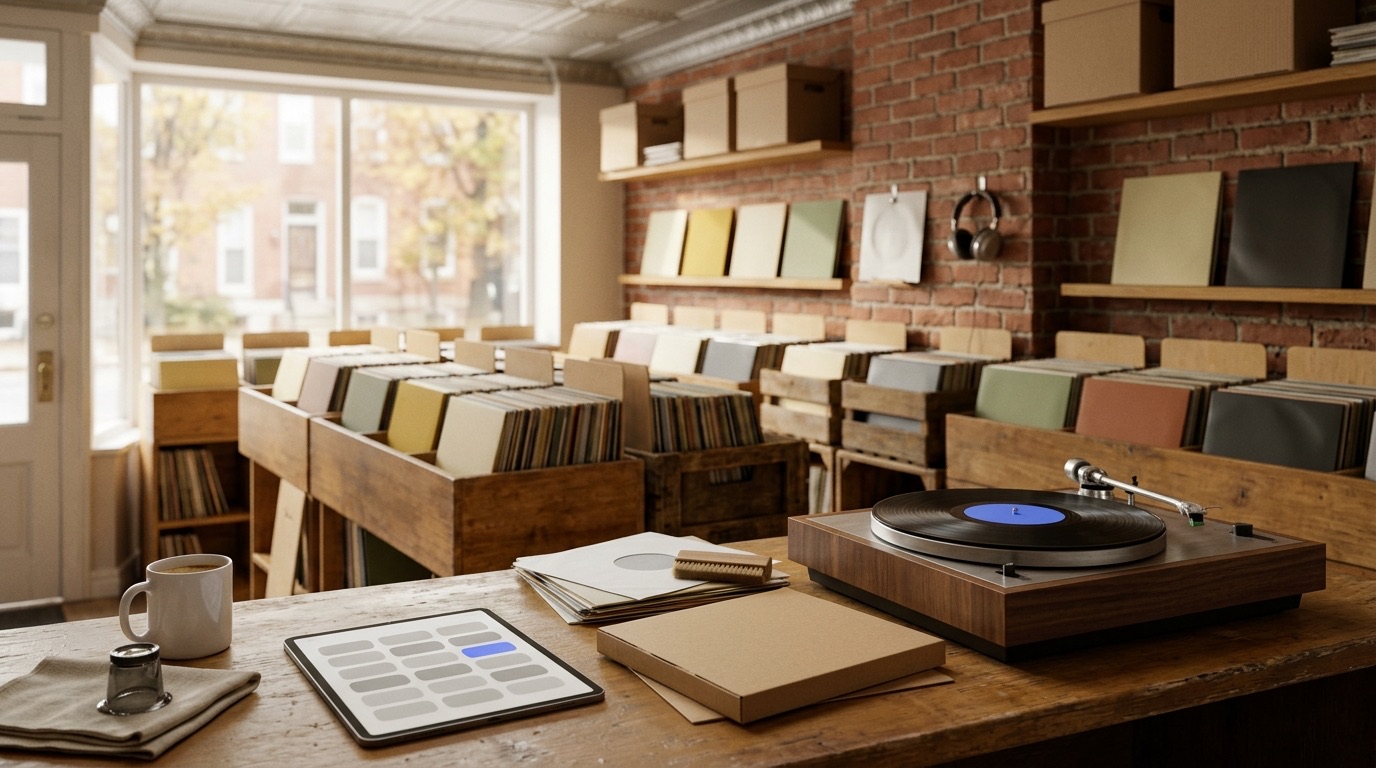
Picture three Baltimore record stores this autumn. They are composites, but every rule in their stories is real. The first is a used-record shop in Hampden on a Saturday in October. A man carries in two milk crates of his late father’s records and, on top of them, a silver 1970s receiver. The buyer finds a first pressing in the second crate that is worth more than everything else combined, a live album with no label name and no address on it anywhere, and a dozen records that will sit in the dollar bin for a year. She pays for the records on the spot. The receiver is a different transaction: the City requires a serial number, the seller’s driver’s license or other identification, a report to the police by noon on Monday and ten days on a shelf in the back before it can be sold.
The second is a shop in Fells Point that has signed Record Store Day’s Pledge. On the Thursday before Black Friday, forty limited releases arrive from the distributor and are received into the point-of-sale system that evening. The system is connected to the shop’s web store and to its Discogs inventory, and it is set, sensibly for the rest of the year, to list everything it receives everywhere at once. RSD’s rule is that the earliest a participating US store can sell those titles online is the morning of Saturday, November 28.
The third is a shop in Towson whose web store took sixty pre-orders in August for a deluxe vinyl reissue with an October street date. In late September the label moved the date to January. On the same afternoon, a customer in Ohio is listening to a thirty-second clip of that album on the shop’s product page, and a licensing agent is on the phone asking the owner what music plays in the store.
Each of those moments is decided by somebody other than the store: the City’s second-hand law, Maryland’s statute on recordings, Record Store Day’s organizers, the Federal Trade Commission and the Copyright Act. And each of them lands in software that was built for a different kind of shop, one where every product has a barcode, every copy of it is identical and the website may sell anything the till can. This article is about that gap. We start with the size of Baltimore’s record trade and what the software costs, then go through what makes a record store different: the copy, the calendar, the music on the speakers and on the website, the pre-order, and the Maryland and Baltimore rules. Then we look at what 10 Baltimore-area record stores show their customers and machines today, what a record store’s online store actually has to do, and what we would and would not build.
What Baltimore’s record trade looks like, and why nobody counts it
Nationally, the numbers are good and slightly confusing. The RIAA, which counts what labels ship to stores, reported for 2025 that vinyl grew for the 19th year in a row, to 46.8 million records and $1.04 billion. That figure is the first one in RIAA’s new wholesale terms; on its old retail-value basis, vinyl was already above a billion dollars in 2023 and 2024. Its mid-year report for 2026 shows vinyl up 17.7% in value and CDs up 58.6%, to $171 million, in the first six months. Luminate, which counts what stores actually sell to customers, tells a quieter story for the same period: CD sales up 16% to 16.3 million, largely on K-pop, and vinyl sales up just 2.4%. Its midyear report adds that about half of the Gen Z and Millennial buyers of those CDs do not own a CD player.
| Measure | 2025 | First half of 2026 |
|---|---|---|
| Vinyl shipped, units (RIAA) | 46.8 million (+7.9%) | 26.5 million (+20.9%) |
| Vinyl shipped, wholesale value (RIAA) | $1,042.9 million (+9.3%) | $543.8 million (+17.7%) |
| Average wholesale value per record (our division) | $22.28 | $20.52 |
| Vinyl sold to customers, units (Luminate) | 47.9 million (+8.6%) | up 2.4% |
| CDs shipped, units (RIAA) | 29.5 million (−11.6%) | 17.5 million (+45.7%) |
| Independent stores’ share of all physical albums sold (Luminate) | 36.6% in the first half of 2025 | 32.1% |
| Independent stores’ share of vinyl sold (Luminate) | 39% | 39.5% through mid-September |
The gap between the two lines matters to a store more than either number. In the first half of 2026, records shipped grew by a fifth while records sold to customers barely grew, which means more new vinyl sitting on shelves somewhere. One of the largest one-stop wholesalers, Alliance Entertainment, says in its annual report that vinyl is not returnable, so the store that over-orders owns the overstock. Independent stores are also losing share of the whole physical market: Luminate puts them at 32.1% of physical album sales in the first half of 2026, down from 36.6% a year earlier, while mass-market chains rose from 23.3% to 28.7%. Vinyl is where independents stay strongest, at about four records in ten, and in Record Store Day week they sell most of the country’s vinyl.
The federal statistics stopped counting record stores in 2012
Locally, the official data cannot tell you how many record stores Baltimore has. The industry code for “Prerecorded Tape, Compact Disc, and Record Stores,” 451220, existed until 2007; the Census Bureau’s 2012 concordance folded it into “Electronics Stores,” and the 2022 code merged those again with appliance retailers. A store that sells mostly used records is filed somewhere else entirely, among used-merchandise stores, next to thrift shops. So County Business Patterns for 2023 can say only that Baltimore City had 19 electronics stores and 23 used-merchandise stores with paid employees, and Baltimore County 39 and 36, with record stores hidden in both. The 2022 Economic Census gets a little closer: nationally, 1,834 of the 24,833 establishments in the electronics-and-appliance code sold recordings, and in those stores recordings were 79% of sales, which is a fair description of a record store; in Maryland, 64 of 403 did, and the Census Bureau withholds their sales.
The private figures are partial too. Luminate’s independent-store numbers are partly modeled from a panel of reporting stores, which in one recent week was 471 outlets, 354 shops and 117 web stores, against the “nearly 1400” independent stores Record Store Day described when it was conceived in 2007. Reporting is a daily file of sales keyed by barcode, sent by SFTP, usually through a service called StreetPulse, which is one more reason a used record without a barcode is invisible in the national charts. For Baltimore, the only count that works is the one we did by hand for this article, which found ten operating stores in the City and the County.
A city that invented Record Store Day
Baltimore’s record trade has a long memory. Record and Tape Traders started out of a Towson home in 1977, grew to nine stores, sold most of them to a chain in 2007 and closed its last one, in Towson, after Christmas 2018. The Sound Garden opened on Thames Street in Fells Point in 1993, outlasted the regional chains and hosted the 2007 gathering where store owners came up with Record Store Day. Celebrated Summer in Hampden turned 20 this year, Normals in Waverly has been selling books and records for more than three decades, and newer or relocated shops now sell records in Station North, Mount Vernon, Federal Hill and Hamilton. The fairs are back too: VinylCon brought more than 50 vendors to UNION Craft Brewing in October 2025, and the Baltimore Record Bazaar brought more than 30 vendors to Peabody Heights Brewery in January. The signals from owners are mixed. Celebrated Summer’s owner told Baltimore Magazine this summer that demand from Gen Z keeps growing, while another owner told a local paper that sales had dropped by a quarter or more toward the end of 2025, and one shop closed its storefront in September. That is the market the software has to serve: small, old, stubborn, and partly invisible to anyone who reads only the statistics.
What record store software costs, and what each meter counts
A record store’s software is rarely one product. It is a point of sale at the counter, a web shop, one or more marketplaces, and, if the owner has had enough of selling the same record twice, a sync tool between them. Each piece is billed on a different meter. The till charges per location per month plus a card fee; the web shop charges per month plus a card fee; the sync tool charges per month but caps the products and orders it will handle; and the marketplaces take a percentage of every sale, often including the shipping. We priced five realistic stacks on the vendors’ own pages on October 25, 2026, software only, with card processing listed underneath.
| Stack | What it includes | Per month | Per year |
|---|---|---|---|
| A. Counter plus Discogs | Square Free point of sale; a Discogs seller account | $0 | $0 |
| A+. Counter with inventory, synced to Discogs | Square Plus ($49 per location); Disconnect Quick Starter on Square ($29.95, 2,000 products and 50 orders a month) | $78.95 | $947.40 |
| B. Shopify store and till with a Discogs importer | Shopify Basic ($39, or $29 on a yearly plan); POS Pro for one location ($89, or $67 on a 12-month term); Discogs Importer Pro ($39, or $429 a year) | $167 | $2,004, or $1,581 on yearly terms |
| C. Lightspeed till, Shopify store, multichannel sync, Whatnot | Lightspeed Retail Basic ($109, or $89 yearly); Shopify Basic; Commercium ProSeller Plus ($79.95, 6,000 products and 600 orders a month); Whatnot ($0) | $227.95 | $2,735.40, or $2,215.50 on yearly terms |
| D. A record-store system: Common Ground | Point of sale, web shop and Discogs in one, up to 10,000 items ($60) or a three-staff plan ($150) | $60 or $150 | $720 or $1,800 |
| E. A record-store system: ThunderPOS Musicware | Full license, one station ($99.99), plus its cloud server ($25); reports sales to Luminate and StreetPulse | $124.99 | $1,499.88 |
Card processing sits on top of all of these. Square charges 2.6% plus 15 cents in person on its free plan and 3.3% plus 30 cents online; Shopify Payments on the Basic plan is 2.6% plus 10 cents in person and 2.9% plus 30 cents online; Lightspeed’s in-person rate is 2.6% plus 10 cents; Common Ground runs on Stripe at 2.7% plus 5 cents in person. On an $8 used LP from the dollar-bin end of the store, Square’s free plan keeps about 36 cents, or 4.5% of the sale, because the fixed part of the fee weighs most on the smallest tickets. A label printer and a barcode scanner add about $330 once.
Four things in that table have changed in the last year, which is why older guides are wrong. Square retired “Square for Retail” in October 2025: its Plus plan fell from $89 to $49 a location while its in-person rate rose by 5 cents a transaction, and the free plan does not include label printing, inventory counts, purchase orders, exchanges or retail pre-orders. Shopify ended Stocky, its purchase-order and stocktake app, after August 31, 2026, and its yearly Grow and Advanced prices appeared to be in an A/B price test in October. Whatnot switched to tiered commissions on September 21, 2026, and Discogs, as we explain in the e-commerce section, has moved every payment to PayPal.
The Discogs sync tools are the thinnest part of the market. A search for “discogs” in Shopify’s App Store returns 146 apps, of which about five actually connect to Discogs. Two of the most specific are new this year and had one review each when we checked: Discogs Importer, launched in February, and Gatefold, launched in August, which identifies a pressing from its matrix number and stores flags for inserts, posters and hype stickers. The most-reviewed, Commercium, with 70 reviews, began life as a dedicated Discogs connector and now sells itself as a general multichannel tool. The record-store-native systems take a different approach: Common Ground, built in Paris, puts the till, the web shop and Discogs in one inventory, and ThunderPOS has a “Musicware” edition that handles buy, sell and trade on one invoice and uploads sales to Luminate automatically.
Two limits matter more than the monthly price. The first is the cap: a store with 5,000 used records is above the entry tier of most of these tools, and the order caps of 50 or 100 a month can be reached in a good December week. The second is the sync interval. For a store whose every used record is a single copy, the time between syncs is the window in which the same record can be sold twice, once at the counter and once online. A daily sync, which one marketplace’s sync service offers, leaves most of a day; a “near realtime” one leaves minutes. Ask any vendor what happens to a copy on Discogs when it sells at the till, and how quickly.
Every used record is a copy, not a product
Most retail software starts from a simple idea: a product is a thing with a barcode, and the store has some number of identical units of it. A hardware store with forty boxes of the same drill bits has one product and a quantity of forty. A record store’s used bins break that idea on the first day. Two copies of the same album can sit side by side in the “R” bin and be worth $8 and $180, and nothing on the outside of the sleeve tells a cashier why. One is a 1990s reissue and the other a first pressing; one plays like new and the other crackles through the quiet passages; one still has its printed inner sleeve and poster and the other lives in a plain white paper sleeve. For a record store, the product is the copy.
What identifies a pressing is not the barcode. We counted the October 2026 Discogs data dump, the full catalog of the database and marketplace that has become the trade’s reference. It describes 19,492,392 releases, 8,069,514 of them on vinyl, and only 13.3% of the vinyl releases carry a barcode at all; of the 2.6 million dated before 1979, just 0.16% do. Discogs’s own guidelines say that, generally, a release with a barcode cannot have been made before 1979. The codes that matter to a collector are the label, the catalog number, the country, the year and, above all, the matrix numbers scratched or stamped into the smooth run-out area between the last groove and the label, which 44.1% of vinyl releases in the dump record; 49.5% have neither a barcode nor a matrix number. Discogs lists fourteen kinds of identifier in its submission guidelines, from the barcode and the label code to the pressing plant ID, the rights society and two separate kinds of matrix number. Each distinct pressing of an album is its own “release” in Discogs, grouped under a “master” for the album as a whole, and that release number has quietly become the closest thing the trade has to a product key. A buyer who has priced a collection on Discogs talks in release numbers, and so does every customer who arrives with a want list on their phone.
Two grades, not one
The second difference is condition. Discogs grades under what it calls the Goldmine Standard, the scale the record-collecting magazine Goldmine popularized, and it grades the record and its sleeve separately: Mint, Near Mint, Very Good Plus, Very Good, Good Plus, Good, Fair and Poor, plus “Generic” for a plain or company sleeve that is not specific to the release. The definitions are short and practical. Mint “should be used sparingly as a grade, if at all,” and Goldmine itself says it should never be used unless more than one person agrees. A standard CD jewel case is not graded at all because it is replaceable. And each lower grade comes with a rule of thumb about value: Discogs says a Very Good Plus record is generally worth 50% of the Near Mint value, Very Good 25%, Good and Good Plus 10 to 15%, and Fair or Poor 0 to 5%.
That last sentence is a pricing engine in disguise. A store that buys a collection of 400 records is making 400 small bets, each of which is a reference price for the exact pressing multiplied by a condition factor for the vinyl and adjusted for the sleeve, the inserts and how fast that title sells in Baltimore. Experienced buyers do it in their heads, which is why a good buyer is the most valuable person in a used record store. Software can do the bookkeeping part of it: remember the pressing, the two grades, the buyer’s notes (“light hairline on side B, seam split at the bottom, poster present”), what the store paid, who sold it and when it went into the bins, and then show which bins are full of records that have not sold in a year.
The database is free to copy. The prices and photos are not
The part of this that surprises most owners we talk to is how open the reference data is. Every month Discogs publishes a complete dump of its release, master, artist and label data, and the page states that the data “is made available under the CC0 No Rights Reserved license.” The October 2026 files were posted on October 1, and the compressed releases file alone is 10.5 gigabytes. Discogs’s API terms of use, last updated May 27, 2025, draw the same line in more detail: release titles, formats, track listings, “barcodes and other identifiers,” credits, versions and links to third-party sites are CC0 data, while “Marketplace Data,” which covers inventory, orders, fees, pricing suggestions and sales history, and the images users upload are restricted. The same terms give, as their example of a breach, using the API “to circumvent Our marketplace platform,” and they forbid using API data to drive traffic to non-Discogs websites. The monthly dump is governed by its own CC0 license, which is why a store’s catalog for its own web shop should be built from the dump, not from the API.
In plain terms, a Baltimore store can load the whole catalog of known pressings into its own system, legally and for free, and use it to identify what comes across the counter, to fill in track listings and credits on its own product pages and to search by matrix number. What it cannot do is treat Discogs’s sales history or other sellers’ photos as its own. That is a reasonable bargain, and it shapes good software: the pressing data comes from the dump, the price comes from the store’s own judgment and sales history, and the photos are of the store’s own copy, which is also what an online buyer of a used record wants to see.
A copy-level record also fixes the most common inventory complaint we hear from used-media shops: that the system says “1 in stock” for an album when there are three copies of it in three different conditions at three prices, or the reverse, three listings for what the till treats as one product. A record store needs both levels at once. The release is what customers search for and what a want list matches against; the copy is what gets graded, priced, photographed, listed and sold. Retail platforms model products with variants, which fits a T-shirt in four sizes. They fit a bin of one-offs only if each copy becomes its own product, which is exactly what the Discogs sync tools in the pricing section above do.
Record Store Day decides when a record may go online
Most retail calendars are set by the store. A record store’s biggest days are set by an outside organization, and they come with rules about the website. Record Store Day was conceived in Baltimore. Store owners from around the country came up with it at a 2007 gathering in Fells Point hosted by Bryan Burkert of the Sound Garden, who has a plaque on his building to mark it, the Baltimore Banner reported this April. The first one took place on April 19, 2008, and since 2010 there has also been an RSD Black Friday. This year’s April event was on Saturday, April 18, and Black Friday falls on Friday, November 27. On both days labels release limited pressings sold only through participating independent stores, and those pressings are why, this April, the line outside the Sound Garden ran several blocks, with the first people arriving by 6 p.m. the evening before. Luminate’s figures, as Billboard reported them, show what the day means: in the week of RSD 2026, independent stores sold about 979,000 of the 1.41 million vinyl albums sold in the US, roughly 70%, against 39% of vinyl over the whole of 2025.
To get the releases, a store has to qualify and then sign. RSD’s application page asks for a full-time, stand-alone physical store whose main business is selling music, independently owned and not publicly traded, with a website or social page showing its location and hours, and open to the public for at least a year. Signing what RSD calls the Pledge puts a small “P” next to the store’s name in the store locator and, more importantly, puts the store on the list RSD gives distributors for ordering. On October 25 the locator showed 29 Maryland stores, 25 of them with the Pledge mark; seven of the listings are in Baltimore City and Baltimore County, and one of those has since closed its storefront.
The public summary of the Pledge says participating stores sell the releases “to their physical customers, on Record Store Day,” and do not hold product back to sell online. The full text, which RSD has taken off its public site but which is preserved in a June 2025 archive copy, is far more specific, and RSD’s 2026 pages give the same dates. It applies equally to RSD and to Black Friday. Nothing on the list may be sold before 8 a.m. Eastern on the day. Nothing may be sold online, or ordered online for later shipping, before or on the day, and the text spells out that this means no system in which someone can put an RSD title in a cart. Leftover stock may go online from 8 a.m. Eastern the next morning, which for Black Friday 2026 is Saturday, November 28, and only through the store’s own branded website or accounts that it uses all year, never at auction, so an eBay or Whatnot listing must be a fixed price. Prices may be no more than 20% above the suggested list price RSD sends stores on a spreadsheet, online or in the store. There are no pre-orders and no holds, in the shop or online. A store that breaks the Pledge can be removed from the list.
RSD also runs its own marketplace, RSD MRKT, where only Pledge stores may sell, only new and unopened records are listed, and stores “must adhere to Record Store Day pricing rules” for RSD titles. And whatever a store orders for the day, it keeps: Alliance Entertainment, the one-stop wholesaler that says it serves more than 2,500 independent music and video retailers, states in its latest annual report that vinyl is not returnable.
A sync tool that does not know the calendar can break the Pledge
This is where the rules turn into software. A store that runs a web shop, a Discogs inventory and perhaps an RSD MRKT or eBay storefront usually connects them, so that a record received into stock appears everywhere at once and a sale on one channel removes it from the others. That is exactly what you want on an ordinary Tuesday. On Black Friday it is the wrong behavior: the RSD titles are received into the system on Thursday, and an automatic sync puts them on the website with a working “add to cart” button, and on Discogs, before the first customer in the line has been served. Nobody at the store meant to hold anything back for online buyers, but under the Pledge’s own wording the cart alone is the problem.
The fix is a small piece of data most systems lack: an event, with an in-store start time and an online start time, stored in Eastern time and attached to every product that belongs to it. The till sells RSD stock from 8 a.m. on the day; every online channel shows it as coming soon, without a cart, until 8 a.m. the next day; and the sync jobs read the same gate, so they cannot publish early, list at auction or put an RSD title on a channel the store does not use all year. The same record carries its suggested list price, so the system can refuse any price more than 20% above it on any channel. RSD titles also need a flag that separates them from the ordinary indie-store exclusives, the colored-vinyl variants that RSD’s own site lists for pre-order, because a pre-order button is fine on one and forbidden on the other. Add an optional per-customer limit at the register, which is store policy rather than an RSD rule, and a report of what sold where and when, and the store can show a label rep or the organizers exactly how it handled the day. REB Records in Bel Air already handles the online gate on its Shopify store: this year’s Black Friday titles were loaded on October 22 and cannot be bought yet.
You may play the record to sell it. You may not stream it
A record store is the only kind of shop where the music on the speakers is part of the merchandise, and US copyright law noticed. On a Saturday afternoon in a Hampden shop, four different things can count as “playing music”: the record a customer cues up at the listening station, the new arrival the clerk drops on the house turntable, the band setting up in the back corner for a four o’clock in-store, and the thirty-second clips on the shop’s product pages that someone in Ohio is listening to at the same moment. Federal law gives each of the four a different answer, and only one of them is a simple yes.
Start with the fact that every record carries two copyrights. One is in the song, the “musical work,” which belongs to its writers and their publishers and is licensed for public performance mostly through ASCAP, BMI, SESAC and GMR. The other is in the recording itself, the “sound recording,” which usually belongs to the label. For the song, the Copyright Act gives the owner the exclusive right to perform it publicly, and a shop open to anyone who walks in is a public place. For the recording, section 106 grants a public-performance right only “by means of a digital audio transmission.” A vinyl record played through the store’s amplifier is not a digital audio transmission, so the label’s copyright is not engaged at all. The question in the store is only about the song.
And for the song, Congress wrote a rule for record stores in 1976. Section 110(7) of the Copyright Act exempts:
“performance of a nondramatic musical work by a vending establishment open to the public at large without any direct or indirect admission charge, where the sole purpose of the performance is to promote the retail sale of copies or phonorecords of the work, or of the audiovisual or other devices utilized in such performance, and the performance is not transmitted beyond the place where the establishment is located and is within the immediate area where the sale is occurring”
Read it as five conditions. The shop is open to the public. Nobody pays to get in, directly or indirectly. The purpose of playing the record is to sell copies of that record, or to sell the turntable, receiver or speakers it is playing on; Congress added the equipment in 1998, which is why the same clause protects a stereo shop demonstrating an amplifier. The sound stays in the building. And it plays near where the record is sold, not in a back room or across the street. A customer at the listening station meets all five. So does the clerk playing a record from the new-arrivals bin that is for sale ten feet away, which is the oldest sales technique in the trade.
What the record-store exemption does not cover
The first thing outside it is the owner’s own music. If the record on the house turntable is from the owner’s personal collection and not for sale, its purpose is atmosphere, not promoting “copies or phonorecords of the work,” and the exemption does not fit. A streaming playlist fails on two counts: the purpose is background, and the consumer services do not allow it. Spotify’s US terms grant “personal, non-commercial use of the Spotify Service and the Content,” and its own help page names stores among the businesses that may not play it publicly; Apple Music, YouTube and Bandcamp limit their consumer services to personal, non-commercial use in much the same way. A shop that wants a playlist rather than its own stock needs a business music service or performing-rights licenses.
The second is the radio, which has a rule of its own. Section 110(5)(B), added in 1998, lets a small business play radio or television broadcasts without a license if, for a shop that is not a restaurant or bar, the space is under 2,000 gross square feet, or larger but using no more than six loudspeakers, no more than four of them in any one room. It covers broadcasts from FCC-licensed stations, plus cable or satellite television, and nothing else, so it says nothing about streaming services, internet radio or the shop’s own records.
The in-store performance is the third. A touring band playing its songs in the back corner is not “a vending establishment” playing a copy it sells, and if the store charges a cover or sells tickets, the “no admission charge” condition fails as well. Live music in a shop is licensed the way it is in a bar or café, through the performing rights organizations or with the permission of every songwriter whose songs are played. Their 2026 rates are public because Colorado requires ASCAP, BMI and SESAC to file them with its Secretary of State. ASCAP’s retail-store schedule, whose own example is live music “in a cafe section of a book or record store,” charges $59.50 per day of live music, up to $4,835 a year. BMI’s retail license counts DJs as live music, charges $58.65 a day for shows with more than one performer and does not cover premises that charge admission. SESAC’s retail license excludes concerts, which need its separate concerts license. GMR, the fourth organization, publishes no rates at all. For a store of under 2,000 square feet with four speakers that also wants background music beyond its own stock, a dozen band days a year comes to about $2,800 across ASCAP, BMI and SESAC, before GMR, and each extra show day adds about $141.
The fourth is the website, and it is the one that matters most for the online store. Section 110(7) requires that the performance “is not transmitted beyond the place where the establishment is located.” A clip that plays on a product page in Ohio is the opposite. It is also, for the recording, a digital audio transmission, and because the listener chooses what to hear, it is the kind of on-demand use that falls outside the statutory license that internet radio relies on. Hosting your own clips means asking the label for the recording and the publishers or the performing rights organizations for the song. The often-repeated “30-second rule” does not exist. The Copyright Office says there are “no legal rules permitting the use of a specific number of words, a certain number of musical notes, or percentage of a work,” and the only court decision we found that interprets section 110(7), United States v. ASCAP in 2009, held that “the exemption was intended only for previews of music in physical record stores” and refused to rule that 10-to-30-second online previews, in that case for ringtones, were fair use.
How to let an online customer hear the record
The platforms’ own terms narrow the easy options more than most owners expect. Spotify’s developer policy bars products built for in-store or retail-staff use and products that generate commercial offers, and new Spotify apps lost access to its 30-second preview files in November 2024. Apple lets developers use its previews only to promote content in Apple’s own stores, next to an Apple badge. Bandcamp’s terms limit its content to personal, non-commercial use. What remains is simpler and safer: a plain link to the album on the streaming services, which is not a performance at all, and YouTube’s embedded player, which YouTube’s terms allow on a page that does not charge people to watch. The Discogs data a store can load for free includes, for many releases, links to videos of the tracks on third-party sites, so a product page can show the official video for the album, where one is linked, without the store hosting a second of audio. For the used rarity that has no official upload, the honest substitute is words: a play-graded note that says the record was played through and how it sounded, side by side, which is what experienced Discogs sellers already write and what a buyer paying $60 for a 1970s pressing actually needs.
None of this needs a lawyer for the everyday case, but it does need the software to know three things it usually does not: which records in the shop are for sale (so the house turntable can be fed from the bins, not from the owner’s shelf), which events have a cover charge, and which product pages play audio from where. Those are fields and flags, not legal opinions, and they are the difference between a store that can answer a licensing agent’s letter in ten minutes and one that cannot.
Pre-orders: the release date on the product page is a promise the FTC enforces
Most record stores that sell online take pre-orders, and many of them have lived through the same week. In August the shop opens pre-orders for a deluxe vinyl reissue with an October street date and sells sixty copies. In late September the distributor emails that the pressing has slipped to January. The money is in the store’s account, the customers are waiting, and most shops send a friendly note and carry on. The federal rule that governs that moment is older than the internet and more specific than most owners expect.
The FTC’s Mail, Internet, or Telephone Order Merchandise Rule applies to anything a customer orders by mail, online or by phone, which by its terms takes in a web pre-order. It requires the seller to have “a reasonable basis” to expect it can ship within the time it states, or within 30 days if it states none. A pre-order page that says “ships on release, October 9” has stated a time, and the distributor’s street date is the store’s reasonable basis for it. When the store learns it cannot ship on time, it must offer the customer, “clearly and conspicuously and without prior demand,” the choice between accepting the delay and canceling for a prompt refund, and it must do so before the promised date passes.
What happens next depends on the length of the delay. If the new date is 30 days or less after the original one, the notice may say that silence counts as consent. If it is longer, or the store does not know the new date, the order is treated as canceled unless the customer actively agrees to wait or the store ships within 30 days of the original date. A label pushing an October title to January is the second case, so a customer who never answers the email is owed a refund, not a record. The FTC’s business guide to the rule says that refunds for payments by cash, check or third-party credit card are due within seven working days of the cancellation, and that a refund for an order that cannot ship at all includes the shipping and handling the customer paid. Two lines in the guide matter more to record shops than to most retailers. A refund the rule requires cannot be store credit: “you cannot substitute credit toward future purchases, credit vouchers, or scrip.” And because the guide treats differences in color or design as material, filling a pre-order for the red-vinyl variant with the black pressing needs the customer’s express consent first. The same guide notes a three-year limitations period for consumer redress and five years for civil penalties, which the FTC kept at up to $53,088 per violation for 2026, and the rule itself presumes that a seller with no records of its shipping procedures had no reasonable basis for its promises.
None of this is hard for software. Each pre-order line needs the date the store promised and where that date came from, a status that changes when the distributor moves the street date, an email template that offers consent or cancellation with working links, a clock that knows the 30-day thresholds, and a refund queue that runs inside seven working days. What is hard is doing it by hand for sixty customers in the same weeks the store is ordering for the holidays. Most general e-commerce platforms let you sell a product before it exists and stop there. One Baltimore store we reviewed takes the simplest safe route and charges a pre-order card only when the record is in stock, so a slipped date never leaves the shop holding a customer’s money. Note too that Square’s free plan does not offer retail pre-orders at all; they start on its $49 Plus plan. And a pre-order can be a ticket: this week the Sound Garden is giving fans who pre-order John Legend’s new album priority entry to his in-store on Tuesday, October 27, with a wristband handed out when they collect the record, which turns a pre-order list into a guest list with a capacity limit.
The record-club rule outlived Columbia House
The other thing stores sell ahead of time is a subscription: a “record of the month” box, a staff-pick club, a membership with a monthly LP. The FTC’s rule on these, 16 CFR Part 425, dates from 1973 and covers what it calls “prenotification” plans, the model the mail-order record and book clubs made famous: the seller announces the next selection, then ships and bills it unless the member says no in time. In 2024 the FTC rewrote the rule into a broad “click-to-cancel” rule; the Eighth Circuit vacated those amendments in July 2025; on February 12, 2026, the FTC put the old text back; and on March 13 it asked for comments on how to modernize it. Then, on October 14, a routine paperwork notice for the restored rule added a coda. FTC staff now estimate that “no more than 25 sellers” in the country are subject to it, the same figure as in 2023 and down from 75 in 2020, and the notice cites a CNN report from August that Columbia House, “a pioneer of product-of-the-month plans,” is ceasing operations. Comments on that notice are open until December 14, 2026.
The restored rule still fits a store club almost word for word. If the shop announces each month’s pick and ships it unless the member declines, the rule requires the terms to be disclosed up front, including how to decline, any minimum purchase and the right to cancel, and it requires the announcement to give the member at least ten days to say no. A plain subscription that ships the same box every month with no announcement is not a “prenotification” plan; it falls under the federal ROSCA statute for online sign-ups and, since June 1, 2026, under Maryland’s automatic renewal law. That law requires the renewal terms and price next to the consent button, a cancellation method at least as easy as the one used to sign up, and, for an online sign-up, “a prominently placed direct link or button” or a ready-made cancellation email. A plan sold with an initial term of a year or more needs a reminder 15 to 45 days before it renews; a plan with a free trial longer than 14 days needs one 3 to 21 days before the first charge. A violation is an unfair, abusive or deceptive trade practice under the Maryland Consumer Protection Act, enforced by the Attorney General with civil penalties of up to $10,000 per violation and $25,000 for a repeat; the law creates no private right to sue.
The Maryland layer: a bootleg is a crime, and a trade-in is not a discount
Maryland has a statute written for records, and few people in the trade have read it. Section 7-308 of the Criminal Law Article defines a “recorded article” as “a phonograph record, disc, wire, tape, film, videocassette, or other article on which sounds are recorded or otherwise stored,” and to “deliver” as “to sell, rent, distribute, or circulate.” It then makes it a crime to knowingly deliver, offer for delivery or possess for delivery a recorded article on which sounds were copied without the consent of the owner of the original recording, or one “embodying a performance without the consent of the performer.”
That second phrase is the bootleg: the live concert taped from the audience or the soundboard and pressed onto vinyl without the band’s permission. The first phrase covers the counterfeit, which, the RIAA told the US Trade Representative in a filing on October 7, now copies shrink-wrap, seals and pull tabs well enough that a casual buyer cannot tell. The same section adds a labeling rule: a recorded article may not be delivered unless it bears, “in a prominent place on its outside face or package,” the “actual name and street address of the transferor of the sounds or images” and “the actual name of the performer or group.” Read literally, that line reaches far more records than its authors had in mind, since many legitimate pressings print a label name and a city but no street. Its target was the anonymous cassette or LP with no manufacturer at all, and a record with no maker’s name anywhere on it is the one a Maryland store should be most careful about buying for resale.
The penalties are counted per act. Under section 7-309, a first violation is a misdemeanor with up to a year in prison or a $2,500 fine, or both, “for each individual act in violation,” and a later one up to three years or $10,000 for each act; section 7-310 lets the police seize and destroy the records and the equipment used to make them. The statute requires that the seller act “knowingly,” and we found no reported appellate case applying it to records. It has been applied to a reseller, though. In McCree v. State (2013), the Court of Special Appeals upheld seven convictions under the labeling clause, with 180 days for each, against a licensed Maryland vendor who testified that he had bought the DVDs found in his van from stores in New York to resell, and had not made them; the court noted that the clause “does not require the State to prove” that the owner had not consented. And in Hicks v. State (1996), the same court held that the labeling rule’s predecessor is not preempted by the federal Copyright Act.
For software, the useful fact is that Discogs already sorts most of this out. Its database tags bootlegs, pirates and counterfeits with the format description “Unofficial Release,” and in a sample of ten such releases we checked through the Discogs API, nine carried a flag that blocks them from sale on the Discogs marketplace. A buy screen that looks up each record as it is graded can show the same flag to the buyer at the counter, before the store pays for a box of live LPs it cannot list and, in Maryland, should not sell.
When the licensing agent calls, Maryland sets the terms of the conversation
Maryland also regulates the other side of the music question. Commercial Law sections 11-1401 to 11-1405 govern how a “performing rights society,” a term the statute illustrates with ASCAP, BMI and SESAC by name, may sell a license to a “proprietor,” which expressly includes “the owner of a retail establishment.” At least 72 hours before a contract is signed, the society must give the store in writing its schedule of rates and terms, the rates it has agreed with “proprietors of comparable businesses in the area,” which the statute defines as a 25-mile radius around each location, a toll-free number for questions about which songs it represents, any local discounts, and a notice that leaving any of this out may make the contract unenforceable. It must offer a one-year contract. Its agents must say whom they work for and why they are calling before they discuss a license, and the society may not charge a royalty “unreasonable in comparison to the royalties for similar licenses in the same area.” A store harmed by a violation can recover its actual damages and attorney’s fees. SESAC’s 2026 license agreements, filed with Colorado’s Secretary of State under that state’s similar law, list Maryland’s section 11-1402 among the state-specific disclosures they make.
For a record store, this is where good records about the music pay off. A shop that can show that its house turntable plays only stock that is for sale, that its in-store sets are licensed or played with the songwriters’ permission, and that its website plays only official embedded players has a short conversation with a licensing agent. A shop that cannot is negotiating a rate it may not need, and it should at least insist on the comparison with similar businesses within 25 miles that Maryland law says it must be shown first.
Six percent on the whole price, whatever the customer traded in
The other Maryland rule a record store meets daily is in the sales tax. Records are taxed at the ordinary 6%, and the question is what happens when a customer pays partly with records. Maryland’s regulation defining the taxable price, COMAR 03.06.01.08, lists among the things that “may not be deducted before computation of the tax” any “transfer, whether in the nature of a ‘trade-in’, return, exchange, or otherwise, of anything to the vendor.” In plain terms, the trade is a form of payment, not a discount, and the tax is computed on the full price of what the customer takes home.
Here is what that means at the counter. A customer brings in a stack of records the store values at $40 in trade and leaves with $60 of new and used vinyl. The correct tax is 6% of $60, or $3.60, and the customer pays $23.60. A point-of-sale system set up to enter the trade as a $40 discount line computes tax on $20 and collects $1.20, so the store under-collects $2.40 on that sale and owes it anyway. Store credit issued earlier for a trade works the same way, in our reading of the regulation: it is a payment method, like a gift card, and it does not shrink the tax. This is one of the few places where a setting in the till, which most owners never look at, decides whether a year of sales tax returns is right.
Shipping goes the other way. The same regulation excludes from the taxable price a charge “for a delivery, freight, or other transportation service for delivery directly to the buyer,” as long as it is stated separately on the invoice. So a Maryland customer who buys a $30 record online with $6 shipping owes tax on $30, not $36. Separately, since 2021 Maryland has also taxed digital downloads, so a store that sells download codes or digital albums alongside the vinyl collects tax on those too.
At a record fair, the promoter has paperwork too
Record fairs and flea markets bring their own Maryland rules, and some of them fall on whoever runs the show. A seller without a permanent sales and use tax license needs the Comptroller’s temporary license, which is valid for 30 days. Under Business Regulation section 17-1811, the promoter of a “show,” a word that includes flea markets and shows “of a temporary nature,” may not let an exhibitor do business unless the exhibitor first hands over a copy of its trader’s license or an exhibitor’s affidavit, and the promoter must send the affidavits to the Comptroller within seven days after the show ends. The Comptroller also warns that resale certificates are not valid for cash, check or card sales under $200 unless the goods are delivered to the buyer’s place of business, which matters at a fair where dealers buy from each other all day. For a store that sells at fairs, that is a document checklist; for a store that runs one, it is a list of exhibitors, their documents and a seven-day deadline.
The Baltimore layer: the records are exempt, the turntables are not
Baltimore City licenses businesses that buy used goods over the counter, and its law has a sentence that reads as if a record store wrote it. Article 2, Subtitle 12 of the City Code defines a second-hand personal property dealer as anyone in the business of buying used property for resale, “including, but not limited to, clothes, furniture, household items, and other moveable personal property, excluding motor vehicles, records, tapes, compact discs, and books.” A shop that buys only records, tapes and CDs is outside the subtitle, which is what we found when we looked at the same law for Baltimore’s bookstores.
Most record stores do not buy only records. The same crate that arrives on a Saturday often has a receiver in it, or a turntable, a cassette deck, a pair of speakers, a guitar pedal. None of those are excluded, so a store that buys them for resale is a second-hand dealer for that part of its business, with everything that comes with it. It needs the City’s annual license, $50 for each place of business, issued by the Department of Consumer Protection and Business Licensing. It may not buy from a minor. For each item or group of similar items, it must file a daily report with the Police Commissioner and the department, electronically “before noon on the business day immediately following” the purchase, listing the make, model, year and “any soundex number or unique identifying number found on the item,” whether the serial number looks altered, what the store paid, and the seller’s name, date of birth and driver’s license number, or two other forms of identification and a physical description, signed by both sides. And it must hold every such item at the shop for at least 10 days after the report before it sells it.
For software, that is the same split a good buy screen should make anyway. The records in the crate go to grading and pricing; the receiver gets a serial number field, an identity check, a line in tomorrow’s report and a hold that keeps it off the website, out of the Reverb and eBay listings and off the shop floor until the tenth day. A store whose web shop sells a receiver two days after the counter bought it has sold an item the City’s code required it to keep for ten days. One caution: the subtitle exempts records by defining who is a dealer, but once a store is a dealer because of its gear, the reporting and holding clauses speak of “each transaction” and “all acquired items.” Whether that pulls the records in the same crate back in is a question for the Police Department’s pawn unit, not for software, and a buy screen can carry a store-wide switch that reports and holds everything until the store has an answer. The same subtitle lets a dealer skip the report and the hold, though not the written record, for items bought from an estate’s personal representative or at a garage sale or flea market, and it requires transaction records to be kept for three years. We could not reach the Baltimore County code online, so a Towson or Catonsville store should check the County’s rules directly.
The in-store show: tax, zoning and the ticket
Stores that host bands meet three more rules. The first is tax. Baltimore City charges an admissions and amusement tax of 10% on the gross receipts from any admission charge, under Article 28 of the City Code, and the County’s rate is also 10%. A ticketed in-store owes it on the tickets; a free ticket owes 15 cents when other tickets to the same show cost more than a dollar; and a show that is free for everyone owes nothing on admission. Maryland’s statute also reaches merchandise sold “in connection with entertainment” at a place where music is provided, and exempts such sales only where dancing is prohibited and the only entertainment is “mechanical music, radio, or television.” Records playing on the house turntable fit that exemption. Record sales during a live set arguably do not, and we found no guidance from the Comptroller applying the rule to a record store either way, so a store with a busy events calendar should ask before assuming. A store inside one of the City’s four arts and entertainment districts, Station North, Highlandtown, Bromo Arts and the Black Arts District, may be able to register as an arts and entertainment enterprise for a ten-year exemption from the City’s tax; Catonsville is the County’s one district.
The second is zoning. The City’s zoning code defines “Entertainment: Live” to include a musical act or a DJ “whether or not done for compensation and whether or not admission is charged,” so even a free set counts. It is allowed in the C-1-E, C-3 and C-5 commercial districts; in C-1, C-1-VC and C-2 it is allowed only as an accessory to a restaurant, tavern, art studio or gallery, with the zoning board’s approval, and a record store is not on that list. Whether an occasional in-store counts as an accessory use is the zoning administrator’s call. The third is the ticket itself: since July 2024, Maryland’s ticket law has required a venue or promoter selling tickets to show the total price, including all fees and taxes, at every step, and to refund in full if the show is canceled. For the software, that is an events calendar that knows which shows are ticketed, which tax applies to which line, and when a live set was playing.
What 10 Baltimore record stores show customers, and machines
Because the federal statistics no longer separate record stores from electronics and appliance retailers, we counted them ourselves. On October 25, 2026, we built a list of every independent shop with records as a main line and a storefront in Baltimore City or Baltimore County, from Record Store Day’s store locator, OpenStreetMap, Visit Baltimore’s guide, Baltimore Magazine’s coverage, directories and search, and then checked each store’s website, its Discogs seller account if it had one, and its Record Store Day listing. We found 10 operating stores, nine in the City and one in the County, including two that sell books and records together. Six have a website; the other four live on Instagram and Facebook. Several more stores in Harford, Anne Arundel and Howard counties showed up in the same search, and we kept them in a separate list.
The most striking numbers are among the smallest. Only three of the ten sell records through their own web shop, and only two have live listings on Discogs: one with 2,216 records for sale and 3,297 seller ratings since 2011, which is Trax on Wax in Catonsville, and one with 74. Taken together, seven of the ten stores sell no records online anywhere we could find, so the used records in their bins are, as far as a search engine or an AI assistant can tell, not for sale at all. Only one of the six websites links to the store’s own Discogs listings, so even the records that are online are often not connected to the store’s name. And no two of the six sites run on the same platform: we found FieldStack Omni, Squarespace with a separate Broadtime storefront, Wix, WordPress with WooCommerce, Blogger and a single static page, and not one Shopify store among the ten.
The product pages that do exist show the “copy, not a product” problem in miniature. One store’s point of sale gives a used LP from the 1980s a 14-digit store-made barcode and marks it as new in the markup that search engines read. Another shows the catalog number, label, country, year and separate sleeve and media grades on the page, which is exactly right, while its structured data leaves the barcode, the condition and the brand empty. Of the two used-record pages whose markup we could check, neither tells a machine that the record is used. A Bel Air shop just outside our frame, REB Records, does something simpler that works: it writes the pressing and both grades into the title, as in “1958 US Mono, VG+/VG+.”
On grading and buying, the language is consistent and the standards are invisible. Five of the six websites say the store buys used records, and three use grade terms such as VG+ or separate grades for the record and the jacket, but none names the standard it grades by. The Sound Garden in Fells Point is the one store that publishes a cash-or-credit rule for sellers, an offer of 20% more for in-store credit than for cash, and its shipping page says pre-orders are charged only once the record is in stock, which keeps the refund side of the FTC’s rule simple when a release date slips.
Record Store Day is where the best practice is already visible. Five of the ten stores carry the Pledge mark in RSD’s locator. The Sound Garden’s Black Friday page confirms Friday, November 27, with doors at 9 a.m., and says that leftover titles go online at 8 a.m. the following day. Hampden’s Celebrated Summer told customers last year, “One per person per title and no holds!” And REB Records’ Shopify store shows what correct software behavior looks like in data: last year’s 139 Black Friday titles became buyable on November 29, 2025, between 8:00 and 9:00 a.m. Eastern, and this year’s 167 were loaded on October 22 and cannot be bought yet.
For machines, the picture is mostly platform defaults. None of the six main websites blocks GPTBot, ClaudeBot, PerplexityBot, Google-Extended or Common Crawl, though one store’s separate new-release shop, hosted on another platform, blocks four of them. One site serves an llms.txt file, generated by its site builder rather than written by the store, and one homepage has LocalBusiness markup, again a builder default. And for four stores in or near Baltimore, the domain name a customer or an AI assistant would guess from the store’s name belongs to someone else: a casino-review site, a parked page, a domain for sale and a “coming soon” page. A store that does not own the obvious address for its name should at least make sure its Google Business Profile, its Discogs profile and its Instagram all point to the one it does own.
The e-commerce half: what a record store’s online store actually sells
Online is already one of the three big places where Americans buy physical music. In Luminate’s 2026 midyear report, independent stores sold 32.1% of all physical albums in the first half of the year, e-commerce 26.1% and mass-market chains 28.7%, up more than five points. So the question for a Baltimore shop is not whether people buy records online. It is what, exactly, a small store can sell there that Amazon, Target and the labels’ own web stores cannot.
New releases at list price are the weakest answer: the same sealed record is available everywhere, and the store competes on price and shipping against companies that do not pay Baltimore rent. The strong answers are the things only the store has. The first is its used copies, every one of them a listing nobody else can offer. The second is the limited release a store was allocated, sold online once the rules allow. The third is the relationship: pre-orders picked up at the counter, a staff-pick club, store credit, gift cards, and the used turntable that has been checked by someone who knows what a cartridge should sound like. A record store’s online shop should be built around those, which is exactly where general platforms are thinnest.
Your own shop, Discogs, or both
For used records, Discogs is where the buyers are, and its fee is simple: 9% of the item and the shipping, with a minimum of $0.10 and a maximum of $150 in US dollars. Payment is the part that is changing this month. Discogs no longer runs a payment service of its own; every sale is paid through PayPal at PayPal’s merchant rates, 3.49% plus 49 cents for a standard checkout, and Discogs says the legacy PayPal connection stops working on October 29, 2026, after which a shop that has not reconnected sees its listings switch to Pending. That is four days after this article was published. The table shows what a store keeps from a $40 used LP with $6 of shipping charged to the buyer, before it pays for postage and packing, on the channels a Baltimore store might use.
| Channel | What it takes | Store keeps |
|---|---|---|
| The store’s own web shop on Shopify Basic | Card processing, 2.9% + 30¢ | $44.37 |
| TikTok Shop | 6% of item and shipping; it has no category for used music | $43.24 |
| Whatnot | 8% of the item, plus 2.9% + 30¢ of the whole order | $41.17, but the buyer’s shipping pays for Whatnot’s label |
| Discogs | 9% of item and shipping, plus PayPal’s 3.49% + 49¢ | $39.76 |
| eBay with a Basic store or higher | 12.7% of the order, plus 40¢; a Basic store costs $21.95 to $27.95 a month | $39.76 |
| eBay without a store | 13.6% of the order, plus 40¢ | $39.34 |
| Amazon, Professional plan | 15% of item and shipping, plus $1.80 per item; $39.99 a month; assumes the seller sets its own shipping rate | $37.30 |
| Amazon, Individual plan | The same, with shipping fixed at $3.99 and 99¢ per item | $34.60 |
| Reverb | Does not allow records at all; useful for turntables and hi-fi | — |
| Bandcamp | Open only to artists and labels selling their own releases | — |
The difference between the top of that table and Discogs is $4.61 a record, or about $4,600 a year for a store that sells a thousand used records online. That is not an argument against Discogs, which brings the buyers and earns its fee; it is the argument for a store’s own web shop, because every buyer the store can bring there keeps the difference. The pattern we would recommend to most stores is to list on Discogs and sell from the shop’s own site too, from one inventory, so the same copy cannot be sold twice. The store’s own product page should be the better page: photos of the actual copy, both grades and a play note, local pickup in Hampden or Fells Point, store credit accepted, and a price that reflects the fees the store does not pay there. What a store must not do is use Discogs to find buyers and then move them off it; the marketplace says that “circumventing the marketplace via the private messaging system” leads to account suspension.
A listing a machine can read
Search engines and AI shopping assistants read the same few fields, and used records break the assumptions behind them. Google Merchant Center defines “new” as unused and still unopened in its original packaging, so a genuinely factory-sealed record from 1978 can be listed as new, while an opened copy in mint condition, a resealed one or a signed one is used. Google asks for the barcode when the manufacturer assigned one, lets older items without one say so, and does not allow two products with the same barcode and the same variant attributes, of which condition is one. Three used copies of the same reissue at three different grades therefore collide in a Merchant Center feed, because grade is not an attribute Google recognizes; a store has to decide which copy represents the record in the feed and keep the others on its own site. Records have their own category, “Records & LPs,” in Google’s product taxonomy.
Pre-orders add a date that has to agree everywhere. Google requires an availability date for pre-order items, shown on the landing page and consistent across the page, the structured data, the checkout and the feed, or the product is disapproved. That is the same date the FTC treats as the store’s shipping promise, so a store that keeps one release-date field and feeds everything from it is compliant twice. On the AI side, OpenAI has moved away from in-chat checkout, and ChatGPT now sends shoppers to finish on the merchant’s site. Its product feed specification warns that an item without a condition may be treated as new, and its overview adds that an item dropped from the feed can linger for up to 14 days unless it is marked ineligible, which matters for a store whose every used copy sells exactly once. Google’s agentic checkout in AI Mode and Gemini, built on its Universal Commerce Protocol, is open only to selected merchants through an interest form, and Shopify’s catalog for AI channels excludes subscriptions and event tickets, so a record club or a ticketed in-store will not travel that way.
There is a vocabulary for records in the structured data that search engines read. Schema.org has a MusicRelease type with a catalog number, a record label and a format value for vinyl, cassette or CD, but Google’s list of supported rich results has no music feature, and there is no property at all for a matrix number or a grade. In practice, a record store’s product page should mark each copy up as a product with an offer, a price and the right condition, add the release details for any machine that reads them, and put the grades and the pressing in plain sentences on the page, where both people and language models will find them.
Selling the gear online: the FTC’s Amplifier Rule
The used receivers and amplifiers that pass through a record store come with one more federal rule. The FTC’s Amplifier Rule, updated in 2024, applies to power claims made in selling home audio equipment, including “record and tape players” and “component audio amplifiers.” If a listing says how many watts a receiver delivers, it has to give the manufacturer’s rating, labeled as the “FTC Power Output Rating,” more prominently than any other power figure and not in a footnote. A listing template with a required field for that rating, shown before any other wattage, is a five-minute fix. Add the City’s ten-day hold from the Baltimore section, and a used-gear listing has two rules a generic e-commerce product page will not remind anyone about.
A note for readers in Lithuania
Part of our team works from Lithuania, so we checked how the same questions land there. The tax line is simpler and starker. On January 1, 2026, Lithuania abolished its 9% VAT rate and moved books and printed sheet music to 5%, according to the customs authority’s explainer, while records, CDs and cassettes stay at the standard 21%. A shop that sells records next to books or sheet music therefore needs two VAT rates at the till, 21% on the LP and 5% on the songbook beside it, and its web shop needs the same split.
The music on the speakers is where the two countries differ most. Lithuania has no exemption written for record stores the way section 110(7) is. Its copyright law does have an exception for demonstrating or repairing equipment, but for songwriters’ works it is worded around reproduction and communication to the public rather than the public performance a shop’s speakers make, while for recordings and performers it covers any use; we read the consolidated text on WIPO’s database, which runs only to 2014, so check the current version. In practice a Lithuanian shop that plays music licenses it twice: from LATGA for the authors and from AGATA for performers and labels, both priced mainly by floor area. Record Store Day itself is run country by country; we could not confirm whether any Lithuanian store takes part, and RSD’s American rules about carts and Saturday mornings do not apply there.
What custom actually costs, and when it pays
We price every project at a fixed fee, agreed before we start, and publish the starting points on our pricing page. For a Baltimore record store, whether it is a used-vinyl basement in Fells Point, a books-and-records shop in Waverly or a Catonsville store with two thousand records on Discogs, the packages map onto this article like this.
| Package | Fixed price | What it would be for a record store |
|---|---|---|
| Prototype Sprint | $3,500 | A one-week working prototype built on your own exports: a buy screen that finds the exact pressing in the free Discogs data by barcode, catalog number or matrix, records both grades and two photos, and flags unofficial releases before you pay; or an aging report of every used record that has sat in the bins for more than a year, with what you paid for it |
| Online Store | from $6,000 | Your own record shop online: a page for every copy with photos of that copy, both grades and a play note, full release details from the Discogs dump, the official video and links to the streaming services; Record Store Day and Black Friday titles held without a cart until the online time and checked against the 20% price cap; pre-orders with promised dates, FTC delay notices and refunds; local pickup and store credit; a Merchant Center feed with the right condition and identifiers; product data search engines and AI assistants can read, and an llms.txt file; all synced with Discogs and your till |
| Custom App or Internal Tool | from $12,000 | The buy counter: grading and offers in cash or credit, unofficial-release and counterfeit flags, the City’s second-hand report for turntables and receivers with serial numbers, identification, the noon deadline and the ten-day hold, a store-credit ledger that taxes trades correctly, and an events desk for in-stores, tickets and pre-order wristbands |
| Operations System | from $12,000 | One copy-level inventory across the till, the web shop, Discogs, eBay, Whatnot and RSD MRKT: event gates and price caps, channel prices net of fees, street dates and pre-orders, sales tax by channel, the Luminate sales export, and the reports an owner reads on Monday morning, from aging bins and sell-through to store credit outstanding and what sold where on Record Store Day |
Most of our projects land between $6,000 and $30,000, and none requires you to give up a point of sale, a Discogs account or a card processor that already works; the demos page shows finished work. In Maryland, the state’s 3% tax on software and IT services applies to a custom build, so the Online Store package starts at $6,180 with tax and a Custom App at $12,360.
Be clear about what custom does not save. The complete published stacks in our pricing table cost between $720 and about $2,735 a year, and the cheapest working combination, a free till and a Discogs account, costs nothing at all. An Online Store at $6,180 costs more than two years of the most expensive stack. Where it can pay for itself is the marketplace fee: every used record a store sells on its own site rather than on Discogs keeps about $4.61 more on a $40 sale, so a store that moves a thousand sales a year to its own site recovers the build in about 16 months. A store that sells two hundred records a year online would need almost seven years to recover it on fees alone, and should keep what it has.
The other returns are harder to put in a spreadsheet and easier to see in a bad week. A till that nets trade-ins before tax under-collects 6% of every trade, which is $3,000 a year for a store that takes $50,000 in trades. A sync that lists Black Friday titles on Thursday night can cost a store its place on RSD’s list. Answering a slipped pre-order with store credit instead of a refund is the practice at the center of the FTC’s record Mail Order Rule settlement, $9.3 million from Fashion Nova in 2020, which had issued gift cards instead of refunds. And a receiver sold online before its tenth day breaks a City rule that carries a fine of $500 to $1,000. Measured against those, the build is cheap. Measured against a shop that sells mostly new records over the counter, keeps a few hundred listings on Discogs and has never had a problem, it is not, and you should keep the subscription.
What we would build for a Baltimore record store
We would not build a point-of-sale system, a payment processor or a replacement for Discogs. The tills in the pricing section above are good at taking money, the card processors are good at moving it, and Discogs is where the world’s record buyers search; a store whose customers find it there should keep listing there. We would not build an accounting package or a shipping-label printer either. What we would build is the layer that knows what a record store knows, connected to the tools it already pays for.
The first piece is the buy counter, because that is where a used record store makes its money. A buyer scans a barcode or types a catalog number or a few characters of the matrix, and the screen shows the matching pressings from the store’s own copy of the Discogs data, so the right one can be picked in seconds and the “Unofficial Release” flag is visible before any money changes hands. The buyer records two grades and a note, takes two photos of the actual copy, and sees a suggested offer built from the store’s own sales of that pressing and its condition rules, as cash or as store credit. If the crate includes a turntable or a receiver, the same screen asks for the serial number and the seller’s identification, adds the item to the City’s daily report and puts it on a ten-day hold, while the records in the same crate go straight to pricing, unless the owner has turned on the store-wide switch that reports and holds everything. If the seller is under eighteen, the gear part of the buy stops there.
The second piece is a copy-level inventory that every channel reads. Each copy carries its pressing, its grades, its photos, its price history and the bin it lives in; the till, the web shop, Discogs and any marketplace storefront see the same copy, and a sale anywhere removes it everywhere. Products that belong to an event, such as Record Store Day or Black Friday, carry the event’s in-store and online start times, so the sync waits until 8 a.m. the next day without anyone remembering to switch it off. Prices can differ by channel, so a record that nets the store $40 at the counter can carry the extra that a marketplace’s fee takes on its listing there.
The third piece is the pre-order desk. Every pre-order line knows the date the store promised and the street date it was based on; when a distributor moves a date, the customers affected get the FTC’s delay-or-cancel choice with working links, the 30-day clocks run by themselves, and refunds for those who cancel or never answer are queued well inside seven working days. The same desk runs a record club, if the store has one, with the announcement, the ten-day decline window and a cancellation button as easy as the sign-up, which covers both the federal rule and Maryland’s.
The fourth piece is the product page, which is where search engines and AI assistants meet the store. Release data comes from the free Discogs dump, so the page has the full track listing, credits, label, catalog number and pressing details; the photos and the grade are of the copy for sale; the audio is the official embedded player for that album, where one exists; and the page carries structured data and a Merchant Center feed that say, in a form machines read, whether the record is new or used, what condition it is in, what it costs and whether it can be picked up in Hampden this afternoon. Behind all four pieces sit a handful of reports an owner actually reads: the bins that have not turned in a year, sell-through by genre and price band, store credit outstanding, the trade-tax check, and what sold where and when on the last Record Store Day.
Build, buy, or leave it alone
Most Baltimore record stores should not build anything, and we would tell yours so on the first call if it is one of them. The honest way to decide is to look at where the shop’s money and risk actually sit, not at how old the till is.
- Leave it alone if you sell mostly new records over the counter, list a few hundred used records on Discogs, do not sell RSD titles online and do not take more than a handful of pre-orders. A basic point of sale and a Discogs account are hard to beat at that size. Check two settings this week and stop there: that your till taxes the full price when a customer pays partly in trade, and that the music on your house turntable comes out of the bins.
- Buy a sync tool if you sell on your own web store and on Discogs and the main pain is double-selling the same copy. The paid stacks in our pricing table cost between $720 and about $2,735 a year; choose on the sync interval and the caps rather than the monthly price, and test what happens to a Discogs listing when the same copy sells at the till. Before Black Friday, find out how it handles a product you want visible in the store but not online until Saturday, and if it cannot, turn the sync off for those titles by hand.
- Build the layer if you buy collections every week, sell on three or more channels, run Record Store Day as a Pledge store with online sales, take pre-orders by the hundred, or buy used audio gear over the counter in the City. That is where the copy, the calendar, the pre-order clock and the City’s report stop fitting into tools built for identical products, and where a missed rule costs more than the software.
- Wait until January if you are reading this before the holidays. Nobody should change an inventory system in the run-up to Black Friday and Christmas. Use the season to keep a list of what went wrong, and bring the list to the call.
Whichever way you go, keep the data portable. The pressing data is free and public, the grades and photos are yours, and the sales history is the most valuable thing the shop owns after the buyer’s eye. Any tool, ours included, should let you take all of it with you in a format another tool can read.
Questions Baltimore record store owners ask us
Can I play music in my record store without a license?
Yes, if the music is the merchandise. Section 110(7) of the Copyright Act exempts a store open to the public that plays a record, with no admission charge, for the sole purpose of selling copies of that record or the equipment it is playing on, as long as the sound stays in the store and near where the record is sold. Playing a sound recording on vinyl or CD does not engage the label’s copyright at all, because US law gives recordings a public-performance right only for digital audio transmissions. Background music that is not for sale, streaming playlists and live performances are outside the exemption.
Can I play Spotify, Apple Music or YouTube in my shop?
Not under their consumer accounts. Spotify’s US terms allow only personal, non-commercial use, and its help pages name stores among the businesses that may not play it publicly; Apple Music, YouTube and Bandcamp have similar limits. A store that wants a playlist needs a licensed business music service or performing-rights licenses. Broadcast radio is different: under section 110(5)(B), a shop of under 2,000 square feet, or a larger one with no more than six speakers and no more than four in any one room, may play an FCC-licensed station.
Can my record store put audio previews on its website?
Not without licenses, and there is no “30-second rule.” A clip on a product page is a transmission beyond the store, so section 110(7) does not apply, and in 2009 the federal court in United States v. ASCAP held that the exemption covers only previews in physical record stores and refused to rule that 10-to-30-second online previews were fair use. Self-hosted clips need permission from the label and the publishers; the safe alternatives are a link to the album on the streaming services and YouTube’s embedded player for official videos.
When can stores sell RSD Black Friday 2026 releases online?
From 8 a.m. Eastern on Saturday, November 28, 2026, the morning after RSD Black Friday on Friday, November 27. Stores that have signed the Record Store Day Pledge may not sell those titles online or take online orders before then, which under the Pledge’s own wording means no cart for RSD titles at all, and online sales must go through the store’s own branded, year-round website or accounts at fixed prices, never at auction. Prices may be no more than 20% above RSD’s suggested list price, and there are no pre-orders or holds.
What are the Discogs fees for selling records in 2026?
Discogs charges 9% of the item price and the shipping, with a minimum of $0.10 and a maximum of $150, and payments now run entirely through PayPal at PayPal’s merchant rates, 3.49% plus $0.49 for a standard checkout. On a $40 record with $6 shipping, the store keeps about $39.76 before postage. Discogs says its legacy PayPal connection stops working on October 29, 2026, and listings of shops that have not reconnected switch to Pending.
Is it cheaper to sell vinyl on Discogs or eBay?
About the same on a typical used LP. On a $40 record with $6 shipping, Discogs leaves the store about $39.76, eBay about $39.34 without a store subscription and $39.76 with a Basic store or higher, which lowers the vinyl fee from 13.6% to 12.7%; a Basic store costs $21.95 to $27.95 a month. The store’s own web shop leaves about $44.37 on the same sale. Reverb does not allow records at all, and Bandcamp is open only to artists and labels.
What do Near Mint, VG+ and VG mean in record grading?
They are grades from the Goldmine standard, which Discogs uses for the record and the sleeve separately. Near Mint is a nearly perfect record with no obvious wear; Very Good Plus shows signs of play and handling but plays without problems; Very Good has surface noise you can hear in quiet passages. Discogs’s rule of thumb is that a VG+ record is generally worth about half the Near Mint value, VG about a quarter, and Good or Good Plus 10 to 15%. Mint should be used rarely, if ever.
Is it legal to sell bootleg vinyl in Maryland?
No. Maryland Criminal Law sections 7-308 and 7-309 make it a misdemeanor to knowingly sell or offer for sale a recording “embodying a performance without the consent of the performer,” or one that does not show the transferor’s actual name and street address and the performer’s name. Penalties run up to a year in prison or $2,500 for each act, and up to three years or $10,000 for repeat violations. Federal law separately covers unauthorized recordings of live performances, and in a sample we checked, Discogs blocked nine of ten releases tagged as unofficial from sale.
Do I charge Maryland sales tax on the full price when a customer trades in records?
Yes. Maryland’s regulation on the taxable price, COMAR 03.06.01.08, says the value of a trade-in may not be deducted before the tax is computed, so a customer who takes home $60 of records and trades in $40 owes 6% of $60, or $3.60, not $1.20. In our reading, store credit issued for earlier trades is a payment method too. A separately stated shipping charge for delivery to the buyer is not taxed.
Does a Baltimore record store need a secondhand dealer license?
Not for records alone. Baltimore City’s second-hand dealer law excludes “records, tapes, compact discs, and books.” A store that also buys used turntables, receivers, speakers or instruments for resale does need the City’s $50 annual license for that business, may not buy from minors, must report each purchase with the serial number and the seller’s identification by noon on the next business day, and must hold the item for 10 days after the report. Baltimore County has its own code.
How long can a record store take to ship a vinyl pre-order?
As long as it promised, if it had a reasonable basis for the promise, or 30 days if it promised nothing, under the FTC’s Mail, Internet, or Telephone Order Merchandise Rule. When a release date slips, the store must offer each customer the choice of waiting or canceling before the promised date passes; if the new date is more than 30 days later, a customer who does not answer is owed a refund, within seven working days for card payments, and the refund cannot be store credit.
How much does record store software cost?
From nothing to about $2,700 a year for software, before card and marketplace fees. A free Square point of sale and a Discogs account cost $0; a Shopify store and till with a Discogs importer cost about $1,581 to $2,004 a year; a Lightspeed till, a Shopify store and a multichannel sync about $2,215 to $2,735; and record-store systems such as Common Ground and ThunderPOS $720 to $1,800 and about $1,500 a year. The sync tools cap products and orders, so check the caps against your inventory.
Is it worth building custom software for a record store?
Usually not, if you sell mostly new records over the counter and list a few hundred used ones on Discogs. It can be worth it if you buy collections every week, sell on several channels, run Record Store Day online as a Pledge store, take many pre-orders or buy used audio gear in the City. Our Online Store package starts at $6,000 ($6,180 with Maryland’s 3% tax); a store that moves a thousand online sales a year from Discogs to its own site would recover that in about 16 months on fees alone.