
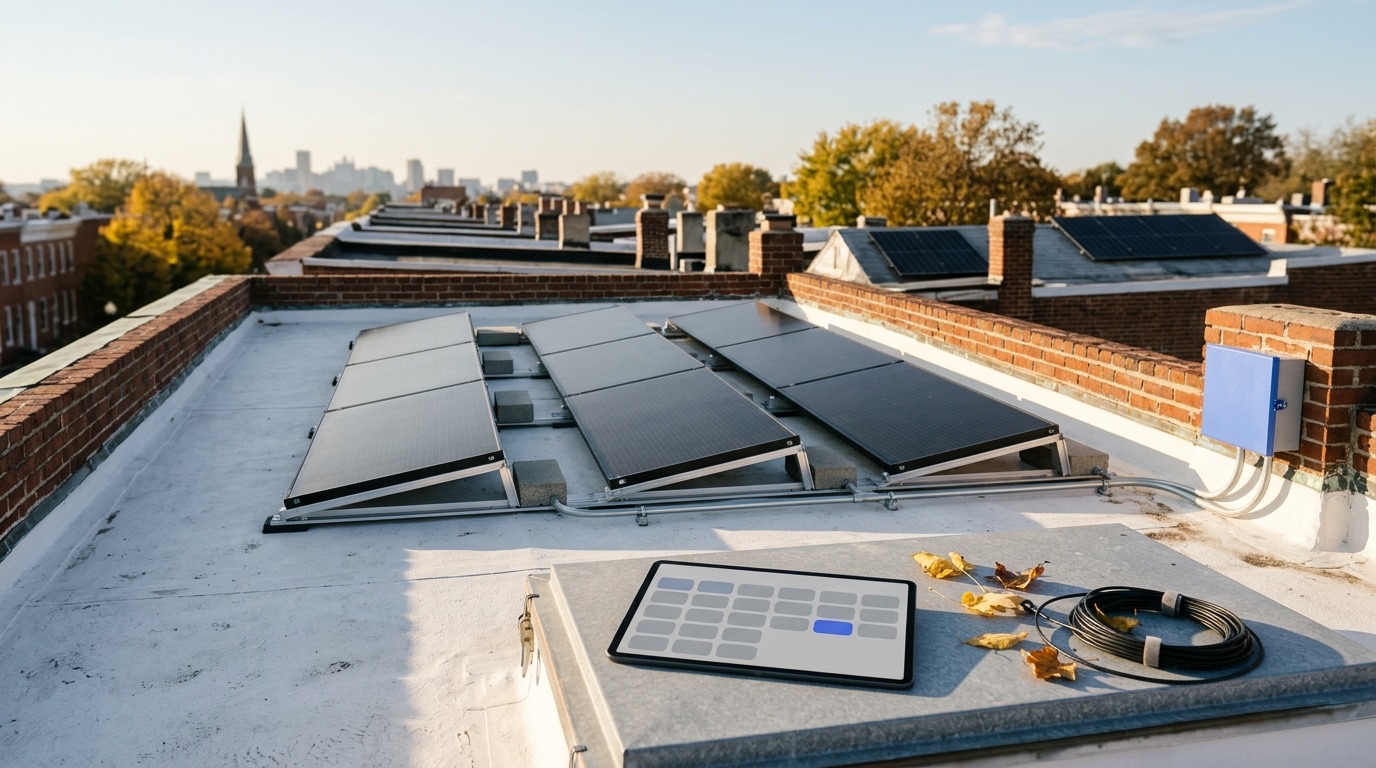
Picture three solar jobs in the Baltimore area this autumn. The first is a rowhouse in Federal Hill whose owner wants panels on the flat roof and a battery in the basement, and signs in November. The house is in a local historic district, so the Commission for Historical and Architectural Preservation has to authorize the work before the City will issue a permit, a process that can take 79 days in the worst case. The City’s fire code declined the model code’s exemption for low-slope roofs, so the layout may have to leave access pathways that a flat roof elsewhere would not. Two batteries of the most common size fit the basement limit and a third would not. And if the Public Service Commission decides that only customers with permission to operate by July 1, 2027 keep today’s net-metering terms, every one of those steps is now racing a date that nobody in the house has heard of.
The second is a house in Towson whose owner installed a system in 2017 through a company that has since gone bankrupt, and now wants four more panels and a battery. The contract is serviced by a successor the homeowner has never dealt with. Before July 1, 2027 the addition is a sales opportunity. After it, adding modules that increase exports ends the old net-metering terms for that house for good, and adding a battery may do the same if it requires a new interconnection agreement, as Maryland’s interconnection rules appear to. The installer who books that job is deciding the customer’s electricity bill for the next decade, whether or not anyone in the office knows it.
The third is a growing installer that sells across Baltimore County, buys leads, calls them with a dialer until 8:30 in the evening and sends proposals that still subtract 30% from the price. Maryland’s calling law has forbidden solicitation calls after 8 p.m. since 2024, with damages of up to $500 per violation. The 30% has not existed for buyers since the end of 2025, and the lease and PPA partners that can still claim a federal credit want an in-service date no later than December 31, 2027 and supplier documents for a foreign-entity test. The installer’s CRM has a field for none of it.
Each of them has a software problem dressed as a regulatory one. The rules now ask who owns the panels and when the installation was finished; which date the utility recorded, and which date the regulator will count; what the roof, the district and the fire code allow; how much of a system has been replaced since the day it was switched on; what a person agreed to when they typed their phone number into a form, and how many times they have been called since. Every one of those questions is answered, or not, by the way an installer quotes, schedules, permits and services its jobs. This article goes through them for Baltimore City and Baltimore County, using the 2025 federal budget law and IRS guidance, Maryland’s 2024, 2025 and 2026 energy laws, the Commission’s draft regulations, BGE’s tariffs, the City’s and County’s codes, PJM’s registry of Maryland solar systems and our own reading of 39 local installer websites. It also sets out what the software costs. It covers the estimate and the online store in detail, because that is where the rules have to work without a person checking. It is our reading of the rules for the products we build, not legal, tax or financial advice.
What Baltimore’s solar trade looks like
There is no official count of solar installers, in Baltimore or anywhere else. The Census Bureau’s industry index files “solar panel installation” under NAICS 238210, electrical contractors, alongside every firm that rewires kitchens and services office panels, so the 2023 County Business Patterns figures, 55 electrical contracting establishments with 669 employees in Baltimore City, 185 with 3,362 in Baltimore County and 1,444 in Maryland, are a rough proxy that says almost nothing about solar. SEIA, the industry’s trade association, counts about 200 solar companies in Maryland, half of them installers or developers, and 4,938 solar jobs in its September 2026 state profile. The installations themselves are better counted than the businesses, because every system that sells renewable energy credits has to be registered with PJM’s tracking system.
We downloaded that register, PJM GATS’s public list of renewable generators, on October 23, 2026 and counted the solar units in Maryland: 113,161 of them, with 3,146 megawatts of registered capacity. Baltimore County has 12,130 units and 237 megawatts, the fourth-largest count among Maryland’s 24 jurisdictions after Prince George’s, Montgomery and Anne Arundel. Baltimore City has 1,954 units and 41.5 megawatts, twelfth. The City figure is probably a floor: in the state’s older grant records, which carry ZIP codes, the City’s share of City-plus-County installations is noticeably higher than in GATS, which suggests some City homes were registered under “Baltimore” and landed in the County. Either way the two jurisdictions together hold about one Maryland solar system in eight.
| Measure | Baltimore City | Baltimore County | Maryland |
|---|---|---|---|
| Solar units registered in PJM GATS | 1,954 | 12,130 | 113,161 |
| Registered capacity | 41.5 MW | 237.3 MW | 3,146.2 MW |
| Share of units of 10 kW or less | 85.2% | 73.2% | 57.9% |
| Median system size, all years | 5.74 kW | 7.28 kW | 9.02 kW |
| Units placed online in 2025 | 223 | 1,074 | 9,247 |
| Units online in 2026 so far (registrations lag) | 165 | 571 | 5,170 |
| Solar permits issued, 2025 / 2026 to Oct. 21 | 564 / 417 | no open data after 2021 | — |
| Electrical contractors (NAICS 238210), 2023 | 55 | 185 | 1,444 |
The shape of the City’s market is the rowhouse. Its median system is 5.74 kilowatts against 9.02 for the state, so the median City system is about 36% smaller than the state’s, and 85% of City units are 10 kilowatts or less. In the City’s own permit records, which we pulled from Open Baltimore, “Dwelling: Rowhouse” is the listed existing use on 279 of the 981 solar permits issued in 2025 and 2026, and many of the 570 marked “single family dwelling” are rowhouses too. Those are the flat, parapeted, party-walled roofs that the zoning code, the fire code and the historic-district guidelines all have something to say about, which is why this article’s permit section is longer than it would be for a suburb. County systems are larger and growing: the County median rose from 5.98 kilowatts for systems placed online in 2015 to 10.00 in 2026, a 67% increase.
The year-end rush that the federal deadline caused is plain in the data. Maryland placed 1,085 solar units online in December 2025, 41% more than the 2025 monthly average of about 771, and small systems of 25 kilowatts or less placed online in the last quarter of 2025 were up 51% on the same quarter of 2024. The City issued 158 solar permits that December, 2.4 times its June-to-November average; 50 of them belonged to a single City-supported program run with the nonprofit Civic Works, and even without those the month was 1.7 times the average.
What has not happened yet in Maryland is the slump. Nationally, SEIA and Wood Mackenzie report residential installations down 12% year on year in the second quarter of 2026 and forecast a 23% fall for the year. Maryland placed 4.5% more small systems online in the first half of 2026 than in the first half of 2025. BGE added 2,575 residential net-metering customers between January and July 2026 against 2,021 a year earlier, according to the utility’s monthly filings with the Energy Information Administration, and BGE’s residential solar reached 55,063 customers and 440 megawatts in July 2026, in preliminary figures. Our reading is that 2025 contracts are still being switched on and that the Maryland downturn is in the pipeline rather than behind it. The state has also scheduled its next rush: if net metering closes to new systems on July 1, 2027, the first half of 2027 is likely to look like December 2025, only longer.
Two more patterns matter for the software. Batteries are arriving from a low base: 3.4% of the City’s solar permits in 2025 mention a battery, and 8.9% in 2026 so far, and 19 of the 37 permits this year that mention a battery add one to an existing array rather than to a new one, which is service work on systems whose net-metering terms, as later sections show, are now worth protecting. And the cost of selling is a large share of the price. The federal residential cost benchmark for the first quarter of 2025, published by the Department of Energy in December 2025, models an 8-kilowatt system at $2.95 a watt, about $23,600, with $3,472 of customer acquisition, $2,152 of permit preparation and fees and $246 of inspection support per system: 24.9% of the price before a single panel is counted. Berkeley Lab’s Tracking the Sun update of August 2026 puts the median price of customer-owned residential systems installed in Maryland in 2025 at $4.0 a watt, above the national $3.6, a figure that includes dealer fees on loans; nationally, third-party ownership rose from 23% of residential systems in 2023 to 40% in 2025.
What the software costs, and what the meter counts
Solar is one of the few trades where the software vendors mostly publish their prices, and where those prices matter least. We fetched the pricing page of every design, proposal, CRM and operations product we could find for residential installers on October 23, 2026 and recorded what each charges and what it counts. The pattern is clear: the tools are priced per user, per project or per signed contract, they are cheap next to the cost of finding a customer, and several of the most popular are free because somebody else in the sale pays for them.
| Product | Published price | What the meter counts |
|---|---|---|
| Aurora Solar | Basic $159 a user a month, or $135 billed annually; Premium $259, or $220 annually | Users, with 50 projects a month per license; site models and plan sets extra |
| HelioScope (Aurora) | Basic $159 a month or $1,620 a year; Pro $259 or $2,640 | Licenses, with 10 projects a month on Basic |
| Solargraf (Enphase) | $2,799 a year (Starter) to $12,999 (Enterprise) | Projects (240 a year on Starter, $11 each beyond) and users ($1,440 each extra); API $4,000 a year below Enterprise |
| SubcontractorHub | $1,500 a month for three modules, or $500 for one, plus $35 per signed contract | Signed contracts |
| SalesRabbit (door-to-door) | Team $59 a user a month; Pro $49 a user a month, billed annually | Users |
| Bodhi (customer updates) | Free up to 5 new projects a month; free to installers using the lender OneEthos | Projects |
| OpenSolar | Free | Nothing; partners pay to be on the platform |
| SolarEdge Designer | “No license or subscription fees” | Nothing; the hardware pays |
| Enerflo, Scoop, JobNimbus, AccuLynx | Quote only | Unpublished |
The free tools deserve a sentence each, because they explain the trade. OpenSolar’s “Why free?” page says manufacturers, finance companies, distributors and permitting firms pay to be on its platform. SolarEdge’s designer charges no license or subscription fee, and SolarEdge makes its money on the inverters it designs around. Bodhi is free to installers who use OneEthos as a lender. Enphase sells installers appointments, and its sign-up form states that the program requires them to present and sell Enphase equipment. EnFin now describes itself as Qcells’ in-house lease and PPA financier, and the old Sighten proposal software now redirects to EverBright, a company selling zero-upfront solar plans. None of this is sinister, and some of it is excellent software, but it means that in this trade the proposal tool often belongs, commercially, to the hardware or the money. An installer whose proposals run through a lender’s or a manufacturer’s platform should know whose defaults it is presenting to its customers. One small sign of how fast the financing side moves: Aurora’s pricing page still lists Mosaic among its integrated lenders, while Mosaic’s own website, after its 2025 bankruptcy, now redirects to a loan-servicing company.
The two meters that matter: leads and lenders
The cost of finding a customer is one of the largest numbers an installer controls. The Department of Energy’s 2025 benchmark puts it at $3,472 for an 8-kilowatt system. SolarReviews, which sells leads, publishes state averages: in Maryland, $1,333 in lead cost per sale from an organic, defined source and $2,167 from an undefined one, and a national all-in customer acquisition cost of $0.43 a watt, from a page last revised in 2024. EnergySage, the largest marketplace, publishes no rates, but its partner help pages publish its rules, and they read like CRM timers. A lead can be returned only within 72 hours and before the installer clicks “Start Quote,” and returns are capped at 10% of leads per pricing category per state. A monthly sales report is due by the end of the following month, even when there were no sales, on pain of losing quoting privileges, and closing a deal requires the final system size, the financing type, the gross cost and an upload of the signed contract. Google’s Local Services Ads list “solar energy contractor” as a category, priced per lead with no published price. And since January 21, 2025, Meta has required U.S. ads for financial products to run in its “financial products and services” category, which removes targeting by age, gender and ZIP code, so an installer whose ad offers a loan should expect to lose its Baltimore ZIP-code targeting.
The second meter is the dealer fee, the amount a solar lender charges the installer to offer a low advertised rate, which the installer builds into the price. The CFPB’s 2024 report found these fees typically between 10% and 30% of the cash price and sometimes above 50%. Minnesota’s Attorney General, in a complaint filed on March 8, 2024 against four solar lenders, alleged average fees of 19.32%, 21.4%, 17.6% and 18.8% of the loan, and that the fee depends on the loan term and rate the installer selects; those are allegations, and we have not seen the case decided. Berkeley Lab’s national medians for 2025 show the effect from the other side: $4.5 a watt for loan-financed systems against $3.0 for cash, a gap the lab attributes in part to those fees. Because the fee is usually a share of the loan rather than of the price, the arithmetic is easy to get wrong: a financed price is the cash price divided by one minus the fee, so a 19.32% fee on a $20,480 cash price, which is 8 kilowatts at EnergySage’s Maryland average quote of $2.56 a watt, produces a $25,384 loan, a $4,904 fee and a 24% markup.
| Cost line | How we computed it | A year | Share of revenue |
|---|---|---|---|
| Software at published list prices | From the free stack to SubcontractorHub’s full platform plus HelioScope | $0 to $22,420 | 0% to 0.9% |
| Customer acquisition, leads only | 80 sales × $1,333 to $2,167 per sale (SolarReviews, Maryland) | $106,640 to $173,360 | 4.2% to 6.8% |
| Customer acquisition, all-in | 640,000 W × $0.43 a watt (SolarReviews, national) | $275,200 | 10.8% |
| Dealer fees | 28 to 46 loans × $4,904.23 (a 19.32% fee on a $20,480 cash price) | $137,318 to $225,595 | 5.4% to 8.8% |
| Deposits taken by card | 80 × $198.27 (2.9% + 30¢ on a one-third deposit of $6,826.67) | $15,862 | 0.6% |
| The same deposits by ACH | 80 × $5.00 (0.8%, capped at $5) | $400 | under 0.1% |
The loan counts assume that 35% or 58% of customers finance with a loan, the second figure being the CFPB’s cited share for 2023, and the dealer fee and the deposit are computed on the $20,480 cash price, because the $4.0 median already includes dealer fees; the deposit rows use Stripe’s published U.S. rates and the largest deposit Maryland’s home-improvement law allows. The conclusion does not depend on the exact inputs. The subscriptions are less than 1% of revenue in every case, while acquisition and financing together take somewhere between a tenth and a fifth of it. That is why we will not tell an installer that custom software saves money on subscriptions; it usually does not. What software can change is which leads are bought and returned on time, which lender and term each proposal uses, whether a deposit goes over a card network or a bank transfer, and, after 2026, whether the proposal is computing the right federal line, net-metering terms and deadlines in the first place.
The 30% credit did not disappear. It moved to whoever owns the panels
The sentence that changed residential solar is one line long. Section 70506 of the July 4, 2025 budget law, Public Law 119-21, rewrote the end date of the homeowner’s credit in 26 U.S.C. 25D so that it “shall not apply with respect to any expenditures made after December 31, 2025.” The old text ran to 2034. The credit had been 30% of the cost of a system on a home the taxpayer lived in, batteries of 3 kWh or more included, and it was the number every residential proposal in America was built around.
What counts as “made” is the part installers learned the hard way. Section 25D(e)(8)(A) treats an expenditure as made “when the original installation of the item is completed,” and the IRS said in its FAQ on the new law that a system paid for in 2025 but finished in 2026 gets nothing: “If installation is completed after December 31, 2025, the expenditure will be treated as made after December 31, 2025.” A signed contract, a paid deposit and a permit did not save a single job. The date that mattered was the day the crew finished, which is why Maryland’s registrations spiked in December 2025, as the market figures above show, and why a customer who signed in the autumn of 2025 but whose installation slipped into January was never going to receive the credit printed on the proposal.
The credit survived in another form, and that is the half of the story most websites have not caught up with. A system owned by a business and leased or sold by the kilowatt-hour to a homeowner can still earn the investment credit in section 48E, which pays 30% for facilities under one megawatt, plus bonus points for domestic content, energy communities and qualifying low-income projects. Sunrun, the largest third-party owner, reported an average credit of 44.0% on its systems in its second-quarter 2026 results, which tells you how much of that value now comes from the bonuses. A homeowner who buys gets nothing. A homeowner who leases, or signs a power purchase agreement, gets whatever share of the owner’s credit the owner passes through in the monthly price.
The lease myth
The budget law did add a line about leasing, and it is the line most often misread. New section 48E(i) denies the credit for property “described in paragraph (1) or (4) of section 25D(d)” when the owner leases it to a third party. Paragraph (1) of 25D(d) is solar water heating and paragraph (4) is small wind; solar electric property is paragraph (2) and batteries are paragraph (6). Leased rooftop solar panels and leased home batteries therefore keep the owner’s credit, and a page or an AI answer that says “leases lost the credit too” has read the cross-reference wrong.
Three dates on every quote
The owner’s credit runs on a clock that the homeowner never sees but the installer has to manage. Under the law’s section 70513, a solar facility whose construction began after July 4, 2026 must be placed in service by December 31, 2027, about fourteen months from now. A facility whose construction began on or before July 4, 2026 escapes that cutoff and instead has the ordinary four-year continuity window under IRS Notice 2025-42. That notice made the physical work test the only way to begin construction, with one exception that matters for rooftops: facilities of 1.5 megawatts AC or less may still use the 5% spending safe harbor. It also lists obtaining permits among the “preliminary activities” that do not count, so a permit date never proves that construction began. Batteries are excepted from the 2027 cutoff altogether, which makes a battery-heavy third-party system the most durable federal product an installer can sell.
Then there is the supply chain. For facilities that begin construction after December 31, 2025, the law bars any “material assistance from a prohibited foreign entity,” measured as a cost ratio: under IRS Notice 2026-15, at least 40% of the cost of the manufactured products in a solar facility that begins construction in 2026 must come from non-prohibited sources, rising to 45% in 2027; for storage the thresholds are 55% and 60%. Treasury has until December 31, 2026 to publish its safe-harbor tables. The owner, not the installer, carries the tax risk, but the owner will ask the installer for the bill of materials, the supplier certifications and the dates, and an installer whose job records cannot produce them will find its third-party partner choosing other installers.
| How the system is owned | Who can claim a credit | Federal credit | The clock | What the owner will ask for |
|---|---|---|---|---|
| Bought with cash | Nobody | None (25D ended for installations completed after Dec. 31, 2025) | Installation date decides | Nothing; remove the line |
| Bought with a loan | Nobody | None | Installation date decides | A loan without a tax-credit paydown assumption |
| Leased | The leasing company | 48E: 30% under 1 MW, plus any bonus | In service by Dec. 31, 2027, unless construction began by July 4, 2026 | Start and in-service dates, bill of materials, supplier certificates |
| Power purchase agreement | The system owner | 48E: 30% under 1 MW, plus any bonus | Same as a lease | Same as a lease |
| Battery, leased or in a PPA | The owner | 48E | No 2027 cutoff for storage | Storage cost ratio of 55% (2026 starts) or 60% (2027) |
| Battery, bought by the homeowner | Nobody | None | Installation date decides | Nothing; remove the line |
| Owned by a business on its own building | The business | 48E | Same as a lease | Same as a lease, plus depreciation records |
What the arithmetic does to a quote
Take EnergySage’s Baltimore figures for October 2026: an average system of 11.54 kilowatts at $30,994 before incentives, or $2.69 a watt in quotes on its marketplace. A calculator that still subtracts 30% shows $21,696 and a $9,298 credit the 2026 cash or loan buyer will not receive; the real figure is $30,994, which is 43% more than the stale number, because $30,994 divided by $21,696 is 1.429. Nationally, SEIA and Wood Mackenzie put the average residential price at $3.39 a watt in the last quarter of 2025 and $3.36 in the second quarter of 2026, so an 8-kilowatt system that cost a buyer $18,984 after the credit in 2025 costs $26,880 in 2026, about 42% more, at a slightly lower price per watt.
For the third-party owner the same system looks very different. A business that claims 30% and expenses the rest of its basis under the bonus depreciation the budget law restored recovers, by our arithmetic at the 21% corporate rate, about 48% of the installed cost in federal tax value: the 30% credit, plus 21% of the basis left after half the credit is subtracted from it, which on $26,880 is $8,064 plus $4,798, or $12,862. With one 10-point bonus the figure is about 57%. None of that reaches a cash buyer. Some of it reaches a lease or PPA customer, and how much is exactly the number that third-party contracts do not print. This is why the national forecast for residential installations in 2026 is down 23% in SEIA and Wood Mackenzie’s Q3 2026 market report, and why installers that sold mostly for cash and loans are trying to move to third-party products: the credit has not gone away, it has changed hands.
The loan that still expects a credit
One more trap sits inside the financing. The Consumer Financial Protection Bureau’s August 2024 report on solar financing, which was not among the guidance documents the Bureau withdrew in May 2025, described the common structure: loans that “re-amortize at a higher monthly payment amount at the 19th month” unless the borrower prepays, typically 30% of the principal, the amount the federal credit was expected to cover. A 2026 buyer has no credit to make that prepayment with. A proposal engine that still offers such a product to a cash-or-loan customer, or that quotes the low pre-month-19 payment as “your payment,” is selling a bill that arrives a year and a half later. The same report found hidden fees in solar loans typically between 10% and 30% of the cash price, and sometimes above 50%, which the section on costs above puts into numbers.
The federal grant program that was meant to fill part of the gap for lower-income households is in court. The EPA selected the Maryland Clean Energy Center for a $62,450,000 Solar for All award in April 2024 and terminated the program on August 7, 2025. The Center is the first-named plaintiff in the states’ claim in the Court of Federal Claims, and two federal district courts, in Rhode Island on September 18, 2026 and in Washington, D.C. on September 22, 2026, held the termination unlawful, according to news reports of the rulings. Whether any money reaches Maryland households, and when, is not settled, and an installer should not sell against it.
Net metering closes on July 1, 2027, and the milestone that counts is still undecided
The part no national platform models is Maryland’s, and it arrived this spring. Section 5 of the Utility RELIEF Act, an emergency law whose net-metering section took effect when the governor signed it on May 12, 2026, amended Public Utilities Article §7-306 so that the standard net-metering contract or tariff is offered to new customers only “until the earlier of: (i) the date on which the rated generating capacity … reaches 3,000 megawatts; or (ii) July 1, 2027.” A new section, §7-306.4, requires the Public Service Commission to approve, by February 1, 2027, “a framework for a net energy metering program to begin July 1, 2027,” to run until the old and new programs together reach 6,000 megawatts, with priority review for customers already in a utility’s queue. The legislature wrote its intention into the statute: the successor should provide incentives “that are less than the incentives provided by the net energy metering program” that exists now.
Which limit arrives first matters less than it sounds. The Commission’s November 2025 net-metering report counted about 1,537 megawatts installed on June 30, 2025, 51.23% of the cap, but also about 2,911 megawatts of community solar in the pipeline, and the legislature’s fiscal note records that the Commission expected the cap to be reached within about two years. On operating capacity alone, our rough projection is that the date comes first; counting reserved community-solar capacity, the cap could come sooner. For a residential installer in Baltimore, either way, the working assumption has to be that a customer who is not on the current terms by the summer of 2027 will be on terms that pay less.
What the current terms are worth is easy to compute from BGE’s own tariffs. A residential customer on BGE’s standard-offer supply in October 2026 pays about 20.2 cents for each kilowatt-hour it draws from the grid once supply, delivery and the per-kilowatt-hour surcharges are added up, or about 20.55 cents in Baltimore City with the local tax; the $10 monthly customer charge cannot be offset. Under net metering, each kilowatt-hour a system exports offsets one of those, so the export is worth the full retail price. Credits left over at the annual true-up after the April billing cycle are paid only at “the generation or commodity portion of the rate,” averaged over the previous 12 months, which on 2026 supply prices is roughly 11 to 14 cents, depending on what BGE counts as the commodity portion. A customer can instead elect to carry credits forward indefinitely; BGE applies the choice in effect on March 1, and a customer who elects indefinite accrual must wait 12 months to switch back. A successor that pays less than retail for exports changes the arithmetic of every system sized to export at midday, and makes a battery that stores the midday surplus worth more.
Three versions of one date
The statute does not say what a customer must have done by July 1, 2027 to count as already in. The Commission’s staff answered with three alternatives in its draft regulations for rulemaking RM 56, posted on June 25, 2026, each labeled with its supporters. Version 1, backed by the Maryland Energy Administration, the state transportation department, Howard County, the Maryland Rooftop Solar Coalition and solar industry groups: the customer “shall submit an interconnection application to the electric company on or before July 1, 2027.” Version 2, backed by Potomac Edison, PHI and BGE: the customer “shall have received permission to operate from the electric company.” Version 3, suggested by staff: the customer “shall have executed an interconnection agreement for net energy metering,” with a fallback under which a customer who applied by the date but had not executed an agreement takes service under the successor program with prioritized review. As of October 23, 2026, no version has been adopted, the docket shows comments filed through October 13, and the working group the Commission set up in Public Conference 78 is due to file its draft report and framework by October 27, 2026, four days from the date of this article. The Commission’s report to the legislature is due by December 15.
The three versions are three different businesses. Under Version 1, a customer signed in June 2027 is safe if the application goes in that week. Under Version 2, the entire chain has to finish: the utility has 20 business days to issue permission to operate after the installation and paperwork are complete, so the paperwork has to be done by early June 2027 at the latest, and earlier for any job in the 10% of cases the utility is allowed to miss, the inspection and meter work before that, the installation before that and, in a historic district, a review that can take 79 days before that. Working backwards from July 1 through the worst-case clocks, a job in a City historic district signed much after the first weeks of 2027 would be a gamble in a Version 2 world. Version 3 sits in between. Until the Commission chooses, the only honest deadline board carries three flags on every job, and the only honest proposal for a system that might miss the strictest one shows the savings both ways.
A grandfathered system is a service history
The same section decides how long the old terms last for the systems that make it. A customer “under a net energy metering contract or tariff” on July 1, 2027 stays on it until the earliest of four events: the system is decommissioned; it is modified to inject more power by adding “more photovoltaic modules than were present” when it was placed in service, or its alternating-current output capacity rises above the original; “the system enters into a new interconnection agreement”; or it is “repowered.” Repowered means that more than 80% of the original DC nameplate capacity of the modules has been replaced “through a single action or a series of actions,” and the statute excludes routine repair and maintenance with similar or better equipment, roof replacement, the remedy of defects, damage from storms, fire, vandalism or theft, and replacements required by a government or the utility. The draft regulations would require systems under one megawatt to notify the utility if they are repowered, after which the utility moves them to whatever tariff is then available, and would not require module-replacement records below 100 kilowatts. Maryland’s net-metering regulation also limits a system to 200% of the customer’s baseline annual use, a test that an upgrade has to pass again. In other words, nobody but the owner and the installer will be keeping the record that decides whether a Baltimore rowhouse still has the old terms in 2034.
Batteries are the open question. Maryland’s interconnection rules, COMAR 20.50.09.06B, require a new interconnection request to change the “proposed use” of an existing facility, and if it is approved, “a new interconnection agreement will be required”; the definition of proposed use includes a combination of generators and energy storage. Read with the statute, adding a battery to a grandfathered system after July 1, 2027 plausibly triggers the new-agreement clause and ends the old terms, and an AC-coupled battery inverter may also raise the system’s AC output capacity. The draft regulations do not address storage, and this is unresolved, not settled law. It matters now: of the 37 solar permits Baltimore City issued in 2026 that mention a battery, 19 added one to an existing array. A service tool that books a battery retrofit on a grandfathered system without asking this question is making a decision about the customer’s bill for the rest of the system’s life.
The clocks between a signature and permission to operate
Maryland regulates the interconnection timeline in unusual detail, and the deadline board is only as good as these numbers. One statute also shapes the checkout: under §7-306.1, the installer must submit the interconnection application, may accept payment before the utility approves it but “may not begin installation” until then, and must “fully refund any payment” if the utility disapproves. BGE charges nothing to file a Level 1 application for an inverter-based system of 20 kilowatts or less, but since May 1, 2026 its Rider 29 adds a hosting capacity fee of $108 and an administrative charge of $17, so each residential interconnection now costs $125.
| Step | Who acts | Limit | Source |
|---|---|---|---|
| Start installation | Installer | Not before the utility approves the interconnection application | PU §7-306.1(a) |
| Say whether a Level 1 application is complete | BGE | 5 business days | COMAR 20.50.09.09B |
| Review a complete Level 1 application | BGE | 15 business days | COMAR 20.50.09.09B |
| Sign the interconnection agreement, or the application is withdrawn | Customer | 30 calendar days | COMAR 20.50.09.09D |
| Inspect a job permitted by solar permitting software | City or County | An average of 5 business days | LG §1-1320(c)(2) |
| Witness the commissioning test, or waive it | BGE | 10 business days | COMAR 20.50.09.06L |
| Disconnect and reconnect the meter | BGE | 5 business days, since July 1, 2026 | LG §1-1320(f) |
| Issue permission to operate after installation and paperwork are complete | BGE | 20 business days, in at least 90% of cases a year | PU §7-306.1(c) |
The Commission has also proposed a “temporary permission to operate,” with a sunset date agreed between the applicant and the utility, in amendments published in the Maryland Register of September 18, 2026, and its notice ties the idea explicitly to the federal credit deadlines; comments closed on October 19. If it is adopted, a job record will need a field for it, and for the date it expires. BGE’s own permission-to-operate rules add one more check that belongs in software rather than in an inspector’s memory: at the certificate of completion, the system’s DC size must match the application or be smaller, never larger.
The permit is supposed to come from software, by August 2027
Maryland’s 2024 Brighter Tomorrow Act told every county and municipality to adopt “solar permitting software” for residential solar by August 1, 2025. That date is gone. The Utility RELIEF Act of 2026, Chapter 353, rewrote Local Government Article §1-1320 with effect from July 1, 2026, and the new text is more demanding and later. By August 1, 2027, every county and municipality must run software that automates plan review against the state building standards, the National Electrical Code and local codes, issues a code-compliant permit, takes payment online and issues the permit “immediately on receipt” of the fee, for residential solar, residential batteries and main electrical panel upgrades and derates. The law then adds clocks and limits that permit offices have never had in Maryland: inspections of software-permitted projects must be completed “within an average of 5 business days” of a properly completed request, with the annual average published. Any manual review of a software-approved permit must be finished within 5 business days, and review is limited to “health and safety requirements.” From August 1, 2027 the fee for a software-issued permit for a rooftop system under 20 kilowatts AC may not exceed $500, plus any card-processing charge. The Attorney General may sue a jurisdiction that does not comply, although the Energy Administration must delay or suspend the mandate if there is not enough state or federal money to help jurisdictions pay for the software.
The same section put a clock on the utility. An electric company must perform any meter disconnection and reconnection needed to interconnect a residential solar or battery system “within 5 business days” of a properly completed request from the owner or installer, and may authorize qualified outside personnel to do it. Every one of those five-day clocks is a field in a job record: the date the request was complete, the date of the inspection or the meter work, and the count of business days between them. An installer that records them will know, within months of the August 2027 deadline, which jurisdictions and which utility crews meet the law; an installer that does not will have only anecdotes.
As of today, neither Baltimore jurisdiction appears to run the kind of software the law describes. SolarAPP+, the tool developed at the federal lab formerly known as NREL and the one the Maryland Energy Administration pays jurisdictions to adopt, lists Betterton on the Eastern Shore among its Maryland users on its public map, and no Baltimore entry. Baltimore City processes every permit through its Accela E-Permits system, which since 2025 has had an “Auto-Issue” feature for applications that need no staff technical review, a different thing from automated code review. The City’s backlog after the switch to Accela stood at more than 1,700 applications waiting for initial review in May 2025 and was down to 68 by February 5, 2026. Baltimore County runs its own staff-reviewed portal. The Energy Administration’s fiscal 2027 grant round pays $10,000 plus $0.95 per housing unit, capped at $100,000, which both Baltimore jurisdictions would reach, and applications are due at 3 p.m. on November 18, 2026.
The $500 cap will not change much in Baltimore, because permits here are already cheap. Under the City’s 2026 fee schedule, a photovoltaic system pays $25 for the first 25 panels and $5 for each additional ten, plus a $25 application fee for a one- or two-family dwelling and a 5% permit tax, so a 20-panel rowhouse job comes to about $52; Baltimore County’s schedule lists $74 for a residential photovoltaic electrical permit. What will change is the clock and the paperwork, which is where installers actually lose weeks.
The rowhouse roof
The City’s zoning code has a short solar section, Article 32 §15-517, and nearly every clause of it is a layout constraint. A building permit application must include “a line drawing of the electrical components.” A rooftop system may “rise no more than 42 inches from a roof surface,” is treated as a permitted height exception, and “in the case of a flat roof” must be “setback 3 feet from the front facade.” Ground-mounted systems must sit at least 3 feet from any lot line, stay under 10 feet in a side or rear yard and under 30 inches in a front yard, be screened from public view and carry voltage warning signs.
The fire code is stricter than it looks, and it disagrees with itself. Baltimore adopted the 2021 International Fire Code with local amendments, and its solar section for one- and two-family buildings ends with “Exceptions: {Not Adopted}.” The exceptions it declined are the model code’s exemptions for houses built under the residential code and for roofs with a slope of 2:12 or less, which means that, on its face, the rooftop access pathways apply to flat rowhouse roofs. The City adopted the residential code’s own solar section unchanged, and that section keeps the low-slope exemption. Until the fire marshal says which governs, a design tool that applies the model defaults to a Baltimore rowhouse is guessing, and a design record should store which rule the layout followed.
Batteries have their own limits under section R328 of the 2021 residential code, which the City adopted as written: no more than 20 kilowatt-hours per unit; no more than 40 in aggregate in utility closets, basements and storage spaces; no more than 80 in garages, accessory structures, on exterior walls or outdoors; none in sleeping rooms; and three feet between units unless large-scale fire testing shows less is safe. Three of the most common 13.5-kilowatt-hour batteries in a basement add up to 40.5, just over the ceiling, so the location of a battery is a design decision with a legal limit attached.
Historic districts
Baltimore City has 40 local historic districts, among them Federal Hill, Fells Point, Butchers Hill and Mount Vernon, and work on the exterior of a building in one needs an Authorization to Proceed from the Commission for Historical and Architectural Preservation before the City will issue a permit. CHAP’s design guidelines say, in guideline 1.14.1, not to install panels where they can be easily seen from the street and to place them on flat or rear-sloping roofs, with low-profile panels. The City Code gives the process its clocks: the building official forwards the application within 2 days; if no authorization has been issued within 11 days of a complete application, a hearing sign goes up; the hearing must be held 10 to 45 days after posting; the decision comes within 21 days of the hearing; and an authorization expires unless the permit is obtained and work begun within a year. That is a worst case of 79 days after a complete application, which in 2027 could be the difference between the old net-metering terms and the new ones.
The state law’s historic carve-out is narrower than it looks. Section 1-1320 does not apply to a “restriction on use” on historic property or in a locally designated historic district, and “restriction on use” is defined elsewhere in Maryland law as a covenant, restriction or condition in a deed, declaration, contract, homeowners’ rules or similar instrument. On its face that protects private restrictions such as recorded preservation easements, not CHAP’s ordinance-based review, and how CHAP’s design review fits with the new “health and safety” limit on permit review is a question for lawyers, not for us. For the software it means the historic check has to stay in the job flow, with its own dates.
Baltimore County is a different permit
The County’s rules diverge from the City’s at almost every step, which is why an address lookup belongs at the start of every job. On the County’s permit pages, as archived in December 2025 (the live site did not respond to our requests from abroad), a residential system under 10 kilowatts needs only an electrical permit and a building permit is required at 10 kilowatts or more; a roof pitched at less than 4 in 12 needs an engineering certificate; the electrical work must be done by a master electrician registered with Baltimore County, who signs a Certificate of Installation for the inspection. Properties within 3.3 miles of Martin State Airport need an airport zoning permit, and a battery installed inside the house needs an alteration building permit with plans showing compliance with section R328, while an outdoor battery needs only a photo of its location. Working without a permit carries a $1,000 civil penalty. County historic review goes to the Landmarks Preservation Commission, which meets on the second Thursday of each month except August and December, with applications due two weeks before; a job that misses the cutoff in July waits until September. And the County’s 2025 rewrite of its solar zoning article, Bill 18-25, excludes rooftop systems and ground mounts accessory to a home from the rules for solar facilities, so the zoning question for a house is usually simple even when the permit is not.
The Maryland layer: a warranty law, a grant for some, and credits with waiting lists
Maryland did something in 2025 that most installers’ contract templates have not caught up with. The Renewable Energy Certainty Act, Chapters 623 and 624 of 2025, added Public Utilities Article §7-320, in force since July 1, 2025, and it reads like a list of contract fields. A person who sells or leases a residential rooftop solar system must “provide to the buyer or lessee a 5–year full warranty on the installation and component parts of the system,” pass through the manufacturers’ warranties, “inform the buyer or lessee of the minimum level of weather–adjusted energy production the buyer or lessee may expect from the system,” and “certify, in writing, that installation of the system is compliant” with the codes and design standards. Each violation can cost up to $1,000. The same section told the Maryland Department of Labor to develop a special solar contractor license; as of today the licensing pages show no sign of it, so installers still work under the general rules.
Those rules are the home-improvement law. The Maryland Home Improvement Commission requires a contractor license for residential solar; a 2025 bill that would have written that into the statute failed, and the legislature’s fiscal note on it said the bill “codifies existing practice.” A licensed electrician working within the trade is exempt, a licensed contractor must carry at least $500,000 of general liability insurance, and the deposit rule we covered in our home-improvement article applies unchanged: no payment before the contract is signed, and no more than a third of the price as a deposit. The 2024 Brighter Tomorrow Act added a solar-specific clause to the contract law itself: a residential solar contract must include “a barrier that meets industry standards to prevent wildlife intrusion,” unless the customer waives it “after being informed of the cost of the barrier and the risks,” and the Commission recommends a waiver that shows the price, the risks and the customer’s initials. Put together, a Maryland rooftop contract now has at least six fields a generic template does not: the warranty term, the manufacturers’ warranties, the production minimum, the code certification, the wildlife barrier or the customer’s documented waiver, and the license numbers.
The only state rebate is for lower incomes
The general state rebate for residential solar is gone. What remains is the Maryland Solar Access Program, which the statute calls the Customer-Sited Solar Program, created by the Brighter Tomorrow Act at State Government Article §9-2016 and run by the Energy Administration: $750 per kilowatt of nameplate capacity, up to $7,500 per system, for households at or below 150% of the state median income, which for a family of four is $195,375. The fiscal 2027 round has up to $10 million, must be reserved before installation, gives the job 180 days from reservation to permission to operate, works only through contractors on the program’s participating list, and closes at 3 p.m. on May 31, 2027; the statute itself expires on June 30, 2027. The program is also the only place we found in Maryland law where leases and power purchase agreements face a price test: annual escalators of no more than 3%, a 30-day right to cancel, and a first-year PPA price at least 20% below the utility’s avoidable rate, or 30% below with an escalator. For BGE the Administration set that rate at $0.213 a kilowatt-hour in July 2026, which caps a first-year PPA price at $0.170 without an escalator or $0.149 with one. The Administration’s own calculator guide for fiscal 2027 records, in its change log, that it “removed Federal ITC reference.”
The energy storage income tax credit that some websites still advertise is also gone. Tax-General §10-719 covered batteries installed through December 31, 2024 and was repealed with effect from July 1, 2025. In its place is a grant of the lesser of $5,000 or 30% of the installed cost for a home, which the Administration may tie to enrollment in a utility’s grid-services program; its fiscal 2027 notice says the program will prioritize systems that enroll in utility virtual power plant pilots, and we could not confirm that the 2027 round has opened.
SRECs, and the 150% that ends in 2028
Solar renewable energy credits are still the second income stream on a Maryland system, and the 2024 law made them more valuable for small ones. Under Public Utilities §7-709.1, a system of 20 kilowatts AC or less placed in service between July 1, 2024 and January 1, 2028 can be certified so that each of its credits has “a compliance value of 150%” for 15 years, for an application fee of up to $50. The ceiling on what any solar credit is worth is the solar compliance payment that suppliers owe when they fall short, and it is falling: $45 a megawatt-hour in 2026, $35 in 2027, $32.50 in 2028, $25 in 2029 and $22.50 from 2030. A certified system producing 10 megawatt-hours a year therefore has a credit ceiling of $675 in 2026, $525 in 2027 and $337.50 a year from 2030, before any discount the market applies. A proposal that shows one SREC price for 15 years is wrong twice: the cap falls each year through 2030, and the 150% applies only to systems placed in service inside the window and certified for it. Credits now live for five years from creation rather than three.
Taxes, and two local credits with different clocks
Solar energy property is not subject to Maryland real property tax under Tax-Property §7-242, and solar energy equipment is exempt from sales tax under Tax-General §11-230; because Maryland’s sales tax law counts a lease as a sale, the exemption should reach leased equipment too. Electricity from solar equipment sold for use in a residential customer-generator’s home, which is the power purchase agreement case, is exempt under §11-207. Batteries are not mentioned in the equipment exemption and we found no Comptroller guidance on them, so a store or proposal tool should treat their sales tax as a setting to be confirmed, not a default.
Both Baltimore jurisdictions offer a property tax credit of half the eligible cost up to $5,000, and they behave nothing alike. The City’s, under Article 28 §10-31, counts costs incurred within 12 months before the application, including a lease, is limited to that year’s City property tax and is applied in the tax year after the application; the City will not accept applications after June 30, 2028. The County’s has an annual budget of $1.5 million and a waiting list: its own page, as archived in June 2025, gave the example of a credit approved in March 2018 and paid on the July 2023 bill, and the credit does not transfer to a buyer of the house. A savings estimate that counts the County credit as first-year money is promising money that, on the County’s own example, can take about five years to arrive.
The homeowners’ association can no longer simply say no
Since October 1, 2025, under Chapters 516 and 517 of 2025, Real Property §2-119 gives the old “unreasonable restriction” rule numbers. A covenant or association rule is unreasonable if it increases the installation cost by at least 5% over the initially proposed installation or reduces the energy generated by at least 10%, and the owner proves it with documentation from a designer certified by NABCEP or one who attests to having designed at least 30 systems in the prior three years. Associations may still restrict systems on common areas, and historic property is carved out. A condominium board, under a 2024 change to §11-125, may grant leases of more than a year for leased clean-energy equipment by majority vote after 30 days’ notice. For a design tool, this means keeping two designs side by side when an association objects, the one first proposed and the one the association would allow, with the cost and production difference computed, because the statute’s test is exactly that comparison.
The sale is a legal record, from the lead form to the kitchen table
Residential solar is sold, more than most trades, by phone and at the door, and Maryland regulates both ends of that process in detail. The rules are old in places and new in others, and they are easy to encode and expensive to ignore.
The lead form and the dialer
Maryland’s Stop the Spam Calls Act, Chapter 413 of 2023, in force since January 1, 2024 at Commercial Law §§14-4501 to 14-4503, is stricter than federal law on the three things a speed-to-lead dialer does. A telephone solicitation that uses “an automated system for the selection or dialing of telephone numbers” or a recorded message needs the called party’s prior express written consent: a signed agreement, electronic signatures included, that clearly authorizes the person placing the call, names the number, and discloses that agreeing is not a condition of buying anything. No solicitation may be made between 8 p.m. and 8 a.m. in the called party’s time zone, an hour earlier than the federal 9 p.m. cutoff that calling software often defaults to. None may be made “more than three times to the same called party during a 24–hour period on the same subject matter or issue, regardless of the telephone numbers used to make the call.” A violation is an unfair or deceptive trade practice. A called party may sue for up to $500 or actual damages, whichever is greater, or up to three times that if the violation was willful or knowing. A call to any Maryland area code is presumed to reach a Maryland resident. The arithmetic is unforgiving: 400 Maryland leads called five times in one day is 800 calls over the limit, which is up to $400,000 of statutory exposure before trebling.
The federal layer moved in the other direction. The FCC’s “one-to-one” consent rule, which would have required every lead form to name a single seller, was vacated by the Eleventh Circuit on January 24, 2025, and the FCC restored its old text in August 2025. Maryland’s definition, though, still requires the consent to authorize “the person making or allowing the placement” of the call, so our reading, which is not settled law, is that a shared lead form that sells one consumer to several installers needs to name each of them for a Maryland number. The FTC’s telemarketing rule, amended in 2024, requires sellers to keep for five years “a copy of the request for Consent in the same manner and format in which it was presented,” with call times recorded to the second in Coordinated Universal Time. A lead record, in other words, is not a name and a phone number. It is the consent wording and its version, the page as the person saw it, every seller it named, the channels it covered, the time, and the source, and the dialer should read that record, the 8 p.m. cutoff and the rolling three-call count before it places a call. Only seven of the 39 installer websites we read show consent wording on their forms at all.
A sale closed entirely by phone has one more rule. Under Maryland’s Telephone Solicitations Act, a merchant-initiated sale made entirely by telephone must be put in a written contract signed by the consumer, with the statement “You are not obligated to pay any money unless you sign this contract and return it to the seller” in at least 12-point type above the signature. The merchant may not charge the consumer’s card until it has the signed contract back. Unless one of the Act’s exemptions applies, such as an earlier sale to the same customer, a checkout that takes a deposit during the call fails that test.
The kitchen table
A rooftop system sold in the customer’s home is a door-to-door home improvement sale, and Maryland’s cooling-off period for those is longer than the three days most people remember. Under Commercial Law §14-302.1, the buyer may cancel until midnight of the fifth business day after the transaction, or the seventh if the buyer is at least 65. The notice of cancellation must be on a separate form, not part of the contract, and the seller must get the buyer’s signature on an acknowledgment of the oral notice, which includes a box to check if the buyer is 65 or older. Maryland counts Saturdays as business days and excludes Sundays and nine named holidays, so a contract signed on Friday, October 23, 2026 can be canceled until midnight on Thursday, October 29, or Saturday, October 31 for an older buyer, while the federal cooling-off rule’s three days would end on Tuesday the 27th. The contract must be in the language of the sales presentation, the seller must refund within 10 business days of a cancellation, and the seller may not assign the customer’s note to a finance company before midnight of the fifth business day. A sale made entirely online escapes the door-to-door rules only if there is no other contact before the work is performed, and our reading is that a site survey at the house brings it back in.
For software, that is a date calculation with a birthday in it, a document that must be generated separately from the contract, a hold on ordering and on lender funding until the window closes, and an automatic refund when a cancellation arrives, however it arrives. Combined with the home-improvement rules, no payment before a signed contract and no more than a third of the price as a deposit, and with the interconnection rule that no installation may begin before the utility approves the application, a Maryland solar job has three separate gates between the signature and the crew, and each has its own date.
What enforcement has looked like
We found no public enforcement action by Maryland’s Attorney General against a residential solar seller or lender between 2019 and 2026, which is a negative finding from the office’s public pages, not a clean bill of health. Elsewhere the pattern is consistent. In 2023 the FTC and Arizona sued Vision Solar and Solar Xchange, alleging tens of millions of calls to numbers on the Do Not Call registry, false claims of a state mandate or a partnership with the local utility, savings promises of 20% to 40% and claims about tax incentives; Solar Xchange agreed to a $13.8 million penalty, partly suspended. Minnesota’s Attorney General sued four solar lenders in 2024 over dealer fees, and Virginia’s amended complaint of February 2026, against two individuals and five lenders and banks, alleges hidden loan fees of 5% to 33%. Those cases are allegations, and they describe the records a defense would need: the consent, the script, the savings assumptions and the cash price next to the financed one.
When the company on the contract no longer exists
The larger consumer risk of the last three years has not been the sale but what happens after it. Sunlight Financial filed for bankruptcy in October 2023, SunPower in August 2024, and Sunnova and Mosaic in June 2025. Connecticut’s Attorney General said in March 2026 that a single company, SunStrong, now manages loans, leases and power purchase agreements from the bankrupt Sunnova and SunPower, and that his office and the state’s consumer protection department had received about 65 consumer complaints about it, alleging unhonored warranties and a $10 monthly fee to receive production data. We found no Maryland statement or customer count, but Baltimore installers are now the people those customers call when an inverter fails. A service record that knows who owns each system’s contract today, who holds its monitoring data, which warranty applies and what the original contract promised is the difference between a paid service call and an unpaid argument.
What 39 Baltimore-area installer websites say
To see how far the 2026 changes have reached the places customers actually read, we built a list of 42 solar installers that serve Baltimore City or Baltimore County and read their websites on October 23, 2026. The list came from EnergySage and SolarReviews, Solar Power World’s 2026 ranking of Maryland contractors, Solar United Neighbors’ co-op installers, the Better Business Bureau and ordinary search: 10 firms based in the City or the County, 15 elsewhere in Maryland, 12 regional firms based in other states and 5 national companies. Thirty-nine sites could be read; for each we fetched the home page and up to eight pages on incentives, financing, pricing, batteries and frequently asked questions.
The credit that is still for sale
Sixteen of the 39 sites still offer buyers the 30% federal credit somewhere, either in so many words, as a generic “federal tax credit” line, or in their arithmetic. Of the 22 sites that discuss the credit at all, that is 16, or 73%. Seventeen sites say nothing about it. Six say clearly that the homeowner’s credit ended, and two more say so on one page while still offering it on another. Four of the ten Baltimore-based firms still present the credit as available, and none of the ten says it ended. The stale copy comes in recognizable shapes: three sites still print the old step-down schedule of 30% to 2032 and then 26% and 22%, two quote the 26% rate of 2020 to 2022, one page headed “2026 Home Energy Incentives” promises up to 30% on solar and heat pumps, and one firm’s worked example prices a 10-kilowatt system at $33,240 before incentives and $23,268 after, which is exactly 30% off.
The clearest explanations we found are worth naming. Glim Solar’s post of August 2, 2026 explains that the credit for cash and financed purchases ended on January 1, 2026 and that leases and PPAs still carry the business credit, which it describes as available “through 2027.” Solar Energy Services in Millersville says plainly that the credit is no longer available for direct residential ownership, and SunPower’s incentives page says the credit expired at the end of December 2025 but remains available to third-party owners. SunnyMac describes a “direct” credit that is gone and an “indirect” one that continues through a PPA, and Solar Energy World’s battery guide works out the finances after the credit expired. Leases or PPAs are mentioned on 29 of the 39 sites, but only five or six spell out that the system’s owner, not the homeowner, now claims the credit, which is the single sentence a customer most needs to read.
Maryland’s own incentives fare a little better: 26 sites name at least one, most often net metering (24) and SRECs (22), then the property tax exemption (11), the sales tax exemption (8) and an Energy Administration grant (7). Three still mention the state’s energy storage tax credit, which was repealed in 2025.
The deadline nobody mentions
One site of the 39 mentions July 1, 2027, and only in the one-line summary of a blog post in its llms.txt file. None mentions SolarAPP+. Two mention the Brighter Tomorrow Act, two mention BGE by name, three mention historic districts, two mention dealer fees and one, an installer in Bowie, offers a calculator for the foreign-entity and domestic-content rules for business customers. Whatever installers say on the phone, the public pages that search engines and AI assistants read describe a Maryland that ended in 2025.
The store that does not exist
No site has a cart, a checkout or an online deposit, and none sells batteries, accessories or community-solar subscriptions online. Nineteen use calculator or “instant estimate” wording, three have a booking widget, about a dozen publish a price figure of any kind and exactly one publishes its own price per watt, a range of $2.50 to $4.00. Five show a Maryland Home Improvement Commission license number. Seven show consent wording for calls and texts on their lead forms, and only four of those mention automated dialing or messages, which is the specific thing Maryland’s calling law asks consumers to agree to.
What machines can read
Thirty-one of 40 sites we could check technically run WordPress, 16 of them with the Elementor page builder. Seven serve a real llms.txt file and four more return an ordinary web page with a 200 status at that address. Only seven use any LocalBusiness type in their structured data, three have FAQPage markup and nine have no structured data at all; the common Organization markup is mostly an SEO plugin’s default. Two sites block AI crawlers, both through Cloudflare’s managed robots.txt. Of the five AI crawlers we tested, that file blocks GPTBot, ClaudeBot, Google-Extended and CCBot but not PerplexityBot, and we cannot tell whether the sites’ owners chose it. One site shows no text at all without running JavaScript, so a crawler that does not run scripts sees an empty page.
The directories that rank for “solar installers Baltimore” are not much better as maps. EnergySage’s Baltimore page, updated in October 2026, lists four marketplace installers, two of them based outside Maryland. SolarReviews’ Baltimore page names three “best” installers, two of whose profiles on SolarReviews itself list no Maryland service, and its page markup still prices a 6-kilowatt system at $16,440 before and $11,508 after the 30% credit. EcoWatch publishes identical lists of 15 firms for Baltimore, Towson, Catonsville, Dundalk and Parkville, all dated January 24, 2025, none with a Baltimore City or County address and one since closed. An installer that publishes accurate, current, well-marked-up pages about the 2026 rules is not competing with much.
The e-commerce half: the estimate is the store
None of the 39 installer websites we read sells anything online, and for the main product that is reasonable: nobody buys a roof-mounted system with a card. But the estimate is the store in every sense that matters. It is where the customer first sees a price, a federal line, a savings figure and a payment, it is the page that search engines and AI assistants index, and after 2026 it is where most of the errors are. An installer’s online store, in our Online Store package terms, is the instant estimate that asks who will own the system before showing a number, shows the net-metering deadline and the Maryland incentives that still exist, records consent properly and takes a refundable deposit, plus a real shop for the things that can be sold online. Maryland added one of those things this year.
Plug-in solar: the first product an installer can put in a cart
The Utility RELIEF Act created Public Utilities §7-321, in force since July 1, 2026, which makes Maryland one of the first states to legalize “balcony” or plug-in solar. A portable system is a movable photovoltaic device that plugs into a standard outlet, is meant to offset part of the building’s use, supplies “not more than 1,200 watts” back to the building’s wiring, and is certified by Underwriters Laboratories or an equivalent laboratory. A person may buy and install “not more than one” per electric meter, for residential use only. The utility may not require approval or charge a fee, but the customer must notify the utility before installation and give it a certification of the device’s safety features and maximum capacity, and must pay for a locking disconnect switch if one is required. The device gets no net metering and “may not generate renewable energy credits of any type,” units of 391 watts or less are exempt from listing rules that would require changes to the wiring, and the Energy Administration’s Solar Access Program excludes them. The Public Service Commission’s balcony solar page tells BGE customers to notify the utility through BGE’s customer call center.
That is a product with its rules written down, which is exactly what an online store can enforce and a phone call cannot. A plug-in kit checkout should ask for the BGE account or meter, refuse a second unit for the same meter, refuse commercial addresses, keep the testing laboratory’s certificate on file for each model, generate the customer’s notice and safety certification for the utility, and leave SRECs and net metering out of the savings estimate entirely. For a Baltimore installer it is also a way to sell something to the renters and condominium owners who cannot put an array on the roof, where their lease or association rules allow it, and to meet them before they buy a house.
Batteries ship as hazardous materials
A home battery is far above the 100-watt-hour limit of the small-battery exception in the federal hazardous materials rules, so under 49 CFR 173.185 it ships as a fully regulated Class 9 lithium battery. Every “subsequent distributor” must be able to provide the UN 38.3 test summary, and a damaged, defective or recalled battery, which is what a warranty return usually is, may travel only by highway, rail or vessel, in Packing Group I packaging with a “Damaged/defective lithium ion battery” marking. The Postal Service accepts standalone lithium batteries only in limited quantities and by surface transport. A store that sells batteries, portable power stations or replacement modules needs the watt-hours of every product, a shipping rule that routes anything large to a hazmat-capable carrier, the test summary attached to the product record and a return flow that treats a dead battery as a defective one.
What Google will list, and what it ignores
An installed system cannot be a Google Shopping listing. Merchant Center’s unsupported-content policy excludes services, immovable property and financial products, and says the ban on services “includes any services sold bundled with physical goods,” so the system, the installation, the lease and the loan are all out, and only hardware such as batteries, accessories and plug-in kits can appear. For the system pages themselves, Google’s product markup distinguishes product snippets, for pages where people cannot buy directly, from merchant listings, for pages where they can, and its guidance on AI features says there are no additional requirements to appear in AI Overviews or AI Mode and no special files to create. That is a useful correction for an industry that has started adding llms.txt files: they may help other assistants, but for Google the lever is a fast, crawlable page that says the right thing in text, with LocalBusiness data that gives a real address; only seven of the 40 sites we checked use any LocalBusiness type at all.
Community solar is an online sale with a rulebook
The one solar product that is routinely sold online in Maryland is a community-solar subscription, and the Commission’s rules for it, COMAR 20.62.05, are the most complete checkout specification in this article. Every piece of marketing must show the seller’s Maryland approval number, that of the subscriber organization or the subscription coordinator. A quoted price must say it excludes utility charges and is not regulated by the Commission. Any projection of savings must assume electricity prices rising by no more than 1% a year. A customer who signs online must initial a Commission-approved contract summary that can be downloaded at signing and is also sent by mail or e-mail, and the seller must confirm the person’s identity. A subscription coordinator may not charge a termination fee and may enroll customers only in contracts that guarantee savings; under the community-solar statute itself, low- and moderate-income subscribers may not be credit-checked or charged a sign-up fee; and prepaid fees are held in escrow until the project operates. On a BGE bill the credit can take two billing cycles or more to appear, a customer may hold no more than four subscriptions, and since January 1, 2026 consolidated billing has let the utility collect the subscription with a fee capped by statute at 1% of the bill credit unless the Commission finds otherwise. An installer that refers customers to community solar, or whose own projects sell subscriptions, is running this checkout whether or not it has built it.
What the ads may say
Search demand in this market leans toward the word “free.” Google’s autocomplete, which we queried with U.S. settings, offers “solar panels maryland free,” “are solar panels free in maryland” and “is there a federal solar tax credit in 2026.” The rules lean the other way. Google’s misrepresentation policy forbids implying support from a government entity that has not given it. The FTC’s impersonation rule at 16 CFR Part 461, in force since April 1, 2024, makes it unlawful to misrepresent government affiliation or endorsement, which is what “state solar program” copy often does. The FTC’s Green Guides also say that a marketer who sells the renewable energy credits for all of its electricity may not claim to use renewable energy, which complicates “power your home with the sun” on any system whose SRECs are sold. Meta’s financial-products category, described above, removes ZIP-code targeting from financing ads. An ad builder that flags “free,” “government program” and a 30% credit on a cash or loan offer before the ad is published is cheaper than any of the alternatives.
What the AI answers are reading
When an assistant answers “is solar worth it in Maryland in 2026,” it reads pages like the ones we found. SolarReviews’ Maryland incentives page, marked “Last updated: October 2026,” still lists the federal credit at an average of $6,900 for all taxpaying U.S. citizens, still lists the state energy storage tax credit that was repealed in 2025, and still advises waiting until 2025 for the state grant; its Maryland cost page prices systems after claiming a 30% credit it calls “now available.” EnergySage’s Baltimore cost page, published September 2, 2026, gets it right: the buyer credit expired at the end of 2025, and lease or rent-to-own providers can still claim a version of it. Between them sit 39 installer websites, of which 17 say nothing about the credit and 16 still offer it. An installer that publishes a current, dated, plainly written page on the 2026 credit, the July 2027 net-metering deadline and Maryland’s own incentives, in HTML that loads without JavaScript, is publishing the page these answers are missing.
A note for readers in Lithuania
Our founders are Lithuanian, and Lithuania made the opposite choice on the question Maryland is deciding. In July 2026 the Seimas kept the kilowatt-hour “storage in the grid” arrangement for prosumers and added a surcharge instead, which the law caps at 1 euro cent per kilowatt-hour, excluding VAT, for prosumers and 0.3 cents for everyone else; the regulator, VERT, approved the method for setting the actual rates on October 8, 2026, while the independent suppliers still argue for net billing. The scale is large: the distribution operator ESO connected its 200,517th prosumer by October 12, 2026, about 2.7 gigawatts, and 32% of them own their plant not on their roof but in a remote solar park. Households choose between four ways of paying for the grid’s “storage” in 2026, from 0.0726 euros per kilowatt-hour recovered to 37% of exported energy kept by the operator, and may switch once a year.
The subsidy went the other way. The 2026 call by the environmental projects agency APVA paid 169.96 euros per kilowatt including VAT if any core photovoltaic component was made in China or the modules’ efficiency was below 23%, and 220.97 euros otherwise, for at most 7 kilowatts, down from 255 euros for up to 10 kilowatts in 2025. That is Lithuania’s own version of the foreign-entity test, applied through a grant rate rather than a tax credit, more than a year before the EU’s forced labor regulation begins to apply on December 14, 2027. The whole 13 million euros was allocated on the day the call opened, June 9, 2026, from more than 11,000 applications, and an application submitted without the operator’s updated ownership-boundary document was rejected with no chance to correct it. A subsidy that runs out in hours is a software problem: the documents have to be complete before the window opens.
The remote parks are the best example we know of solar sold like an online store. Ignitis’s eParkai lists each park with a price per kilowatt, a live share already reserved, the kilowatts left, the maintenance fee and a payback calculator: on October 23, 2026, a tracker park in Prienai was listed at 889 euros per kilowatt plus 19 euros per kilowatt a year, 78.06% reserved, and Elektrum’s park at 790 euros per kilowatt plus 1.99 euros per kilowatt a month. Identity is checked through Smart-ID, a mobile signature or online banking, a reservation fee is held until the project reaches its minimum raise, the contract arrives as a PDF by e-mail with a 14-day right of withdrawal, and ESO assigns the plant to the buyer’s meter within eight working days. Under the EU’s buildings directive, solar will also be required, where technically and economically feasible, on new public and non-residential buildings of more than 250 square meters by the end of 2026 and on new homes by the end of 2029. For a firm that works in both countries the data model is the same one this article describes for Maryland: installed and permitted export capacity as separate fields, tariffs stored by effective date, the origin of every component, and a deadline engine that knows when a window opens and closes.
What custom actually costs, and when it pays
We price every project at a fixed fee, agreed before we start, and publish the starting points on our pricing page. For a Baltimore solar company, whether it is a two-crew residential installer in Parkville, an electrical contractor in Hampden that added solar and batteries to its service list, or a regional firm selling across Baltimore County with a third-party-ownership partner, the packages map onto this article like this.
| Package | Fixed price | What it would be for a solar installer |
|---|---|---|
| Prototype Sprint | $3,500 | A one-week working prototype built on your own exports: a deadline board that projects every signed job’s permission-to-operate date from your real step durations and lists the ones that will land after July 1, 2027; a proposal audit that finds every open quote still carrying a federal credit its ownership structure no longer gets; and a service-book report of the systems on the current net-metering terms, with what is known about their original module capacity |
| Online Store | from $6,000 | Your own estimate and checkout: an instant estimate that asks who will own the system before it shows a number, prices cash, loan and PPA options with the federal line computed rather than assumed, shows the net-metering deadline and the Maryland incentives that still apply, records consent the way Maryland’s calling law needs it, takes a refundable deposit by bank transfer, and sells batteries, chargers and service plans with shipping rules that know what a lithium battery is; plus markup that search engines and AI assistants can read, including LocalBusiness, Service and Offer data and an llms.txt file |
| Custom App or Internal Tool | from $12,000 | The field and permit side: a site survey that records the roof, the parapets, the party walls and the structure; an address check for Baltimore City or County and for historic districts; layout checks against the City’s 42-inch and three-foot rules and the fire code’s pathways; a permit packet and status tracker for the automated and manual paths; inspection and meter-work requests with their five-business-day clocks; and the cancellation-period hold that stops a job from being ordered before the customer’s right to cancel has run out |
| Operations System | from $12,000 | One system for what each installed system has been through: DC nameplate, AC rating and serial numbers on the day it was placed in service; every later replacement with a reason code and the running share of original module capacity replaced; interconnection agreements and their versions; SREC registration, monitoring and warranty owners, including the successors of bankrupt lenders and lease companies; and, for third-party-owned systems, the in-service dates and supplier documents the owner’s financing depends on, connected to the CRM, design tool and lender portals you already use |
Most of our projects land between $6,000 and $30,000, and none requires you to give up a design tool, a CRM or a lender that already works; the demos page shows finished work. In Maryland, the state’s 3% tax on software and IT services applies to a custom build, so the Online Store package starts at $6,180 with tax and a Custom App at $12,360.
Be clear about what custom does not save. In our model installer the subscriptions are the small number: $2,799 a year for Solargraf’s starter plan, $5,280 for two Aurora Premium seats billed annually, or about $20,800 for SubcontractorHub’s full platform with 80 signed contracts, against roughly $107,000 to $275,000 of customer acquisition and up to about $226,000 of dealer fees that no choice of software removes. An Online Store build at $6,180 with tax costs a little more than two years of Solargraf’s starter plan. It pays only where the rented tools cannot hold what the business now depends on: the job whose permission to operate has to land before July 1, 2027, the third-party system that has to be in service by December 31, 2027, the grandfathered system whose next service call could end its net-metering terms, and the lead record that has to survive a claim of up to $500 a call. Measured against those, the build is cheap. By our arithmetic, a single third-party-owned 8-kilowatt system at $3.36 a watt that slips past its in-service deadline costs its owner about $7,200 of federal value, the $8,064 credit less about $850 of extra tax savings from the larger depreciation deduction it would take instead, and a small system placed in service after January 1, 2028 loses the 150% SREC multiplier for 15 years. Measured against a CRM and a design tool that already do the work, it is not, and you should keep them.
What we would build for a Baltimore solar installer
We would not build a design tool. The roof-modeling and shading products this trade runs on have spent a decade on lidar, irradiance data, string sizing and the plan sets that permit offices accept, and an installer whose designs pass review should keep the one it has. We would not build a lender, a monitoring portal or an accounting system either, and we would not try to replace the inverter and battery makers’ installer apps, which carry the warranty registrations and the firmware. What we would build is the layer that 2026 added around all of them: a record of who owns each system, which clock each job is racing, what each address allows and what each system has had done to it since the day it was switched on.
The first piece is a proposal engine that knows who owns the panels. Every quote carries an ownership structure (cash, loan, lease or power purchase agreement) and an equipment list split into solar modules and storage. The federal line on the quote is computed from those two facts and three dates rather than typed in: when the contract is signed, when construction begins and when the system is expected to be placed in service. A cash or loan quote for a system finished in 2026 shows no federal credit, because there is none. A lease or PPA quote shows the owner’s credit only if the financing partner confirms eligibility, the projected in-service date sits inside the deadline and the equipment clears the foreign-entity test, and the quote says what happens to the price if the date slips. The same engine prints the cash price next to the financed price, so that a dealer fee is a visible line and not a silent markup, and it archives every assumption behind the savings estimate, the electricity rate, the escalator, the net-metering arrangement and the degradation figure, with the version of the proposal the customer actually signed.
The second is a deadline board. Every signed job is a chain: site survey, design, permit, any historic review, installation, inspection, the utility’s meter work, permission to operate. The board projects each job’s permission-to-operate date from the real durations of the jobs before it, in this jurisdiction and with this utility. It lays that date against July 1, 2027, when Maryland’s current net-metering arrangement closes to new systems, and against December 31, 2027, when a leased or PPA system whose construction began after July 4, 2026 has to be in service for its owner to claim the federal credit. Jobs that will miss either line surface weeks before they miss it, with the step that is holding them, so the office spends its calls on the inspection that is overdue rather than on the customer who is merely impatient. When the Public Service Commission publishes the successor program, the board recalculates every proposal that can no longer reach the old arrangement and tells the salesperson which customers need a new estimate.
The third is a permit packet that knows the address. The site record looks up whether the property is in Baltimore City or Baltimore County, whether it sits in a historic district that needs review before any permit, and which automated permitting path, if any, the jurisdiction runs. For a City flat roof it checks the layout against the zoning code’s 42-inch height limit and the three-foot setback from the front facade, and against the fire code’s access pathways; for a battery it checks the residential storage limits for the location in the house. It assembles the plan set, the line drawing the City asks for and the structural letter, tracks the fee against the $500 cap that applies to automated permits from August 2027, and records the inspection request date so that the five-business-day average the statute now sets can be measured from the installer’s side.
The fourth is a system ledger, and it is the piece we would build first for an installer with a service book. Each system keeps the facts that decide whether it stays on the old net-metering terms: its DC nameplate and AC rating on the day it was placed in service, the module and inverter serial numbers, the interconnection agreement and its version, and every later change with a reason code such as routine repair, roof replacement, defect, storm, fire or theft damage, or a replacement required by the utility or a government agency. The ledger keeps a running total of how much of the original module capacity has been replaced, because Maryland now treats a system with more than 80% of it replaced as repowered, and it refuses to schedule an “add two panels” job on a grandfathered system without a warning that the addition ends the old terms. The same record holds the SREC registration, the monitoring login, the warranty owner and, for the customers whose lease or loan company went bankrupt, the name of whoever now services it.
The fifth is a sales record that will stand up. A web lead stores the consent wording the person saw, every seller it named, the time, the page version and the web address it came from, and the dialer reads that record before it calls or texts, along with Maryland’s calling hours and its limit on repeated calls about the same subject. A contract signed on a tablet at the kitchen table carries the separate cancellation notice Maryland requires and starts the clock, five business days or seven for a buyer of 65 or older; nothing is ordered or scheduled and no loan is assigned until it runs out, and a cancellation triggers the refund automatically. Every document the customer signed is kept as the version they saw, with the savings assumptions attached, because the questions that reach installers years later are almost always about what the customer was told.
Around those five pieces sits the store described in the e-commerce section: an instant estimate that does the ownership arithmetic honestly, a refundable deposit by bank transfer, a shop for batteries, chargers and service plans with shipping rules that know what a lithium battery is, and markup that search engines and AI assistants can read. All of it connects to the design tool, the CRM, the lender portals and the monitoring platforms you already use, through their exports where there is no interface, and you own the code and the data on the day it ships.
Build, buy, or leave it alone
Most Baltimore installers should not start with custom software, and the ones that should usually need less of it than they think. A crew of four doing thirty residential jobs a year, selling for cash and loans, with a design tool that passes plan review and a CRM the office has learned, is better served by a spreadsheet of deadlines and an afternoon spent fixing the proposal template than by any build. The subscriptions in this trade are cheap next to what the leads and the lenders cost, and the money that leaves the business through a dealer fee will not come back because the CRM was rewritten.
The question is not whether your software is good. It is whether it can hold the facts that 2026 made decisive, and you can test that in an afternoon with your own data. Custom work starts to pay when several of these are true:
- Your proposals still have a single “federal tax credit” field, and somebody has to remember to switch it off for cash and loan customers and on, conditionally, for a lease or a PPA.
- You have signed jobs whose permission to operate could land after July 1, 2027, and nobody can tell you today which ones, or which step is holding each of them.
- You sell a meaningful share of systems through a third-party owner, whose financing depends on in-service dates and on supplier documentation that your installation records do not keep.
- You have a service book of systems installed under the current net-metering terms, and your records cannot say how much of each system’s original module capacity has since been replaced, or why.
- You work in both Baltimore City and Baltimore County, including historic districts, and the permit path is in somebody’s head rather than in the job record.
- You buy leads or run a dialer, and you could not produce, for a given phone number, the consent wording that person saw and the date they saw it.
- You inherited customers from a lender or a lease company that went bankrupt, and their warranty, monitoring and service history live in three different places, or nowhere.
If one or two of these describe you, fix them inside the tools you have: most CRMs take custom fields, most dialers can be fed a do-not-call list, and a weekly export into a shared sheet will show the deadline risk well enough for a small pipeline. If three or more describe you, and especially the deadline, the third-party-ownership and the service-book items, the rented tools are being asked to hold a regulatory record they were never designed for, and a fixed-price build around them is cheaper than the jobs it would protect. And if none of them describes you, keep your software, keep your money, and spend the next eight months selling into the deadline instead of rebuilding anything.
Questions Baltimore solar installers ask us
Is the 30% federal solar tax credit still available in 2026?
Not for homeowners who buy a system. The Section 25D credit does not apply to expenditures made after December 31, 2025, and an expenditure counts as made when the installation is completed, so a system paid for in 2025 but finished in 2026 gets nothing. A system owned by a business and leased to a homeowner or sold through a power purchase agreement can still earn the Section 48E credit for its owner, 30% for systems under one megawatt plus possible bonuses, if it is placed in service by December 31, 2027 or began construction by July 4, 2026, and if it meets the foreign-entity rules. Batteries in third-party ownership are not subject to the 2027 cutoff. This is general information, not tax advice.
When does net metering end in Maryland?
The 2026 Utility RELIEF Act closes Maryland’s current net-metering contract to new customers on the earlier of July 1, 2027 or the date statewide net-metered capacity reaches 3,000 megawatts. The Public Service Commission must approve a framework for a successor program by February 1, 2027, to begin on July 1, 2027, and the law says the successor’s incentives should be lower than today’s. Customers already on net metering on July 1, 2027 keep it until their system is decommissioned, gains modules or AC capacity, enters a new interconnection agreement or is repowered.
What does a customer have to do by July 1, 2027 to keep the current net metering?
That has not been decided. The Commission staff’s draft regulations in rulemaking RM 56 offer three versions: an interconnection application submitted by July 1, 2027, permission to operate received by that date, which is the version BGE supports, or an executed interconnection agreement, with a fallback that sends customers who applied but had not signed to the successor program with prioritized review. No version had been adopted as of October 23, 2026, so installers should plan their pipelines against the strictest one.
Will adding panels or a battery to an existing system end its net metering?
For a system on the old terms after July 1, 2027, adding modules that increase what it exports, or raising its AC output capacity, ends them, and so does replacing more than 80% of the original module capacity, apart from routine repairs, roof replacements, the remedy of defects, damage from storms, fire, vandalism or theft, and replacements a government or the utility requires. A battery is unresolved: Maryland’s interconnection rules require a new interconnection agreement when a system’s proposed use changes to include storage, and a new agreement is one of the statutory triggers. Get a written answer from the utility before adding one.
How much does a solar permit cost in Baltimore, and is it issued by SolarAPP+?
Under Baltimore City’s 2026 fee schedule, a 20-panel rowhouse system pays about $52 in permit fees, and Baltimore County’s schedule lists $74 for a residential photovoltaic electrical permit. Neither jurisdiction appeared on SolarAPP+’s public map in October 2026. State law, as amended in 2026, requires every county and municipality to use automated solar permitting software by August 1, 2027, with inspections averaging five business days and a $500 cap on fees for software-issued permits for rooftop systems under 20 kilowatts AC.
Do solar panels in a Baltimore historic district need CHAP approval?
Yes. Exterior work in one of Baltimore City’s 40 local historic districts needs an Authorization to Proceed from the Commission for Historical and Architectural Preservation before the City issues a permit. Its guidelines ask that panels not be easily seen from the street and that they go on flat or rear-sloping roofs. In the worst case the process takes 79 days after a complete application, and an authorization expires after a year if the permit has not been obtained and work begun.
How far from the front of a Baltimore rowhouse roof must solar panels be?
On a flat roof, Baltimore City’s zoning code requires a solar system to be set back 3 feet from the front facade, and no rooftop system may rise more than 42 inches above the roof surface. The City’s fire code did not adopt the model code’s exemption for low-slope roofs, although the residential code the City adopted keeps one, so rooftop access pathways may apply to flat rowhouse roofs as well; ask the fire marshal how they are being applied.
How long does BGE take to approve a residential solar interconnection?
For a Level 1 system of 20 kilowatts or less, Maryland’s rules give BGE 5 business days to say whether an application is complete and 15 business days to review it, and the utility must issue permission to operate within 20 business days after the installation and paperwork are complete in at least 90% of cases each year. Since July 1, 2026, meter work for a residential solar or battery system must be done within 5 business days of a complete request. BGE charges $125 per residential interconnection under its Rider 29.
What Maryland solar incentives are left in 2026?
Solar equipment is exempt from Maryland sales tax and solar energy property from real property tax. Small systems of 20 kilowatts AC or less placed in service by January 1, 2028 can earn SRECs at 150% for 15 years. Households at or below 150% of the state median income can get $750 per kilowatt, up to $7,500, from the Maryland Solar Access Program until May 31, 2027. Baltimore City and Baltimore County each offer a property tax credit of half the cost up to $5,000, but the County’s has a waiting list measured in years. The state’s energy storage tax credit was repealed and replaced by a grant.
Can a solar company call or text a Maryland homeowner?
Only within limits. Maryland’s Stop the Spam Calls Act requires prior express written consent for solicitations that use automated dialing or recorded messages, bans solicitation calls between 8 p.m. and 8 a.m., and allows no more than three in 24 hours on the same subject, whatever numbers are used. A consumer may sue for up to $500 per violation or actual damages, whichever is greater, or up to three times that if the violation was willful or knowing.
How long does a Maryland homeowner have to cancel a solar contract signed at home?
Until midnight of the fifth business day after signing, or the seventh if the buyer is 65 or older, for a home improvement sold at the home. Saturdays count as business days in Maryland; Sundays and nine named holidays do not. The notice of cancellation must be on a separate form, and the seller must refund within 10 business days of a cancellation.
Is plug-in balcony solar legal in Maryland?
Yes, since July 1, 2026. A plug-in system of up to 1,200 watts, certified by a recognized testing laboratory, may be used for residential purposes, one per electric meter. The utility may not require approval or charge a fee, but the customer must notify it before installation and provide a certification of the device’s safety features and maximum capacity. Plug-in systems receive no net metering and cannot earn renewable energy credits.
How much does solar installer software cost in 2026?
Published prices run from free, at OpenSolar and SolarEdge Designer, where manufacturers and other partners pay, through $135 to $259 a user a month at Aurora Solar and $2,799 to $12,999 a year at Solargraf, to $1,500 a month plus $35 per signed contract for SubcontractorHub’s full platform. For an installer doing 80 systems a year, the software comes to less than 1% of revenue, while customer acquisition and dealer fees take between a tenth and a fifth of it.
How many solar systems are there in Baltimore?
PJM’s GATS register listed 1,954 solar units in Baltimore City and 12,130 in Baltimore County on October 23, 2026, out of 113,161 in Maryland. City systems are small, with a median of 5.74 kilowatts, and 85% of them are 10 kilowatts or less. Maryland placed 9,247 units online in 2025, 1,085 of them in December alone, as the federal homeowner credit ran out.
Should a Baltimore solar installer build custom software?
Usually not at first. A small installer selling for cash and loans with tools that work should fix its proposal template and keep a deadline spreadsheet. Custom work pays when the 2026 facts have to live in the job record: credit logic by ownership, permission-to-operate dates against July 1, 2027 and December 31, 2027, a service history for grandfathered systems, separate City and County permit paths and a defensible consent record for every lead. Our fixed-price packages start at $3,500 for a one-week prototype built on your own data.