
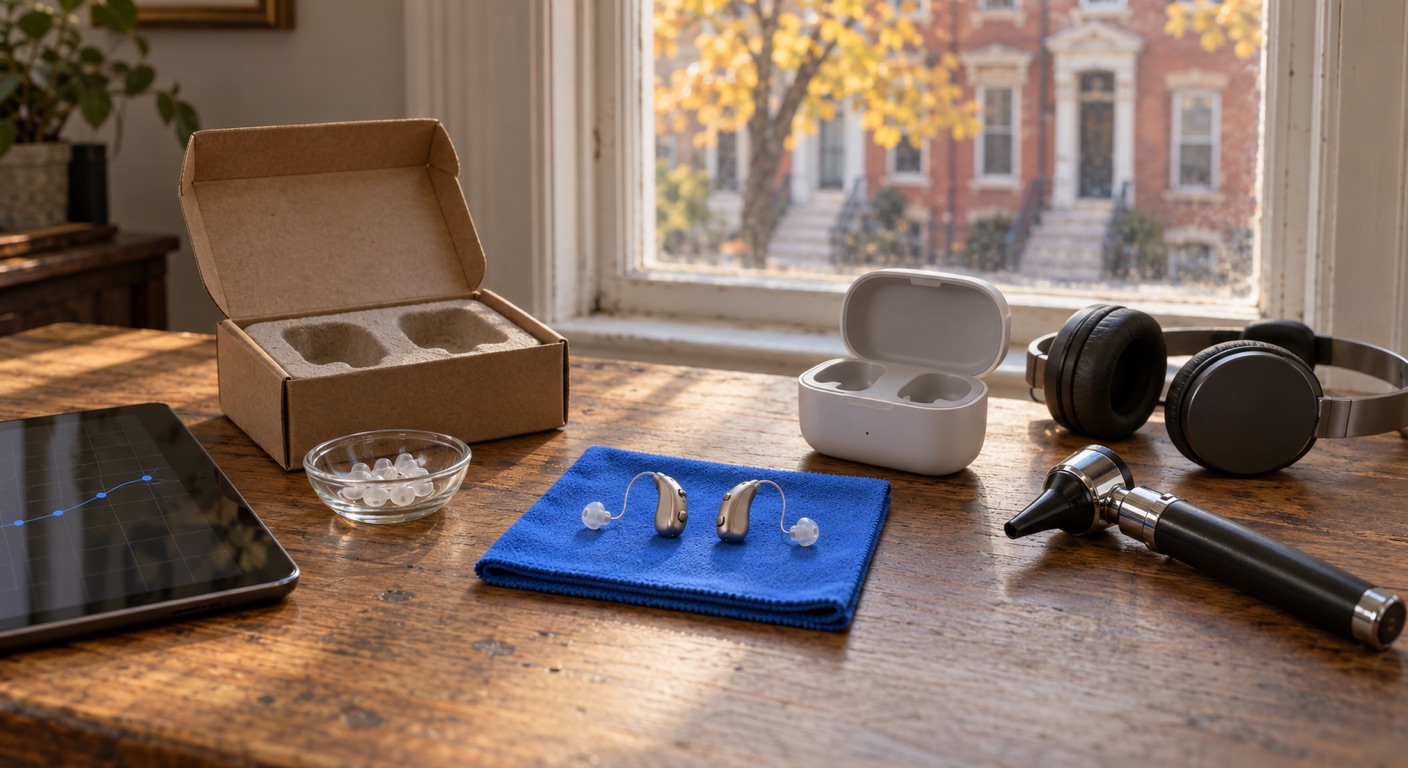
On a Tuesday in October, a couple from Hamilton in their early sixties spend the afternoon at a two-audiologist practice in Towson. One of them has a moderate loss in both ears and a health plan through work. The audiologist fits a pair of prescription hearing aids for $4,800, the plan pays its share and the rest goes on a card. The other has a milder loss, does not want an appointment, and that evening orders a pair of over-the-counter hearing aids from the practice’s web store for $1,199, paying with a health savings account card, and adds a second pair for a 16-year-old grandchild who has been struggling to hear in class. A box of domes and a pack of size 312 batteries go in the same cart. The parcel arrives on Friday. Five weeks later, the OTC pair comes back in the mail with a note: it was fine, but not enough.
Every step of that ordinary week touches a rule the practice’s software almost certainly does not hold. The second OTC pair should never have been sold: since October 2022, federal law has prohibited selling an OTC hearing aid “to or for” anyone under 18. The prescription pair could be sold only after the practice checked for a physician’s ear examination in the past six months or collected a signed waiver, and its contract needed a bold statement above the signature that the buyer may cancel for any reason within 30 days of delivery, with the practice keeping at most 10%. On our reading of Maryland law, the OTC pair came with the same 30 days, counted from Friday, not Tuesday, so taking it back after five weeks is the practice’s choice, but only if the paperwork that started the clock was right; if it was not, the buyer may cancel “in any manner and by any means.” Having been worn, the returned pair is now a used hearing aid. The hearing aids and the batteries carry no Maryland sales tax; the domes do. Whether the health account card worked depended on the merchant category code the web store’s processor had assigned it, and the advertising pixel on the product page told an ad platform that a Maryland resident was shopping for hearing aids, which the state’s privacy law treats as health data. And the employer plan had to pay its share, up to $1,400 per ear, only because it is a plan Maryland regulates, which a large employer’s self-funded plan is not, and because a licensed audiologist dispensed the pair.
This article goes through those rules for Baltimore’s audiology practices, hearing aid dispensers and stores: the federal split between OTC and prescription hearing aids and what it means for a web store, Maryland’s 30-day cancellation law, its licensing, tax and insurance rules, what the software costs and who pays for hearing aids, what 51 hearing care locations in Baltimore and 5,263 listings on 92 web stores show a customer or a machine, how to sell hearing aids online when the same shelf holds devices with different rules, and what we would build. We are a software studio, not lawyers; where a rule is our reading of the text rather than an agency’s or a court’s statement, we say so.
The trade in Baltimore: hearing research in the City, hearing aid stores in the County
The official count of hearing loss in Baltimore is a floor. In the Census Bureau’s American Community Survey for 2020 to 2024, 15,297 Baltimore City residents, 2.7%, said they had serious difficulty hearing, and so did 24,208 people in Baltimore County, 2.9%. The share rises steeply with age: 10.3% of City residents aged 65 and over and 16.5% of those 75 and over, slightly below the national rates of 13.4% and 21.0%. Those are self-reported answers to a single survey question, and they undercount the much larger group with a measurable loss who would not describe it as serious; researchers at Johns Hopkins’ Cochlear Center for Hearing and Public Health estimate that hearing loss “affects 1/4 of adults in their 60s and nearly 2/3 of Americans over 70.”
That center is part of why the OTC category exists. Frank Lin, its inaugural director, chaired the 2014 National Academies workshop on hearing health care, advised the President’s Council of Advisors on Science and Technology in 2015, served on the 2016 National Academies study that recommended an over-the-counter category, and testified for the 2017 bill that created it. His group’s ACHIEVE trial, published in The Lancet in 2023, followed 977 adults aged 70 to 84 for three years; hearing aids and counseling did not slow cognitive decline in the group as a whole, but in a prespecified subgroup of participants at higher risk, Hopkins reports that decline was 48% slower. Baltimore also trains the trade: Towson University runs one of the state’s doctor of audiology programs, and its Hearing and Balance Center at the Institute for Well-Being dispenses hearing aids to the public.
Counting the businesses is harder, because the industry codes are shared. County Business Patterns puts hearing aid stores in NAICS 446199, “all other health and personal care stores,” together with medical supply, prosthetic and mobility scooter stores: in 2023 that code had 14 establishments with paid employees in Baltimore City and 33 in Baltimore County. Audiologists’ offices are counted with physical, occupational and speech therapy practices in NAICS 621340, which had 89 establishments in the City and 175 in the County; we used that code for our physical therapy post, which tells you how little it says about hearing. The federal registry of health care providers is more specific. In the NPPES database, which we queried on October 6, 77 individual providers with an audiology or hearing instrument specialist taxonomy list a practice location in Baltimore City and 117 in Baltimore County, against 677 in Maryland as a whole; the Maryland licensing board counts 558 active audiologists and 148 hearing aid dispensers statewide. An NPI is not a business, and a seller of OTC hearing aids needs neither an NPI nor a license, so all these numbers describe the prescription side of the trade.
| Area | Residents with hearing difficulty | Share aged 75+ | Audiologists and hearing instrument specialists (NPI, individuals) | Stores in NAICS 446199, incl. hearing aid stores |
|---|---|---|---|---|
| Baltimore City | 15,297 (2.7%) | 16.5% | 77 | 14 |
| Baltimore County | 24,208 (2.9%) | 17.0% | 117 | 33 |
| Maryland | 171,320 (2.8%) | 17.3% | 677 | 158 |
| United States | 11,925,313 (3.6%) | 21.0% | – | 10,170 |
Nationally, the market is larger and more concentrated than the storefronts suggest. In MarkeTrak 25, the industry’s long-running consumer survey, fielded in late 2024 and published in Seminars in Hearing, 39% of adults with hearing difficulty owned prescription hearing aids, up from 30% in 2015. OTC hearing aids added only about four percentage points to adoption, half as much as earbuds with hearing features, and most people who owned an OTC device had still received some professional service. Buyers reported paying an average of $1,700 per prescription hearing aid, with a median of $1,560, and an average of $510 for an OTC device, with a median of $150; 80% paid a single price for the device and the services combined. Five manufacturers make most of the world’s hearing aids, and all five own or supply American retail networks: Sonova owns AudioNova, Demant owns HearingLife, WS Audiology owns HearUSA, GN owns Beltone, which counts about 1,500 Beltone-branded stores in the United States, and Starkey runs Audibel. Amplifon, which makes no hearing aids, franchises Miracle-Ear, and in March 2026 it agreed to buy GN Hearing, the maker of ReSound and Beltone devices and Jabra’s OTC hearing aids, for about €2.3 billion, with closing expected by the end of 2026. Costco’s website lists prescription hearing aids from four brands at $1,599.99 to $1,699.99 a pair, and Apple sells AirPods Pro 3, a hearing aid after a software setup, for $249.
Our own count of where hearing aids are dispensed in Baltimore, 51 locations run by 31 businesses, is in the census section below. The short version: the City’s hearing care is mostly hospitals and academic clinics, and almost every store, chain and warehouse club is in the County.
What audiology software costs, and what the meter counts
A hearing practice runs on four layers of software. At the bottom is NOAH, from HIMSA, the Hearing Instrument Manufacturers’ Software Association, which describes itself as “a privately owned company” that “operates much like a consortium” of the industry’s suppliers; every manufacturer’s fitting software opens inside it, on “an estimated 130,000 PCs.” Above it sits a practice management system, called an OMS in this trade, holding patients, appointments, devices by serial number, warranties, insurance and invoices. Around it are reminders, texting, reviews and booking. And at the edge there is, increasingly, a web store, plus the card processor that every layer ends up sending money through. Here is what each costs at published prices, which in this trade is a short list.
The practice system: one vendor publishes a price list
“The audiology PMS category doesn’t publish public pricing. We do.” That line is on amplifyOMS’s pricing page, and on the evidence of October 6, 2026, it is true. amplifyOMS charges $97 a month for a small starter tier, $149 for Growth, $249 for Professional and $495 for Premium, or ten months’ price for a year; the tiers that connect to NOAH include two providers per clinic and $25 a month for each additional one. Its page adds three phrases that read like a description of everyone else: “No revenue share. No transaction skim. No per-fitting fee,” and “No manufacturer equity.”
CounselEar publishes one number, $249.99 per location per month with unlimited users, plus add-ons from $19.99 for two-way texting to $79.99 for online reviews; comparison sites still quote an older $199.95. The rest of the category quotes privately. Sycle shows a page titled “Features & Pricing” with no prices on it; its privacy policy says that “Sycle is a wholly-owned subsidiary of Cochlear Limited,” the Australian maker of cochlear implants. Blueprint OMS has no pricing page at all, but its partner page has a category headed “Manufacturer Programs with Blueprint OMS Subscription Coverage,” listing Interacoustics, Oticon, Phonak, ReSound and Signia, which suggests that some practices’ software bills are paid, in whole or part, by the companies whose hearing aids they fit; the terms are not public. Auditdata’s page is headed “Transparent, Tailored Pricing” and then says “There is no one-size-fits-all list price.” Suno, HearForm and others ask for a demo.
None of that is sinister, and some of it is generous: a manufacturer paying for a practice’s software is a discount. But it is a discount with a direction, and a practice that wants to know which brand it actually fits best, or whether its web store pays, should be able to get those answers from data it owns.
The contract that comes with a card processor
CounselEar’s master services agreement, last updated on June 9, 2026, names the seller as “Fullsteam Software Holdings LLC DBA CounselEAR, a subsidiary of Fullsteam Operations LLC.” Section 6.6 is about payments: “Unless otherwise stated in an applicable Order Form, Client must be enrolled in and processing payments through Company’s integrated payments processing platform within sixty (60) days of the Effective Date of this Agreement.” A practice that does not may find that the company will “delay or restrict certain Services product features, increase Fees and/or charge a non-integrated payment processing fee.” The processing rates are not published. The agreement runs for twelve months and renews automatically unless the practice gives 90 days’ notice. Integrated payments can be convenient and the rates may be competitive, but on this contract the price of the software is $249.99 a month plus a processing rate that is not on the pricing page, and the processing is the larger number.
NOAH, the database underneath
NOAH is the one layer no practice that fits prescription hearing aids can skip, because the fitting programs run inside it and the audiograms live in it. The desktop version, Noah 4, is licensed “per site, not per computer or per user,” at a price “set by each distributor.” The cloud version, Noah ES, costs $15 per named user a month on an annual plan, and “Each individual who works with patient data must have and use their own user.” Noahlink Wireless 2, the small interface that programs most modern hearing aids, is on HIMSA’s distributor price list at $67.50; what a practice pays is again up to the distributor.
The biggest meter is the card terminal
Put the published prices together for a realistic practice and one line dwarfs the rest. Take two audiologists and a front desk in one Baltimore location, fitting 600 hearing aids a year, 300 pairs, at an average of $2,400 per aid, paid privately and by card, plus $40,000 a year of batteries, domes and accessories sold online in $40 orders. That is $1.44 million of device revenue in a year, which a busy two-audiologist practice could plausibly see; put your own numbers in its place. The arithmetic below uses only prices that the vendors publish.
| Layer | Product | What the meter counts | Per year |
|---|---|---|---|
| Practice system | amplifyOMS Professional | A tier per clinic, two providers included | $2,490 |
| Practice system | CounselEar | Per location; its own card processing required within 60 days | $3,000 |
| Practice system | Sycle, Blueprint OMS, Auditdata, Suno | Quote only | Not published |
| Hearing data | Noah ES, two users | Named users | $360 |
| Patient messages | Weave | Plans from $199 a month | $2,388 or more |
| Online booking | Calendly Standard, two seats | Seats | $240 |
| Web store for supplies | Square Online, free plan | 3.3% + 30¢ per online order | $1,620 |
| Web store for supplies | WooCommerce with WooPayments | Hosting from $25 a month, plus 2.9% + 30¢ per order | $1,760 |
| Cards on $1.44 million of hearing aids | Clover Standard | 2.3% + 10¢ per payment and $84.95 a month, plus $1,899 of hardware | $34,169 |
| Cards on $1.44 million of hearing aids | Square, free plan | 2.6% + 15¢ per in-person payment | $37,485 |
| Cards on $1.44 million of hearing aids | Stripe Terminal | 2.7% + 5¢ per in-person payment | $38,895 |
The cheapest combination built only from published prices, amplifyOMS, Noah ES, Calendly, WooCommerce and Clover, costs about $39,000 a year, and almost nine dollars in ten of it are card fees. The software subscriptions come to between $3,000 and $6,000; the processing on the hearing aids alone comes to six to twelve times that, about $62 for every hearing aid sold. That is why a payment clause in a software contract matters more than the software price, and why the most valuable thing a system can do for this practice’s margins has little to do with appointments: move the large private payments to cheaper rails where the patient agrees, such as a bank transfer, and keep the card terminal for everything else.
The plan card moves the money somewhere else
Many hearing aids in Baltimore never pass through a practice’s card terminal at all, because a health plan, and behind it a benefit administrator, sets the price and handles the device. Original Medicare does not pay for hearing aids; the statute excludes “hearing aids or examinations therefor,” and three bills to change that, including the Medicare and Medicaid Dental, Vision, and Hearing Benefit Act introduced by Maryland’s Senator Angela Alsobrooks in June 2025, have sat in committee since they were filed. Medicare Advantage plans fill the gap: 95% of people in individual Advantage plans have a plan that offers hearing exams or aids, according to KFF. In Baltimore City, 36.8% of people eligible for Medicare were enrolled in an Advantage plan in September 2026, against 24.8% for Maryland as a whole, according to CMS’s county penetration file.
We read CMS’s plan benefit files for every Advantage plan sold in Baltimore City and Baltimore County. In 2026, 22 of 25 individual plans and 19 of 20 special needs plans cover hearing aids, and most of them set a fixed copay per aid by technology tier: from $399 to $1,800 per aid at Cigna, $400 to $1,875 at CareFirst, $699 to $999 at Humana and at Johns Hopkins Advantage MD, and $199 to $1,249 in UnitedHealthcare’s plan for Erickson communities; Kaiser gives a $1,000 allowance per ear every three years. The Hopkins plan’s evidence of coverage spells out how the benefit works: “$699 copay per aid for Advanced hearing aids, $999 copay per aid for Premium,” “Limited to 2 hearing aid(s) every year,” a 60-day trial, a three-year warranty and 80 batteries per aid, and “Benefit is limited to TruHearing’s Advanced and Premium hearing aids”; a member “must see a TruHearing provider to use this benefit,” and hearing aids “that are not TruHearing-branded” are not covered. The 2027 files, published on October 1, show the market moving: Aetna and UnitedHealthcare will sell no individual Advantage plans anywhere in Maryland, Humana’s copays fall to $575 and $750 per aid, and the hearing aid cap in Hopkins’ plan for people eligible for both Medicare and Medicaid falls from $1,500 to $800.
The administrators behind those benefits are not neutral clearinghouses. WS Audiology, the maker of Signia, Widex and Rexton hearing aids and the owner of the HearUSA chain, lists TruHearing, Inc. among its wholly owned subsidiaries in its 2024/25 annual report, alongside hear.com, the online hearing aid seller that refers its customers to local practices. Amplifon, which franchises Miracle-Ear, owns Amplifon Hearing Health Care, whose network is Miracle-Ear clinics plus about 5,580 independent retailers; its provider FAQ explains that under its discount plans “Testing fees are collected and retained by your office while hearing aid fees are paid directly to Amplifon,” and that “Provider reimbursements are paid out at 60 days of delivery.” NationsHearing belongs to NationsBenefits, which also runs the hearing pages of Sam’s Club. None of the administrators publishes what it pays a practice per fitting, and Demant, the maker of Oticon, warns investors in its 2025 annual report that managed care may affect “the general level of fitting fees in hearing aid clinics.” The channel may also be shrinking: WS Audiology told investors in its August report that “The contract with a large US Managed Care customer will not be renewed after it expires on January 1, 2027.” For a practice’s software, the consequence is concrete. A benefit sale is a different kind of order: the device comes from the administrator, the patient pays a copay, the practice is paid a fee weeks later, and the trial period, warranty and battery allowance are the plan’s, not the practice’s. A system that treats it like a private sale gets the margin, the return window and the paperwork wrong.
Is it legal to sell hearing aids online? Since October 2022, the box decides who may
From 1977 until 2022, federal rules made every hearing aid sale in the United States wait on a medical evaluation or a signed waiver of one, and state licensing laws reserved the sale for licensed dispensers. Congress changed that in 2017 with section 709 of the FDA Reauthorization Act, and the Food and Drug Administration finished the job with a final rule that took effect on October 17, 2022. A hearing aid that meets the conditions of 21 CFR 800.30 is an over-the-counter hearing aid, and anyone may sell it, in a store, by mail or online. Every other hearing aid is, in the words of 21 CFR 801.422(a), “a prescription device.” Physically the two can be near twins, with the same receiver-in-canal shell, the same rechargeable cell and the same app. Legally they are two different products, and the difference is printed on the box.
Over the counter means 18 or older, perceived, and mild to moderate
The definition is one sentence, and every clause in it ends up in a web store. An OTC hearing aid is an air-conduction hearing aid that needs no surgery and “is intended for use by a person age 18 or older to compensate for perceived mild to moderate hearing impairment.” The user controls and customizes it “through tools, tests, or software,” and it is available “without the supervision, prescription, or other order, involvement, or intervention of a licensed person, to consumers through in-person transactions, by mail, or online.” The word that does the most work is perceived: the preamble says that “objective measurements of hearing impairment are not necessary.” The buyer decides that the loss is mild to moderate, and the seller does not have to check.
The age is different, because the rule makes it a condition of sale. Paragraph (g)(1) reads, in full: “Sale to or for a person younger than 18 years of age is prohibited.” It binds whoever sells the device, and it covers a purchase made for a minor as well as by one, so a grandparent buying a pair online for a 16-year-old is a sale the rule forbids. The FDA left the method to the seller. “We are not requiring age verification,” the preamble says; a seller’s practices “may, but are not required to, entail age verification by checking a government-issued photographic identification.” Hearing aids for children are not banned; they “would be considered prescription hearing aids.” For a web store the practical answer, and it is our reading rather than the agency’s, is a required age statement at checkout for every OTC hearing aid, stored with the order.
The box carries the warnings, and the web carries the box
Paragraph (c) tells manufacturers what the outside of the package must say: a warning against use under 18; the symptoms of a mild to moderate loss; the reminder that “Some people with hearing loss may need help from a hearing healthcare professional”; a “When to See a Doctor” list of nine red flags, among them a deformed ear, fluid or pus in the past six months, pain, dizziness, a sudden change in hearing, and ringing or loss in one ear only; the type and number of batteries; whether a phone is needed; and a “notice of manufacturer’s return policy,” meaning a short statement of the policy or of the absence of one. The front panel must carry the marks “OTC” and “hearing aid,” and under (g)(2) a device without them may not be sold.
Two parts of the rule reach past the shelf. The user brochure must also exist as “an electronic version available for download without site or customer registration and without requiring purchase of any product or service,” and the FDA wrote that the labeling “will have to be available to prospective users prior to purchase.” The duty to publish sits with the manufacturer or distributor, but the agency explained the OTC mark in terms any store developer will recognize: “a person shopping online may filter a list of the devices offered by the seller with ‘OTC’ and view only pictures of the device itself.” A product page that shows the photographs and the price, but not the red flags, the maker’s return policy and a link to the brochure, gives the shopper less than the box on a drugstore shelf does.
A pair worn at home and sent back is a used hearing aid
The rule defines a hearing aid as “used” if a user “has worn it for any period of time,” except during a “bona fide hearing aid evaluation” in the presence of the dispenser. A pair a customer wore for a week at home and mailed back is used. It may be sold again only as used or rebuilt, declared on the package, after it has been “adequately reprocessed for the next user”; a rebuilt OTC hearing aid is one the manufacturer itself has inspected, tested and reprocessed. Stores that state a return window for OTC hearing aids give anywhere from 30 to 100 days, as our census below found, and the FDA declined to make any return period mandatory. A store that takes a pair back can send it to the maker, sell it as used with the declaration, or write it off; putting it back on the shelf as new is the one choice the rule closes. Marketplaces draw the same line: eBay’s medical devices policy, which we read on October 6, bans “Hearing aids that require a prescription” outright and allows over-the-counter devices if the listing says whether the device has been opened or used.
Everything else is a prescription hearing aid
A prescription hearing aid is defined by exclusion: any hearing aid that does not meet section 800.30, including any hearing aid for someone under 18 and any device louder than the OTC limits of 111 decibels, or 117 with input-controlled compression. Under 21 CFR 801.109 it is “to be sold only to or on the prescription or other order of” a licensed practitioner and carries an “Rx only” statement. The 2022 rule removed the federal medical evaluation and waiver, though the FDA said state rules substantially identical to them “may continue in effect as applied to prescription hearing aids.” What a prescription hearing aid needs is “a written or oral authorization from a practitioner licensed by law,” and “States, not FDA, generally determine the licensing requirements for practitioners.” There is no federal rule on selling prescription hearing aids online; the agency says it “does not generally establish standards for medical practice, including telemedicine.” In Maryland that hands the question to the state licensing board, which we come to below.
The sound amplifier on the next shelf may not mention hearing loss
Next to both kinds of hearing aid sit personal sound amplification products, which the FDA does not treat as medical devices as long as they are not sold as hearing aids. The statute describes them as products “for nonhearing impaired consumers in situations including hunting and bird-watching,” and the FDA’s guidance of August 2022 lists what turns one into a hearing aid, including describing it as “for users with certain types or severity of hearing loss/impaired hearing” or “marketing it as a less expensive alternative to hearing aids.” Anyone who has searched for hearing aids on a large marketplace knows how often that line is crossed. A study of 138 Amazon listings that called themselves OTC hearing aids, published in Otology & Neurotology in February 2026, could verify only 37 of them, 26.8%, as FDA-cleared or registered.
Enforcement has been quiet. In the full text of the FDA’s public index of 3,723 warning letters issued since January 2021, the phrases “hearing aid,” “PSAP” and “sound amplification” do not appear. The FDA’s consumer page warns that “FDA Registered” or “FDA Certified” claims “may be misleading,” and the preamble calls implied approval “misleading” and misbranding. That matters because most OTC hearing aids never pass through an FDA review at all. In the FDA’s registration database, which we queried through openFDA on October 6, the two OTC product codes exempt from premarket notification account for 174 device listings, against 44 for the self-fitting code that needs a 510(k) clearance, under which the FDA has issued only ten clearances since October 2022. For most products, “registered” means a firm told the FDA it makes them. Of the 141 establishments listed under any OTC hearing aid code, 80 are in China, 31 are in the United States, and none is in Maryland.
Washington took the license off the OTC shelf, not off the audiologist
The rule preempts any state or local requirement “specifically related to hearing products that would restrict or interfere with” the sale of OTC hearing aids “through in-person transactions, by mail, or online,” including any requirement for a licensed person’s involvement, and selling them cannot oblige anyone to obtain “specialized licensing, certification, or any other State or local sanction.” A grocery store, an electronics shop or a pure web store needs no hearing license to sell them. Two sentences cut the other way. The first: “a person representing as any other defined professional or establishment, or as a State licensed dispenser, is subject to applicable State and local requirements even if the person undertakes commercial or professional activities only in relation to OTC hearing aids.” An audiologist selling OTC hearing aids from the practice’s web store sells them as an audiologist. The second is the statute’s savings clause, which leaves untouched claims under state “product liability, tort, warranty, contract, or consumer protection law,” and the FDA added in the preamble that a state requirement for “a reasonable warranty or return period for hearing aids (e.g., 60-day period) would likely promote, rather than restrict or interfere with, commercial activity.” That sentence matters a great deal in Maryland.
An earbud, a pair of glasses and a phone became hearing aids
On September 12, 2024, the FDA granted Apple a De Novo authorization, DEN230081, for what its press release called “the first over-the-counter (OTC) hearing aid software device,” creating a new regulation, 21 CFR 874.3335, and a product code, SCR. Apple’s support page says that “AirPods Pro 2 and AirPods Pro 3 provide a clinical-grade Hearing Aid feature.” Four more products have been cleared under the code since: Luxottica’s Nuance Audio glasses in January 2025, the Tuned self-fitting app in September 2025, a “Hearing assist” feature from Meta on July 13, 2026, and Samsung’s Hearing Aid Feature on July 31, 2026. For many people the first hearing aid will be a pair of earbuds bought for music, and some of them will come into a practice when the earbuds are not enough, with a hearing test already on their phone. A practice’s software that can take that result in and record which device the patient already owns is answering a question the patient is already asking.
The batteries have their own rules, and an exemption
Most non-rechargeable hearing aids run on zinc-air button cells, which fall between two parts of the federal battery law named for Reese Hamsmith, an 18-month-old who died in December 2020 after swallowing a coin cell that fell out of a remote control. The Consumer Product Safety Commission’s performance and labeling rule, 16 CFR 1263, excludes them: “Button cell or coin batteries that the Commission has determined do not present an ingestion hazard are not subject to this part. These are: zinc-air button cell or coin batteries.” The packaging requirement of Reese’s Law has no such exemption, and the CPSC’s answers for business say zinc-air cells “are still subject to the special packaging requirements,” enforced for batteries made or imported after March 8, 2024. Hearing aids themselves are outside both, as medical devices, and none of it reaches the web page: the Commission dropped its proposed website notices. A store selling hearing aid batteries online owes the buyer child-resistant packaging, not a warning on the listing; whether to add one anyway is a judgment, and we would.
Maryland hearing aid law: 30 days for every buyer, a mandate for most plans, and no tax on the device
Maryland regulates hearing aids in four places, and a practice’s software has to hold all four: a consumer protection law that predates the OTC category, a licensing law amended for it, an insurance mandate that began on January 1, 2025, and a sales tax exemption that asks for no prescription.
Thirty days from delivery, for any reason, with at most a tenth kept
Maryland’s Hearing Aid Sales Act, sections 14-2501 to 14-2506 of the Commercial Law Article, is short and blunt. “Within 30 days of the date of delivery, a purchaser of a hearing aid may cancel the purchase for any reason.” The buyer gets back “the entire consideration paid, less 10 percent for services and payments made for diagnostic tests”; a seller whose documented costs of fitting, delivery and return to the manufacturer are higher may keep up to 20% of the price, but only if that amount is “conspicuously identified as ‘nonrefundable’ on the contract or bill of sale.” Diagnostic tests must be billed separately and are not refunded. “The right of cancellation may not be waived or otherwise surrendered.”
The paperwork is prescribed to the word. The contract or bill of sale must carry, in bold type of at least 10 points, on the same page as the buyer’s signature and above it: “You may cancel this purchase for any reason, at any time within 30 days after the date of delivery of the hearing aid. To cover the costs of dispensing the hearing aid, the seller may withhold from the refund 10 percent of the purchase price or the seller’s actual costs up to 20 percent of the purchase price.” At delivery the seller must hand over a Notice of Cancellation that states the total refundable amount, filled in with the seller’s name and address, the date of delivery and the last date to cancel. For a purchase made somewhere other than the seller’s place of business, the refund is due within 30 days after the notice of cancellation arrives; a late refund earns the buyer an extra 1% for each month or part of a month. A seller who breaks any of these rules is committing an unfair or deceptive trade practice, and under section 14-2505 the buyer may then cancel “in any manner and by any means,” with no deadline written into that subsection.
Two words in the statute decide how far it reaches. The first is delivery. The 30 days start when the hearing aid reaches the buyer, not when the order is placed, so a web store that ships hearing aids needs the carrier’s delivery date to print a correct notice, and a practice that orders a pair, fits it two weeks later and takes payment on the day of the order needs its software to know which date the law counts. The second is the definition in section 14-2501: for this subtitle, a hearing aid is “Any instrument or device that is designed for or represented as being capable of improving or correcting impaired human hearing,” or “Any part or accessory of the instrument or device.” The definition says nothing about prescriptions or the FDA, and it reaches parts and accessories.
That raises the question this article exists to ask: does Maryland’s 30-day right cover an OTC hearing aid sold online? Maryland conformed to the federal OTC rule in 2023, with Chapters 60 and 61, but that law amended only the Health Occupations Article. The Hearing Aid Sales Act was not touched, and it has no OTC exception. The federal rule preempts state requirements that would “restrict or interfere with” OTC sales, but the FDA wrote in its preamble that “reasonable return or warranty requirements for OTC hearing aids would likely promote, rather than restrict or interfere with, commercial activity involving OTC hearing aids by reducing the financial risk to purchasers,” and section 709(b)(5) of the statute preserves claims under state consumer protection law. Our reading, which is not a court’s, is that a pair of OTC hearing aids shipped to a Maryland buyer carries the same 30 days, the same 10% ceiling and the same notice as a pair fitted in a Towson office. The cautious way to build a store is to assume it does, and to let a lawyer tell you otherwise. A box of replacement domes is the harder case: the definition’s “any part or accessory” seems to reach it, and a store that gives every hearing product a 30-day window loses little by not arguing the point.
Who may sell which box in Maryland
The licensing law is Title 2 of the Health Occupations Article, administered by the State Board of Examiners for Audiologists, Hearing Aid Dispensers, Speech-Language Pathologists, and Music Therapists, on Patterson Avenue in northwest Baltimore. Dispensing, which the statute defines to include “the ordering, selling, renting, leasing, or delivering of a hearing instrument, including a prescription hearing aid,” requires a license: an audiologist’s, or a hearing aid dispenser’s, which takes a two-year degree, a course, six months of supervised training and an exam. Physicians may also fit hearing aids. As of July 14, 2026, the Board’s minutes counted 558 active audiologists in Maryland, 130 hearing aid dispensers and 18 dispensers with limited licenses; it publishes no breakdown by county.
Since July 1, 2023, the title does not “Apply to the servicing, marketing, sale, dispensing, use, customer support, or distribution of over–the–counter hearing aids through in–person transactions, by mail, or online as authorized by federal law and regulations.” The Board’s page on hearing aid sales goes a step further: “The Board does not regulate internet sales of hearing aids or sales of over-the-counter hearing devices.” It adds a warning for licensees who fit hearing aids sold by out-of-state online sellers: that “alone is not grounds for discipline,” but “A Maryland licensee may be liable for any refund that might be due to the consumer in the course of a transaction.”
For prescription hearing aids sold by a licensee, the old paperwork survives in state law even though the FDA dropped its own version in 2022. Before selling a hearing aid, an audiologist or dispenser must check whether the buyer has had an ear examination by a physician in the past six months and, if not, give a written recommendation to get one; the sale may go ahead only for a replacement or for a buyer of 18 or older who signs a written waiver, and the licensee must keep a copy (section 2-314.1). The FDA said in 2022 that state rules “substantially identical” to its repealed condition “may continue in effect as applied to prescription hearing aids.” Every sale needs a receipt with the licensee’s license number, the make, model and serial number, whether the device is used or reconditioned, the price and “The total refundable amount of the hearing aid if it is returned within 30 days” (section 2-314.8). Since August 5, 2024, the Board’s regulations have added a notice the buyer must sign before buying a device that only certain locations can program or service: “The hearing aid being purchased uses proprietary or locked programming software and can only be serviced or programmed at specific facilities or locations” (COMAR 10.41.08.14A). Door-to-door selling is banned unless the customer asked for the visit, licensees may not diagnose hearing disorders “by correspondence,” and audiologists must keep patient records for seven years.
The practical result is two checkouts in one store. An OTC pair can be bought by anyone of 18 or older, with no exam, waiver or license involved. A prescription pair sold to a Maryland buyer, online or not, is dispensing: a Maryland-licensed audiologist or dispenser, the exam or the waiver, the receipt and, where it applies, the locked-software notice. Both come with the 30-day cancellation.
The hearing aid is tax-free in Maryland, and the dome is not
Maryland’s 6% sales tax exempts “an artificial eye, hearing device, or limb,” “a battery for an artificial hearing device,” and, since a 2020 amendment, a custom-made earmold, a battery charger and “a receiver for an artificial hearing device” (Tax-General §11-211(b)). The hearing device exemption, unlike the one for other appliances in the same section, does not require a prescription, so on our reading an OTC hearing aid is exempt like a fitted one. Other accessories are taxable at 6%: a 2023 bill, House Bill 925, would have exempted TV streamers, remote microphones, phone clips, domes, wax filters and tubing, and it died. A sound amplifier sold as something other than a hearing aid is probably taxable too. Repair labor is not taxed, while parts listed separately on a repair invoice are, unless the part is itself exempt. The Comptroller’s own guidance on medicine and medical equipment, which we read on October 6, still lists “A replacement cord for an artificial hearing device,” an exemption the same 2020 law repealed, and leaves out earmolds, chargers and receivers, so a point-of-sale system configured from it would be wrong in both directions.
Who pays in Maryland: private plans since 2025, Medicaid since 2018
The searches for “Maryland hearing aid law 2025” and “2026” are about one statute. Insurance Article §15-838.1, enacted as Chapters 951 and 952 of 2024, requires insurers, nonprofit health service plans and HMOs to cover “all medically appropriate and necessary hearing aids for an adult” for policies issued or renewed in Maryland from January 1, 2025, up to $1,400 per hearing aid for each impaired ear every 36 months; a buyer may choose a more expensive aid and pay the difference. As first enacted, the hearing aid had to be prescribed, fitted and dispensed by a licensed audiologist. Chapters 742 and 743 of 2025 added hearing aids “ordered, fitted, and dispensed by a licensed hearing aid dispenser” from January 1, 2026. Children were already covered under §15-838, with the same cap. The mandate reaches plans regulated by Maryland, not self-funded employer plans governed by federal law, and not Medicare, and because it requires a licensed dispenser, an OTC pair bought online does not qualify, on our reading.
Maryland Medicaid has covered hearing aids for adults since July 1, 2018. Under COMAR 10.09.51, an aid must be fitted by an audiologist with written medical clearance, “Sold on a 30-day trial basis” and carry a two-year manufacturer warranty, and every aid needs prior authorization; an adult qualifies with an average loss of at least 40 decibels in the better ear, gets one aid by default and two only on further criteria, and may replace them every five years. The regulation still cites the two FDA sections that were repealed in October 2022. Its 2026 fee schedule is the most precise public price list for hearing care in the state, and we reproduce part of it below. The State Department of Education’s hearing aid loan bank, the subject of another common search, lends aids only to residents under 21 who are still in school, 25 aids to 15 children in 2025, and the Department of Disabilities offers low-interest loans for assistive technology, hearing aids included.
| Code | Item | Maximum fee |
|---|---|---|
| V5257 | Digital hearing aid, one ear, behind the ear | $1,400.00 |
| V5261 | Digital hearing aids, both ears, behind the ear | $2,800.00 |
| V5241 | Dispensing fee, one ear | $106.00 |
| V5160 | Dispensing fee, both ears | $175.00 |
| 92628 | Hearing aid evaluation | $78.00 |
| 92634 | Hearing aid fitting | $42.00 |
| V5264 | Earmold | $27.00 |
| V5266 | Battery, each | $0.58 |
| V5014 | Repair | $250.00 |
What 51 Baltimore hearing care locations show a customer, or a machine
On October 6 we built a list of every place in Baltimore City and Baltimore County where a business fits or dispenses hearing aids today, from the federal provider registry, the chains’ own store locators, hospital and university directories and OpenStreetMap, and placed each address in the City or the County with the Census Bureau’s geocoder rather than by ZIP code, because ZIP codes such as 21224 and 21229 straddle the line. We counted 51 locations run by 31 businesses: 12 in the City and 39 in the County. Then we read every business’s website, as a patient would and as a crawler would. We ran these checks from outside the United States, and a few health system sites refuse such visitors, so a page we could not open is not necessarily broken.
| Kind of business | Locations | Businesses | In the City |
|---|---|---|---|
| Independent audiology and hearing aid practices | 18 | 9 | 1 |
| Hospitals, academic and university clinics | 11 | 8 | 6 |
| Ear, nose and throat practices with audiology | 9 | 5 | 3 |
| Warehouse clubs (Costco, Sam’s Club) | 4 | 2 | 0 |
| Owned by or franchised from a hearing aid maker (HearingLife, AudioNova, Beltone) | 4 | 3 | 0 |
| Retail franchise (Miracle-Ear) | 2 | 1 | 0 |
| Nonprofit (Gateway Maryland, formerly the Hearing and Speech Agency) | 1 | 1 | 1 |
| Not open to the public (Baltimore VA, Kaiser Permanente) | 2 | 2 | 1 |
The two jurisdictions run two different trades. In the City, hearing care is mostly institutional: Johns Hopkins at its main campus and Bayview, the University of Maryland on Eutaw Street, Kennedy Krieger for children, Loyola’s clinical centers, ear, nose and throat practices at Mercy, on Calvert Street and at the Rotunda, and Gateway Maryland, the nonprofit that until recently was the Hearing and Speech Agency. The City has exactly one independent hearing aid storefront, Audiology Associates on Wilkens Avenue, and no chain store or warehouse club at all. The County has the rest: independent practices along York Road, Belair Road and Frederick Road, both Costcos and both Sam’s Clubs, two Miracle-Ear franchises, and the only four locations owned by or franchised from a hearing aid manufacturer, Demant’s HearingLife in Owings Mills, Sonova’s AudioNova in Nottingham and two GN Beltone offices, in Catonsville and Lutherville. WS Audiology’s HearUSA and Starkey’s Audibel have no storefront in either jurisdiction. The manufacturers’ reach into Baltimore runs less through storefronts than through the benefit administrators described above.
What a patient can do online is limited. Four of the 31 businesses have an online checkout: Beltone’s accessory shop, AudioNova’s Shopify store, which sells two OTC Sennheiser models at $999.95 and $799.95 alongside batteries and chargers, Sam’s Club, which sells an OTC Jabra pair for $999, and one independent, Live Better Hearing, whose shop sells accessories. Nobody sells a prescription hearing aid online, and only two businesses sell any hearing aid online at all. Six businesses publish a price for the hearing aids they fit, all of them chains or clubs, from Beltone’s “start around $1,000 per device” to Miracle-Ear’s $1,000 to $8,000; not one independent practice, ENT practice or hospital clinic publishes a price. Three businesses state a trial period in days, HearingLife 30 and two independents 45, and only one, Taylor Listening Center, tells patients that Maryland law requires 30 days. Three businesses, all chains, let a patient pick an open appointment slot online; ten offer a request form, and eight a phone number. Nine mention OTC hearing aids, and two sell them. One names a hearing benefit administrator, three mention FSA or HSA accounts, and four say they accept Maryland Medicaid plans.
What a machine sees is a mix of openness and neglect. No hearing business in our census blocks AI crawlers in its robots.txt file, although the Cloudflare walls in front of the Johns Hopkins and University of Maryland sites turned away our scripted visits. Four have an llms.txt file: HearingLife’s is written by hand, MedStar’s is a 2.4-megabyte automatic index, and the Shopify stores of Beltone and AudioNova carry Shopify’s generated “Agent Instructions,” which invite AI agents to shop through Shopify’s commerce endpoint. Eleven of 27 readable sites have structured data describing the business, and none marks up a single product or clinician. The chains’ templates show the cost of running hundreds of local pages from one system. HearingLife’s price page tells machines, in its structured data, that it is a review of a “Game” named HearingLife, rated 9.47 out of 10 by an author called “NPS.” Beltone’s Catonsville page asks, in visible text, “How much do hearing aids cost at in ?” with the city and the office left blank. Miracle-Ear’s Towson page still advertises an “End of Summer Sales Event” running “Now through August 31st,” and the HTML a crawler reads without running scripts carries placeholders such as {#shop_city} and {#avgReview} where the city and the review score should be. OpenStreetMap, which many map and AI tools draw on, knows 6 of the 51 locations, and only one of the 12 in the City, under a name that is out of date.
What 5,263 listings on 92 web stores say about OTC, age and returns
To see how the rest of the country sells hearing products online, on October 6 we read the public catalogs of 92 American-facing Shopify stores that sell them: 48 brands selling their own hearing aids or amplifiers, 14 multi-brand retailers, seven shops of practices, chains and manufacturers, five battery shops and a mix of accessory and medical supply stores. Of their 41,535 products, 5,263 were hearing products: 755 OTC hearing aid listings at 61 stores, 739 prescription hearing aid listings at 16, 121 sound amplifiers at 16, 236 battery listings at 21, and about 3,400 domes, chargers, streamers and other supplies. We classified them by rules applied to each listing’s title, description and options and checked a random sample by hand; the final pass made one error in 50. We report pooled figures rather than naming stores beside a compliance problem, and every figure is a floor, since a store may say more elsewhere on its site.
The OTC listings rarely say what the FDA rule makes the product. Only 215 of the 755, 28.5%, use the words “OTC” or “over-the-counter” anywhere in the title, description or options, and the share is 41.4% at stores based in the United States against 6.1% at the 19 foreign-based stores selling in dollars. Only 24 listings, 3.2%, at seven stores, state that the device is for people 18 or older, the one fact the rule turns into a condition of sale. A quarter, 178, say “mild to moderate”; 40 listings at 16 stores claim to suit severe or profound loss, which the FDA’s consumer page says OTC hearing aids are “NOT for.” Sixty-one mention the FDA at all, and the wording is telling: 31 say “FDA registered,” nine at three stores say “FDA approved,” and only four say “FDA cleared,” all of them for one model, Sennheiser’s All-Day Clear, which was. Fifty-eight OTC listings have no description at all. The median lowest price was $179.
Returns and money are almost absent from the listings themselves. Only 85 OTC listings, 11.3%, state a return or trial period in days: 45 days is the most common, at 13 stores, followed by 30, 60 and 100 days. Warranty terms appear in 92 listings, mostly one year, and health account eligibility, which almost every buyer of a hearing aid could use, in six. The sound amplifiers cross exactly the line the FDA’s guidance draws: 50 of the 121 amplifier listings, 41.3%, at eight stores, describe themselves in terms of hearing loss, 45 amplifier titles also use the words “hearing aid,” and only six say plainly that the product is not a hearing aid or not a medical device. None mentions the FDA, OTC status or an age.
Prescription hearing aids are sold online too, by 16 of the stores, at a median price of $1,399. In 604 of their 739 listings, 81.7%, nothing tells the buyer what is needed to be fitted: no prescription, audiogram or appointment. Eighteen ask for an audiogram or prescription, 63 mention a professional fitting and 100 describe remote programming after purchase, and on the 81 product pages we opened, no store made an upload a required step before payment; the most explicit says “Upload Your Audiogram Optional.” None mentions a medical waiver or a state license. Sold to a Maryland buyer, such a device is, on our reading of the Health Occupations Article, being dispensed, and the exam check, the waiver and the licensee’s receipt are the seller’s problem whether or not the page mentions them.
The batteries are the most carefully described products in the census and the least warned about. Of 236 battery listings, 97.5% give the size and 61.0% say zinc-air, but only 36.4% give the color that users actually shop by. Not one carries a swallowing or ingestion warning, in English or Spanish, which is lawful for zinc-air cells, and only 21 listings, at two stores, mention child-resistant packaging. The median price was $0.50 a cell, a little under the $0.58 that Maryland Medicaid pays. And every one of the 92 stores now publishes Shopify’s agents.md file and a Universal Commerce Protocol profile for AI shopping agents; not one of those files mentions an age, a prescription or the FDA, and the public catalog that agents read has no barcode field at all.
How to sell hearing aids online: what a hearing care web store is actually selling
A hearing care web store sells four kinds of thing under four sets of rules, and most stores we read treat them as one. OTC hearing aids may be sold by anyone to anyone of 18 or older, with the manufacturer’s labeling in front of the buyer and, on our reading of Maryland law, 30 days to change their mind. Prescription hearing aids may be sold only on a practitioner’s order, which in Maryland means through a licensed audiologist or dispenser. Sound amplifiers are ordinary electronics that may not be sold as help for hearing loss. Batteries, domes, wax guards and chargers are supplies, some tax-exempt and some not, most payable with health accounts, and all bought again and again. Selling hearing aids online well means building those differences into the catalog, the checkout and the order, not into a paragraph in the footer.
OTC in the cart, prescription on the calendar
The cleanest structure we know gives the two kinds of hearing aid two different paths. An OTC hearing aid goes into the cart like any product, but its page carries what the box carries: the words “OTC” and “hearing aid” in the title, the statement that it is for adults with perceived mild to moderate hearing loss, the “When to See a Doctor” red flags, the battery and the phone it needs, the manufacturer’s own return policy, and a link to the manufacturer’s brochure, which by rule must be downloadable without registration. The checkout asks the buyer to confirm that the hearing aid is for someone 18 or older and stores the answer with the order. A practice that sells OTC devices can add something no drugstore can: a short questionnaire built on the red flags, whose “yes” answers suggest booking a visit instead of buying, and a booking link right there. That is good care, and it is also good business, since some of those buyers need a prescription pair.
A prescription hearing aid, by contrast, should not have an add-to-cart button. What the web can sell is the path to it: a hearing evaluation booked on a live calendar, a published price or price range for each technology level, the insurance plans and benefit programs the practice accepts, and a deposit if the practice takes one. When the device is chosen, the Maryland paperwork follows: the exam check or the signed waiver, the contract with its bold cancellation statement, the receipt with serial numbers and, for a locked device, the signed software notice. Each is a document software can generate from the order, sign electronically and keep, and each is something most practices still do on paper.
The app is part of the hearing aid
The FDA’s definition of an OTC hearing aid says the user controls and customizes it “through tools, tests, or software,” and for most OTC devices sold today that software is a phone app connected to the maker’s cloud. The rule makes the box say whether a phone is required. It does not say what happens when the maker disappears, and this fall two of the best-known OTC brands are showing what that looks like. On July 15, 2026, LXE Hearing, the Eargo companies and hearX USA each entered an assignment for the benefit of creditors under California law, and LXE’s notice to customers sets the dates: the Lexie app is removed from the app stores and its cloud connectivity switched off on October 8, 2026, and the Eargo app on October 22. Version 9 of each app is “expected to remain functional locally” if it was installed and synchronized before then, but will get no updates, and “Older versions will cease to function when cloud connectivity is deactivated.” New warranty and repair requests stopped being accepted on September 15. The hearing aids themselves keep amplifying, on their last saved settings.
For a store, that turns the app into a product field like the battery size: which app the device needs, on which phones, from which company, and with what plan if the company goes. It also shows what an order history is for. A practice that sold Lexie or Eargo devices and kept a proper device record can email every one of those buyers this week, before October 8 for Lexie and October 22 for Eargo, with the one instruction that matters: update to Version 9, and keep the phone it is installed on. A store that recorded only “OTC hearing aid, 1, $799” cannot.
The 30-day clock starts at the doorstep
A return policy for hearing aids is three policies, and the order record has to hold all of them. There is the manufacturer’s policy, which the FDA rule puts on the OTC box. There is the store’s own policy, which in our national census of web stores only 85 of 755 OTC listings mention in the listing itself, most often as 45 days. And in Maryland there is the statute: 30 days from delivery, any reason, a refund within 30 days of the notice, at most 10% kept unless documented costs, marked nonrefundable in advance, justify up to 20%. A store selling to Maryland needs to print the statutory statement in bold above the place where the buyer agrees, which on a web checkout means above the order button, and to send a completed Notice of Cancellation, with the delivery date and the last day to cancel filled in, when the parcel arrives. That makes the carrier’s delivery scan a legal date, and a store that only knows when it shipped does not know when the buyer’s 30 days end.
What comes back is the other half of the problem. A hearing aid that was worn is a used hearing aid under the FDA rule, and it can be resold only as used, after reprocessing, and declared on the box; Maryland’s receipt rule separately requires a statement when a hearing aid sold by a licensee is used or reconditioned. Amazon and Walmart do not allow used medical devices at all, and eBay allows used OTC devices only with that disclosure. The returns flow should route every returned hearing aid to the manufacturer or to a used-stock record, never straight back into new inventory, with its serial number attached.
Batteries are a size, a color and a reorder
Disposable hearing aid batteries come in four sizes that every user learns by color: 10 is yellow, 312 brown, 13 orange and 675 blue. A user who has not switched to a rechargeable model goes through them steadily; Maryland Medicaid allows 76 a year for one hearing aid and 152 for two. That makes batteries the most natural subscription in the trade, and the right product record is not “batteries, 60 pack” but a size linked to the patient’s hearing aids, so that the reorder reminder, the web page and the front desk all know which color this patient needs. Maryland exempts them from sales tax and the IRS counts them as a medical expense. A store that also sells lithium coin cells for remote controls owes those a different packaging warning, which is one more reason to keep the two in separate product types.
The FSA card needs the right merchant code
IRS Publication 502 is unambiguous about the products: “You can include in medical expenses the cost of a hearing aid and batteries, repairs, and maintenance needed to operate it.” Whether a health account card works at checkout is a different question. Under IRS Notice 2006-69, health FSA and HRA cards may be accepted without item-level checks only at merchants whose category codes are related to health care, “such as physicians, pharmacies, dentists, vision care offices, hospitals, and other medical care providers”; other merchants need an inventory information approval system that flags eligible items at checkout, and many HSA card issuers apply the same filters. Visa’s merchant manual has a code of its own for this trade, 5975, “Hearing Aids – Sales, Service, and Supply,” and processors treat it as a health care code. A practice whose card terminal is coded 5975 will usually see FSA cards approved; the same practice’s web store, set up separately under a general retail code, may see them declined, unless it adds an approval system of its own or one of the Shopify apps, such as Flex, that run one on the merchant’s behalf. The code is assigned when the merchant account is opened, so a practice should check it, and ask for the right one, before it launches a store.
Your ad pixels can see who has hearing loss
Maryland’s Online Data Privacy Act, which we wrote about at length in a separate post, treats consumer health data as sensitive data, and a business it covers may collect, process or share sensitive data only where that is strictly necessary to provide what the consumer asked for, and may never sell it. Clinical records that a practice holds as protected health information under HIPAA are exempt. A web store’s advertising pixels are not clinical records. A pixel that reports “viewed: OTC hearing aid” or “purchased: size 312 batteries” to an ad platform is telling a third party something about a visitor’s hearing, and since July 1, 2026, Maryland also treats as sensitive any data a business infers to indicate a health condition, so a marketing segment called “likely hearing aid users,” built from battery purchases, is sensitive data the business created. The law applies once a business has handled the data of 35,000 Marylanders in a year, a threshold a local store’s visitors can reach faster than its customers do. An uploaded audiogram, such as the PDF that Apple’s hearing test lets a user export, is health data on any reading. The safe design is simple: mark hearing products and hearing tests as sensitive in the catalog, keep them out of every advertising event and audience, and store uploaded test results with the patient record, not in a marketing tool.
What Google, ChatGPT and AI shopping agents can read
The shared vocabularies that search engines and AI assistants read have room for a hearing aid, but not for the fact that decides who may buy it. Google’s product taxonomy, unchanged since September 2021, has a category for hearing aids, number 5690, and none for the batteries, domes and chargers that make up much of a practice’s online sales. Google’s age_group attribute can say adult, but in Google’s own definition that means “Typically teens or older (13 years old or more).” There is no attribute for over-the-counter or prescription status, none for medical-device status and none for FSA or HSA eligibility. What a store can use is product detail, up to 100 short name-and-value pairs that Google says help products show up “across AI-driven surfaces, like AI Mode in Google Search.”
Google has also started to decide which products its AI can sell directly. Its guide for merchants joining agentic checkout, updated on October 2, 2026, excludes from the “Buy” button in AI Mode and Gemini “healthcare/pharmaceuticals,” “items requiring ID verification (e.g., Alcohol, Tobacco)” and “items requiring additional contracts, such as warranties, installation, or setup.” Our reading is that a hearing aid can still be found and clicked through to the store from Google’s AI surfaces, but should not be expected to sell inside them, and a fitted prescription pair never will. OpenAI’s merchant documentation does not name hearing aids either; it prohibits “age-restricted products (for example, alcohol, nicotine, gambling)” and says that “Warning and age-restriction fields do not establish purchase restrictions,” which leaves the 18-and-over rule exactly where the FDA left it: with the seller.
Shopify’s standard product taxonomy, version 2026-08, is more detailed: a Hearing Aids category with eleven styles, a Hearing Aid Accessories category, and attributes for battery size, telecoils, rechargeability and a “Hearing loss level” running from Mild to Profound. It has no attribute for OTC or prescription status, so a store can tell a machine that an over-the-counter device suits severe loss, which the FDA rule does not allow, but cannot tell it that the device is over the counter. Its certification values for batteries even include “FDA approved.”
The marketplaces have written their own rules. Amazon’s medical device policy lets OTC devices be sold to anyone, limits prescription devices to licensed practitioners, bans used and refurbished devices and anything “Not listed in the FDA’s establishment registration and device listing database,” and forbids disease claims the FDA has not cleared, the rule that should catch amplifiers sold as hearing aids. Walmart’s marketplace policy allows “Certain OTC medical devices with pre-approval (e.g., hearing aids…)” and bans prescription, used and refurbished ones. Shopify’s Universal Commerce Protocol, the profile every Shopify store now publishes for AI agents, requires a description for every product and has a disclosure mechanism, with an age_restricted code among its examples, that agents “MUST NOT hide or auto-dismiss”; the agent files of all 92 hearing stores in our census are the platform’s boilerplate, with nothing about age or prescriptions.
The practical answer is the same for a practice and for a national brand. Say what the product is in its title: “OTC hearing aid,” “prescription hearing aid” or “sound amplifier, not a hearing aid.” Put the class, “adults 18 and older with perceived mild to moderate hearing loss,” the battery, the telecoil, the return window and the warranty into product detail rows and into the visible text of the page. Mark the products in structured data with schema.org’s hasAdultConsideration set to HealthcareConsideration, which schema.org defines as a pharmaceutical or “a restricted medical device,” and an audience with a suggestedMinAge of 18, even though Google will only read the bucket. Link every battery, dome and wax guard to the hearing aids it fits with isAccessoryOrSparePartFor. And keep amplifiers out of the hearing aid category in every feed. A catalog that says all of this in plain text is the one an assistant can recommend without guessing, and the one a regulator would find nothing wrong with.
A note for readers in Lithuania
Part of our team works from Lithuania, where hearing aids are sold under rules that split the market along a different line. America split it by the device: OTC or prescription. Lithuania splits it by the payer.
In the European Union, every hearing aid is a class IIa medical device under Rule 9 of the Medical Device Regulation, and the regulation leaves prescriptions to national law: it “shall not affect national law concerning the organisation, delivery or financing of health services and medical care, such as the requirement that certain devices may only be supplied on a medical prescription.” There is no European OTC category. A web shop selling hearing aids is a distributor with duties of its own under Article 14: before it sells, it must check that “the device has been CE marked and that the EU declaration of conformity of the device has been drawn up,” that the manufacturer’s information comes in the national language, and that a unique device identifier has been assigned. Lithuania’s Health System Law adds that a distributor must pass that information on in Lithuanian and, since May 28, 2026, forbids selling medical devices to consumers away from business premises, distance sales excepted, which is the opposite of the American in-home sales visit.
Lithuania pays for hearing aids through the compulsory health insurance fund, administered by the Ligonių kasos. An ear, nose and throat doctor issues an electronic referral, the patient has 180 days to take it to one of 17 firms with a contract, and under the minister’s order No. V-234 an adult qualifies with an average hearing threshold of 40 dB or more and gets two aids, one per ear, no more often than every five years. The fund pays a fixed amount per adult aid, from €190 to €386 depending on the type, and €630 to €705 for children and students under 24; a patient may pay extra for a better model, but only after confirming in writing that a fully funded model was offered. The number of aids funded rose from 7,786 in 2021 to 26,635 in 2023. Hearing aids bought with that support carry 5% VAT instead of 21%. The prescription unlocks the money, not the purchase: we found no Lithuanian rule requiring a prescription to buy a hearing aid privately, and the EU’s database of regulated professions lists no audiologist or hearing aid dispenser for Lithuania, while it does for ten other member states.
On October 6 we read 44 product pages at eleven Lithuanian sellers: ten hearing clinics with fund contracts and the marketplace varle.lt. Twenty-eight pages showed a price. Sixteen let a shopper buy online, six of them at one clinic’s shop and ten on the marketplace; every other clinic page led to a consultation booking. None of the 44 stated a CE marking, none showed warnings in Lithuanian on the page, though six linked to Lithuanian manuals, and none showed a return policy. Three listings sold a sound amplifier under the heading of hearing aids, including a €13.98 device titled “Klausos aparatas, garso stiprintuvas,” a hearing aid and a sound amplifier in the same breath. Clinic prices ran from €400 to €4,100 for a pair; the marketplace from €13.98 to €329.99. The one-click hearing aids of the Lithuanian web, in other words, are mostly the devices the American OTC rule was written to sort out.
Returns are unsettled. Online buyers in the EU have 14 days to withdraw, and since June 19, 2026, every web shop must offer a withdrawal function, which Lithuania’s Civil Code labels atsisakyti sutarties čia. The Consumer Rights Directive excludes “sealed goods which are not suitable for return due to health protection or hygiene reasons and were unsealed after delivery,” and the European Commission’s guidance, citing the Court of Justice in slewo, reads that narrowly, but no court has said whether a hearing aid is such a good. Lithuanian shops have three answers: one excludes opened hearing aids for hygiene reasons, one takes them back only if the seller agrees, and one takes back goods without defects within seven days. Maryland’s answer, 30 days for any reason with at most a tenth kept, is more generous than any of them. Lithuanian buying guides, like American ones, are mostly about money; a September 2026 guide from Sonnos puts the cost of one aid after compensation at anywhere from nothing to €2,200, the Lithuanian version of the question every Baltimore practice gets on the phone.
What custom actually costs, and when it pays
We price every project at a fixed fee, agreed before we start, and publish the starting points on our pricing page. For an audiology practice or a hearing aid store, they map onto this article like this.
| Package | Fixed price | What it would be for a hearing care business |
|---|---|---|
| Prototype Sprint | $3,500 | A one-week working prototype on your own data: last month’s fittings run through a Maryland cancellation flow that prints the contract statement and fills in the Notice of Cancellation from the delivery date, or an OTC product page and checkout with the labeling, the red flags and the age confirmation, that you can try with real patients before you commit to anything |
| Online Store | from $6,000 | An OTC and supplies store: OTC hearing aids with the manufacturer’s labeling on the page and the age confirmation stored with the order, prescription hearing aids as bookings rather than cart items, batteries by size and color linked to each patient’s devices with reorder reminders, domes and wax guards linked to the hearing aids they fit, Maryland tax set per product type, the 30-day notice sent on the delivery scan, a checkout that takes FSA and HSA cards, product data that tells Google and AI agents exactly what each item is, and no hearing product in any advertising event |
| Custom App or Internal Tool | from $12,000 | A fitting and paperwork app for the booth: the exam check or the signed waiver, the contract with its bold statement, the receipt with serial numbers for each ear, the locked-software notice, the 30-day clock and the refund, and warranty and loss-and-damage dates, all signed on a tablet and kept for seven years |
| Operations System | from $12,000 | One system behind the front desk, the booth, the web store and the payers: patients, audiograms from NOAH, devices by serial number, orders and returns, benefit program orders and Medicaid prior authorizations, repairs and warranties, battery subscriptions, payments routed by type, and reports on data you own |
Most of our projects land between $6,000 and $30,000, and none requires you to drop NOAH, the manufacturers’ fitting software, the benefit program portals or an accounting package that already works; the demos page shows finished work. In Maryland, the state’s 3% tax on software and IT services applies to a custom build, as we explained in a separate post, so the Online Store package costs $6,180 with tax.
Here is when it pays, using the payment figures above. In the model practice, every private pair is a $4,800 payment. On a card terminal at 2.6% plus 15 cents, that pair costs $124.95 to collect. The same payment by bank debit through Stripe, at 0.8% with a $5.00 cap, costs $5.00. If a third of the practice’s 300 private pairs a year were paid that way, because the deposit link, the invoice and the reminder all offered it first, the practice would keep about $12,000 a year, roughly twice what the Online Store package costs with tax. The other saving is harder to count and could be larger. Under Maryland’s Hearing Aid Sales Act, a seller that skips the bold statement, hands over an incomplete notice or refunds late gives the buyer a right to cancel “in any manner and by any means”; a single disputed pair puts $4,800 at stake, plus 1% a month on a late refund, and a contract flow that cannot skip a step is cheap insurance against it. A solo audiologist fitting a few pairs a week should not build anything. A practice with several locations, a web store and three benefit programs is already paying for this software, in fees, paper and the occasional refund it did not expect.
What we would build for a Baltimore audiology practice or hearing aid store
If a Baltimore practice asked us to fix the problems in this article without replacing anything that already works, this is what we would build, roughly in this order.
- A device record for each ear. Make, model and serial number; OTC or prescription; open or locked programming; new, used or reconditioned; battery size or rechargeable; the delivery date, the warranty and the loss-and-damage dates. The receipt, the cancellation notice, the repair ticket and the battery reminder all read from this record, so nobody types a serial number twice.
- A sale that knows which rules apply. OTC or prescription decides the path. An OTC sale stores the buyer’s age confirmation; a prescription sale checks for an ear exam in the past six months or collects the signed waiver, and adds the locked-software notice where it applies. Every sale prints Maryland’s cancellation statement in bold above the signature or the order button, declares anything nonrefundable in advance and caps it at the legal limit, and starts the 30-day clock on the date the device is delivered, not the date it was ordered.
- A return that knows a worn hearing aid is used. The refund is calculated and paid within the statutory 30 days, the device goes back to the manufacturer, to a used-stock record or to a write-off, never straight back on the shelf as new, and its serial number stays attached so the next receipt can say what it is.
- A catalog that says what each product is. OTC hearing aid, prescription hearing aid, sound amplifier or supply; Maryland’s tax answer for each; FSA and HSA eligibility; batteries, domes and wax guards linked to the hearing aids they fit; and the same facts in the page text, the structured data and the feeds Google and AI agents read.
- Payments routed by type. Card, bank debit, FSA or HSA card, financing, benefit program or Medicaid, each with its fee visible on the order, and a web store set up under the merchant code that lets health account cards through.
- Privacy built into the product types. Hearing products and hearing tests flagged as sensitive, kept out of every advertising event and audience, and uploaded audiograms stored with the patient record rather than in a marketing tool.
For a practice that already runs NOAH, an OMS and a card terminal, most of this sits beside them. NOAH keeps the audiograms and the fitting sessions, the OMS keeps the schedule if it does that well, and the benefit program portals keep taking their orders; the device record, the sale rules, the store and the payment routing are the parts we would build and hand back to you to own.
Build, buy, or leave it alone
Most Baltimore hearing practices should buy their software, and several of the products in this article do their jobs well. If you are a solo audiologist or a small practice that fits prescription hearing aids and sells batteries over the counter, NOAH, one of the practice systems above and a card terminal will serve you for less than anything we could build. Keep them, and do a few things by hand this month. Put Maryland’s cancellation statement, word for word, in bold above the signature line of every hearing aid contract. Hand over a Notice of Cancellation at delivery with the delivery date and the last day to cancel filled in, and make sure the receipt shows your license number, the serial numbers and the total refundable amount. Use the locked-software notice when you sell a device that only certain locations can program or service. Keep checking for an ear exam in the past six months, and keep the signed waivers. Ask your processor which merchant code your terminal and your web store run under. And if you sell anything online, take the hearing products out of your advertising pixels.
If you run several locations, sell OTC hearing aids or supplies online, or fit hearing aids through three benefit programs and Medicaid, the question is different. Your problem is not any one tool but the record that passes between them: which device, in which ear, sold under which rules, delivered on which date, refundable until when, paid through which route. Do not migrate everything. Add the device record, the sale rules and the store around the systems you have, and replace the practice system only when its workarounds, the paper forms, the spreadsheet of serial numbers and the refunds calculated by hand cost you more than owning the record would.
Leave alone what is cheap and works: NOAH and the manufacturers’ fitting software, the benefit program portals, your accounting package, and the referral sources that bring you patients you could not reach yourself. Build the few things nobody sells to this trade: the Maryland paperwork generated from the order, the OTC store that carries the box’s labeling and asks the age, the catalog that tells a machine what each product is, and the payment routing that keeps $124.95 of fees off a $4,800 pair. If you are not sure which of those is costing you money, a one-week prototype on last year’s fittings is the cheapest way to find out.
Questions audiologists and hearing aid dispensers ask us
Can you buy hearing aids online?
Yes, if they are over-the-counter hearing aids and the buyer is 18 or older. Since October 17, 2022, federal rules have allowed OTC hearing aids for adults with perceived mild to moderate hearing loss to be sold in stores, by mail or online without a prescription or a hearing professional. Prescription hearing aids may be sold only on the order of a licensed practitioner, and in Maryland only by a licensed audiologist or hearing aid dispenser, so online you can book the evaluation, compare prices and pay a deposit. Sound amplifiers are sold freely, but they are not hearing aids and may not be marketed for hearing loss.
Is it legal to sell hearing aids online?
For OTC hearing aids, yes, and no hearing license is needed: federal law preempts state licensing for OTC sales, and Maryland’s Health Occupations Article has excluded them since July 1, 2023. The seller must not sell to or for anyone under 18, and the device’s labeling must carry the marks “OTC” and “hearing aid.” Selling a prescription hearing aid to a Maryland buyer, online or in person, counts as dispensing and needs a Maryland-licensed audiologist or hearing aid dispenser. Amazon and Walmart allow OTC hearing aids but not prescription or used ones, and eBay bans prescription hearing aids.
What is the difference between OTC and prescription hearing aids?
An OTC hearing aid meets the FDA’s rule at 21 CFR 800.30: it is for adults 18 and over with perceived mild to moderate hearing loss, the user sets it up through an app or controls, its maximum output is limited to 111 dB SPL, or 117 dB SPL with input-controlled compression, and its box carries specific warnings and the manufacturer’s return policy. Any hearing aid that does not meet that rule, including any hearing aid for a child, is a prescription hearing aid, fitted by an audiologist or hearing aid dispenser to an audiogram. The two can look alike; the label decides the rules.
Do you need a prescription for hearing aids in Maryland?
Not for OTC hearing aids, which any adult may buy without seeing anyone. For a prescription hearing aid, Maryland law requires the audiologist or dispenser to check whether you have had an ear examination by a physician in the past six months and, if not, to recommend one in writing; an adult may instead sign a written waiver of the examination, and replacements are exempt (Health Occupations §2-314.1). Children’s hearing aids are always prescription devices.
What is the hearing aid trial period in Maryland?
Thirty days from delivery. Under Maryland’s Hearing Aid Sales Act, Commercial Law §14-2503, a buyer may cancel a hearing aid purchase for any reason within 30 days of the date of delivery and get back everything paid except up to 10% of the price, or documented costs of up to 20% if they were marked nonrefundable on the contract; diagnostic tests billed separately are not refunded. The contract must state this in bold type above the signature, and the seller must hand over a completed Notice of Cancellation at delivery. The right cannot be waived. The act defines a hearing aid without any exception for OTC devices, so on our reading it also covers OTC hearing aids sold to Maryland buyers.
Are OTC hearing aids FSA or HSA eligible?
Yes. IRS Publication 502 lists “the cost of a hearing aid and batteries, repairs, and maintenance needed to operate it” as medical expenses, and the industry’s eligible product list includes OTC hearing aids, hearing aid batteries and OTC hearing aid accessories, but not personal sound amplifiers. Whether the card works at a particular checkout depends on the merchant: sellers coded as hearing aid merchants (code 5975) or medical providers can usually accept FSA and HSA cards directly, while general web stores need an inventory approval system, which apps such as Flex provide for Shopify stores.
Are hearing aids taxable in Maryland?
No. Maryland’s sales tax exempts hearing devices, batteries for hearing devices, custom-made earmolds, battery chargers and receivers (Tax-General §11-211(b)), and the hearing device exemption does not require a prescription, so on our reading OTC hearing aids are exempt too. Other accessories, such as domes, wax guards, tubing, TV streamers, remote microphones and phone clips, are taxable at 6%; a 2023 bill to exempt them failed. Separately stated repair labor is not taxed.
Does insurance have to cover hearing aids in Maryland?
For plans regulated by Maryland, yes. Since January 1, 2025, Insurance Article §15-838.1 has required insurers, nonprofit health service plans and HMOs to cover medically appropriate hearing aids for adults, up to $1,400 per hearing aid for each impaired ear every 36 months, and children were already covered with the same cap. At first the hearing aids had to be dispensed by a licensed audiologist; since January 1, 2026, licensed hearing aid dispensers qualify too. The mandate does not reach self-funded employer plans or Medicare, and OTC hearing aids bought without a licensed dispenser do not qualify.
Does Maryland Medicaid cover hearing aids for adults?
Yes, since July 1, 2018. An adult qualifies with an average hearing loss of at least 40 decibels in the better ear; the hearing aid must be recommended and fitted by an audiologist with written medical clearance, sold on a 30-day trial basis with a two-year warranty, and approved in advance, and it can be replaced every five years. One hearing aid is the default, two only on further criteria. The 2026 fee schedule pays up to $1,400 for one behind-the-ear digital hearing aid and $2,800 for a pair, plus dispensing fees, earmolds, repairs and batteries.
Does Medicare cover hearing aids in 2026?
Original Medicare does not: federal law excludes hearing aids and the exams for fitting them, and bills to change that, including one from Maryland’s Senator Angela Alsobrooks, have not left committee. Medicare Advantage plans usually do. In 2026, 22 of the 25 individual Advantage plans sold in Baltimore City and Baltimore County cover hearing aids, mostly with a copay per aid that depends on the technology level, such as $699 or $999 at Johns Hopkins Advantage MD, through a benefit administrator such as TruHearing. Several plans change their hearing benefits for 2027.
Are AirPods Pro hearing aids?
They can be. In September 2024 the FDA authorized Apple’s Hearing Aid Feature as the first over-the-counter hearing aid software, and Apple says AirPods Pro 2 and AirPods Pro 3 provide it, set up with a hearing test on an iPhone or a professional’s audiogram. Like any OTC hearing aid, it is for adults 18 and over with perceived mild to moderate hearing loss. Samsung and Meta received FDA clearances for similar features in July 2026. For more severe loss, or for anyone under 18, a fitted prescription hearing aid is still the answer.
What is the best audiology practice management software?
It depends on what you need it to do, and on what its contract asks of you. Among the systems used by American audiology practices, amplifyOMS publishes prices from $97 to $495 a month, CounselEar charges $249.99 per location per month and requires practices to use its own payment processing within 60 days, and Sycle, Blueprint OMS and Auditdata quote privately; Sycle is owned by Cochlear, and Blueprint lists manufacturer programs that cover its subscription. All of them sit on top of NOAH, which runs the manufacturers’ fitting software. Choose on reporting, NOAH integration, benefit program workflows and payment terms, and check that your data can leave with you.
Where can I get hearing aids in Baltimore?
In Baltimore City, hearing aids are dispensed mainly by hospital and academic clinics: Johns Hopkins at its Outpatient Center and Bayview, the University of Maryland Hearing & Balance Center, Kennedy Krieger for children, Loyola’s clinical centers and Gateway Maryland, formerly the Hearing and Speech Agency, along with ear, nose and throat practices and one independent practice, Audiology Associates on Wilkens Avenue. Baltimore County has most of the independent practices, along York, Belair and Frederick roads, as well as the hearing centers at Costco and Sam’s Club, Miracle-Ear, Beltone, HearingLife and AudioNova, and Towson University’s Hearing & Balance Center. Enrolled veterans can get hearing aids at no cost through the VA. OTC hearing aids are sold without an appointment at pharmacies, big-box stores and online.