
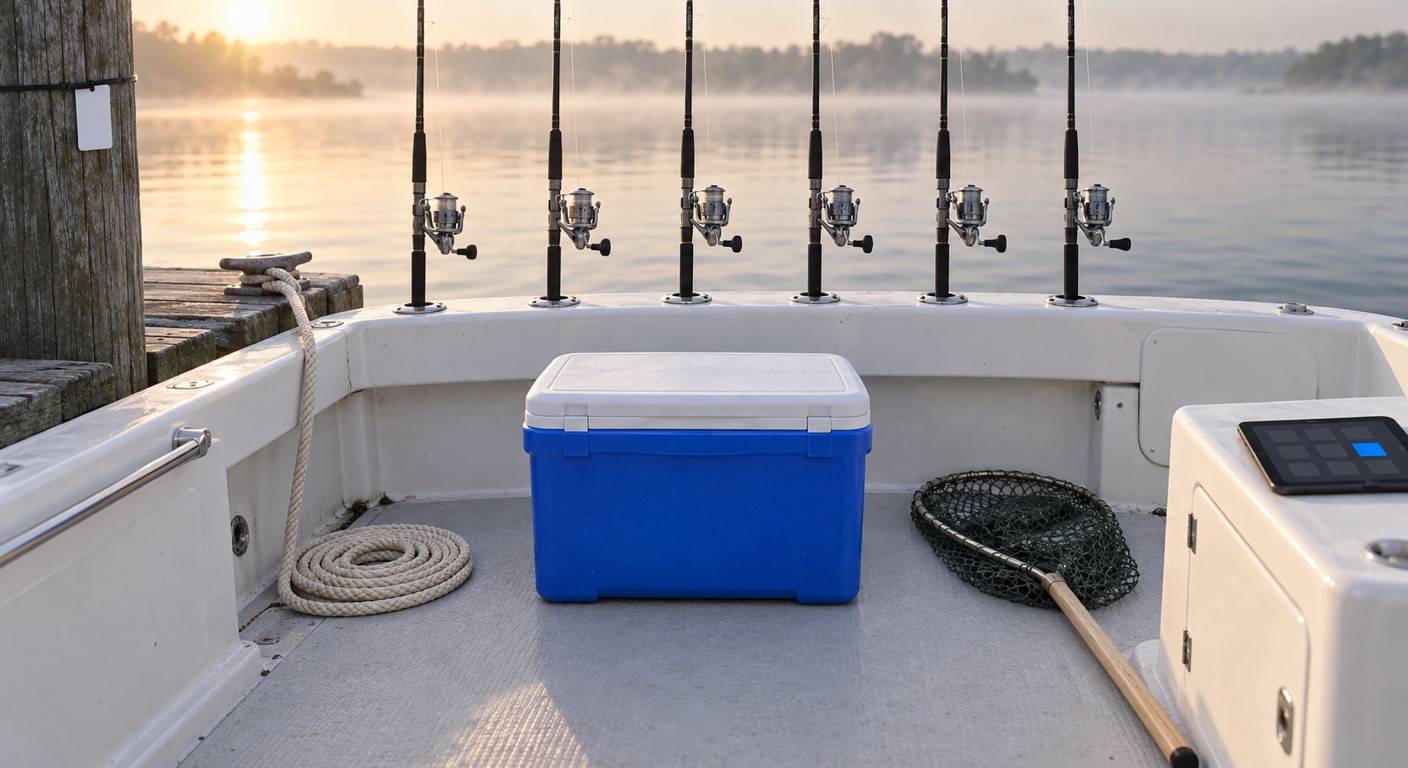
A family in Towson books a rockfish trip on your website in February: six people, six hours, the first Saturday in August, deposit paid. On 1 April the trip they bought becomes one the law does not allow. Maryland’s new striped bass seasons, approved by a legislative committee on 18 March, close the whole of August to fishing for striped bass in the Chesapeake Bay, while the second half of July, closed every summer since 2020, is open again. Your booking page still shows the first Saturday in August as available. Nobody told it otherwise, because nobody tells booking pages anything.
That example is most of this article. A charter business sells dates, and in Maryland the state decides what each date means: whether a striped bass may be kept, caught and released, or not fished for at all; how many striped bass trips a licensed guide may run that day; how many people a boat may carry under which license; and what has to be reported when it comes back. Much of that changes from year to year, and the rules allow parts of it to change with 48 hours’ notice. Every booking platform we looked at treats a charter as a time slot with seats. None of them knows what the state has done to the date.
The trade is also coming out of two very hard years. In 2024, the first season in which charter customers could keep only one striped bass instead of two, the number of charter trips on the Bay fell by more than half, according to figures the Maryland Charter Boat Association put in front of the state Senate this March. The captains still running sell fewer trips at higher stakes, often through marketplaces that take a share of every one. That makes the booking page more important, not less, and it makes a lost or refunded trip more expensive.
We build custom software for small businesses in Baltimore, so my interest here is practical. I am not a lawyer, and none of this is legal advice: check the current rules with the Department of Natural Resources before every season, and after every notice. The question I want to answer is the one every charter business with a website runs into eventually: which of the facts your captain carries in their head does your booking page need to know before it takes a deposit?
What the Chesapeake charter trade actually looks like
Charter fishing is a small trade in the federal statistics and a large one on the water. In the North American Industry Classification System a charter boat is NAICS 487210, Scenic and Sightseeing Transportation, Water, whose index entries include “charter fishing boat operation,” while a fishing guide working without a boat of their own lands in 713990. The Census Bureau’s County Business Patterns for 2023, the latest year published, counts the businesses in 487210 that have at least one employee on the payroll.
| Area | Establishments | With fewer than 5 employees | Employees | Annual payroll |
|---|---|---|---|---|
| United States | 2,217 | 1,645 | 14,913 | $806,376,000 |
| Maryland | 22 | 17 | 143* | $7,871,000 |
| Baltimore metro area | 8 | 4 | 128 | $6,302,000 |
| Anne Arundel County | 5 | – | 80* | $4,035,000 |
| Worcester County | 4 | – | 4 | $575,000 |
| Talbot County | 3 | – | 1 | $317,000 |
The asterisks mark figures that the Census Bureau flags as carrying 5% or more of deliberate statistical noise, and the dashes are cells it does not publish. Baltimore City, Baltimore County, Kent, Queen Anne’s and Calvert do not appear at all, either because they have no such business or because the bureau withholds any county cell with fewer than three. Twenty-two employer businesses in the whole state, sixteen of them S corporations and seventeen with fewer than five employees: that is the payroll view of a trade that is mostly one captain and one boat.
The rest of it is in the Census Bureau’s Nonemployer Statistics, which count businesses with no employees but publish only the broader group, NAICS 487, which also takes in sightseeing cruises, tour trolleys and scenic railways. In 2023 Maryland had 149 such businesses, 122 of them sole proprietors, with receipts of $5,493,000 between them, about $36,900 each; 63 were in the Baltimore metro area and 20 in Anne Arundel County. Put the two files together and about five in six of Maryland’s scenic and sightseeing transport businesses, 83.2%, have nobody on the payroll. That is the captain who owns the boat, the license and the website, and it is the reason so much of this trade’s software is sold as a marketplace listing rather than as a subscription.
The licensing side draws a tighter border than the business statistics. As the rules section explains, Maryland caps its tidal fishing guide authorizations at the number issued between September 1998 and March 1999, 517 residents and 57 nonresidents, and caps striped bass authorizations for the charter fishery at 499. We could not find a published count of how many are active today; the department’s website was unreachable from our network, and we have not guessed.
The demand side is where the last two years show. Figures from the state’s own catch reporting system, which the Maryland Charter Boat Association obtained through a public information request and put before the Senate’s Education, Energy and the Environment Committee in March, describe a trade that lost half its trips in one season.
| Measure | 2023 | 2024 | Change | 2025, to 15 September |
|---|---|---|---|---|
| Charter trips | 11,362 | 5,412 | −52.4% | not given |
| Anglers carried | 78,839 | 50,955 | −35.4% | 35,117 |
| Striped bass harvested | 100,997 | 34,985 | −65.4% | 26,566 |
| Anglers per trip | 6.9 | 9.4 | +35.7% | – |
| Striped bass per angler | 1.28 | 0.69 | −46.4% | – |
The first three rows are the association’s numbers, from the written testimony of its vice president, Captain Jason Seman; the last two rows are our arithmetic on them. The same letter says 54 charter boats have been listed or sold and five tackle shops have closed since the interstate commission’s last round of cuts. Read the derived rows with care, because we do not know exactly which trips the reporting system counts. Fish per angler fell by almost half, which is what a limit cut from two fish to one does. Anglers per trip rose by more than a third, which suggests that the trips that disappeared were the smaller ones, and that is a guess the data cannot confirm.
NOAA’s recreational fishing survey, which estimates angler trips from a sample of charter captains and dockside interviews, tells a softer story: 156,961 angler trips on Maryland charter boats in 2023, 157,132 in 2024 and 142,739 in 2025, the lowest in the seven years we pulled, with a margin of error of about 20% either way (MRIP effort estimates). The two sources measure different things, over different fleets and species, and neither is wrong because the other disagrees. What matters for a charter business is simpler: the most detailed record of its own trade sits in a state database that it can only get at by asking. In money, the Department of Legislative Services puts all recreational fishing trip spending in Maryland at $471.0 million in 2022, citing NOAA, and NOAA’s figures for 2021 attribute $39.0 million of that year’s $300.0 million in trip spending, 13.0%, to for-hire trips.
What the software costs, and what the meter counts
Charter software comes in two families that are easy to confuse. Marketplaces, such as FishingBooker, GetMyBoat and Guidesly, list your boat next to everyone else’s and send you customers. Booking systems, such as FareHarbor, Peek, Xola, Rezdy, Checkfront, Bókun and Bookeo, put a calendar and a checkout on your own website and send you nothing. A business can use one of each, and the two are metered in completely different ways. We read each vendor’s own pricing page and help center on 25 September 2026 and applied what they publish to one six-hour private trip at $725, the median published price for that trip on the Chesapeake charter websites we read for this article (more on those below).
| Tool | What the vendor publishes | Business pays | Customer pays on top |
|---|---|---|---|
| FishingBooker marketplace | Commission of 10% to 30%, in 5% steps, chosen by the captain; the commission is the customer’s deposit | $72.50 to $217.50 | $0 |
| FishingBooker Direct (your own site) | No commission; 2.65% + 3¢ payment processing | $19.24 | $0 |
| GetMyBoat marketplace | Owner 11.5%; renter up to 13% plus a flat $20 | $83.38 | up to $114.25 |
| Guidesly Pro | 3% at the dock, 10% on your own website, 15% on its marketplace | $21.75 / $72.50 / $108.75 | $0 |
| FareHarbor | No monthly fee; a booking fee charged to the customer at checkout, percentage not published | processing only | not published |
| Peek Pro | “Custom, quote-based pricing” | not published | not published |
| Xola | 6% service fee on online card sales, paid by you or the guest; cards 2.39% + 30¢ | $61.13 if you pay the fee | or $43.50 |
| Rezdy Foundation / Checkfront | $49 or $99 a month plus 3% per online booking, which you may pass on | $21.75 + monthly | optional |
| Bókun | $49 a month plus 1.5% | $10.88 + monthly | optional |
| GoFish.Rocks | $1.50 per passenger, $9 minimum per charter | $9 | optional |
| Bookeo | $14.95 to $119.95 a month, no commission | $0 + monthly | $0 |
| Stripe card processing | 2.9% + 30¢ online, fees kept on refunds | $21.33 | $0 |
Sources are the vendors’ own pages: FishingBooker’s listing costs and Direct pricing, GetMyBoat’s service fees, Guidesly Pro, FareHarbor’s own description of its model, Peek Pro, Xola and its Flex Standard terms, Rezdy, Checkfront, Bókun, GoFish.Rocks, Bookeo and Stripe. Several sites show euro prices to European visitors, and we used the US prices throughout.
Multiply by a season and the two families separate. For a boat that runs 100 trips at $725, $72,500 of bookings, FishingBooker takes $7,250 at its minimum commission and $21,750 at its maximum. GetMyBoat takes $8,337.50 from the owner and up to $11,425 more from the customers, so close to $19,800 of the roughly $83,900 that those customers paid never reaches the boat. Guidesly Pro takes $7,250 even when every booking comes through your own website. At the other end, Bókun costs $1,675.50 for the year, Rezdy Foundation $2,763 and Checkfront $3,363, all before card processing, which adds about $2,130 on any of them, and Bookeo costs $479.40 for twelve months, or about $312 if you freeze the account for the six quiet months at the 30% rate it offers. The spread between the cheapest and the most expensive way to take the same 100 bookings is more than $19,000 a year, more than the starting price of every package we describe below.
That comparison is unfair to the marketplaces in one important way, and it is worth saying plainly. A marketplace is not software; it is a sales channel. The 10% to 30% buys customers who would never have found your website, and on a Tuesday in October that may be the only booking you get. The honest question is not which meter is cheapest but which of your customers you are paying the marketplace rate for. A regular who has fished with you every June for five years and books through a marketplace because it is convenient costs you the same commission as a stranger it found for you. Knowing which is which needs your own booking records, not the marketplace’s.
Two clauses in the fine print change how an online store should work. First, FishingBooker’s commission is the deposit: “The commission captains give to FishingBooker is the same as their trip deposit,” its help center says, and it keeps it only “after a successful trip,” refunding the customer if the weather cancels. The captain’s money is the balance, collected on the day, which means the deposit a customer thinks they paid to you is not in your account at all. Second, the marketplace sets a floor under your own prices. Its Best Price Guarantee asks captains to keep listing prices “the same as or lower than the prices on your website or other online services,” and a listing that is more expensive drops in the rankings and can be put on hold. So your own store’s advantage is not that it can be cheaper. It is that you keep the commission, and you keep the customer.
And a pattern we have found in almost every trade we have written about shows up here too, in a milder form: several of the best-known names do not publish a number. FareHarbor’s /pricing address returns its booking app rather than a price list, and the percentage of its customer booking fee appears nowhere on its site; Peek Pro’s returns a 404 and its homepage says pricing is by quote; Captain Experiences’ returns a 404; and TripWorks’ redirects to a demo form. The marketplaces at least publish their ranges, and the flat-fee systems print their prices on the first page you land on.
If you would rather build a site yourself, the shelves are nearly bare. WordPress.org lists four booking plugins made for fishing charters, Charter Booker, SeaFishingCharters Calendar, BookingFish Calendar and HarborBook, each reporting fewer than ten active installations, and the Shopify App Store has no fishing charter booking app at all. None of the plugins we found mentions seasons, bag limits or captain licensing.
The part no national platform models: Maryland decides what your dates mean
Every booking platform in this article sells the same basic unit: a time slot on a boat, with a price and a number of seats. For most of the tour and activity businesses those platforms were built for, that is the whole product. A kayak tour on 14 August is the same kayak tour it was when the customer booked it in February. A striped bass charter on the Chesapeake is not, because what the trip is legally allowed to be is decided by the state, by date, and the state changes its mind. This section goes through the rules a Maryland charter business actually works under, in the order in which they reach the calendar.
The season is a public notice
The striped bass seasons live in the Code of Maryland Regulations, chapter 08.02.15, which the Department of Natural Resources rewrites through ordinary rulemaking. The department told the Senate this March that the process takes “at minimum, four to five months.” But the chapter also contains a faster lever, and every charter business should know its exact wording.
In order to implement the Atlantic States Marine Fisheries Commission Interstate Fishery Management Plan for Striped Bass, the Secretary may modify or close a season or catch limit, set a monthly catch limit, modify a size limit, or require specific vessel trip information by issuing a public notice on the Fisheries Service website that shall state its effective hour and date at least 48 hours in advance of the effective hour and date.COMAR 08.02.15.12H(1)
Read that as a software requirement and it says three things. The season can change with two days’ notice. The change is published as a notice on a web page, not delivered to you. And the notice can require “specific vessel trip information,” which means the state can change what you have to record about a trip as well as what the trip may do. A violation of such a notice is its own line in the enforcement schedule, which we come to below.
In practice the big changes come through regulation, and 2026 brought one. The Joint Committee on Administrative, Executive and Legislative Review approved the department’s new seasons on 18 March; they were published in the Maryland Register on 20 March and took effect on 1 April. DNR’s Assistant Secretary for Aquatic Resources, Kate Charbonneau, described the aim as simplifying the recreational and charter seasons, “making them easier to find and read.” For anglers they are simpler. For a charter business with a calendar already half sold, they moved about a quarter of the year.
| Dates | 2025 | 2026 | Days whose meaning changed |
|---|---|---|---|
| 1 Jan – 31 Mar | Catch and release | Catch and release | 0 |
| 1 – 30 Apr | Closed to targeting | Catch and release | 30 |
| 1 – 15 May | Closed to targeting | Harvest, named areas only | 15 |
| 16 May – 15 Jul | Harvest | Harvest | 0 |
| 16 – 31 Jul | Closed to targeting | Harvest | 16 |
| 1 – 31 Aug | Harvest | Closed to targeting | 31 |
| 1 Sep – 5 Dec | Harvest | Harvest | 0 |
| 6 – 10 Dec | Harvest | Catch and release | 5 |
| 11 – 31 Dec | Catch and release | Catch and release | 0 |
| Whole year | 304 days open, 193 with harvest | 334 days open, 188 with harvest | 97 |
The table is built from the regulation (COMAR 08.02.15.09 and .12I), the department’s 2025 and 2026 season announcements, and the Department of Legislative Services’ fiscal note on Senate Bill 755, which sets out the pre-2026 rules in the state’s own words. In both years harvest means one fish per person per day between 19 and 24 inches, and the spawning rivers stay closed to targeting from 1 March to 31 May. We counted a day as changed when its status moved between closed, catch and release, and harvest. Ninety-seven days changed, 26.6% of the calendar, and the total number of harvest days barely moved: 193 against 188. The state did not take many days away. It moved them.
Now look at that from the boat. A family that booked a rockfish trip in February for a Saturday in August booked a date that has been closed to targeting striped bass since 1 April. August 2026 had five Saturdays and ten weekend days in all. Meanwhile the second half of July, which charter captains had learned to leave empty because it was closed in every season from 2020 to 2025, reopened. And the end of the season moved: harvest now stops after 5 December, where last year it ran to the 10th, so a trip sold as “the last keeper of the year” for the second week of December is now a catch-and-release trip.
None of this is a complaint about the department. The seasons follow an interstate management plan, and the state cannot simply freeze them. The trade tried: this year’s Senate Bill 755 would have written a fixed season into statute, from 16 May to 10 December, with two fish per charter passenger and a three-weekend trophy season. The department testified that the bill would put Maryland “well outside of compliance” with the Atlantic States Marine Fisheries Commission’s plan and could lead to a federal closure of the whole fishery, and the bill got a hearing on 10 March and went no further. The trade was split on it, too: the Maryland Charter Boat Association supported it, while a joint letter from the Coastal Conservation Association Maryland, the American Sportfishing Association, the Marine Trades Association of Maryland and several dozen captains and guides opposed it. For software the lesson is the same either way: the season is going to keep moving, so it has to be data that someone can change, not logic that someone has to rewrite.
The department said the same thing about itself in its testimony, and it is the best one-sentence argument for treating the season as data that we found anywhere:
Having different rules during the same fishing season causes confusion amongst those fishing, which can lead to noncompliance and enforcement difficulties.Maryland Department of Natural Resources, testimony on SB 755, 10 March 2026
Two striped bass trips a day, counted per license
The second rule reaches the calendar more quietly. In the same regulation, under the heading “Restrictions for Charter Boats,” sits one sentence that none of the booking platforms whose documentation we read can express:
A fishing guide licensee may not make more than two guided fishing trips daily to fish for striped bass.COMAR 08.02.15.12G(2)
Notice what it counts. Not boats, not seats and not time slots, which is what booking software counts, but trips per licensed guide per day, and only trips that target one species. A captain who runs a morning rockfish trip, an afternoon rockfish trip and an evening trip can do it, as long as the evening trip is for something else, and a business with two boats and one licensed guide cannot run three rockfish trips on a Saturday, however many seats the booking page shows as open. To enforce that, the system has to know three things the typical booking page does not record: which licensed guide is running each trip, which species each trip targets, and how many of that guide’s trips for that species are already booked on the date. We went through the help centers of FareHarbor, Peek, Xola, Bookeo, Checkfront and FishingBooker. All of them can cap seats and close dates, and none has a setting for “two striped bass trips per captain per day.” The nearest thing, FareHarbor’s resource limits, counts how many of something are in use “at one time,” not across a day.
The paragraph before it has a twist of its own. During a charter trip the captain and mate may not keep a striped bass for themselves, “except as provided in COMAR 08.02.13.06,” and that cross-reference leads to the reporting rules, where the exception turns out to be a reward for reporting electronically, as the section on reporting below explains.
The license sets the capacity, twice
Maryland does not license charter passengers one by one. It licenses the boat. Under Natural Resources §4-745(d)(1) the department issues a special charter boat license that covers everyone fishing aboard a single vessel run by a licensed guide, which is why your customers do not need their own tidal fishing licenses (§4-745(c)(4)). The statute prices it by headcount, $240 a year “for 6 fishermen or less” and $290 “for 7 or more,” and it expires on 31 August whatever day you bought it. The guide needs a license of their own, a fishing guide authorization on a tidal fish license, which costs $100 a year for a Maryland resident and $200 for a nonresident under §4-701(d), and §4-210(b) forbids guiding from a boat at all without “appropriate federal licenses to operate a vessel carrying passengers for hire.”
That last phrase is where the second capacity comes from. Federal law divides passenger boats at six. A vessel of less than 100 gross tons “carrying not more than 6 passengers, including at least one passenger for hire” is an uninspected passenger vessel under 46 U.S.C. §2101(53), and its operator needs the Coast Guard credential that everyone calls a six-pack license, formally an Operator of an Uninspected Passenger Vessel endorsement (46 CFR 15.605). Add a seventh paying passenger and the same boat becomes a small passenger vessel (§2101(47)), which “may not be operated without having on board a valid U.S. Coast Guard Certificate of Inspection” (46 CFR 176.100). The certificate states the routes the boat may travel and “the maximum number of passengers and total persons that may be carried” (176.103). The federal penalty for running without one is up to $5,996 a day after the latest inflation adjustment in 33 CFR 27.3, and the Coast Guard does enforce it on the Bay: in 2020 its Maryland–National Capital Region sector had issued Captain of the Port orders to ten vessels in a year over illegal charters. The state fee schedule, you will have noticed, breaks at exactly the same number.
So a charter boat’s real capacity is the smallest of three numbers: the seats the owner is willing to sell, the headcount its state charter license was bought for, and the passenger limit that its Coast Guard paperwork allows. Only the first of those is usually typed into the booking system, and the product page says “up to 6” because someone typed it once. A system that stores the license and the certificate as records, with their limits and expiry dates, can refuse the seventh seat by itself and can warn you in August that every trip you sold for September sits on a state license that expires on the 31st.
A license you cannot simply apply for
Here is the fact about this trade that surprised us most. The number of people allowed to guide paying anglers on Maryland’s tidal waters is not open-ended. COMAR 08.02.01.05 sets targets for each kind of tidal fish license authorization, and it defines them as “the number of authorizations issued between September 1, 1998, and March 31, 1999,” adjusted since: 517 resident fishing guides and 57 nonresident ones. New applicants go on a waiting list kept “in order of the date and time that applications are received” (§4-701(i)). The same statute caps striped bass authorizations for the charter boat fishery at 499 participants (§4-701(j)).
Scarcity makes a market, and the statute provides the paperwork for one: a license or authorization held for at least two years can be transferred permanently “to a person who provides a notarized bill of sale” (§4-701(k)(6)), with a $50 application fee per authorization, and it can be transferred temporarily, up to twice a license year. People search for exactly that; “maryland fishing guide license for sale” is one of Google’s own autocomplete suggestions. Renewal is due by 31 August, with a late window to 31 March that needs good cause and another $50. And there is a grandfathered tier, the master fishing guide license, open only to people who on 1 April 1997 already held a guide license and owned two or more charter vessels, a vessel of 50 tons or more, or a marina with at least ten charter boats. A master guide may employ other captains, gets one copy of the license per vessel, and is “held responsible for any violations committed by the person employed to operate the vessel” (§4-701(r)(5)).
For software, this turns a license from a line in a filing cabinet into the most valuable asset the business owns, with its own dates, transfer history and people attached. For a buyer of a charter business it is the thing that actually changes hands.
The guide answers for the angler
What makes the license precious also makes it fragile. Maryland runs a point system for fishing guides in COMAR 08.02.13.08, and it assesses points only for violations “that occurred during a guided fishing trip,” which in practice means the guide’s record carries what the customers do. A first-tier violation is five points; the tier includes one fish over the striped bass limit, one fish outside the slot, and “Violation of Striped Bass Public Notice: 1 Fish.” Two fish is ten points. Under the schedule in .07, ten points in any two years is up to a 30-day suspension, fifteen is 60 days, twenty is 90, and thirty-five is revocation, with up to five years for a guide suspended three times in six years. A 30-day suspension that starts in June takes out what is, for many boats, the best month of the year.
One detail shows how hard it is to keep up with this calendar, even for the state. The point schedule was last amended with effect from 7 July 2025. It still assigns points for spring-season size violations under regulation .08 of the striped bass chapter, which was repealed with effect from 25 November 2024, cites Potomac tributary rules in regulation .10, repealed on 1 April this year, and refers to subsections of regulation .09 that no longer exist in its current text. That is not a scandal; it is what happens when rules that change every year are cross-referenced by hand. It is also exactly the failure a charter business’s own website and booking pages are prone to, as our census below shows.
The report is the other half of the trip
Maryland’s statute is short on this: “A commercial fishing guide shall be required to submit reports monthly on forms provided by the Department” (§4-210(d)). The regulation, COMAR 08.02.13.06, is long. A licensed guide reports guided fishing activity, the reporting week runs Sunday through Saturday, and a paper Fishing Guide Daily Log is due by the 10th of the following month. A report more than 50 days late can cost the license: the regulation’s own ladder runs from a warning for the first late report to a three-day suspension for the second, a week for the third, and a year for the twelfth, counted per report in any twelve months.
The alternative is electronic reporting, and one version of it, reporting “with hailing,” turns the report into part of the trip itself. Before the boat is underway, the guide sends a start hail. Within 30 minutes of finishing, and before landing the catch, the guide sends an end hail. The boat carries the letters EHRG, in plain block letters at least three inches high on the port side near the stern, whenever it runs a guided trip under that system. And the state pays for the trouble in fish: a guide reporting with hailing is the exception that the charter boat rule pointed to.
Notwithstanding COMAR 08.02.15.12, the captain and one mate may each possess up to one striped bass per person per day for personal consumption during the open recreational and charter boat summer and fall fishery.COMAR 08.02.13.06I
We have not seen another trade in which the state’s incentive for going digital is paid in dinner. The software point is duller and more useful. A start hail goes to the state’s system about a trip that your booking system already knows everything about: who is running it, when it leaves and how many people are aboard. The end hail reports the catch, which your booking system never learns. Nothing connects your booking system to the state’s app, so the captain types the trip twice, once for the customer and once for the state, and the business ends up with its best data about its own trips in the state’s system, where it has to ask for them. That is not a figure of speech: the fleet figures the charter association gave the Senate this year, quoted earlier, came through a public information request.
What your website may not promise
Three more lines from the same regulation belong on the marketing side of the business. First, outside ponds and lakes and unless the Secretary authorizes it, nobody may “conduct a fishing tournament or contest” for striped bass or “offer or give a reward or incentive to a recreational or fishing guide led angler for catching striped bass” (COMAR 08.02.15.12D). A “biggest rockfish of the month wins a free trip” promotion, the kind of thing a marketing plug-in will happily run for you, is exactly that. Second, between midnight and 5 a.m. no one may possess striped bass while fishing the Bay, which is worth knowing before you sell a night trip that comes home at one in the morning. Third, a licensed captain or mate may fillet striped bass aboard only on a vessel displaying a current commercial charter boat decal, keeping no more than two fillets per legal fish and every carcass in a separate container until the passengers have left the dock. “We clean and fillet your catch” is a service with conditions attached.
Tax is the easy part
After all that, it is a relief to report that tax is simple. A charter trip is a service that Maryland’s sales tax does not list, and the Comptroller’s list of taxable goods and services does not mention charters at all. The admissions and amusement tax, which catches a surprising amount of recreation, names “charter fishing boats” among the four things no county or city may tax, alongside bowling lanes, bingo run under the Criminal Law and nontethered hot air balloons; we went through that list in our post on entertainment centers. What you sell over the counter is another matter: the shirt, the hat and the bag of ice carry Maryland’s 6% sales tax, and a gift certificate is governed by Maryland’s gift certificate law, which does not let it expire for four years. Four years is four seasons, and on this year’s evidence probably four different calendars. We explained that law in our post on clothing boutiques.
What 85 Chesapeake charter websites say
To see how the trade sells today, we read the websites of charter fishing businesses on the Maryland side of the Bay on 25 September 2026. We started from local searches and from the captains’ directories that several harbors publish, found 113 candidate websites, and set aside 28: eight domains that no longer resolve, seven parked or placeholder pages, five second websites of a business already counted, two businesses outside the region and six sites we could not read. That left 85: 29 in Anne Arundel County, from Pasadena to Deale, 27 in Calvert, 12 on Kent Island and in Queen Anne’s, 8 in Rock Hall, 5 in Baltimore City and County, 2 on Tilghman Island and 2 that run from several ports. For each site we recorded how a customer can book, what it says about the striped bass rules, and what it says about capacity, deposits, cancellations and gift certificates. We report pooled figures only and name no business.
One caveat comes first. Only 51 of the 85 sites show any date from 2024 or later, so some of the rest may belong to businesses that no longer run. That is a finding of its own. For a customer, an AI assistant or a search engine, a charter website that has not been touched in three years looks exactly like one that has, and it still answers the question “can I catch a rockfish in August?”
| Finding | Websites | Share |
|---|---|---|
| Online checkout that takes a dated booking and a payment | 14 (16 with two unconfirmed) | 16.5% |
| Booking by request or phone, with an online payment link | 15 | 17.6% |
| Inquiry form, no payment | 36 | 42.4% |
| Phone, email or text only | 18 | 21.2% |
| States at least one out-of-date striped bass rule | 35 | 41.2% |
| States the current 2026 rules | 5 | 5.9% |
| States no striped bass rules | 45 | 52.9% |
| Advertises rockfish trips in August | 13 | 15.3% |
| States a passenger capacity | 67 | 78.8% |
| Mentions a Coast Guard license | 53 | 62.4% |
| Mentions a deposit / states an amount | 50 / 37 | 58.8% / 43.5% |
| Publishes any cancellation or weather policy | 43 | 50.6% |
| Promises a refund or new date when weather cancels | 19 | 22.4% |
| Mentions gift certificates | 8 | 9.4% |
Start with booking. Only 14 of the 85 sites let a customer pick a date and pay online in one go, and two more probably do through a scheduling widget we could not confirm. The platforms behind those checkouts are scattered: four Guidesly-hosted sites, three on VallyPro, two each on Peek and FareHarbor, and single sites on a custom Stripe calendar, Schedulista and Wix. Another 15 sites take the booking by request or phone and then send a payment link, eleven of them through PayPal. The largest group, 36 sites, has an inquiry form that takes no money, and 18 have nothing but a phone number, an email address or a text line. We found no Xola, Rezdy, Checkfront, Square Appointments or Acuity checkout anywhere, and although three sites display FishingBooker badges, none of them takes its bookings through FishingBooker. The trade’s real booking system, in other words, is still the captain’s phone, and the marketplace listing lives on a different website from the captain’s own.
Now the rules. Thirty-five sites, 41%, state at least one striped bass rule that is no longer true: a spring trophy season with a 28- or 35-inch minimum, a season that opens on 16 May or closes on 10 or 15 December, a closure from 16 to 31 July, or a limit of two fish per person. A few of those also carry the correct 2026 rules on another line, so the number of sites that are simply wrong lies somewhere between 31 and 35. Five sites state the current rules. Forty-five state none at all. These are some of the out-of-date lines, verbatim:
“Trophy Season: May 1st – May 15th Regular Season: May 16th” · “*Rockfish season closed July 16-31 due to regulations” · “18″ - 28″ and two fish per person.” · “Rockfish (striped bass) reopens September 1 and runs through December 10.” · “2026 Fishing Season May 1 st thru December 10 th”Chesapeake charter websites, read 25 September 2026
The last one is the most instructive. It is dated 2026 and gets the start of the harvest right and the end wrong, as if someone updated the page for the new season and missed one of the two dates. Thirteen sites, 15%, still advertise rockfish trips in August, mostly in season calendars along the lines of “August - October Rockfish,” and one has a rate table that runs from 1 August to 10 December. And the sites that take money online are no better than the rest: of the 16 that have a dated checkout, one states the 2026 rules, five state out-of-date ones and ten state none. The page that takes the deposit is exactly the page that does not know what the date allows.
None of this is careless in the ordinary sense. These are small businesses with one captain, and the rules changed in 2024 and again this April. A season written into the text of a website is a season that goes out of date every spring, and every stale line is also a line that search engines and AI assistants read and repeat to your customers. The same pages are better on the things that do not change: 67 sites, 79%, state how many passengers they take, and 53 mention the captain’s Coast Guard license. One says it outright: “By law, we cannot exceed 6.”
The money terms are thinner. Fifty sites mention a deposit and 37 state an amount, usually a flat sum between $100 and $400, and at least one adds a 3% convenience fee to card payments. Forty-three publish some cancellation or weather policy, 19 promise a refund or a new date when the weather cancels, and four say in so many words that the call is the captain’s. In the 43 policies we read, we found none that says what happens when the state closes a date after the trip was sold. Eight sites mention gift certificates, and at least three sell them online. And for the arithmetic in this article, the published prices: the median six-hour private trip for up to six people costs $725 on the 20 sites that list one, most between $650 and $800, and the median four-hour trip costs $550 on the 10 that list one.
The e-commerce half: what a charter’s online store is actually selling
Put the rules and the census together and the design of a charter business’s online store follows from them. It is not a shop with a calendar bolted on. It is a calendar in which each date carries legal facts, and the shop is the part the customer sees.
The product is a trip type on a date, not a time slot
A booking platform stores a charter as a time slot on a boat with a price and a number of seats. What the business actually sells is a trip type: a species or two, a length, a boat, a licensed guide and a way of fishing, offered on dates whose status the state sets. Store it that way and several things become easy that are otherwise impossible. The product page for a six-hour rockfish trip can check the date the customer picks against a season table and say, in plain words, whether it is a harvest day, a catch-and-release day or a closed one, and offer the trip that is lawful on that date instead. The checkout can count the guide’s striped bass trips on that date and stop at two. The seat limit can come from the smaller of the state license and the Coast Guard paperwork rather than from whatever number someone typed once. And when a notice changes the season, you edit one table rather than forty product descriptions.
That season table is small: a row for each period, with its dates, its status for each species you sell, the size and bag limits, the areas it applies to and a link to the rule it came from. Someone in the business, not a developer, should be able to edit it the day a notice is posted. Everything else reads from it: the product pages, the confirmation emails, the captain’s trip sheet and the notes on the website that tell customers what they may keep.
When the rules change, the store has to list who is affected
A notice with 48 hours’ warning, or a regulation like this spring’s, creates a job that no booking platform we checked does for you: find every sold trip on a date whose status changed, decide what to offer each customer, tell them, and record what they chose. The platforms can close future dates, but closing them does not touch the bookings already made; FareHarbor’s help center says in as many words that canceling an availability “does not automatically cancel bookings,” and Bookeo’s bulk cancellation skips time slots that already have them. In a well-built system that is a query and a queue. Change the season table, and the system lists the affected bookings with the customer, the party size, the deposit taken and the options that are lawful on that date, whether that is the same date for another species, a different date or a refund. It drafts the message, and it keeps track of who has answered. For a business with a spring and summer calendar partly sold by March, that is the difference between an afternoon and a week of phone calls.
It also exposes a hole in the cancellation policies we read. Charter policies cover two kinds of cancellation, the customer’s and the weather’s, and they treat them differently: customers forfeit deposits inside a deadline, and weather cancellations are refunded or rescheduled at the captain’s call. A trip whose purpose becomes unlawful is a third kind, and it is worth writing into the terms before it happens, because the customer who booked an August rockfish trip did nothing wrong and neither did you.
Deposits, the weather call and the card fee
The money side of a charter is simple in outline and awkward in the details. Most operators take a deposit when the trip is booked and the balance on the day, and they refund or reschedule when the captain calls the weather. The awkward parts are timing and fees. A card authorization lasts about a week online, so a deposit for a trip three months away has to be charged, not held, and when it is refunded the payment processor generally keeps its fee, as we worked through in our post on party rentals. A business that refunds forty weather cancellations a season at $200 each loses the processing fee on $8,000 of deposits, and a system that offers a rescheduled date first, and a refund second, keeps most of that money and most of those customers.
Gift certificates that outlive the season
Charter gift certificates sell at Christmas, and in Maryland a gift certificate cannot expire for four years. A certificate for “a six-hour rockfish trip for four” is therefore a promise about four seasons that nobody has written yet, and the 2026 change shows how that can go. The Lithuanian operator in the next section, which sold its trips partly through gift-voucher sellers, learned the same lesson when a ban arrived. The safer design is to sell certificates as a value, record what the buyer thought they were buying, and let the system map the certificate onto whatever trip types are lawful when it is redeemed. The liability belongs in the books too: unredeemed certificates are money you owe, not revenue you have earned.
The start hail is a booking record
Finally, the report. The hails and the Fishing Guide Daily Log are about two things, the trip and the catch. A booking system already holds most of the trip side, the guide, the boat, the departure time and the party, but never the catch, and the captain’s trip sheet can hold the catch as well if it asks for it at the dock. We did not find a published interface that lets outside software file those reports for you, and we would not promise one. What a good system can do is print or show the trip sheet with the same fields in the order the state asks for them, collect the catch once, and keep the business’s own copy of every trip it ever ran. In a year when the charter association had to use a public information request to put its own fleet’s numbers in front of the Senate, keeping your own copy is not a small thing.
A note for readers in Lithuania
We write mostly for Baltimore, but part of our team and many of our readers are in Lithuania, where boats out of Klaipėda and Šventoji take paying anglers onto the Baltic, and the comparison is unusually close. The Lithuanian sea-fishing trade has already lived through the Chesapeake’s central problem, a season rewritten after the trips were sold, in a harsher form.
In the autumn of 2019 the European Union shut the eastern Baltic cod fishery, and Lithuania’s sea-angling trips had been built around cod. 15min reported that one Klaipėda operator had already sold about €30,000 of trips for the following year and had contracts with several gift-voucher sellers. Its director, Sergejus Babeško, asked the obvious question: „Aš irgi darau verslą. Kodėl negaliu pretenduoti į kompensaciją?“ (“I run a business too. Why can’t I claim compensation?”) The ban is still in force. The Council regulation that fixes the 2026 Baltic fishing opportunities, Regulation (EU) 2025/2454, says in Article 10(1) that “recreational fisheries of cod shall be prohibited in subdivisions 22 to 32,” which covers Lithuania’s coast, and Article 11 allows a recreational angler to keep only “one specimen of adipose fin-clipped salmon” a day, after which they must stop fishing for salmon for the rest of the day. The trade moved from cod to salmon and sea trout: in 2021 inspectors checked 313 recreational fishing boats and recorded 285 salmon, 15min reported. And the calendar is about to move again. The Commission’s proposal for 2027 would end recreational fishing for reared salmon as well, and ministers are due to settle the 2027 figures at the Agriculture and Fisheries Council on 26 and 27 October (Commission press release, August 2026).
Lithuania has also gone further than Maryland in one respect: it made the captain of any boat fishing at sea, charter or not, responsible for reporting everyone aboard. Under point 18 of the rules for recreational fishing at sea (order No. 3D-36, as amended in 2024), when anglers fish from a boat on the Baltic, „už laive esančių žvejų mėgėjų duomenų ir jų sugauto laimikio registravimą … yra atsakingas laivo kapitonas“: the captain is responsible for registering the anglers aboard and their catch. Since 1 January 2025 that is done in a mandatory mobile app, eLaimikis, and the ministry’s own description of how it works is, step for step, Maryland’s hailing system: you mark the start of fishing, enter each fish as it is caught, and press “finish” at the end (Ministry of Agriculture, March 2026). And a European rule now points the same way. The revised EU Control Regulation, applying since 10 January 2026, requires recreational fishers of certain species to be registered and to report catches electronically, lets that be done “by a legal person on their behalf,” and says expressly that it covers “fishing activities organised by commercial entities in the tourism sector” (Regulation (EU) 2023/2842, amending Article 55 of Regulation 1224/2009).
Two more Lithuanian details map straight onto software. The limits are counted per boat as well as per person: point 6 allows one salmon and one sea trout per angler per day, but when fishing for them a boat may use no more than twelve rods and take no more than six of these fish aboard, whoever caught them. And the state itself runs the kind of dated, capacity-limited store this article keeps describing. Adult anglers, with some exemptions, need a recreational fishing ticket, žvejo mėgėjo bilietas, sold online through the environmental permits system ALIS for €3 for two days, €10 a month or €30 a year under Article 11 of the Law on Recreational Fishing, and on some waters day cards are sold through the same system with a hard daily limit: at Laumenas lake, no more than 24 cards may be issued for the same day. A Lithuanian charter’s booking page therefore has to handle a per-boat quota, a per-passenger permit and a captain’s report, where a Baltimore one has to handle a per-guide trip count, a boat license and a monthly log. The rules differ; the shape of the problem is the same.
What custom actually costs, and when it pays
We price every project at a fixed fee, agreed before we start, and publish the starting points on our pricing page. For a charter fishing business they map onto the problems in this article like this.
| Package | Fixed price | What it would be for a charter business |
|---|---|---|
| Prototype Sprint | $3,500 | A working season engine on your own trips in about a week: the 2026 season table, your trip types by species, the two-trips-per-guide count and a date picker that tells a customer what each date allows, running on last season’s bookings |
| Online Store | from $6,000 | A booking store on your own domain and your own card account: trip types on dates, seats capped by license and certificate, deposits, weather and rule-change rescheduling, gift certificates sold as value, and a product page that updates itself when the season table changes |
| Custom App or Internal Tool | from $12,000 | A captain’s app: the day’s trips, the party list, the trip sheet in the order the state asks for it, the catch entered once at the dock, and license, decal and certificate dates with reminders |
| Operations System | from $12,000 | The back office for a fleet: several boats and guides, crew scheduling, the rebooking queue for rule changes, marketplace listings kept in step with your own calendar, and payments, refunds and gift-certificate liability in your accounting |
Most of our projects land between $6,000 and $30,000, and none of them needs you to drop a booking platform or a marketplace that brings you customers; the demos page shows what finished work looks like. If you are in Maryland, remember that the state’s 3% tax on software and IT services applies to a custom build, which we explained in a separate post.
The honest case for building is not that charter booking software is expensive. A flat-fee booking system costs less than a tank of fuel a month. The case is that the money leaks out in places the subscription does not reach. Here is one worked example, using the modeled boat from the pricing section, with every assumption stated. Suppose 40 of its 100 trips come through a marketplace at a 20% commission, and that a third of those, 13 trips, are regulars who would book directly if your own site made it as easy: that is $1,885 a year in commission paid for customers you already had. Suppose this spring’s rule change caught eight August rockfish trips sold over the winter, and you kept five by moving them to other dates or other species and lost three: $2,175 of revenue. Together that is about $4,000 in a single season, before counting the evenings spent on the phone or the risk to the license from a trip run on a date that had closed. Over two seasons it covers the starting price of an Online Store. Change the assumptions and the number moves, but the shape does not: in this trade the money goes where the rules and the regulars are, and neither shows up on the booking platform’s invoice.
What we would build for a Baltimore charter business
If a charter operation on the upper or middle Bay asked us to fix the problems in this article without replacing anything that already works, this is what we would build, roughly in this order.
- A season table that a person can edit. One row per period with its dates, the status for each species, the size and bag limits, the areas and a link to the rule, loaded with the 2026 seasons and changed by you, not by a developer, on the day a notice is posted.
- Trip types instead of time slots. Each trip carries its species, its length, its boat and its licensed guide, so the booking page can tell a customer what a date allows, offer the lawful alternative, and stop a third striped bass trip for the same guide on the same day.
- Licenses and certificates as records. The boat’s state charter license with its headcount and its 31 August expiry, the guide’s authorization, the Coast Guard license or certificate with its passenger limit, the charter decal, each with a date and a reminder, and a seat count that can never exceed the smallest of them.
- A rebooking queue for rule changes. Change the season table and the system lists every affected booking, drafts the message, offers the options that are lawful and records the answers, with the deposit and the refund handled the way your terms say.
- Deposits and gift certificates that behave. Deposits charged, rescheduled before they are refunded, and reported with the fees they cost; gift certificates sold as a value, mapped to lawful trips when they are redeemed, and kept as a liability until they are.
- A trip sheet the captain fills once. The guide, the boat, the departure time and the party from the booking, the catch entered at the dock, the fields in the order the state’s log and hails ask for them, and every trip kept in the business’s own records.
None of that is exotic engineering. It is a small table, a counter, a handful of records with expiry dates and a queue. That is also why, as far as we could find, nobody sells it: it is too specific to one fishery in one state to be a product, and too important to leave in a captain’s memory, especially when the rules move every spring.
Build, buy, or leave it alone
Most Chesapeake charter businesses should buy their booking software, and several of the products in this article are good at it. If you run one boat with one licensed captain, a booking platform will take deposits and send reminders, a marketplace listing can fill some of your quiet weekdays, and nothing we could build would be a better use of your money. Keep it. Before next spring, do three things by hand: put the 2026 season into your own calendar, check every product page and FAQ on your website for last year’s rules, and add a line to your terms about trips the state closes after you sold them.
If you run several boats, employ captains under a master license, sell a lot of gift certificates, or list on two marketplaces as well as your own site, the question is different. Your problem is not the booking platform but everything around it: keeping the season in step across every listing, counting trips per guide, rebooking when the rules change, and knowing which of the money you hold is yours. Do not migrate. Add what is missing around the system you have, and only replace the storefront if the storefront is what is losing you bookings.
Leave alone what is cheap and works: the payment processor your customers trust, the weather forecast you already read, the accounting package and the marketplace that brings you people who would never have found your website. Build the few things nobody sells in this trade, which are the season table, the per-guide count, the license records and the rebooking queue. And if you are not sure which of those is costing you money, a one-week prototype running on last season’s bookings is the cheapest way to find out.
Questions charter captains ask us
How much does fishing charter booking software cost in 2026?
It depends on whether you are buying software or customers. When we checked on 25 September 2026, booking systems published prices from $14.95 a month with no commission (Bookeo) to $49 a month plus 3% per online booking (Rezdy) or $99 plus 3% (Checkfront), and Bókun charged $49 a month plus 1.5%. FareHarbor charges the customer a booking fee whose percentage it does not publish, and Peek Pro quotes on request. Marketplaces take a share of each trip instead: FishingBooker 10% to 30%, GetMyBoat 11.5% from the owner plus up to 13% and $20 from the customer, and Guidesly Pro 10% even on bookings through your own website. Card processing at about 2.9% plus 30 cents comes on top of most of these.
What are Maryland’s 2026 rockfish season dates in the Chesapeake Bay?
For recreational and charter fishing in 2026, striped bass may be caught and released from 1 January to 30 April; harvested from 1 May to 31 July, in named areas only until 31 May; not targeted at all from 1 to 31 August; harvested again from 1 September to 5 December; and caught and released from 6 to 31 December. When harvest is open the limit is one fish per person per day between 19 and 24 inches. The spawning rivers, including the Susquehanna Flats, the Choptank, Chester, Nanticoke and Patuxent, are closed to targeting from 1 March to 31 May. The rules took effect on 1 April 2026 and can be changed by public notice with 48 hours’ warning, so check the Department of Natural Resources before every trip.
Can you fish for rockfish in August in Maryland?
Not in the Chesapeake Bay or its tidal tributaries in 2026. COMAR 08.02.15.12I(5) says that from 1 to 31 August “a person may not target striped bass or striped bass hybrids,” and the regulation defines targeting as catching, attempting to catch, harming, harassing or pursuing, so catch and release is not allowed either. In 2025 the closure was 16 to 31 July instead, and August was open for harvest. Charter trips in August can target other species.
Do passengers need a fishing license on a Maryland charter boat?
Not if the boat carries a special charter boat license. Under Natural Resources §4-745, that license covers everyone fishing aboard a vessel run by a licensed fishing guide, and people fishing under it are exempt from the individual Chesapeake Bay and coastal sport fishing license. The license costs $240 a year for six fishermen or fewer and $290 for seven or more, and it expires on 31 August.
How do I get a fishing guide license in Maryland?
A fishing guide in tidal waters needs a fishing guide authorization on a tidal fish license, which costs $100 a year for a Maryland resident and $200 for a nonresident, plus a Coast Guard license to carry passengers for hire. The number of authorizations is limited: the department’s targets are 517 resident and 57 nonresident guides, the number issued between September 1998 and March 1999, and new applicants join a waiting list. An existing authorization held for at least two years can be transferred to a buyer with a notarized bill of sale and a $50 application fee.
How many striped bass trips can a charter captain run in a day in Maryland?
Two. COMAR 08.02.15.12G(2) says a fishing guide licensee “may not make more than two guided fishing trips daily to fish for striped bass.” The limit counts trips per licensed guide, not per boat, so a third trip on the same day has to target another species.
What is a six-pack captain’s license?
It is the Coast Guard’s Operator of an Uninspected Passenger Vessel credential, or OUPV. Under 46 U.S.C. §2101, a vessel under 100 gross tons carrying no more than six passengers, at least one of them paying, is an uninspected passenger vessel, and 46 CFR 15.605 requires its operator to hold an OUPV endorsement or a higher license. A boat that carries seven or more paying passengers is a small passenger vessel and needs a Coast Guard Certificate of Inspection, which sets its maximum number of passengers and its routes.
Do Maryland charter captains have to report their trips?
Yes. A licensed fishing guide reports guided fishing activity to the Department of Natural Resources, for a reporting week running Sunday to Saturday, with paper logs due by the 10th of the following month. Reports more than 50 days late can lead to suspensions, from a warning for the first to a year for the twelfth in twelve months. Guides who choose electronic reporting with hailing send a start hail before leaving and an end hail within 30 minutes of finishing, display the letters EHRG on the boat, and in return the captain and one mate may each keep one striped bass during the summer and fall season.
What does FishingBooker charge charter captains?
A commission of 10% to 30% of the trip price, chosen by the captain in 5% steps, with no subscription. The commission is the same as the trip deposit, and FishingBooker keeps it only after the trip runs, refunding the customer if the weather cancels it. Its separate FishingBooker Direct product, for bookings on your own website, charges no commission and 2.65% plus 3 cents in payment processing. FishingBooker also asks captains to keep their listing prices the same as or lower than the prices on their own website, and a listing that is more expensive can drop in the rankings or be put on hold.
Is a fishing charter taxable in Maryland?
Generally not. A charter trip is a service that Maryland’s sales tax does not list, and Tax-General §4-103 bars counties and cities from imposing the admissions and amusement tax on charges for charter fishing boats. Merchandise you sell, such as shirts and hats, carries the 6% sales tax, and gift certificates fall under Maryland’s gift certificate law, which does not allow them to expire for four years.
Should a Baltimore charter business build custom booking software?
Usually not for the core. A booking platform or a marketplace listing handles deposits, reminders and payments well for one boat and one captain. Build only the layer that no platform sells: a season table you can edit when the rules change, trip types that count striped bass trips per guide, licenses and certificates stored with their limits and expiry dates, and a queue for rebooking customers when the state closes a date you already sold. That layer can sit next to the platform you already use.