
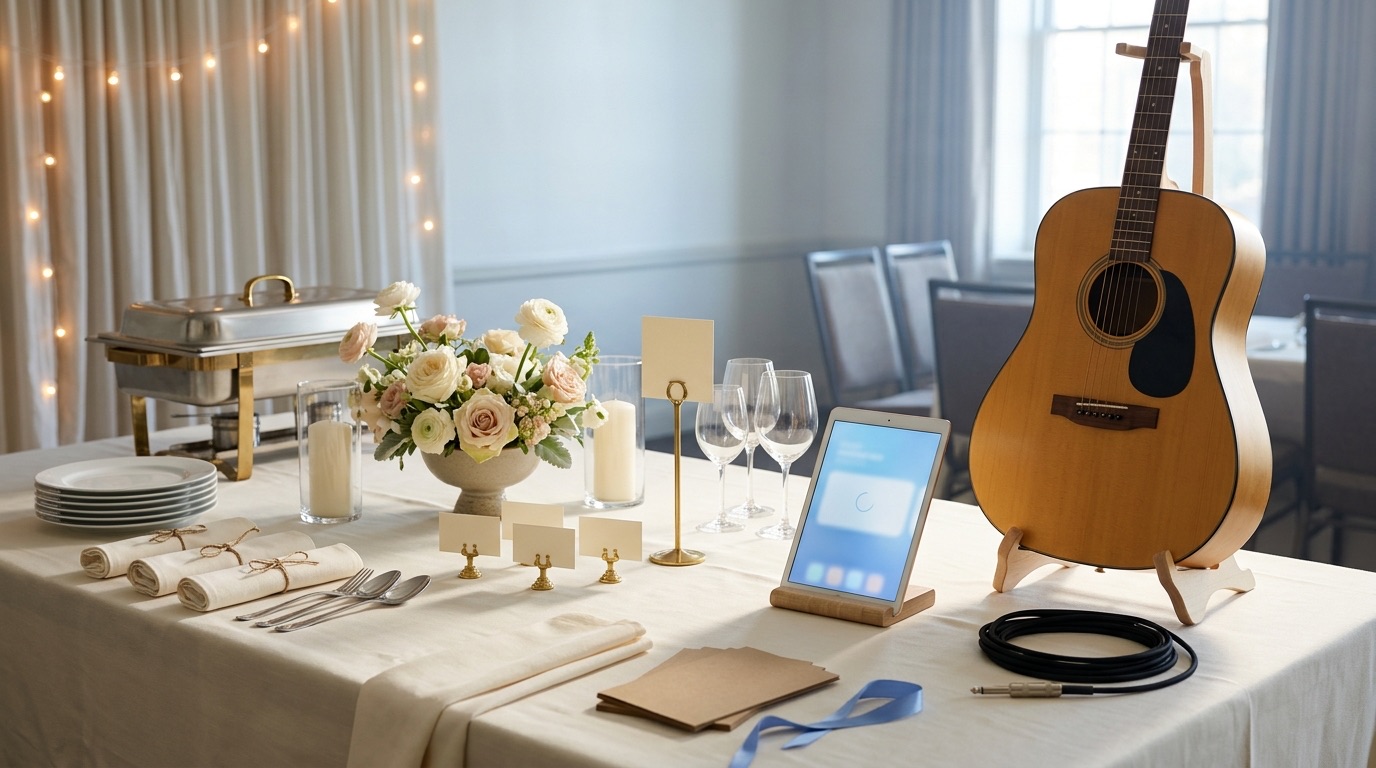
I have been asking the same question in the first ten minutes of a call with a caterer for about six months now, and I have not yet had a confident answer.
The question is: at the events you ran last month, was there dancing?
People assume I am making conversation. They tell me about the wedding in Fells Point where the floor did not clear until one in the morning, and the corporate thing in Hunt Valley where nobody danced because nobody ever dances at those. Then I ask the second half of the question, which is whether they know that the answer changes what they owe the state on the food, and the conversation stops.
This is the twenty-third trade we have taken apart in this series. In most of them, the hard fact was a number nobody could know at the moment of sale: the weight of the meat, the supplement on the collision job, the eight business hours ticking away in a prescriber's office, the eighteen days a jeweler is forbidden from selling what they just bought. Catering has one of those too, and we will get to it. But it also has something I have not seen anywhere else, and it is the reason this article exists.
In this trade, the tax rate on your largest line item is set by the behavior of a person you did not hire. Not by what you sold. Not by who you sold it to. By whether the musician standing in the corner of the room happens to be sitting down.
Let us start with the market, because Baltimore's is a good deal more interesting than the national picture suggests.
What Baltimore's catering and events trade actually looks like
There is no single industry code for this trade, which is part of why it is so badly served. An operation that a customer experiences as one evening is split by the Census across at least six classifications, and the businesses in them do not look remotely alike. Here is the 2023 County Business Patterns data for Maryland, pulled from the Census flat files rather than the API, which returns nothing useful at county level.
| Sector (NAICS) | MD establishments | MD employees | MD annual payroll | Employees per establishment |
|---|---|---|---|---|
| Food service contractors (722310) | 607 | 9,003 | $275.7M | 14.8 |
| Caterers (722320) | 272 | 3,824 | $140.8M | 14.1 |
| Mobile food services (722330) | 172 | 524 | $14.8M | 3.0 |
| Convention and trade show organizers (561920) | 101 | 1,667 | $109.3M | 16.5 |
| Promoters of events without facilities (711320) | 75 | 355 | $31.4M | 4.7 |
| Promoters of events with facilities (711310) | 44 | 1,152 | $54.3M | 26.2 |
| Total | 1,271 | 16,525 | $626.3M | 13.0 |
A caveat that matters more here than in almost any other trade we have covered: County Business Patterns counts only establishments with paid employees. The 172 mobile food services in that table are the food trucks that run payroll. Anyone who has been to a Baltimore festival knows the real number is a large multiple of that, because the overwhelming majority of trucks are sole proprietors with a spouse and a cousin. The same caveat applies at the small end of catering, where a great many one-person operations run entirely on contractors. So read every count in this article as a floor.
Now the local picture, and it contains the strangest thing in the dataset.
| Jurisdiction | Population (2023) | Caterers | Residents per caterer | Venues | Venue employees |
|---|---|---|---|---|---|
| Baltimore City | 567,517 | 34 | 16,692 | 9 | 566 |
| Baltimore County | 848,676 | 52 | 16,321 | 4 | 60 |
| Anne Arundel | 599,965 | 31 | 19,354 | 4 | 52 |
| Prince George's | 956,533 | 49 | 19,521 | 9 | 262 |
| Montgomery | 1,069,397 | 47 | 22,753 | 11 | 163 |
| Howard | 337,341 | 13 | 25,949 | 4 | 44 |
| Frederick | 294,154 | 11 | 26,741 | — | — |
| Harford | 264,771 | 7 | 37,824 | 3 | 5 |
| Carroll | 176,735 | 3 | 58,912 | — | — |
| Maryland | 6,217,062 | 272 | 22,857 | 44 | 1,152 |
Two things fall out of that table. The first is that Baltimore City is, for once, the best-served jurisdiction in the region rather than the worst. In the optical piece we wrote in August, the city turned out to be about three times thinner in eye care than its neighbors. Here it is at the top of the list, one caterer per 16,692 residents against a state average of 22,857 and a Carroll County figure of 58,912. If you run a catering business in Westminster, you have roughly three and a half times fewer competitors per head than a business in the city, and roughly three and a half times further to drive.
The second thing is stranger. Baltimore City has nine establishments coded as event venues with facilities, and they employ 566 people between them — 62.9 per venue. That is the highest figure in the state by a distance, and it is the fingerprint of a city with stadiums and arenas in it. But the payroll per employee in that group is $24,390, the lowest of any jurisdiction in the region, because a stadium's headcount is overwhelmingly part-time gameday labor.
Now put that beside the other end of the same evening. Baltimore City also has twelve establishments coded as convention and trade show organizers — the people who plan events rather than host them. Between them they employ twenty-one people, at $130,619 each.
Baltimore City stages events with 62.9 people per venue at $24,390 a head, and organizes them with 1.8 people per firm at $130,619 a head. Same city, same evenings, a 35× gap in headcount and a 5.4× gap in pay, sitting either side of a line the customer never sees.
That gap is the shape of the whole trade. There is a small, highly paid, information-heavy layer that decides what happens, and a large, thinly paid, logistics-heavy layer that makes it happen, and almost all of the software sold into this market is built for the first layer while almost all of the money is spent on the second. Hold that thought; it comes back when we look at what the products actually do.
One more figure for scale. Nationally there are 12,251 caterers with employees, 143,014 people working in them, and $4.47 billion of payroll. Maryland's 272 establishments are 2.2% of the national count while the state holds about 1.8% of the population, so this is a slightly over-indexed trade here — which is what you would expect from a state with a lot of government, a lot of hospitals, a lot of universities and a very large wedding market on both sides of the Bay.
The sentence that decides your tax rate
Maryland has a tax most people outside the state have never heard of, and most people inside it associate only with concert tickets. It is the admissions and amusement tax, it is set locally and collected by the Comptroller, and it is the reason this article has the title it does.
Start with the definition. Tax-General §4-101(b)(1) says an admissions and amusement charge means a charge for admission to a place, for the use of a game of entertainment, for the use of a recreational or sports facility, for the use or rental of recreational or sports equipment, and then this:
"…merchandise, refreshments, or a service sold or served in connection with entertainment at a nightclub or room in a hotel, restaurant, hall, or other place where dancing privileges, music, or other entertainment is provided."
Read that slowly, because it is doing something unusual. It is not taxing entertainment. It is taxing the dinner, on the grounds that entertainment was happening nearby. A banquet hall that serves a plated meal in a room where a band is playing has, on the face of the statute, converted its entire food, drink and merchandise take into gross receipts subject to a local tax of up to ten percent — on top of the sales tax it was already collecting.
Then comes the exemption, at §4-103(b)(1). The tax may not be imposed on gross receipts:
"…derived from any charge for merchandise, refreshments, or a service sold or served at a place where: (i) dancing is prohibited; and (ii) the only entertainment provided is mechanical music, radio, or television."
So the way out of the tax is to forbid dancing and play a recording. Both conditions, not either. A room with a playlist and a dance floor is taxable. A room with a string quartet and a strict no-dancing policy is taxable. A room with a playlist and a rule against dancing is not.
I want to be careful here, because it would be easy to make this sound sillier than it is. The clause is old, and its original target was the difference between a restaurant and a nightclub in an era when that distinction was legally and socially significant. It is not an absurd rule; it is a rule written for a world that has since produced the wedding-industrial complex, the corporate off-site, the brewery taproom with a Tuesday open mic, and the museum atrium rented out for a gala. What it is, unambiguously, is a rule that turns on facts about a room that nobody in the room is recording.
Baltimore City then adds its own layer. Article 28 of the City Code sets the rate at ten percent at §19-1, with two reductions at five percent — one for a theater on the National Register of Historic Places, one for a single-screen movie theater that rents its film through commercial distribution. And at §19-3 it exempts, alongside not-for-profit community associations:
"…restaurants that provide entertainment consisting solely of an individual roving performer whose act does not employ and is not dependent on the use of amplified sound for entertaining patrons within the restaurant."
There are four separate conditions packed into that sentence, and every one of them is binary.
Solely. One act. Book a harpist for the cocktail hour and a guitarist for dinner and you have two, and the exemption is gone. An individual. One person. A duo does not qualify, however quiet. Roving. The performer must move. This is the condition that catches people, because nothing in the rest of the clause hints at it and because a musician sitting on a stool is the most natural thing in the world. Not amplified, and not dependent on amplification. The second half of that phrase is doing real work: it is not enough that the amp is switched off, if the act would not function without it.
Put the state exemption and the city exemption together and you get a ladder that no software on earth models.
| What is happening in the room | Which rule applies | A&A on food, drink and merchandise |
|---|---|---|
| Recorded music only, and dancing is prohibited | §4-103(b)(1) | Exempt |
| One roving acoustic performer, no amplification | City §19-3 | Exempt |
| One seated acoustic performer, no amplification | §19-3 requires "roving" | Taxable |
| Two roving acoustic performers | §19-3 requires "solely… an individual" | Taxable |
| One roving performer with a microphone | §19-3 requires no amplification | Taxable |
| Recorded music, and guests may dance | §4-103(b)(1)(i) not satisfied | Taxable |
| A DJ, or any band | Amplified and not roving | Taxable |
Before anyone writes to tell me this is theoretical, let me put a number on it. Take a 120-guest reception in Baltimore City at $95 a head for food and $40 a head across the bar — $11,400 and $4,800, which is a completely ordinary mid-market Baltimore event in 2026. In the exempt configuration the admissions and amusement tax on that evening is zero. In the taxable configuration it is $666, for reasons we will unpack in a moment. A venue that runs 120 comparable events in a year is looking at a swing of roughly $80,000 decided by facts about musicians.
Obviously, at a wedding people dance, and the question answers itself. But a very large share of what a Baltimore caterer or hall actually does is not weddings. It is rehearsal dinners, memorial receptions, corporate lunches, board dinners, gallery openings, retirement parties, bar association mixers and holiday luncheons — rooms where there may or may not be a musician, where nobody has thought about whether they are seated, and where the operator has never once been asked to record it.
And here is the part that turns a tax curiosity into a software problem. The admissions and amusement tax is imposed on the person receiving the receipts. Business Tax Tip #20 is explicit that, unlike the sales and use tax, there is no requirement to state it separately — and that "the tax owed the state is the same whether calculated on a separately-stated or tax-included basis." So this is not a tax you collect from a customer at checkout and remit. It is a tax you either priced into the event or absorbed out of your own margin, decided months later, on the basis of something that happened in a room.
One reception, one invoice, six rates
The other half of the picture is the sales and use tax, and on a catering bill it does not behave like a single rate either.
Maryland taxes prepared food at 6% and alcoholic beverages at 9%. Business Tax Tip #27 — a genuinely excellent document, and the one I would hand to any new operations manager in this trade — lists what is taxable on a caterer's bill, and the list is longer than most people expect: food and beverages, linens and tablecloths and chair covers and napkins, tables and chairs and portable bars, plates and silverware and stemware, chafing dishes and sterno and serving utensils and ice, cleaning charges, fountains and fondue equipment, flowers, decorations and balloons, ice sculptures, security services, tents and temporary flooring, generators and HVAC and portable restrooms, lighting, audio-visual equipment, pipe and drape, charges for bartenders and cashiers and shuckers and carvers, mandatory gratuity for groups over ten, and photo booths and casino tables.
The list of things that are not taxable is four items long: separately stated valet car parking, separately stated coat check, separately stated delivery of the food and equipment to the buyer, and gratuities the customer leaves voluntarily. Room rental gets its own paragraph — not taxable, but "only if the room charge is separately stated on the bill to the customer."
Notice how many times the phrase "separately stated" is doing the work. It is not a formatting preference. It is the condition on which several thousand dollars of tax treatment depends. And the Comptroller has put the point beyond argument in its guidance for caterers who quote the way most caterers actually quote:
"If you do not itemize your bill… and instead elect to bill a lump-sum price for the entire bill or per-person charge, you must charge the higher 9% tax rate on the entire bill."
Nine percent. On the salad, the linens, the chairs, the generator and the staff, because you wrote "$185 per person, all inclusive" on a proposal. That is a three-point penalty applied not to anything you sold but to the shape of the document you sold it with.
Now stack the two taxes. Tax-General §4-105(b) forbids a combined rate above 11%, and the Comptroller's rate schedule effective 1 January 2024 carries the two footnotes that implement it: use a 5% A&A rate for an activity also subject to the 6% sales tax, and a 2% A&A rate for an activity also subject to the 9% alcohol tax. Here is what that produces on a single Baltimore City event where a band is playing.
| Line on the invoice | Amount | Sales & use tax | Local A&A | Combined |
|---|---|---|---|---|
| Plated dinner, 120 × $95 | $11,400 | 6% | 5% | 11% |
| Bar — wine, beer, spirits | $4,800 | 9% | 2% | 11% |
| Non-alcoholic bar and coffee service | $900 | 6% | 5% | 11% |
| Room rental, separately stated | $2,500 | 0% | 0% | 0% |
| Valet parking, separately stated | $1,100 | 0% | 0% | 0% |
| Coat check, separately stated | $300 | 0% | 0% | 0% |
| Mandatory 20% service charge, party of 120 | $3,420 | 6% | unsettled | ≥6% |
| Voluntary tip left by the host | — | 0% | 0% | 0% |
| The same event quoted as one all-inclusive per-person price | $24,420 | 9% | as above | ≥9% |
Six distinct rate combinations on one invoice for one evening, in one room, for one customer. And the last row is the one that should make anybody who quotes per-head sit up. Itemized, that bill carries 6% on the food, the non-alcoholic bar and the service charge, 9% on the alcohol, and nothing at all on the room, the valet and the coat check. Quoted as a single per-person figure, all $24,420 of it goes to 9% — which moves $15,720 of lines up by three points and drags $3,900 of exempt lines up by nine. The difference is $823, and it is not a difference in anything you sold. It is the price of how the proposal was written.
On the service charge line I am going to do something unfashionable and tell you that I do not know the answer. The sales tax position is clear — Business Tax Tip #5 says a separately stated mandatory gratuity is not taxable for a group of ten persons or less, and is taxable for a group of more than ten "regardless of whether they are separately stated." The admissions and amusement position is less clear, because a mandatory service charge is plausibly "a service sold or served in connection with entertainment" under §4-101(b)(1)(v). I have not found guidance that settles it. If your events routinely run a twenty percent service charge, that is a question for the Comptroller's Special Events Section, and it is worth a phone call rather than an assumption.
There is one more line worth knowing about even though it will not appear on a wedding invoice. Business Tax Tip #20 explains that most subdivisions impose an additional tax on reduced-charge or free admissions — five cents a ticket where the regular price is under fifty cents, ten cents under a dollar, and fifteen cents at a dollar or more — and that this tax "is payable in full even if the actual amount of taxes payable would exceed 10 percent of gross receipts." For a ticketed gala, that means the comp list has its own tax bill, uncapped. Several jurisdictions opt out of it; the rate chart flags them with footnotes.
The county line, and the cap that flattens it
The admissions and amusement tax is set by counties and municipalities, and §4-105(d) lets a municipality set a rate different from its county's. §4-103(a)(1) then goes further: a county may not impose the tax on receipts from any source inside a municipality if that municipality imposes its own tax or specifically exempts any gross receipts. In other words, a town can switch off its county's tax by exempting something.
The result is the Comptroller's rate schedule, which is not a table of twenty-four counties. It is a table of roughly 150 political subdivisions, many with per-activity splits inside them, and it is the single best artifact I can show anyone who thinks a national platform can handle Maryland. Montgomery County alone occupies twenty-three rows. Anne Arundel's county area lists separate rates for agritourism, athletic facilities, movies and bingo before it gets to "all other activities." Annapolis prices billiard parlors at 3.5%. St. Michaels taxes boat rides and carnival rides at 10% and everything else at 4%. Frederick County's county area is exempt outright while Brunswick and Frederick City charge 10%.
Now the arithmetic, and it produced a result I did not expect. Take the same $16,200 of food and bar from the reception above, and move it around Montgomery County.
| Where the tent goes up | Headline A&A rate | Effective on food | Effective on bar | A&A on the evening |
|---|---|---|---|---|
| Somerset (the Montgomery County town) | Exempt | — | — | $0 |
| Poolesville | 0.5% | 0.5% | 0.5% | $81 |
| Kensington | 4.5% | 4.5% | 2.0% | $609 |
| Montgomery County area | 7.0% | 5.0% | 2.0% | $666 |
| Gaithersburg | 10.0% | 5.0% | 2.0% | $666 |
Look at the bottom two rows. Gaithersburg's published rate is 43% higher than the county's, and the bill is identical to the dollar, because the 11% combined cap has already bitten in both places. Above five percent, the headline rate tells you nothing at all about what a caterer pays. Below five percent, every tenth of a point is real money — Poolesville is 8.2× cheaper than the county area a twenty-minute drive away, and Somerset is free.
The cap compresses the top of the range and leaves the bottom untouched. So the published rate — the one number anybody would put in a spreadsheet — is uninformative exactly where it is highest, and decisive exactly where it is lowest.
That is the kind of finding that only falls out if you do the arithmetic rather than reading the chart. It also has an operational consequence: a caterer serving three weddings on one Saturday across Montgomery County can face three different effective rates and one exemption, and the difference is which side of a town line the tent is on. There is no lookup service for this. There is a PDF.
A few more provisions in this family are worth knowing, because they show how location-dependent this tax is. Montgomery County may not impose it on nightclub or entertainment-related receipts inside a designated enterprise zone under §4-103(a)(5) — so an economic-development map overlays the tax map. §4-104(e) lets any county or municipality exempt receipts of an arts and entertainment enterprise inside an arts and entertainment district, which Baltimore City has used. §4-104(g) does the same for a qualifying tourism enterprise in a tourism zone. And §4-105(g) requires 60 days' notice to the Comptroller before any rate change takes effect, which is the only reason this is tractable at all.
Finally, a footnote for venues rather than caterers. Business Tax Tip #24 explains that gross receipts from leasing out a sporting or recreational facility are taxable unless the lessee will themselves charge for the use of the same facility — and in that case "the lessor of the facilities must notify the Comptroller's Office of the proposed use before the lessee uses the facilities." A pre-event filing obligation, triggered by the commercial structure of a booking. And Business Tax Tip #20 adds the line that most surprises people who have spent their careers in sales tax: if a customer presents an exemption certificate, "you are not permitted to accept it." The nonprofit exemptions in this tax are properties of the jurisdiction, not of the customer. A nonprofit arts group's gala is exempt in Takoma Park and Anne Arundel because those tax areas exempt it, and taxable elsewhere no matter what certificate the group holds.
The numbers you cannot know when you take the booking
Every trade in this series has one, and catering has four. They are worth listing together because they are the reason a generic CRM never quite fits.
The first and most familiar is the guaranteed count. The standard structure in this trade is that the client commits to a number some fixed period before the event — seventy-two hours is the common figure in Baltimore — and is billed on the greater of the guarantee and the actual attendance. Everything upstream of that moment is an estimate: the food order, the staffing, the rentals, the floor plan, the revenue. This is not a defect in anyone's process. It is the trade. But it means that a booking record which stores a single "guest count" field is storing the wrong thing. What actually exists is a series of counts with timestamps, one of which becomes contractually binding at a moment computed backwards from the event date, and after which changes have a different commercial meaning.
The second is whether you are a licensed caterer at all, which is a question about your own annual revenue mix. Business Tax Tip #27 defines a licensed caterer as a business offering catering in connection with a specific event that holds a food service facility license — and then excludes anything "primarily engaged in the preparation and service of food to the general public at the facility," which it defines as more than 50% of gross sales revenue derived from sales of non-catered specific events. If you are a Hampden restaurant that caters on the side, you are inside or outside an entire purchase-side exemption regime depending on where a ratio lands at year end. And the exemption in question is not trivial: it is the tax on tents, generators, HVAC, portable restrooms, lighting, audio-visual equipment, pipe and drape, decorations, ice sculptures, security services and photo booths.
The third is the predominant use test. The same document says materials used in non-catering services qualify only "if at least 50% of their use was dedicated to the performance of catering contracts." That is a utilization percentage, per asset, measured over a period. If you own a tent and it goes out on twenty jobs a year, some catered and some not, the tax status of that tent is a fraction you have to be able to compute. I have never seen a catering system that tracks it, and I have looked.
The fourth is my favorite, because it is a question about the future. Among the items that do not qualify as caterer purchases, Business Tax Tip #27 lists:
"Any purchases that are returned to the caterer's inventory for use at other parties, events, or functions."
So the tax treatment of an object depends on whether it comes back. A tent bought for a specific contract and consumed by it is one thing; the same tent, folded up and put on a shelf for next weekend, is another. You cannot know which at the moment you buy it.
And in the same list, two lines apart, sits the clause I would frame and put on a wall. Fresh flower arrangements and live plants are qualified caterer purchases — but only when acquired under a contract with the customer:
"…that provides the customer with the right to take the fresh flower arrangements and live plants with them at the conclusion of the event."
Delete that sentence from your contract template and the same centerpieces, from the same florist, for the same wedding, stop qualifying. The tax on the flowers is set by a clause in a document. Two items further down, costumes qualify and "standard uniforms for staff" do not — the same garment, taxed differently depending on whether it is thematic.
None of this is exotic. It is the ordinary operating reality of a Maryland caterer. But notice what all four have in common: they are facts about relationships between records over time — a count and a deadline, a revenue ratio and a fiscal year, an asset and its utilization history, a purchase and its eventual disposition. They are not fields. They are joins. And a product built to be sold in fifty states cannot afford to model any of them.
There is one more, on the license side, and it is the clearest example in the article of a rule that ought to be visible in your booking form. The state's Statewide Caterer application sets the annual fee by population:
| License | Total population covered | Annual fee | A Baltimore-area combination that lands here |
|---|---|---|---|
| Limited SCAT | Not more than 300,000 | $750 | Carroll (176,735) alone |
| Limited SCAT | 300,000–600,000 | $1,000 | Baltimore City (567,517) alone |
| Limited SCAT | 600,000–1,000,000 | $1,500 | Baltimore City + Howard (904,858) |
| General SCAT | Above the Limited bands | $2,000 | Baltimore City + Baltimore County (1,416,193) |
A caterer whose work is entirely in the city sits in a $1,000 band. Accept one wedding at a venue in Towson and the combined population is 1,416,193, and the license is a General SCAT at $2,000. The inquiry form on your website collects a venue address, which means it is already collecting a license-cost input. It just does not know that.
What the software actually costs
We checked twenty-six catering, banquet, venue-management, rental and event-booking products on 6 and 7 August 2026, by fetching each vendor's own pricing page and reading what was on it. Twelve publish a figure you can read off the page. That is a better ratio than pharmacy, where we found none out of thirty, and roughly in line with specialty food.
But the interesting thing is not the ratio. It is where the publishers sit. Every horizontal tool in the sample — the room-booking system, the ticketing platform, the scheduling app, the staff communications app — publishes a full price list. Among the products built specifically for catering and venues, most do not: Tripleseat, Curate, Planning Pod, FoodStorm, Goodshuffle Pro, Momentus, Prismm, Rentman, EventPro, MonkeyMedia, Galley Solutions and Flex all returned either a missing pricing page or a page with no figure on it when we checked.
The more precisely a product is aimed at this trade, the less likely it is to tell you what it costs. That is not a coincidence; it is what happens when the seller knows the buyer's revenue and the buyer does not know the seller's price.
Of the ones that do publish, three are worth taking apart properly.
Caterease publishes three tiers billed annually: Express at $99 a month, Standard at $149 and Professional at $199, each including one user. Additional users are $28 a month. Optional modules — Guest Rooms Manager, Prospect Manager, Document Builder, Web Inquiry, Banquet Rooms — are $25 a month each, and integrations to QuickBooks, DocuSign and the rest are a further $25 a month each. And then a line most people skim: "One time launch fee for all plans: $200 (per user)."
A launch fee scaled by headcount is unusual, and it changes the shape of the decision. A six-person catering office on Professional, with three feature modules and two integrations, is at $199 + (5 × $28) + (5 × $25) = $464 a month, and pays $1,200 to start. The published floor is 21% of that monthly figure. Nothing here is hidden — every number is on the page — but the number a buyer remembers is $99.
Total Party Planner publishes Nibble at $119 a month with one user, Feast at $299 with two, and Delicacy at $429 with three, additional users at $25, with 10% off for annual payment. Setup is $299 one-time, and an optional Initial Data Entry Package is $500 for up to 2,000 menu, beverage and rental items. Its online ordering module, TPP Order, is where it gets interesting: +$149 a month on Nibble, +$129 on Feast, +$119 on Delicacy. The same feature gets cheaper as your base plan gets more expensive. On the entry tier the online store costs more than the software it plugs into.
And then, at the bottom of the pricing page, verbatim:
"A $200 monthly fee applies to clients who do not adopt TPP Pay. TPP Pay adoption is included with the discounted rate."
That is the most explicit statement of the underlying business model we have found in twenty-three teardowns. The published price is conditional on routing your payments through the vendor. Keep your own processor and the entry tier goes from $119 to $319 — a 168% surcharge, larger than the software. A one-user caterer who wants online ordering and keeps an existing merchant account is at $119 + $149 + $200 = $468 a month, against a headline of $119. The headline is 25% of the real number.
Perfect Venue does something different and, in its way, more honest: it publishes both halves. Basic is $99 a month per location with card processing at 1.2% + $0.30; Professional is $199 with 0.5%; Premium is $299 with 0.3%; Enterprise adds no processing fee at all. The monthly fee and the transaction fee move in opposite directions, which means the cheapest plan is only the cheapest plan below a certain volume. We worked out where the lines cross.
| Monthly card volume | Basic ($99 + 1.2%) | Professional ($199 + 0.5%) | Premium ($299 + 0.3%) | Cheapest |
|---|---|---|---|---|
| $5,000 | $159 | $224 | $314 | Basic |
| $14,286 | $270 | $270 | $342 | Basic / Professional tie |
| $25,000 | $399 | $324 | $374 | Professional |
| $50,000 | $699 | $449 | $449 | Professional / Premium tie |
| $100,000 | $1,299 | $699 | $599 | Premium |
A venue on the $99 plan taking $100,000 a month in card payments pays $1,299 — more than twice the $599 it would pay on the $299 plan. The first crossover is at $14,286 a month, which in this market is roughly one wedding. So the correct plan changes the first time a couple pays a deposit by card, and nothing in the product tells you.
The rest of the publishing group, for completeness: Event Temple lists $249 a month; CaterZen, Better Cater, Aisle Planner and Skedda all publish tiered figures with entry points between roughly $49 and $99; Sched, Eventbrite and Connecteam publish full price lists as you would expect from horizontal tools. None of these are bad products. Caterease has been doing this since before most SaaS existed, Perfect Venue's pricing page is genuinely clearer than most, and Total Party Planner's feature list is the work of people who have obviously stood in a commercial kitchen at six in the morning.
The point of the teardown is not that any of them is overpriced. It is that the loaded, honest, all-in monthly number for a real Baltimore catering office is somewhere between three and five times the number on the pricing page, and that none of these products has a field for whether the guitarist was sitting down.
The e-commerce half: why your booking page cannot quote a price
Most caterers and venues in Baltimore have a website with a contact form on it. A handful have a real booking flow. Almost none sell anything.
That is a strange outcome for a trade with this much prepayment in it. Deposits are universal. Tasting fees are common. Gift certificates sell extremely well in December. Drop-off catering — the corporate lunch, the sandwich platters, the breakfast trays — is a genuine e-commerce product with a fixed menu, a fixed price and a delivery window, and it is the single most under-sold thing in this market. Merchandise, cooking classes, holiday pie orders and cocktail kits all work online. And yet the standard state of the art is a form that says "tell us about your event" and an email three days later.
There are honest reasons for that, and it is worth being fair about them before proposing to fix it.
The first is the one this whole article has been circling: you genuinely cannot quote the full price of an event online, because several of the inputs are unknown and at least one of them is a tax question about a room. A per-head number is not a price; it is an opening position. And as we have seen, quoting a flat per-head number is precisely what triggers the 9% treatment on the whole bill.
The second is that the deposit is not revenue. Money taken in March for an October wedding is a liability until the food is served, and a booking system that reports it as sales will mislead you about your own year. This is the same problem breweries have with mug clubs and gift cards, and it is one of the few places where an accounting integration genuinely earns its keep.
The third is that alcohol makes online selling complicated, and correctly so. A Statewide Caterer license lets you furnish alcohol at events across jurisdictions, but it is a license with conditions, and the bar package on a proposal is not the same kind of object as a tray of sandwiches.
What follows from all that is not "don't sell online." It is that the thing you sell online should be the part of your business that is actually determinate, and the thing you build for the indeterminate part is a structured proposal rather than a cart. Concretely, that means four separate surfaces, and most operators only ever think about the first.
A drop-off store is a real online store: fixed menus, real prices, delivery windows, minimums by zip code, cutoff times, and a checkout that computes 6% on the food and 9% on anything alcoholic as separate lines because the state requires it. This is our Online Store package almost exactly as it ships — from $6,000, on your own domain, with your own merchant account, and with the tax logic written for Maryland rather than inherited from a plugin.
A proposal builder is not a store. It is a document generator with tax rules inside it: line items typed by category, so that room rental, valet and coat check land in the not-taxable column and stay there; alcohol separated from food automatically so the 9% never leaks onto the salad; qualified caterer purchases itemized on the customer contract because the exclusion depends on that itemization; and the flowers clause present in the template by default, because deleting it costs money. That is an Operations System, from $12,000.
A deposit and payment surface that is yours. Your merchant account, your rates, your money, no per-transaction tax levied by your software vendor. Given the Perfect Venue arithmetic above, a venue doing $100,000 a month through cards is paying $1,200 a month in software-linked processing on the entry plan. Twelve months of that is $14,400, which is more than an Operations System costs outright.
A guarantee workflow — the count, its deadline, the reminders, the version history, and the point at which the number becomes contractual. This is the least glamorous of the four and the one that recovers the most money.
What custom actually costs
Our prices are published and fixed, and they are the same for a caterer as for anyone else.
| Package | Fixed price | What it is for a catering or events business |
|---|---|---|
| Prototype Sprint | $3,500 | One week. The proposal builder with the tax logic in it, or the guarantee workflow, built and working against your real menus so you can decide with something in front of you rather than a quote. |
| Online Store | from $6,000 | Drop-off catering, gift certificates, tasting fees and merchandise on your own domain and your own merchant account, with Maryland's split food and alcohol rates computed as separate lines. |
| Custom App | from $12,000 | The client-facing side: booking, proposals, e-signature, deposit schedules, guarantee deadlines, and a portal a couple or an office manager can actually use. |
| Operations System | from $12,000 | The internal side: event calendar, BEO generation, staffing, rental and asset utilization, the tax classification layer, and the entertainment register described below. |
For context on the comparison: a six-user Caterease office at $464 a month plus its $1,200 launch fee comes to $6,768 in year one and $5,568 every year after. A Total Party Planner customer on Nibble with online ordering who keeps their own processor is at $468 a month, or $5,616 a year, plus $799 of setup and data entry. An Operations System at $12,000 pays for itself against either of those in roughly two to two and a half years and then costs nothing but hosting — and, more to the point, does the thing the subscription cannot.
We are not going to pretend the comparison is always that flattering. If you run eight events a month and your problem is that you keep losing track of which linens went where, buy Caterease. It is cheaper than us and it will work on Monday.
What we would actually build for a Baltimore caterer
In the order we would do it.
First, the tax classification layer. Not a report — a property of every line item in your proposal template. Each line carries a category, and the category determines its sales tax rate, whether it can be separately stated out of the taxable base, and whether it is a qualified caterer purchase. Room rental, valet and coat check are typed so they cannot accidentally be folded into a package price. Alcohol is typed so it never shares a line with food. The proposal cannot be sent as a single per-head number without an explicit override and a warning that says what the override costs. This is perhaps two weeks of work and it is the highest-leverage thing in the building, because it converts a tax exposure that currently depends on whoever wrote the quote into a property of the system.
Second, the entertainment register. One record per event: what entertainment was provided, how many performers, whether they were amplified, whether they were roving, whether dancing was permitted, and the venue's political subdivision. Six fields. From those six fields and the Comptroller's rate schedule, the system computes the admissions and amusement position for the event and files it into the return rather than leaving it to be reconstructed in April. It also does the more valuable thing, which is to tell you the position before the event, while the entertainment is still a choice. I have never seen this built. It is not hard. It has simply never been worth anyone's while to build it for a market this small.
Third, the guarantee workflow. Guest counts as a timestamped series rather than a field, with the guarantee deadline computed backwards from the event date, automatic reminders to the client, a hard cutover at the deadline, and billing on the greater of guarantee and actual. Then the same numbers drive the food order and the staffing, so that the three most expensive decisions in the business all read from one record.
Fourth, the drop-off store. Fixed menus, real prices, zip-code minimums, cutoff times, your own merchant account. This is the fastest revenue in the list and it is entirely independent of everything above, which is why we would ship it early rather than last.
Fifth, asset utilization, and only if you own equipment. Tents, linens, china, portable bars and audio-visual gear, each with a job history, so that the fifty percent predominant use test is a query rather than an argument. If you rent everything from a third party, skip this entirely.
What we would not build. We would leave your accounting alone, your payroll alone and your email marketing alone. We would not rebuild a floor-plan designer; Social Tables and Prismm have spent a decade on that and you should rent it. And we would not touch your kitchen production system if you have one that works.
Build, buy, or leave it alone
The honest summary of a long article. Most catering businesses in this state should keep what they have and add one thing.
- Keep buying your catering CRM. Caterease, Total Party Planner, Tripleseat and the rest do real work — menus, BEOs, staffing, calendars, client history — and they are cheap relative to what they handle. If yours works, it works.
- Read your own pricing page again. Specifically, look for a per-user launch fee, a payment-adoption penalty, and a processing rate that moves inversely to the subscription. All three are on published pages right now.
- Build the tax classification layer if you quote per head. This is the cheapest fix in the article and it addresses a three-point exposure on your whole bill.
- Build the entertainment register if you host events in a room where music happens. Nobody sells this, and in Baltimore City the difference between the two states is real money.
- Build the drop-off store if corporate lunch is a business you could have and do not. It is the most conventional e-commerce opportunity in this trade and the most neglected.
- Do not build a floor planner, an accounting package, a payroll system or a payment processor. Rent those forever and be glad.
The test we apply has not failed us yet: rent anything where you are one of ten thousand businesses with the same problem, and build the thing that is true about your trade and false about the trade next door. Here, the thing that is true and unshared is that a tax on your largest line item is decided by facts about a room — who was playing, whether they moved, whether anyone danced, and which of 150 political subdivisions the tent was standing in. Nobody is going to build that for you, because outside Maryland nobody needs it, and inside Maryland the market is 1,271 establishments.
Who we are
We are founderandai, a small studio in Baltimore. We are ex-startup founders who got tired of watching good local businesses pay agency rates for software that did not fit and subscription rates for software that fitted less. Everything is fixed price and fixed date, agreed before we start. You talk to the people writing the code. You own every line, every repository, every key and every account when it ships.
We have now written twenty-three of these teardowns — restaurants, trades, warehousing, healthcare, property, law, nonprofits, fitness, auto repair, childcare, veterinary, salons, funeral homes, breweries, florists, dental, pharmacy, hotels, accounting, specialty food, optical, jewelry and now catering and events — and the pattern holds every time. The subscription is rarely the problem. The problem is the one number, or the one clock, or in this case the one sentence about a musician, that your trade runs on and that no national platform has ever been asked to model.
If you run a catering business, a banquet hall or an event venue in Baltimore, Towson, Columbia, Annapolis or anywhere in Maryland, bring us last month's proposals and a list of the events you ran. We will tell you what we would build, what you should keep renting, and the fixed price that goes with it. If the answer is that you should change nothing, we will tell you that too — we have said it before and the call is still free.
This article describes Maryland tax law as we read it in August 2026 and is not tax or legal advice. Title 4 of the Tax-General Article, Article 28 of the Baltimore City Code, the Comptroller's rate schedule and the Business Tax Tips cited here all change, and several of the questions raised above are genuinely unsettled. Verify your own position with the Comptroller of Maryland's Special Events Section, the Alcohol, Tobacco and Cannabis Commission, or your own advisers before relying on anything here.