
Shop-management software is metered on five things at once: a feature tier, a per-location charge, a cut of every card payment, a separate subscription for the repair information your technicians use on every job, and per-message texting and marketing. No two vendors stack those the same way, so the tier prices you compare — Tekmetric from $199, AutoLeap from $179, Shopmonkey from $239 — are the smallest number in the bill and not the one that decides it. The number that decides it is the card-processing rate, and Shopmonkey is the only major vendor that prints it; Tekmetric hides integrated payments inside a custom-quoted Enterprise tier, and AutoLeap does not publish a rate at all. Do the arithmetic on the one vendor that shows its hand and a strange thing falls out: its middle plan is never the cheapest choice at any transaction volume. Underneath the pricing sits the part no national platform models — Maryland's State Police safety inspection and its 90-day certificate, the VEIP emissions program whose fee jumped to $30 on July 1, 2025, and Commercial Law §14-1002 and §14-1008, which cap a repair at ten percent over the written estimate and hand the customer the right to their old parts back. That gap is the argument for owning a thin layer of your own. For most Baltimore shops, it is also the argument for keeping the shop-management system you already run.
The shops this is actually about
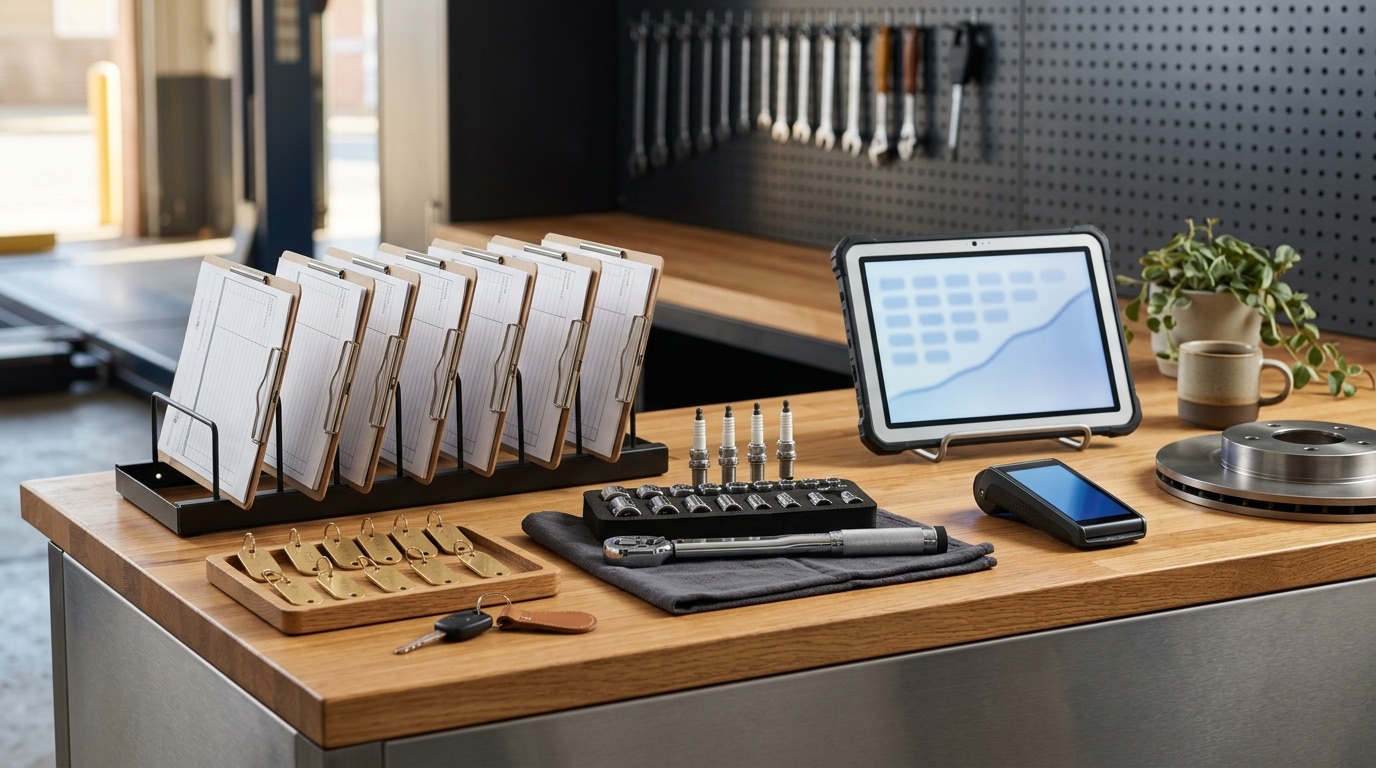
It is worth being precise about the business in question, because most writing about shop-management software is aimed either at a fifteen-bay dealership service department or at a solo mobile mechanic, and the shop we mean is neither.
We mean the independent general-repair shop: three to eight bays, a couple of lifts, an owner who is often still turning wrenches, one or two service writers at the counter, and a handful of technicians of varying certification. It is a common kind of business and a well-regulated one. The Maryland State Police license roughly 1,600 vehicle-inspection stations across the state, and a large share of them are exactly this sort of shop, because in Maryland a licensed inspection station is a source of steady, non-discretionary work. That number is a decent proxy for how many independent shops the state runs on, and it is a lot of small businesses solving the same operational problems in slightly different spreadsheets.
The economics of the shop are worth stating plainly, because they are what make the software question serious rather than cosmetic. A shop sells labor at a posted rate — the "door rate" — that runs, for independents in a market like Baltimore, somewhere around $130 to $165 an hour in 2026, against a national independent benchmark near $140. It pays the technician performing that labor a fraction of it: automotive service technicians and mechanics earn a national median of about $49,670 a year, and in the Baltimore market the going rate lands closer to the mid-fifties, which is roughly $26 to $28 an hour. The gap between the rate billed and the wage paid is not profit — it covers the building, the lift, the diagnostic equipment, the insurance, the comebacks and the hours a technician spends not billing. But it means that the entire margin of the business lives in the accuracy of how labor is estimated, authorized, tracked and invoiced. A quarter-hour of unbilled diagnostic time on every job, a labor guide that is soft on a common repair, a comeback that was really a mis-scoped estimate — those are the leaks, and they are all software-shaped. This is why a shop should think about the tool it runs on as a margin instrument, not an appointment book.
Nationally, the Census Bureau's County Business Patterns counts automotive repair and maintenance as one of the largest small-business categories in the country — on the order of 165,000 establishments employing around 900,000 people — and, as with fitness studios and law firms, the striking thing about the distribution is how small the median business is. This is an industry made almost entirely of owner-operated shops, and owner-operated shops are precisely the businesses that get sold software designed for someone larger and then quietly bend their process to fit it.
What the platforms charge, and what they are charging you for
We went through the pricing pages in this category in July 2026 the same way we did for law firms and for fitness studios, and the result was the same in structure and, if anything, harder to untangle. It is not that shop software is expensive. It is that a single vendor bills you on several meters at once, and no two vendors use the same set, so there is no arithmetic that puts two quotes side by side.
| Platform | What the meter is attached to | Rate published? |
|---|---|---|
| Tekmetric | Feature tier per shop, then a per-location add-on and separate module add-ons for tires and marketing | Yes — $199 / $349 / $439, then "Enterprise: let's talk" |
| Shopmonkey | Feature tier plus a card-processing rate that changes with the tier | Yes — $239 / $399 / $499, and it prints the swipe rate too |
| AutoLeap | Feature tier per shop, plus a one-time setup fee, behind a demo | On the page, yes — $179 / $309 / $409 — but a sales call gates the real quote |
| Mitchell 1 | Modules, billed separately — shop management (Manager SE) and repair information (ProDemand) are two subscriptions | Partly — ProDemand about $214; the working bundle lands near $275–$500 |
| NAPA TRACS | Published tiers tied to your NAPA parts relationship — and, unusually, the labor guide is in every tier | Yes — from $109 up to $249 |
| Shop-Ware, Protractor | Feature tier per location — published, but the ladders start higher and climb into four figures | Yes — Shop-Ware from $279, Protractor from $399 |
Read down the middle column and the problem announces itself. Tekmetric's $199 Start plan is genuinely $199, but it does not include the labor guide — that arrives at the $349 Grow tier — and it does not include two-way texting, which is a $439 Scale feature, and if you run a second location that is another add-on, and a second location's marketing module is $345 a month on its own. Shopmonkey's $239 is genuinely $239, but the number that will actually move your bank balance is the 2.5% to 2.7% it takes off every in-person card payment, which is printed lower down the same page. AutoLeap publishes a clean $179 / $309 / $409 ladder and then asks you to book a demo before it will quote you, and levies a setup fee it does not print. Mitchell 1 does not really sell one product at all; it sells shop management and repair information as separate subscriptions that most shops buy together, which is why its real monthly number — once you add the shop-management side to the repair information — runs from roughly $275 to just under $500, not the sub-$220 figure a quick search for ProDemand will surface.
Before this reads as an indictment, it should be said that several of these vendors are, by the standards of the category, admirably straight. Tekmetric publishes its full three-tier ladder, states plainly that there are no long-term contracts and no per-user fees, and gives you unlimited users, unlimited repair orders and unlimited support at every tier — in a market full of quote forms, a published price is a real courtesy. AutoLeap publishes its ladder too. And NAPA TRACS, for a shop that already runs its parts through NAPA, can be the most economical option on the board precisely because it is priced as part of a relationship you already have rather than as another line item — and, alone in the category, it folds the Mitchell labor guide into even its $109 entry tier. The criticism here is not that these are bad products or dishonest companies. It is that the category's billing model makes the one comparison a shop owner most wants to make — this platform versus that one, at my volume — close to impossible to perform.
The number on the pricing page is the smallest number you will pay
The single most useful habit a shop owner can build when shopping for this software is to stop reading the subscription and start reading the payment-processing rate, because for any shop of real size the second number dwarfs the first. Shopmonkey is the right vendor to work the arithmetic on, not because it is the worst offender but because it is the only major platform that actually prints the rate, which lets us do math the others make impossible.
Shopmonkey publishes three tiers on annual billing — Basic at $215 a month, Clever at $359, Genius at $449 — and, unusually, it publishes the card-processing rate beside them: in-person swipes cost 2.7% at Basic, 2.6% at Clever and 2.5% at Genius, each plus fifteen cents a transaction, while online payments are 2.9% plus thirty cents on every tier. Set the online rate aside, since it is identical across the three, and the tiers differ by only a fifth of a percentage point on in-person volume. Here is what the three plans actually cost a shop across a year, subscription plus in-person processing, by the volume of card payments running through the counter.
| Annual in-person card volume | Basic — $215/mo, 2.7% | Clever — $359/mo, 2.6% | Genius — $449/mo, 2.5% |
|---|---|---|---|
| $250,000 | $9,330 | $10,808 | $11,638 |
| $500,000 | $16,080 | $17,308 | $17,888 |
| $750,000 | $22,830 | $23,808 | $24,138 |
| $1,000,000 | $29,580 | $30,308 | $30,388 |
| $1,500,000 | $43,080 | $43,308 | $42,888 |
Two things fall out of that table, and both are worth keeping. The first is the scale: at $500,000 of in-person card volume — an ordinary number for a healthy three-bay shop — the processing cut on the Basic plan is about $13,500 a year, which is more than five times the $2,580 subscription. A shop owner agonizing over whether to pay $215 or $449 a month is optimizing the wrong number by an order of magnitude. The lever that matters is the rate on the swipe, and the difference between a 2.7% platform rate and a 2.3% rate you could negotiate with a standalone processor is, at that volume, roughly $2,000 a year — comparable to the entire subscription.
The second is subtler and, we think, genuinely original: on Shopmonkey's own published numbers, the middle plan is never the cheapest of the three at any volume. Below about $1.4 million in annual in-person card volume, Basic wins, because the fifth-of-a-point rate cut on the higher tiers never catches up to their larger subscription. Above roughly $1.4 million, Genius wins outright. There is no volume at which Clever, the $359 plan a lot of shops will reflexively land on as "the sensible middle," is the rational choice. It is a decoy — the plan that looks like a compromise and is, on arithmetic, always a mistake. To be clear, Shopmonkey is not hiding any of this; every figure is on its page, which is more than we can say for its competitors. The point is that the page is built to be read as three subscription prices, and the moment you read it as three all-in costs, the recommended-looking option evaporates.
Now hold that finding up against the rest of the category. Tekmetric keeps integrated payments off its published tiers entirely, offering them only on the custom-quoted Enterprise plan, so there is no rate to read at all until you are in a sales conversation. AutoLeap does not publish a processing rate either. Independent tallies of the category put a shop's true all-in cost 40% to 60% above the advertised subscription once processing, add-ons and location count are folded in. So the honest summary of shop-software pricing is this: the biggest line in your bill is a percentage of your revenue, only one major vendor will tell you the percentage before you sign, and that vendor's own math shows its middle tier is a trap. Everything else you compare is noise on top of that.
The bill you cannot run the shop without, sold separately
There is a second cost the pricing pages are quiet about, and it is the one closest to the actual work. A technician cannot perform a modern repair without repair information: factory labor times, torque specifications, fluid capacities, wiring diagrams and the step-by-step procedures that turn a fault code into a fix. That information is a product in its own right, sold by Mitchell 1 as ProDemand, by ALLDATA, by MOTOR and by Identifix, and it typically costs somewhere between $100 and $250 a month per seat. The question every shop-management platform quietly answers, and rarely on the pricing page, is whether that information is included — and the answer, across the market, is a study in gating.
ALLDATA, which AutoZone owns, prints the whole structure on a single page and is the clearest proof of it: $329 a month for shop management, another $209 for the repair information, another $69 for digital inspections — $607 in total, of which nearly half is the two "extra" subscriptions a working shop cannot actually skip. Mitchell 1 is equally candid in its own way: ProDemand, the repair information, and Manager SE, the shop management, are two separate subscriptions, and once you add them together the real number runs to several hundred dollars a month rather than the roughly $214 that ProDemand alone would suggest. The cloud-native platforms bury the same cost inside their tiers. Tekmetric folds a labor guide into its middle Grow tier, which means the $199 Start plan — the number a shop compares against everyone else's entry price — cannot look up a labor time. Shopmonkey and Shop-Ware both hold the MOTOR labor guide back to their upper tiers. AutoLeap charges an added fee for the OE diagrams and procedures on top of the subscription. The honorable exception is NAPA TRACS, which includes the Mitchell labor guide in every tier, entry price included — proof that bundling it is a choice rather than a technical necessity. Everywhere else the pattern is the same: the one capability a shop physically cannot operate without is the capability held back to lift you a tier or sold to you twice. When you build the real monthly figure for any of these platforms, the repair-information line belongs in it from the start, because you are going to pay it one way or another.
The part no national platform models
Everything above is true in every state. What follows is true in Maryland, and it is the reason a shop here cannot simply take the highest-rated national product off the shelf and be done. This is the section worth slowing down on, because it is where a shop's software either fits the way it actually has to operate or quietly makes it non-compliant.
Start with inspection, because Maryland does it differently from most of the country. There is no annual safety-inspection sticker here. Instead, a Maryland safety inspection is triggered by a transaction: a used vehicle generally has to pass one before it is sold or its title is transferred, and an out-of-state vehicle needs one to be registered. The inspection happens at a station licensed by the Maryland State Police, of which there are roughly 1,600, and it produces a Maryland Safety Inspection Certificate that is valid for just 90 days from the date it is issued — with a longer window, six months, when the vehicle is offered by a licensed dealer. That 90-day clock is a small piece of software with real consequences: an inspection done a fortnight too early is an inspection done again, at the shop's cost or the customer's annoyance. A national platform built to schedule oil changes has no concept of a certificate that expires in ninety days, no place to file the state form, and no way to warn the counter that a sale-pending vehicle's certificate is about to lapse. The State Police can ask a licensed station for its inspection records; a shop should not be keeping them in a drawer.
Then there is emissions, which is where a very fresh fact lives. Maryland runs the Vehicle Emissions Inspection Program, VEIP, in thirteen counties plus Baltimore City, on a two-year cycle, and on July 1, 2025 the fee rose to $30 — up from the $14 that had held for years. For most cars built since 1996 the test is a quick read of the on-board diagnostics; vehicles newer than three model years, all-electric vehicles and qualifying historic vehicles are exempt. The reason this belongs in a repair shop's software rather than only at the state kiosk is that a failed emissions test is a work order waiting to happen: the car comes to a shop for diagnosis and repair of whatever tripped the monitor, and then goes back for a retest. A system that knows which of a shop's customers are inside a VEIP county, and which of their vehicles are coming due, is running a marketing and scheduling engine the national tools do not have the data to build — and the July 2025 fee change is a small illustration of a larger truth, which is that the local layer moves on its own timetable and the national subscription does not flinch when it does.
The deepest part of the Maryland layer, though, is the law that governs the estimate itself. Subtitle 10 of the Commercial Law Article — Maryland's Automotive Repair Facilities statute — writes the shape of a repair order into law, and it is worth reading what it actually requires.
"An automotive repair facility may not charge a customer without his consent any amount which exceeds the written estimate by 10 percent."
Section 14-1002 requires that, on the customer's request, before beginning any repair on which the customer will be charged more than $50, the shop provide a written estimate carrying the estimated completion date, the estimated price of parts and labor, and a statement of the shop's liability for damage to the vehicle while it is on the premises. Section 14-1008 then requires a separate authorization form that tells the customer, in plain terms, that they cannot be charged more than ten percent over that estimate without consent, that they are entitled to the return of any replaced parts except those a warranty requires be sent back, and that repairs they did not authorize cannot be billed to them — and the statute requires those rights to be displayed immediately before the signature line, conspicuously, physically separated from the rest of the form. That is not a suggestion about good customer service. It is a workflow: estimate, then authorization with a hard ten-percent guardrail, then a documented moment where the customer either approves an overage or does not, then an invoice, then the offer of the old parts back. A generic "approve estimate" button does not enforce the ten-percent ceiling, does not generate the rights disclosure in the position the statute demands, and does not flag the replaced-parts obligation. A shop can absolutely comply using a national tool and a lot of manual discipline — but the discipline is the part that fails at 4:45 on a Friday, and the software is exactly where that failure could have been designed out.
Finally, the invoice has to know Maryland tax law, and here the rule is specific enough to be a genuine software requirement rather than a footnote. Maryland taxes the parts on a repair order at 6% but does not tax separately stated labor — and the words "separately stated" are load-bearing. Bill a job as a single lump sum and the shop loses the labor exemption and instead owes tax on everything it bought to do the work; itemize parts and labor apart and only the parts are taxed. On top of that, Maryland levies an $0.80 recycling fee on every new tire a shop sells, and that fee is itself part of the tire's taxable price, so the tax is calculated on top of it. None of this is hard once, but it is exactly the sort of rule a shop wants encoded in the software rather than remembered by a service writer, because getting it wrong is not a one-time mistake — it is the same mistake on every invoice until an auditor finds it.
What custom actually costs
When shops hear "custom software" they picture a six-figure project and a year of meetings, because that is what custom software cost for a long time. It is not what it costs now, and our own prices are fixed and published rather than quoted, which is the whole point of how we work.
| Package | What it is, for a shop | Fixed price |
|---|---|---|
| Prototype Sprint | One core flow — a Maryland-compliant estimate-and-authorization form, or an inspection-certificate tracker — clickable, deployed and yours in a week, credited toward a full build | $3,500 |
| Online Store / Portal | A branded customer portal or tire-and-parts store on your own domain and your own payment processor, so the card cut is the processor's rate, not a platform's | from $6,000 |
| Custom App / Internal Tool | A single workflow done right — the estimate ledger, the DVI-to-approval flow, the VEIP due-list — on web and, where it earns its keep, on a phone | from $12,000 |
| Operations System | The connected system: repair orders, scheduling, inventory, inspection and emissions records, the compliance calendar and the tax-correct invoice, modeled to how your shop actually runs | from $12,000 |
Most shop builds land between $6,000 and $25,000, which is a fraction of what an agency quotes for the same thing and, more to the point, is a number you pay once rather than a meter that grows with your revenue forever. You know the figure and the delivery date before any code is written, you pay half to start and half when it ships, and you own the source code, the repositories, the keys and the accounts at the end. There is no per-seat license and no cut of your card payments, and if you want to hand it to another developer next year, that is a normal thing to do and we will hand it over cleanly. You can see the kind of software these budgets buy on our demos page, and the full breakdown on the pricing page. One caveat worth stating plainly: Maryland's new 3% tax on information-technology services applies to a custom development invoice just as it applies to your software subscriptions, so budget for it on both sides.
What we would actually build, and the case for not replacing your shop system
Here is the part that runs against our own commercial interest, which is the part worth reading. For most Baltimore shops, do not replace your shop-management platform. The repair-order engine, the scheduling, the parts-catalog integrations, the technician clock and the accounting hooks in a mature product like Tekmetric or Shopmonkey represent years of accumulated detail, and for a single-location shop they are worth far more than they cost. Rebuilding that from scratch is the most reliable way we know for a shop to spend $30,000 and end up with something slower. If a developer tells you otherwise, look closely at whose product the break-even calculation was written to sell.
What pays is the layer around the platform — the parts the national product was never going to fit, because they are specific to Maryland or specific to how your shop makes money. Nearly always, the first build is the estimate-and-authorization layer: a form that generates the §14-1008 rights disclosure in the position the statute requires, refuses to let a repair order close more than ten percent over the authorized estimate without a recorded customer approval, timestamps that approval so the file proves compliance instead of assuming it, and flags the replaced-parts offer on every job. That single object protects the shop from the one category of dispute — "you charged me more than you quoted" — that turns into a complaint to the Consumer Protection Division, and it does it by making the compliant path the only path.
Second is the records-and-reminders layer that the national tools have no data model for: the 90-day inspection-certificate clock, the retained State Police inspection records, and the VEIP due-list that turns a customer's registration county and vehicle age into a scheduled reminder before their emissions test comes due. This is unglamorous and it is some of the highest-return software a shop can own, because it converts a regulatory obligation into a marketing engine — the same list that keeps you compliant is the list that fills the bays.
Third is whatever your shop does that the platform has no concept of, and this is different at every shop, which is exactly why it is never in the product. A fleet-maintenance account with its own approval chain and monthly consolidated billing. A used-car dealer client who sends you every pre-sale inspection and wants them batched. A tire-and-service package with per-axle pricing the platform cannot express. A technician pay plan that is flat-rate hours plus a bonus above a weekly threshold, computed differently for diagnostics than for installs. Every one of those currently lives in a spreadsheet one person maintains, and that person, not the software, is the real operational risk. Around all of it sit the integrations that keep it honest — your shop-management platform's own API so the repair orders stay in one place, a parts network like PartsTech or your NAPA relationship, your accounting system, and exports a bookkeeper can open without calling you.
When you should not call us
Being specific about this is more useful than another paragraph about our process. Do not build if any of the following is true:
- You run one shop, your shop-management platform mostly works, and your real constraint is car count — not enough vehicles are coming through the door. Software is not the bottleneck, and a build will pull attention off the marketing and service that is.
- You have not yet used your current platform's own tools. A surprising share of what shops ask us to build already exists under a menu they have never opened, and we would rather show you that on a free call than sell you around it.
- Nobody at the shop owns operations. Custom software needs one person who decides how the shop actually works; without that, you get an expensive rendering of a disagreement between the owner and the front counter.
- You are inside a year of selling the shop. A buyer wants clean books and boring, standard systems, not a bespoke stack they have to learn and maintain.
- What you want is a customer-facing booking page or a digital inspection your platform already does well. Paying to rebuild a feature you are already renting is the clearest waste of money in this category.
The honest summary is that a single-bay shop should keep everything and change nothing; a busy three-to-eight-bay shop should keep its platform and own the Maryland-and-margin layer above it; and only a multi-location operator with genuinely unusual work — heavy fleet, dealer-inspection volume, an in-house parts operation — should be having a conversation about replacing anything larger. We will tell you which of those you are on the call, including, often, when the answer is the first one.
How we work
We are a two-person studio in Baltimore. You talk to the people writing the code, every time, and there is no account manager in the middle turning what you said into a ticket for someone offshore.
The first call is thirty minutes and free, and the useful version of it is not a demo. Bring the estimate form you photocopy, the technician-pay spreadsheet, the report you rebuild by hand at month-end, and the thing your platform will not do that you stopped complaining about because you assumed it was impossible. We will tell you what we would build, what you should keep paying for, roughly how fast it ships and what it costs. If the answer is that you should change nothing, we will say that, and it costs you half an hour.
We use AI heavily in the build, which is why a fixed price of $12,000 buys what an agency quotes $50,000 for and ships in two to four weeks rather than two to four months. We are specific about how in the piece on our build stack, because "AI-accelerated" is a claim worth being suspicious of when a vendor makes it. What it does not change is that somebody experienced still has to decide what the software should do — and for a shop, that means somebody who understands both the repair order and §14-1008, which is the part we are actually selling. Everything ships deployed, on infrastructure you own, with the source in a repository that is yours. We wrote about what custom software really costs and why we fix the price if you want the longer argument.
Questions we get from shop owners
How much does auto repair shop software cost in 2026?
Advertised plans run about $179 to $499 a month per shop — Tekmetric starts at $199, AutoLeap at $179, Shopmonkey at $239 — but the sticker is the smallest number you pay. On top of it, most platforms take roughly 2.5% to 2.9% of every card payment, charge for each additional location, and either gate the repair information a technician cannot work without behind a higher tier or sell it as a second subscription. Independent tallies put the real all-in cost 40% to 60% above the pricing page, so a single-location shop typically spends $350 to $700 a month once everything is switched on. A custom build is priced differently: our own fixed packages run from a $3,500 one-week prototype to $12,000 for a full operations system, agreed before any code is written, and you own it outright at the end.
Why is my auto repair software bill higher than the advertised price?
Because the advertised price is one of five meters, and usually the smallest. National shop-management platforms bill you on a feature tier, then add a per-location charge, then take a percentage of every card payment you run through them — commonly 2.5% to 2.9% plus a per-transaction fee — then charge again for the labor guides and repair procedures your technicians use on every job, and again for texting and marketing. On a shop doing $500,000 a year in card sales, the processing cut alone can be five times the subscription. The number that matters most is the one most vendors do not print.
Tekmetric vs Shopmonkey vs AutoLeap — which is cheapest for a single-bay shop?
On the sticker, they are close: AutoLeap starts at $179 a month, Tekmetric at $199, and Shopmonkey at $239, all billed annually. But the real decision is total cost at your card volume, and there the comparison breaks, because Shopmonkey is the only one of the three that publishes its card-processing rate. Tekmetric puts integrated payments only on its custom-quoted Enterprise tier and does not print a rate; AutoLeap does not publish one either. For a low-volume single-bay shop the entry tiers are effectively a wash, so choose on workflow and on which vendor will tell you, in writing, what it takes off every repair order.
Is custom-built auto repair software cheaper than SaaS?
Not on day one. A custom system is a real upfront build — our fixed packages run from $6,000 for a store or portal to $12,000 and up for a full operations system. What changes is the shape of the cost afterward: a system you own is not metered on your card volume, your locations, or your headcount, so it stops growing when your revenue grows. For a busy shop paying $600 or more a month in subscription plus a percentage of every swipe, the arithmetic often crosses over inside a year or two. For most single-location shops, though, the honest answer is not to replace the shop-management system at all, but to build only the layer around it that the national product was never going to fit.
Do I need special software to run Maryland state safety or VEIP emissions inspections?
No single national platform is required, and none of them is built for it. A Maryland safety inspection is performed at a station licensed by the Maryland State Police and recorded on a state certificate that is valid for 90 days, and VEIP emissions results flow through the state's own system. What a shop actually needs is software that tracks the 90-day certificate clock, keeps the inspection records the State Police can ask for, and knows which of your customers' vehicles are due for VEIP — none of which a generic shop-management tool built for all fifty states does out of the box.
What does Maryland law require on a repair estimate?
Under Maryland Commercial Law §14-1002, when a customer requests it and the job will cost more than $50, the repair facility must give a written estimate with the estimated completion date, the estimated price of parts and labor, and a statement of the shop's liability for damage while the vehicle is on the premises. The facility may not charge more than 10% over that estimate without the customer's consent. Section 14-1008 requires a separate authorization form telling the customer they may not be charged for unauthorized repairs and that they are entitled to the return of their replaced parts, with those rights shown immediately above the signature line.
How often is Maryland VEIP emissions testing required, and what does it cost now?
Most gasoline vehicles registered in Maryland's 13 emissions counties plus Baltimore City must pass a VEIP emissions test every two years. On July 1, 2025 the fee rose to $30, up from the $14 that had stood for years. Vehicles newer than three model years, all-electric vehicles, and qualifying historic vehicles are exempt. For a repair shop this matters because a failed test sends the car to you for diagnosis and emissions repair before a retest, and no national shop-management platform tracks a customer's VEIP status or the fee change.
Do I pay Maryland sales tax on my auto repair shop software?
Yes, as of July 1, 2025. House Bill 352, the Budget Reconciliation and Financing Act of 2025, applies a 3% sales and use tax to data and information-technology services and to software publishing that previously sat outside Maryland's sales tax base. That reaches your shop-management subscription, your texting tool and your parts-ordering platform — and, to be straight about it, our development invoices too. It is separate from the sales tax on the job itself, where Maryland taxes the parts on a repair order but not separately stated labor, which is one more reason the invoice has to keep parts and labor apart.
Figures in this article were verified in July 2026 from the vendors' own published pricing pages, the Maryland Code, the Maryland Comptroller's business tax guidance, and Maryland State Police and MDE program pages. Vendor pricing changes without notice, and nothing here is legal or tax advice — the Maryland provisions described are summarized, not reproduced in full, and your own attorney or accountant should tell you how they apply to your shop.